The Iridium Theater stands as one of New York City’s most intimate and important live music rooms, a place where jazz history, rock history, and Broadway energy all meet under one roof. Best known for its long association with guitar legend Les Paul, the Iridium has welcomed world-class musicians while preserving the spirit of small-room performance in the heart of Manhattan. In a city where real estate pressures have erased so many historic music venues, the Iridium remains a reminder that New York’s live music story is still being written every night.
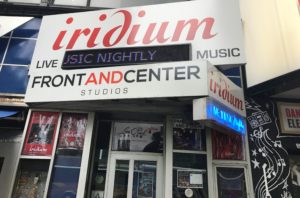
Iridium Theater – Photo: Brian Kachejian ©2017
The History Of The Iridium Theater
Ask a teenager to name one or two members of The Beatles, and you will be lucky if they can name one. Ask a teen to name the lead singer of The Rolling Stones, and 99 out of every 100 will stare at you with a blank face. So, it is amazing that a place that caters to jazz music still exists in the world of high-priced real estate in New York City. However, right next to the theater that continues to host the very successful School of Rock movie-turned-Broadway play stands the Iridium Theater. In 2019, the Iridium Theater still stands as one of the premier rooms to see a jazz legend, as well as some great modern-day jazz artists.
The Iridium Theater, located at 1650 Broadway and 51st Street in Manhattan, first opened in 1994. The site’s original location was not where it stands in 2019. The current location has existed since 2011. The Iridium first opened its doors in 1994 as the Iridium Room Jazz Club. The new jazz room opened across the street from Lincoln Center at 63rd Street and Central Park West. At the time the club opened in 1994, its manager, Ronald Sturm, focused on booking young, unknown jazz acts just starting to make their mark in the jazz world. They were probably also a lot cheaper to pay. Nonetheless, the club’s opening weekend featured big names in jazz like Elvin Jones, followed by other jazz legends such as Lee Konitz and McCoy Tyner.[1]
Les Paul And The Iridium
In 1996, the legendary guitarist Les Paul began performing at the club every Monday night. The Iridium became the weekly home of Les Paul. Monday nights are usually the off nights for musicians. The most common thing musicians do on their off nights is go see other musicians. The only problem is most musicians are also off on Monday nights. So, the Les Paul Monday night residency at the Iridium turned out to be very successful for Mr. Paul.
Many legendary musicians came to see Les Paul on those Monday nights. In many instances, some of them joined Les Paul on stage. Over the years, Les Paul performed on the Iridium stage with artists such as Brian Setzer, Slash of Guns N’ Roses, Billy Gibbons of ZZ Top, and perhaps the greatest artist of all time, Sir Paul McCartney.
Les Paul continued to perform at the Iridium jazz club from 1996 until his passing in 2009. The impact Les Paul had on music, especially from a technological standpoint, led the Iridium jazz club to develop the capacity to operate not only as a performance nightclub but also as a recording studio. In 2011, the Iridium jazz club started its own jazz label. Jeff Beck’s CD Rock and Roll Party Honoring Les Paul became one of the most commercially successful releases the label issued.
Residencies And Live Recordings
What sets the Iridium jazz theater club apart from other theaters is that many artists who perform there will do a short residency instead of just a single-night show. In similar fashion to the Blue Note, musical artists like Mike Stern will book themselves there for a few nights in a row. For musicians, a residency makes performing much easier because there is no need to break down and set up equipment after only one night. It is also a great opportunity for fans who may witness the first show and come back every night until the performance closes. It is sort of a mini-Broadway run for these great jazz artists.
In 2015, the Iridium jazz club showcased over $150,000 in renovations designed to establish the club as a place to shoot television specials for broadcast. The Iridium jazz club hosts the critically acclaimed public television show Front and Center. The show has featured such legendary artists as Joe Jackson, Kip Moore, and George Ezra.
The Iridium In Modern New York
Recently, the Iridium jazz club has also presented shows that cross all musical genres. As jazz music continues its never-ending struggle for commercial acceptance across the board, the club has featured more rock, hip-hop, and country artists, as well as just about any type of performer who can sell out the club. Rent is not cheap in New York City, and a club has to do what it has to do to survive. The club also rents out its theater for private functions.
In the end, seeing a show at the Iridium jazz club can be an incredible experience for the music fan. The theater only holds 180 people. There are not many places that small where you can see some of the most legendary jazz artists of all time perform. It is like having them perform in your living room or backyard; you are right up close. Furthermore, you can order a great meal and enjoy a wonderful glass of wine or another spirit. And it is all located in the heart of Manhattan on Broadway, under beautiful lights and the wondrous sounds of New York City.
Related Articles
If you enjoyed this look at the Iridium Theater, continue exploring New York City’s music and entertainment history with our articles on The History of the Ed Sullivan Theater, Lincoln Center, Carnegie Hall, Radio City Music Hall, and Times Square.
Updated June 29, 2026.
Sources:
[1] Watrous, Peter. “Critic’s Notebook; Jazz With Pizazz: A New Generation of Clubs.” The New York Times. April 15, 1994. Accessed June 7, 2019. https://www.nytimes.com/1994/04/15/arts/critic-s-notebook-jazz-with-pizazz-a-new-generation-of-clubs.html?searchResultPosition=12.