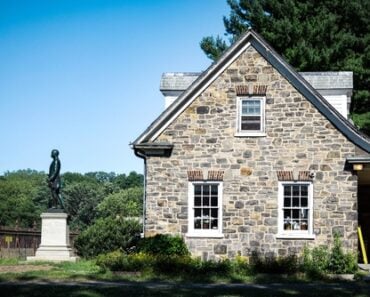
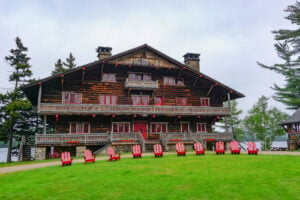
The Main Lodge at Great Camp Sagamore, one of the most celebrated examples of Adirondack Great Camp architecture. Photo: Linda Harms/Shutterstock.com
During the late nineteenth and early twentieth centuries, some of America’s wealthiest families sought an escape from crowded cities, summer heat, and the formal routines of urban society in the Adirondack Mountains. Families associated with names such as Vanderbilt, Morgan, Rockefeller, Huntington, Post, and others built elaborate wilderness retreats where tremendous wealth was deliberately disguised behind bark-covered walls, rough logs, stone fireplaces, and buildings that seemed to grow out of the surrounding forest.
Today these properties are widely known as Adirondack Great Camps. Rather than resembling the marble palaces of Newport, they developed an architectural language rooted in the northern woods. Native logs, bark siding, cedar shingles, fieldstone, twig work, broad porches, boathouses, and clusters of separate buildings became defining characteristics. William West Durant played a central role in establishing the style, while architects including Robert H. Robertson, William L. Coulter, William G. Distin, Theodore Blake, Addison Mizner, and John Russell Pope carried the idea in new directions. These fifteen historic camps reveal how the Adirondacks created one of the most distinctive forms of American resort architecture.
Camp Pine Knot (Raquette Lake)
Builder / Designer: William West Durant | Begun: 1877
Camp Pine Knot is generally recognized as the prototype from which the Adirondack Great Camp tradition developed. William West Durant began creating the compound on Raquette Lake in 1877, arranging separate buildings for sleeping, dining, recreation, service, and waterfront use rather than concentrating everything inside one enormous house. The rustic buildings incorporated logs, bark, shingles, stone, and decorative branch work while remaining carefully integrated into the wooded site. Durant sold Pine Knot to railroad magnate Collis P. Huntington in 1895. Today the property is known as Camp Huntington and is operated by SUNY Cortland as an outdoor education center.
Great Camp Sagamore (Sagamore Lake)
Builder / Designer: William West Durant | Constructed: 1895–1897
Sagamore represented one of Durant’s most sophisticated expressions of the camp idea. Built as his own private retreat on what was then known as Shedd Lake, the original compound combined a substantial main lodge with supporting buildings in an isolated setting. Alfred Gwynne Vanderbilt purchased Sagamore in 1901 and greatly expanded its recreational and service facilities. Under Vanderbilt and later his widow, Margaret Emerson, Sagamore became one of the most famous private retreats in the Adirondacks, complete with guest buildings, a playhouse, bowling alley, farm complex, and its own infrastructure. The surviving property is now preserved as Great Camp Sagamore.
Camp Uncas (Mohegan Lake)
Builder / Designer: William West Durant | Constructed: 1893–1895
Camp Uncas marked an important step in Durant’s development of the Great Camp form. Unlike Pine Knot, which evolved over many years, Uncas was conceived as a coordinated wilderness estate from the beginning. Its separate buildings, monumental fieldstone fireplaces, heavy log construction, and isolated location around Mohegan Lake created a more unified and dramatic version of Adirondack rustic architecture. Financier J. Pierpont Morgan purchased the property in 1896 and used it as a private retreat until his death in 1913.
Camp Santanoni (Newcomb)
Owners: Robert C. and Anna Pruyn | Architect: Robert H. Robertson | Constructed: 1892–1893
Camp Santanoni was built for Albany banker Robert C. Pruyn and his wife, Anna, on a vast private preserve near Newcomb Lake. Architect Robert H. Robertson designed the main camp as a series of log pavilions joined into an extraordinary lakeside composition, while later buildings at the preserve involved the firm of Delano & Aldrich. Santanoni eventually included a gate complex, farm, service buildings, and the main camp deep within the preserve. Its unusual plan, rustic workmanship, and remarkable relationship to the surrounding landscape made it one of the defining Adirondack camps. The property is now preserved within the Forest Preserve as the Camp Santanoni Historic Area.
Camp Wild Air (Upper St. Regis Lake)
Owners: Whitelaw and Elisabeth Reid | Begun: 1882
Camp Wild Air began in 1882 and became the first permanent camp on Upper St. Regis Lake. The earliest cabin was designed by Whitelaw Reid’s niece, Ella Spencer Reid, and the property evolved over several decades rather than emerging from one single architectural plan. Later work included important buildings designed by William Rutherford Mead of McKim, Mead & White, particularly as the camp was rebuilt and enlarged during the early twentieth century. Its polygonal rooms, log veneers, waterfront pavilions, service buildings, and decentralized layout made Wild Air one of the most distinctive experiments in Adirondack rustic design.
Echo Camp (Raquette Lake)
Location: Raquette Lake | Begun: 1883
Echo Camp was among the earliest properties to follow the architectural path established at nearby Camp Pine Knot. Begun in 1883, it used a decentralized arrangement of modestly scaled buildings, native materials, and informal planning closely tied to the wooded setting. The National Park Service has singled out its unusual towered lodge as an important surviving example of early Adirondack camp architecture. Echo demonstrates how quickly Durant’s experiments at Pine Knot began influencing other wilderness retreats around Raquette Lake.
Moss Ledge (Upper Saranac Lake)
Architect: William L. Coulter | Constructed: 1898
Moss Ledge is especially significant as the first known Adirondack camp commission of architect William L. Coulter, who would become one of the region’s most important designers. Built for Isabel Ballantine on Upper Saranac Lake, the camp translated earlier Durant ideas into a more architecturally refined chalet form. Its surviving buildings retain the low, rustic relationship between timber construction and the lakeside landscape that became characteristic of Coulter’s work throughout the region.
Eagle Island Camp (Upper Saranac Lake)
Architect: William L. Coulter | Commissioned by: Levi P. Morton | Constructed: 1903
Eagle Island was commissioned by Levi P. Morton, who had served as Vice President of the United States and Governor of New York. William L. Coulter created a carefully integrated island compound using verandas, walkways, rustic screening, chalet-inspired forms, and an imaginative mixture of natural materials. The National Park Service considers Eagle Island one of the finest surviving examples of Coulter’s work, and the property retains an unusually high level of architectural integrity. It later became a youth camp and has been preserved as a National Historic Landmark.
Prospect Point Camp (Upper Saranac Lake)
Architect: William L. Coulter | Constructed: 1903–1905
Built for financier and copper magnate Adolph Lewisohn, Prospect Point became one of William L. Coulter’s largest and most ambitious Adirondack commissions. The camp was organized around a dramatic group of linked chalet-style lodges positioned on a bluff above Upper Saranac Lake, with a substantial boathouse at the water. Its scale and commanding siting reflected the increasingly elaborate direction of Great Camp architecture in the early twentieth century while retaining the rustic materials and lake-oriented planning that defined the Adirondack tradition.
Kamp Kill Kare / Lake Kora
Early Developer: Timothy L. Woodruff | Major Later Architect: John Russell Pope | Developed: Beginning in the late 1890s
Located on secluded Lake Kora, the property historically known as Kamp Kill Kare became one of the grandest expressions of the Great Camp ideal. Lieutenant Governor Timothy L. Woodruff acquired the preserve from William West Durant in 1897 and developed an extensive private camp there. After a major fire in 1915, later owners Francis and Mabel Garvan employed architect John Russell Pope and designer Charles Hiscoe to rebuild and enlarge the estate. The resulting complex combined rustic log construction with extraordinary stonework, a chapel, boathouse, playhouse, service buildings, and an architectural sophistication rarely matched elsewhere in the Adirondacks.
Camp Topridge (Near Upper St. Regis Lake)
Owner: Marjorie Merriweather Post | Architect: Theodore Blake | Major Development: Beginning in the 1920s
Camp Topridge represented the Great Camp tradition at its most opulent. Marjorie Merriweather Post acquired the property in 1920 and transformed it over the following decades into a sprawling private retreat. Architect Theodore Blake and master builder Ben Muncil were central to its development. The estate eventually contained dozens of buildings, including an immense main lodge, guest cabins, boathouses, service structures, and a private lift carrying guests from the waterfront toward the ridge above. Topridge combined traditional Adirondack materials with the scale and amenities of a twentieth-century luxury estate.
White Pine Camp (Osgood Pond)
Original Owners: Archibald and Olive White | Architects: William Massarene and Addison Mizner | Begun: 1907
White Pine Camp stands apart for the originality of its architecture. Archibald and Olive White commissioned William Massarene to begin the camp, with master builder Ben Muncil carrying out much of the construction. Addison Mizner later designed important additions. The property combined soaring rooflines, unusual window arrangements, bark and wood finishes, boathouses, recreation buildings, and its famous Japanese teahouse. White Pine Camp entered presidential history in 1926 when Calvin Coolidge used it as his Summer White House.
Flat Rock Camp (Lake Champlain)
Designer / Owner: Augustus G. Paine Jr. | Begun: About 1890
Flat Rock Camp occupies an unusual setting on the sandstone shoreline of Willsboro Point overlooking Lake Champlain. Augustus G. Paine Jr. began developing the property around 1890 and designed much of the camp himself, while local builder Lyman Smith carried out much of the construction. The compound grew over roughly two decades and is distinguished by its careful relationship to the exposed rock, native vegetation, gardens, stone chimneys, and buildings arranged across the landscape. Its combination of rustic architecture and unusual natural setting earned it listing on the National Register of Historic Places.
Camp Wonundra / The Point (Upper Saranac Lake)
Owner: William Avery Rockefeller II | Architect: William G. Distin | Constructed: 1930–1933
Camp Wonundra, now known as The Point, carried the Great Camp tradition into the 1930s. William Avery Rockefeller II commissioned Saranac Lake architect William G. Distin to design the retreat on Upper Saranac Lake. Built of massive logs and natural stone, the property included a main lodge, guest buildings, boathouse, service structures, and numerous fireplaces, combining modern comfort with the visual language established by earlier Adirondack camps. The Point later became an exclusive resort, allowing the Great Camp experience to continue in a very different form from its original private ownership.
Minnowbrook (Blue Mountain Lake)
Architect of 1949 Lodge: William G. Distin | Historic Site: Blue Mountain Lake
Minnowbrook represents the late continuation of the Adirondack camp tradition. An earlier lodge on the property dated to around 1900, but it was destroyed by fire in 1947. Architect William G. Distin designed a replacement lodge completed in 1949, using a combination of rustic chalet forms, wood construction, stone fireplaces, and carefully selected materials that consciously continued the Great Camp vocabulary. Syracuse University acquired Minnowbrook in the 1950s and developed it as a conference center. The 1949 lodge was itself destroyed by fire in 1988 and replaced, making Minnowbrook an unusual example of how the Adirondack camp tradition continued through successive generations of buildings on the same historic site.
The Great Camps of the Adirondacks remain one of the most distinctive achievements in American residential and resort architecture. Their importance lies not simply in their wealthy owners, but in the way architects, builders, craftsmen, and local materials created a form of luxury rooted in wilderness rather than opposed to it. From Durant’s experiments at Pine Knot to the later work of Coulter, Distin, Blake, Mizner, and Pope, these camps transformed logs, bark, stone, shingles, and forest landscapes into an architectural tradition found nowhere else in quite the same form.
For more stories from Upstate New York, explore The Beauty and History of Lake George, our look at 10 Historic Small Towns in Upstate New York Worth Visiting, and Where Does Upstate New York Begin? Defining New York State’s Regions and Boundaries.
Sources
National Park Service — Adirondacks: Great Camps and Outdoor Recreationalists
National Park Service — Adirondack Camps National Historic Landmarks Theme Study
SUNY Cortland — History of Camp Huntington / Camp Pine Knot
Adirondack Architectural Heritage — Great Camps Tourism
Syracuse University Libraries — Minnowbrook Lodge History
The Point — The Great Camp Era
Lake Champlain Committee — History of Flat Rock Camp