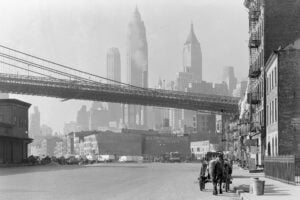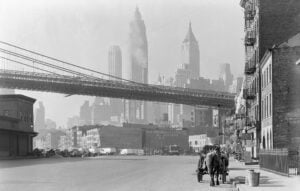
A 1933 view of the Brooklyn Bridge and Lower Manhattan skyline, with a horse-drawn wagon in the foreground. Public domain image via the Library of Congress / Gottscho-Schleisner Collection.
On May 11, 1934, New Yorkers looked up and saw something that did not belong in the Manhattan sky. A strange gray haze spread over the city, dimming the spring sunshine and making familiar landmarks difficult to see. Streetlights came on in the middle of the day. From the observation deck of the Empire State Building, visitors could no longer make out Central Park. The material drifting through the streets had not come from a local fire or an industrial smokestack. It was soil from the Great Plains, carried more than a thousand miles by the wind.
For approximately five hours, New York City experienced one of the most extraordinary episodes in its weather history. The storm was part of the Dust Bowl disaster, when drought and severe erosion stripped agricultural land across the nation’s interior. The event did not plunge Manhattan into complete nighttime darkness, but it produced an unnatural half-light that contemporary observers compared to an eclipse. For New Yorkers who knew the distant Plains mostly through newspaper reports, the agricultural catastrophe had suddenly arrived at their own windows.
What Happened in New York City on May 11, 1934?
On the morning of Friday, May 11, fine dust was already spreading across the Eastern Seaboard. Its journey had begun days earlier, when strong winds lifted dry topsoil from exposed fields on the Plains and carried it eastward. By May 10, the dust had reached cities around the Great Lakes, including Buffalo. The following day, it affected New York, Boston, Washington, and other eastern cities before continuing over the Atlantic Ocean.
The following morning, The New York Times described the event in a front-page headline reporting that a huge dust cloud had traveled 1,500 miles and dimmed New York for five hours. Contemporary accounts also described a broad belt of dust stretching across much of the country. These figures referred to the scale and movement of the storm system, not to a solid wall of dust 1,500 miles tall or to a single cloud confined to Manhattan.
The scientific journal Nature published a short report on May 19, 1934, describing the gray dust over New York and the unusual reach of the phenomenon. Its account estimated a cloud extending approximately 1,500 miles in one horizontal direction and 900 miles in another, with dust rising to great heights in the atmosphere. The measurements varied across contemporary reports, but there was no doubt about the basic event: dry soil from the American interior had traveled across the continent and reached the country’s largest city.
The Day Manhattan’s Famous Skyline Faded
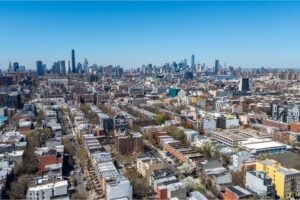
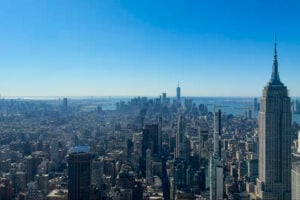
Dust changed the appearance of New York’s buildings and streets. Instead of the bright spring light residents expected, an ashen haze settled over Manhattan. The city’s famous skyscrapers became indistinct, and people on the Empire State Building’s observation deck found that Central Park, normally an unmistakable landmark to the north, had disappeared from view. The effect was particularly unsettling because New Yorkers could see that the sky was not behaving like an ordinary overcast day.
Streetlights were switched on during daylight hours, and motorists used their headlights as visibility deteriorated. Around New York Harbor, the dust obscured familiar sights. A ship delayed entering because its captain had difficulty seeing the Statue of Liberty through the haze. These were not conditions normally associated with an East Coast spring day, much less with a storm that had begun in distant agricultural states.
Fine particles also found their way indoors. Dust settled on ledges and furnishings, and building ventilation systems had to deal with material that had traveled enormous distances before reaching the city. Pedestrians complained of irritation to their eyes and throats. The haze made a national environmental disaster painfully tangible to people who had never seen a Great Plains dust storm firsthand.
How Did Dust From the Great Plains Reach Manhattan?
The Dust Bowl was not caused by a single bad season. During earlier decades, large areas of native grassland had been plowed for agriculture. Those grasses had helped hold the soil in place. When severe drought gripped the Plains in the 1930s, crops failed, exposed earth dried out, and strong winds could lift enormous quantities of loose material into the atmosphere. Economic pressures during the Great Depression made the disaster even more destructive for farming families.
The May 1934 storm gathered dust over a vast region and carried it east on powerful winds. The amount of displaced soil was immense: contemporary estimates often placed the total at roughly 300 million tons, while some later accounts gave even higher figures. That number described material swept up by the storm across its broad path; it did not mean that hundreds of millions of tons fell on New York City.
Once aloft, the finest particles could travel far beyond the farms where they originated. They crossed the industrial Midwest, reached the Appalachian region and the Atlantic states, and finally moved over the ocean. Ships hundreds of miles offshore reported dust settling on their decks. The journey made visible a connection between distant landscapes that urban residents seldom had reason to consider.
What Did New Yorkers Experience During the Dust Storm?
To someone standing on a Manhattan sidewalk, the storm was chiefly a problem of light and air rather than the violent, ground-level walls of blowing dirt experienced in parts of the Plains. The city took on an eerie color, sunlight weakened, and distance became difficult to judge. The dust cloud did not bury New York’s streets as it had buried fields and farm buildings farther west, but it made ordinary routines uncomfortable.
Newspaper accounts described dust troubling people’s eyes and throats, while visibility affected travel and aviation across the eastern states. The familiar separation between an urban city and a rural ecological crisis had collapsed. It was possible to see the consequences of damaged farmland from the top of an Art Deco skyscraper, or simply by looking out an apartment window.
The incident also attracted scientific interest. Meteorologists studied how such a large quantity of airborne soil could move through different atmospheric layers and remain suspended over such long distances. The dust over Manhattan was unusual, but the broader disaster on the Plains was ongoing. May 11 was one dramatic episode in a succession of destructive storms during the 1930s.
Did the 1934 Dust Storm Change American Environmental Policy?
The passage of Great Plains dust over eastern cities helped make soil erosion a national issue, but it did not single-handedly create federal conservation policy. The federal government was already responding. Soil scientist Hugh Hammond Bennett had warned about erosion for years, and the Roosevelt administration established a temporary Soil Erosion Service in 1933, before the New York dust storm.
Additional dust storms in 1935 brought the crisis into national political discussions again. According to the U.S. Department of Agriculture’s history of conservation efforts, dust darkened Washington during congressional consideration of a permanent soil-conservation agency. On April 27, 1935, President Franklin D. Roosevelt signed the Soil Conservation Act, establishing the Soil Conservation Service within the Department of Agriculture. That agency eventually became today’s Natural Resources Conservation Service.
Conservation work encouraged practices intended to keep soil on the land, including improved planting methods, ground cover, and erosion control. These measures did not immediately end the Dust Bowl. Drought and severe storms continued, and the crisis forced many farm families to leave their homes. Still, the years surrounding the 1934 dust cloud helped establish the principle that protecting agricultural soil was a matter of national concern.
Why the 1934 Dust Cloud Still Matters to New York City History
New York has endured hurricanes, blizzards, heat waves, and blackouts, but the dust cloud of May 11, 1934, stands apart. Nothing had to happen within the five boroughs for the city’s atmosphere to change. The damage had been done to farmland far away, and the wind brought the evidence directly to Manhattan. It was a reminder that a city dependent on distant regions for food and other necessities was not separate from the environmental conditions affecting those places.
The image is difficult to forget: the Empire State Building standing above streets illuminated in the middle of the day, while Central Park vanished into a gray haze. Manhattan’s sky did not literally become black as night, but for several hours the country’s most recognizable skyline bore the visible consequences of one of America’s great ecological disasters.
For more on the unusual events that have shaped New York, read our articles on New York City’s air-quality and smog history, the worst heat waves in New York City history, and destructive hurricanes and coastal storms in New York.