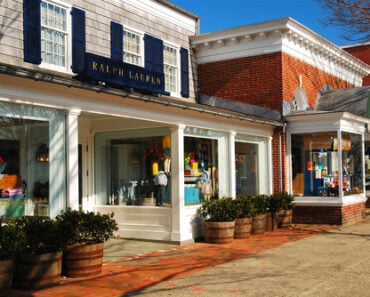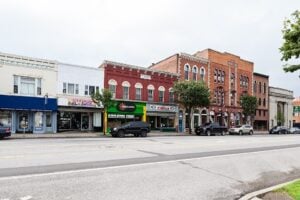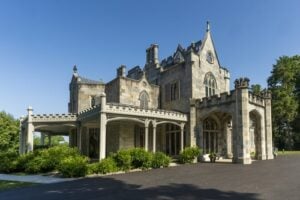

Market Square in the historic Stony Brook Village Center on Long Island, New York. Photo: Popova Valeriya / Shutterstock.com.
On the North Shore of Suffolk County, about 55 miles east of Manhattan, Stony Brook has managed to retain much of its small-town character while becoming the home of one of New York State’s major research universities. The hamlet’s best-known gathering place, Stony Brook Village Center, was completed in 1941 under the direction of philanthropist Ward Melville. Its white storefronts, harbor views, and post office with a mechanical eagle that flaps its wings on the hour during the day have become familiar sights to generations of Long Islanders.
Long before the university opened its Stony Brook campus in 1962, the community was home to artists, merchants, and people who participated in the American Revolution. The Hawkins-Mount House and the collections of the Long Island Museum preserve important pieces of that earlier history. The arrival of the university added another dimension to the community, attracting internationally recognized scientists and scholars to the North Shore.
Stony Brook’s connections to American popular culture are equally remarkable. Two brothers who grew up in the same local household became stars of a television comedy set in Queens, while two left-handed pitchers born in the hamlet were drafted by the New York Mets. The following 20 people were born in Stony Brook, grew up there, or established meaningful residential roots in the community as adults. Those different connections reveal how a relatively small Long Island hamlet has contributed to the worlds of entertainment, sports, art, science, and American history.
1. Kevin James
Before he was delivering packages across Queens as Doug Heffernan on CBS’s hit sitcom The King of Queens or patrolling suburban shopping centers in Paul Blart: Mall Cop, Kevin James grew up in Stony Brook. Born Kevin George Knipfing in Mineola, he attended Ward Melville High School in East Setauket, where he wrestled alongside another future Suffolk County celebrity, WWE Hall of Famer Mick Foley.
James attended SUNY Cortland before pursuing comedy. His introduction to performing came through his older brother’s comedy troupe, which appeared at the East Side Comedy Club in Huntington Station. That club and the Long Island comedy circuit gave James a place to develop the physical humor and conversational delivery that would become his trademarks.
From 1998 to 2007, The King of Queens made James a familiar face to television audiences and earned him an Emmy nomination. He subsequently starred in films including Hitch, Grown Ups, and Here Comes the Boom. He returned to a distinctly Long Island setting in the sitcom Kevin Can Wait, playing a retired Nassau County police officer.
2. Gary Valentine
Kevin James wasn’t the only comedian raised in the Knipfing household in Stony Brook. His older brother, Gary Valentine, also grew up on Long Island and developed his own career in stand-up comedy. In fact, Valentine was already performing when his younger brother began exploring the possibilities of a career in entertainment.
The brothers eventually worked together on The King of Queens, with Valentine portraying Doug’s cousin Danny Heffernan. Valentine also contributed as a writer on the series. Their familiarity with each other gave the fictional family relationship a natural comic rhythm, particularly when Danny found himself involved in Doug’s latest misadventure.
Valentine’s screen credits include Stuck on You, I Now Pronounce You Chuck & Larry, and Here Comes the Boom. He appeared as a deputy in the first season of Fargo and reunited with James on Kevin Can Wait, playing the retired police officer’s brother, Kyle Gable.
3. Awkwafina
Although she famously celebrated her Queens upbringing in the title of her Comedy Central series Awkwafina Is Nora from Queens, actress, comedian, and rapper Awkwafina was born in Stony Brook on June 2, 1988. Born Nora Lum, she grew up in Forest Hills, Queens, rather than in the Suffolk County hamlet where she entered the world.
Awkwafina first attracted a large audience through her independently released rap music and online videos. Her distinctive comedic delivery subsequently brought her to Hollywood, where she appeared in Ocean’s 8 and Crazy Rich Asians, both released in 2018.
Her performance in Lulu Wang’s The Farewell earned her a Golden Globe for Best Actress in a Motion Picture – Musical or Comedy. She went on to appear in Marvel’s Shang-Chi and the Legend of the Ten Rings and shared an Emmy Award as a producer of the 2023 television film Quiz Lady, in which she starred alongside Sandra Oh.
4. Sarah Drew
Millions of television viewers followed Dr. April Kepner on ABC’s long-running medical drama Grey’s Anatomy, a role brought to life by actress Sarah Drew. Although she has identified Massachusetts as her birthplace, Drew spent part of her childhood in Virginia before growing up in Stony Brook, where she attended The Stony Brook School.
Drew was already doing professional voice work while attending high school, providing the voice of Stacy Rowe on MTV’s animated series Daria. She subsequently earned a drama degree from the University of Virginia and gained experience in the theater before becoming a regular television performer.
Her portrayal of Hannah Rogers on Everwood introduced her to a national television audience. She joined Grey’s Anatomy in 2009 and remained a major part of the series through 2018, returning for later guest appearances. Her other screen credits include Mad Men and Cruel Summer, and she has expanded her work in television into writing and producing.
5. Steven Matz
Few Long Island athletes have experienced a homecoming quite like left-handed pitcher Steven Matz. Born in Stony Brook in 1991, he grew up in a family of New York Mets fans and attended Ward Melville High School. The Mets selected him in the second round of the 2009 Major League Baseball draft, giving him an opportunity to pitch for the team he had followed since childhood.
Injuries delayed his progress through the minor leagues, but Matz finally reached the majors in June 2015. In his debut at Citi Field, he drove in four runs and earned the pitching victory, making the afternoon particularly memorable for his family and the many Long Islanders who had followed his career.
Later that season, he started a World Series game for the Mets against the Kansas City Royals. His subsequent major league career included time with the Toronto Blue Jays, St. Louis Cardinals, and Tampa Bay Rays. For the Three Village community, his journey from local school baseball to the mound at Citi Field remains a particularly memorable chapter in Long Island sports history.
6. Anthony Kay
Another Major League left-hander born in Stony Brook is Anthony Kay. Born on March 21, 1995, Kay followed Steven Matz through the baseball program at Ward Melville High School before pitching for the University of Connecticut. The New York Mets selected him with the 31st overall pick in the 2016 draft.
In 2019, Kay became part of a trade with a particularly interesting Long Island connection. The Mets sent him and pitching prospect Simeon Woods Richardson to the Toronto Blue Jays in exchange for Marcus Stroman, the former Patchogue-Medford High School star. Kay made his major league debut with Toronto later that year.
After pitching for Toronto, the Chicago Cubs, and the Mets, Kay continued his career in Japan with the Yokohama DeNA BayStars. His success there opened another opportunity in the major leagues when he signed with the Chicago White Sox in December 2025.
7. William Sidney Mount
Long before Stony Brook became a university community, it was home to one of the most important painters of nineteenth-century America. Born in neighboring Setauket in 1807, William Sidney Mount lived and worked for much of his life in the Hawkins-Mount House in Stony Brook. The eighteenth-century farmhouse, now a National Historic Landmark, contained the attic studio where he produced many of his paintings.
Mount became one of America’s leading genre painters by portraying the lives of ordinary people. His subjects included musicians, farmers, fishermen, and rural gatherings. Works such as The Banjo Player, The Bone Player, and Eel Spearing at Setauket provide unusually vivid glimpses of nineteenth-century Long Island and its inhabitants, including African American musicians and laborers.
Mount also explored ways to take his painting beyond the studio, designing a portable, horse-drawn studio that allowed him to work outdoors. The Long Island Museum in Stony Brook preserves a substantial collection of his work, and the survival of his family home provides a rare physical connection to the world represented in his paintings.
8. George Booth
For more than half a century, readers of The New Yorker could recognize a George Booth cartoon almost immediately. His drawings populated American living rooms with unruly dogs, eccentric cats, bewildered couples, and the assorted clutter of domestic life. Born in Missouri, Booth and his wife, Dione, lived for decades in an old saltbox house in Stony Brook.
Booth served in the United States Marine Corps and worked on the military magazine Leatherneck before establishing his civilian career as an illustrator. He began contributing to The New Yorker in 1969, and his wonderfully idiosyncratic characters became part of the magazine’s visual identity.
His honors included the National Cartoonists Society’s Milton Caniff Lifetime Achievement Award and an honorary doctorate from Stony Brook University. He died in 2022 at the age of 96, leaving behind a body of work that found humor and affection in the everyday frustrations of American family life.
9. Brooke Ellison
Few stories in Stony Brook’s history are as moving as that of Brooke Ellison. At the age of 11, she was struck by a car while crossing Nicolls Road on her way home from her first day of junior high school in September 1990. The accident left her paralyzed from the neck down and dependent on a ventilator.
With the support of her family, Ellison graduated with honors from Ward Melville High School and continued her education at Harvard. In 2000, she became the first quadriplegic student to graduate from Harvard College. She later earned a master’s degree in public policy there. Her mother, Jean, shared the demanding experience of college life with her, and together they wrote the memoir Miracles Happen, adapted into the 2004 television film The Brooke Ellison Story, directed by Christopher Reeve.
Ellison returned to Long Island, earning a doctorate in sociology from Stony Brook University in 2012 and joining its faculty. Her work addressed medical ethics, disability rights, health policy, and stem cell research. Until her death in 2024, she used her academic training and personal experience to advocate for greater opportunities and independence for people with disabilities.
10. Elizabeth Allen Rosenbaum
Film and television director Elizabeth Allen Rosenbaum was born in Stony Brook. Her interest in performing developed as a child through a drama program, and she later graduated from Cornell University before studying filmmaking at the University of Southern California.
Rosenbaum directed the 2006 fantasy comedy Aquamarine, followed by Ramona and Beezus in 2010. The latter film drew on Beverly Cleary’s celebrated children’s books, introducing their characters to a new generation of moviegoers.
She reached a particularly large international audience in 2022 with two very different streaming films: the Disney+ musical Sneakerella and the Netflix romantic drama Purple Hearts. Her television directing credits also include episodes of Gossip Girl, The Vampire Diaries, and Dead to Me, demonstrating a versatility that has allowed her to move between family entertainment, comedy, and drama.
11. Karsh Kale
Tabla player, drummer, composer, and producer Karsh Kale was born in England and raised in Stony Brook after his family moved to the United States. Growing up on Long Island, he absorbed Indian classical music alongside rock, hip-hop, and other American popular music. Those influences would eventually become central to his work as a performer.
Kale emerged as an important figure in the meeting of South Asian music and electronic dance music. He joined the pioneering Tabla Beat Science ensemble with musicians including Zakir Hussain and Bill Laswell, and released his own albums Realize in 2001 and Liberation in 2003.
His collaborations have extended across continents and musical traditions, including work with Anoushka Shankar, Herbie Hancock, and Norah Jones. He also developed a successful career composing for film, contributing to productions such as Karthik Calling Karthik and Gully Boy. His work demonstrates how the musical interests of a Long Island childhood could develop into a career with an international reach.
12. Harold Beverage
One of the most influential engineers in the early history of radio made his home in Stony Brook. Harold Henry Beverage was born in Maine in 1893 and graduated from the University of Maine before joining General Electric. In 1920, he began working on transoceanic communications for RCA on Long Island.
Beverage developed the directional receiving antenna that bears his name, helping improve reception of radio signals transmitted across great distances. His work came at a time when reliable international wireless communications had enormous importance for shipping, commerce, and the exchange of information.
Over the course of his career, Beverage received more than 40 patents and numerous professional honors, including the Institute of Radio Engineers’ Medal of Honor in 1945. An oral history conducted by the IEEE History Center in his Stony Brook home in 1992 preserves his recollections of the early decades of radio engineering. He died the following year at the age of 99.
13. Dusa McDuff
One of the leading mathematicians of the modern era, Dusa McDuff moved to Stony Brook in 1978 after studying and teaching in Britain. Her own autobiographical account describes establishing a family home with fellow mathematician John Milnor after he also joined the university. She remained at Stony Brook until moving to Barnard College in 2007.
McDuff helped develop symplectic geometry and topology, mathematical fields whose origins include the study of classical mechanics. Her research has provided new ways of understanding the geometric structures underlying systems of motion and energy.
In 1991, she became the first recipient of the American Mathematical Society’s Ruth Lyttle Satter Prize. She was elected to the Royal Society and the National Academy of Sciences and received the Royal Society’s Sylvester Medal in 2018. Alongside her research, McDuff has devoted considerable effort to mathematics education and mentoring women pursuing careers in the discipline.
14. Maria Michta-Coffey
Born in Stony Brook on June 23, 1986, Maria Michta-Coffey grew up in Suffolk County and attended Sachem High School. She distinguished herself in race walking, an Olympic track and field discipline that requires athletes to maintain a particular walking technique while competing at remarkably fast speeds.
Michta-Coffey represented the United States in the 20-kilometer race walk at the 2012 London Olympics and the 2016 Rio de Janeiro Olympics. In 2014, she set American records at multiple race-walking distances, and her career included numerous national championships.
Equally impressive was her pursuit of a scientific education alongside her athletic career. She earned a doctorate in biomedical sciences and was inducted into the Suffolk Sports Hall of Fame, adding to the county’s tradition of athletes who achieved international recognition while remaining connected to Long Island.
15. Jonas Hawkins
Stony Brook’s involvement in the American Revolution can be traced through the life of Jonas Hawkins, a local merchant associated with the Culper Spy Ring. Hawkins lived in Stony Brook and operated a general store, providing goods to residents at a time when Long Island communities were largely agricultural and travel was much slower than it is today.
During the British occupation, Hawkins participated in the network that gathered intelligence for George Washington. His association with the Culper Ring connected him with the larger revolutionary history of the Three Village area, where residents faced considerable danger for aiding the American cause.
Surviving commercial records preserved by the Three Village Historical Society offer another perspective on Hawkins. They illuminate the everyday business of a rural Long Island merchant whose ordinary life intersected with one of the most significant intelligence efforts of the Revolutionary War.
16. Evelina Mount
William Sidney Mount wasn’t the only talented painter in nineteenth-century Stony Brook. His niece, Evelina “Nina” Mount, born in 1837, grew up in the Hawkins-Mount House, surrounded by members of a family with a remarkable artistic tradition. Her father, Henry Smith Mount, was a painter, and her uncle William became an important mentor.
Evelina developed her own abilities as a still-life and landscape painter, producing delicate floral compositions and scenes inspired by the Long Island countryside. At a time when women faced substantial obstacles to professional artistic recognition, she exhibited work at the National Academy of Design in New York City.
Many of her surviving paintings are held by the Long Island Museum, while examples of her work are also documented in the Smithsonian’s collections database. Her paintings preserve a distinct artistic perspective on nineteenth-century Stony Brook and help tell the broader story of the Mount family’s contribution to American art.
17. Nathan Bruckenthal
Nathan Brandt Bruckenthal, born in Stony Brook on July 17, 1979, holds an honored place in United States Coast Guard history. He spent part of his childhood on Long Island before attending high school in Virginia. His father served as Northport’s police chief, and Bruckenthal developed a strong interest in public service from an early age.
He enlisted in the Coast Guard in 1999 and served as a Damage Controlman Third Class. During Operation Iraqi Freedom, he was deployed to the Persian Gulf, where he was killed in action on April 24, 2004, at the age of 24. He was the first member of the Coast Guard killed in combat since the Vietnam War.
Bruckenthal received the Bronze Star with Combat “V” and the Purple Heart posthumously. The Coast Guard commissioned a fast response cutter named USCGC Nathan Bruckenthal in 2018, ensuring that his name and service would be remembered by future generations.
18. Frank E. Gaebelein
When The Stony Brook School opened in 1922, its founding headmaster was a 23-year-old educator named Frank E. Gaebelein. A graduate of New York University and Harvard, Gaebelein made the boarding school community his home and led the institution for 41 years, retiring as headmaster in 1963.
Gaebelein sought to combine rigorous academic instruction with Christian education. His influence extended beyond the classroom, and his interests included music, literature, and the relationship between religious belief and scholarship. Generations of students passed through the school during his long tenure.
After retiring as headmaster, he served as co-editor of Christianity Today and was general editor of the multivolume Expositor’s Bible Commentary. His work made him an influential figure in twentieth-century Christian education, and the school he helped establish remains part of Stony Brook’s educational history.
19. Lars Brownworth
Long before narrative history podcasts became commonplace, Lars Brownworth was introducing listeners to the Byzantine Empire through an independently produced series. Brownworth grew up on the campus of The Stony Brook School, where his father served as senior master, and later returned to teach history and political science.
In 2005, he launched 12 Byzantine Rulers, using the lives of individual emperors to introduce a broad audience to the history of the Eastern Roman Empire. At a time when podcasting was still a relatively new medium, the series attracted listeners far beyond his Long Island classroom.
Brownworth subsequently wrote books including Lost to the West: The Forgotten Byzantine Empire That Rescued Western Civilization and The Normans: From Raiders to Kings. His work helped make medieval history accessible to readers and listeners who might never have encountered these subjects in a traditional classroom.
20. Micah Hawkins
One of Stony Brook’s earliest contributions to American musical theater came through Micah Hawkins, an uncle of painter William Sidney Mount. Born in 1777, Hawkins grew up in the family’s Hawkins-Mount House before moving to New York City, where he operated a business and pursued interests in music, poetry, and theater.
His best-known theatrical work was The Saw Mill; or, A Yankee Trick, performed in New York in 1824. The comic musical work was an early example of an American composer creating a stage production around American characters and themes, at a time when imported European entertainment dominated much of the country’s theatrical life.
Hawkins also helped introduce his nephew William to the arts, including music. That connection is particularly interesting in light of the many musicians and musical instruments that later appeared in William Sidney Mount’s paintings. The family’s old Stony Brook farmhouse thus links two distinct chapters of American cultural history: the development of American musical theater and the emergence of American genre painting.
For more stories about the people who shaped Long Island and its communities, explore our articles on famous people from the Town of Brookhaven, famous people from Suffolk County, and famous athletes from Long Island.