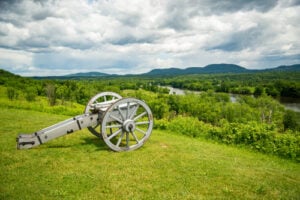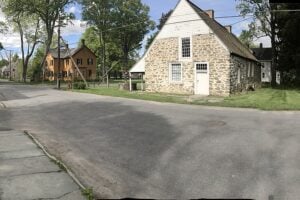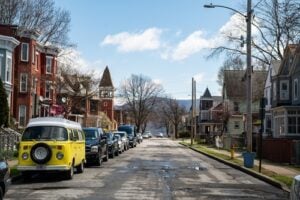
Courtney Avenue in Newburgh, New York, April 12, 2022. Photo: KMarsh / Shutterstock.com.
Newburgh holds a remarkable place in Hudson Valley history. The Orange County city rises from the western shore of the Hudson River, opposite Beacon, with streets and historic buildings that recall its years as a river port, manufacturing center, and important American crossroads. George Washington spent the final months of the Revolutionary War at headquarters in the Hasbrouck House, but the city’s story did not end with the Revolution. In the nineteenth century, its nurseries, businesses, churches, schools, and riverfront connections helped support a lively community whose influence traveled well beyond Orange County.
Another side of Newburgh’s history deserves just as much attention: the people who began their lives there. A celebrated author, a major American abstract painter, a pioneering landscape designer, and the first woman nominated for vice president by a major American political party all have Newburgh connections. So do a silent-film cowboy, a founding Black religious leader, a rock drummer, Broadway performers, an influential civil-rights lawyer, and a computer scientist whose ideas helped shape modern operating systems.
What makes this collection interesting is the distance between those careers. Newburgh has produced people whose work changed American gardens and public parks, people who changed national politics, and people who made their names in books, motion pictures, music, and television. Several became nationally known while keeping strong memories of their hometown. Others were born in Newburgh but moved away as infants or children. These are different kinds of local connections, and the distinction is worth preserving rather than suggesting everyone on this list grew up on the same streets.
The following 25 people were born in Newburgh or its immediately associated historic area, grew up there, or attended Newburgh schools during important formative years. Newburgh is not interchangeable with Orange County as a whole: someone born in another county community qualifies here only with a documented Newburgh connection. This is not a ranking, and fame can take many forms. Some names will be immediately familiar; others are important because of what they accomplished in their own fields.
1. James Patterson (Born 1947)
Newburgh connection: Born and raised in Newburgh; his family moved to Massachusetts later in his school years.
James Patterson’s worldwide publishing career began far from the Manhattan advertising offices and international book sales that later made him famous. Born in Newburgh on March 22, 1947, Patterson grew up in a working-class family and attended local Catholic schools. His mother taught, and memories of his grandparents, their work, and their Newburgh neighborhood stayed with him long after he left the Hudson Valley. Patterson has discussed the city in interviews, including the memories of his grandparents’ restaurant and the people he encountered there.
After studying English at Manhattan College and Vanderbilt University, Patterson joined J. Walter Thompson in advertising and rose to senior executive. He published his first novel, The Thomas Berryman Number, in 1976, which won an Edgar Award for Best First Novel. His greatest commercial breakthrough followed with the Alex Cross thrillers, beginning with Along Came a Spider, and he built other popular series around the Women’s Murder Club and Michael Bennett. His career also includes books for young readers and support for literacy and school libraries. For Patterson, Newburgh is more than a line on a biographical record: it is part of the environment he has said helped shape his storytelling.
2. Ellsworth Kelly (1923–2015)
Newburgh connection: Born in Newburgh on May 31, 1923; moved away with his family when he was an infant.
Ellsworth Kelly became one of the defining American artists of the postwar period, but he spent little time in Newburgh. His family records that he was born in the city in 1923 and moved to Pittsburgh at about six months old. The family later settled in New Jersey, where he grew up. This is an important distinction: Newburgh is his documented birthplace, not the setting for the full childhood sometimes attributed to him.
Kelly served in the Army during World War II, studied art in the United States, and spent several formative years in France after the war. He developed a style centered on the relationship between shape, color, edge, and the spaces around painted or sculpted forms. His simplified compositions influenced hard-edge abstraction, while his observations of plants, shadows, architecture, and other everyday forms supplied ideas for paintings and sculptures. Major museums worldwide have exhibited and collected his work. One of the most influential American abstract artists of the twentieth century thus began life in a Hudson Valley city he left almost immediately.
3. Geraldine Ferraro (1935–2011)
Newburgh connection: Born in Newburgh on August 26, 1935, and spent part of her childhood there before her family moved to the Bronx.
Geraldine Ferraro’s Newburgh childhood preceded one of the most consequential moments in American electoral history. Her parents were Italian immigrants, and her father died when she was young. Her mother moved the family to the Bronx, worked to support the children, and emphasized education. Ferraro attended Marymount School and Marymount College, then earned her law degree from Fordham while working as a teacher. Before entering Congress, she became an assistant district attorney in Queens.
Ferraro represented a Queens congressional district from 1979 to 1985. In 1984, Walter Mondale chose her as his running mate, making her the first woman nominated for vice president on a major American political party ticket. Although the Mondale–Ferraro ticket lost to Ronald Reagan and George H. W. Bush, the nomination made a lasting mark on the possibilities available to women seeking national office. Ferraro subsequently continued her work in law, public affairs, and international human-rights discussions. Her journey from Newburgh to the national campaign stage remains one of the city’s best-known political connections.
4. Andrew Jackson Downing (1815–1852)
Newburgh connection: Born in Newburgh; lived and worked there throughout his life.
Few people on this list left an influence as directly visible in American public life as Andrew Jackson Downing. Born in Newburgh in 1815, he entered the family nursery business and became deeply involved in horticulture and landscape design. During the nineteenth century, as American towns expanded and middle-class families paid more attention to their homes and gardens, Downing promoted the idea that beauty, nature, and carefully designed surroundings could improve daily life. His books included A Treatise on the Theory and Practice of Landscape Gardening and Cottage Residences.
Downing also helped bring the English architect Calvert Vaux to the United States. After Downing died at just 36 in the 1852 steamboat Henry Clay disaster on the Hudson River, Vaux went on to collaborate with Frederick Law Olmsted on the winning design for Central Park. Downing did not design Central Park himself, but his advocacy for public landscapes and his influence on Vaux form an important part of its intellectual history. His home city later honored him with Downing Park, designed by Olmsted and Vaux. Newburgh’s landscape history is inseparable from his name.
5. Saul Williams (Born 1972)
Newburgh connection: Born in Newburgh on February 29, 1972, and attended Newburgh Free Academy.
Poet, musician, actor, and writer Saul Williams belongs to a generation of artists who moved easily between the spoken word, recorded music, film, and live performance. His artistic beginnings have a concrete Newburgh connection: he was born there and attended Newburgh Free Academy. He later studied at Morehouse College and earned a graduate degree in acting from New York University’s Tisch School of the Arts. In New York City, his poetry performances brought his writing to a wider audience.
Williams co-wrote and starred in the independent film Slam, which won the Grand Jury Prize at the 1998 Sundance Film Festival. His recordings blend rap, rock, electronic sound, and poetry, and he has collaborated with Trent Reznor. His writing is often politically engaged, but it also examines individual identity, language, and the possibilities of live performance. Unlike many artists recognized primarily for one medium, Williams has continually crossed boundaries between them. Newburgh Free Academy was one stop on the path to that unusually varied career.
6. William S. Hart (1864–1946)
Newburgh connection: Born in Newburgh on December 6, 1864; spent much of his childhood elsewhere as his family moved west.
William S. Hart helped establish the movie cowboy long before the sound Western became a fixture of Hollywood. He was born in Newburgh in 1864, but his family later moved through the upper Midwest and western territories. That childhood exposure to frontier life gave him memories and interests he drew upon when playing Western characters. He first built a career on the theatrical stage and entered filmmaking relatively late, around the age of 50.
Hart became one of the great stars of silent Westerns, emphasizing spare performances, difficult moral choices, and a comparatively realistic atmosphere. His work helped establish a cinematic vocabulary used by later generations of filmmakers. Films such as Hell’s Hinges and Tumbleweeds are associated with his legacy, and his former ranch in California became a museum dedicated to his life. His Newburgh birthplace is easy to overlook because his screen image became so inseparable from the American West.
7. Sara Delano Roosevelt (1854–1941)
Newburgh connection: Born at Algonac, the Delano family’s Hudson River estate near Newburgh, on September 21, 1854.
Sara Delano Roosevelt is remembered chiefly as the mother of President Franklin D. Roosevelt, but her origins also tell a story about the Hudson Valley’s nineteenth-century merchant families. She was born at Algonac, the Delano estate near Newburgh. Her father, Warren Delano Jr., made a fortune in the China trade, and the family’s circumstances allowed Sara to grow up in an environment that joined Hudson Valley estate life with extensive international connections. She spent part of her youth in Hong Kong and also received education abroad.
In 1880, Sara married James Roosevelt and moved into the family world associated with Hyde Park. Their son Franklin was born in 1882. Sara remained a prominent influence in his upbringing and an important presence in his adult life, although her role and relationship with other family members have been interpreted in different ways by biographers. Her story connects the Newburgh area with another major Hudson Valley center of political history. The distinction between her birth at Algonac, near Newburgh, and Franklin Roosevelt’s birth in Hyde Park is important to the record.
8. George Inness (1825–1894)
Newburgh connection: Born in Newburgh on May 1, 1825; raised principally in New York City and New Jersey.
George Inness is among America’s most admired landscape painters. Born in Newburgh in 1825, he moved away with his family and spent significant childhood years in New Jersey. His early artistic development took place after that relocation, so it would be misleading to attribute all of his later observations or technique to his Newburgh birthplace. His career nonetheless began with a real Orange County connection.
Inness became associated with American landscape painting at a time when the Hudson River School was influential, but his mature work developed in a different direction. Encounters with French Barbizon painters encouraged him to emphasize atmosphere and mood rather than sharply delineated detail. Religious and philosophical interests also entered his art, and the effects of mist, fading light, and color often mattered as much as the exact terrain depicted. His paintings now belong to major museum collections. Newburgh’s place on the map of nineteenth-century American art includes both Inness and the very different landscape artist Ellsworth Kelly.
9. Pardison Fontaine (Born 1989)
Newburgh connection: A Newburgh native whose music and videos have repeatedly returned to the city.
Rapper and songwriter Pardison Fontaine, born Jordan Thorpe, is an example of contemporary Newburgh talent reaching a national audience through popular music. In interviews and music coverage, he has been identified as a Newburgh native, and he has spoken about the city with the familiarity of someone whose musical path began there. His work as a songwriter gained attention before many casual listeners recognized him as a performer.
Fontaine became widely known for his collaboration with Cardi B on the 2018 single “Backin’ It Up,” and he contributed writing to other major hip-hop releases. His mixtape Under8ed placed more emphasis on his identity as a solo artist. He also used Newburgh locations and local participants in his music videos, keeping the city visible as his career expanded. That attachment distinguishes him from someone merely born in a place and immediately removed from it: Newburgh has remained part of the public story he tells about himself.
10. James Varick (1750–1827)
Newburgh connection: Born near Newburgh in 1750, according to histories of the African Methodist Episcopal Zion tradition.
James Varick belongs to an earlier chapter of New York history, when enslaved and free Black New Yorkers faced severe restrictions on their religious participation and civic lives. Church histories place his birth near Newburgh in 1750. Sources differ about whether his mother was enslaved, and it is safest not to describe Varick himself as certainly born into slavery without stronger documentation. He moved into the religious world of New York City, where he trained as a shoemaker and became active in Methodist worship.
In 1796, Varick joined other Black Methodists in organizing separate worship meetings in response to discrimination in their existing congregation. The movement led over time to the independent African Methodist Episcopal Zion Church. It would be inaccurate to say that Varick single-handedly founded the fully independent denomination in 1796: its organizational separation and ordination of its own ministers developed over subsequent decades. He became its first bishop in 1822. The denomination’s later association with abolitionism and civil rights gave Varick a legacy far beyond his birthplace near the Hudson River.
11. Rob Cohen (Born 1949)
Newburgh connection: Born in Cornwall, Orange County, and graduated from Newburgh Free Academy.
Director and producer Rob Cohen was not born in the City of Newburgh, a distinction worth making clear. His connection to the city is educational: he attended Newburgh Free Academy before going on to Harvard University. For a list about people from Newburgh, school years can be a meaningful local connection, but they should not be confused with a birthplace. His presence here reflects that documented part of his upbringing in the Newburgh area.
Cohen worked as a film executive, producer, writer, and director before finding his largest box-office successes in action filmmaking. He directed Dragon: The Bruce Lee Story, Dragonheart, The Fast and the Furious, and xXx. The original Fast and the Furious became the starting point for one of Hollywood’s longest-running action franchises. His work spans both studio management and the creative side of production, illustrating a career that began in the Hudson Valley and grew into major international filmmaking.
12. John E. Wool (1784–1869)
Newburgh connection: Born in Newburgh on February 29, 1784.
John Ellis Wool’s military career extended across the War of 1812, the Mexican-American War, and the Civil War. Born in Newburgh on a leap day in 1784, Wool lost his parents when young and moved to Troy to live with family. He had limited formal schooling but built a long military career, becoming known for discipline, organization, and detailed knowledge of military administration. He spent many years as an inspector general, a role involving the condition and management of the Army rather than the battlefield alone.
By the Civil War, Wool was one of the oldest officers on active duty. His command responsibilities included Fort Monroe in Virginia, an important Union-held position. His longer career also involved deeply troubling federal policies, including Army involvement in the forced removal of Cherokee people; an accurate account cannot treat every assignment as uncomplicated heroism. Wool’s service illuminates the changing role of the United States Army through much of the nineteenth century. Newburgh was his birthplace, although Troy became his more enduring home.
13. Charles Downing (1802–1885)
Newburgh connection: Born in Newburgh in 1802; educated locally and worked in the family nursery business.
Charles Downing may be less familiar than his younger brother Andrew Jackson Downing, but his contribution to American fruit growing was considerable. Born in Newburgh in 1802, Charles learned horticulture through the nursery operated by his father, Samuel Downing. He took over the business after his father’s death and later worked with Andrew in a partnership. Their careers eventually developed in different directions: Andrew became famous for landscape design and architectural writing, while Charles concentrated on fruit varieties and the practical knowledge needed by growers.
Charles Downing’s work in pomology, the study and cultivation of fruit, made him an authority consulted well beyond the Hudson Valley. His expanded editions of The Fruits and Fruit-Trees of America helped identify and describe apples, pears, and other fruit varieties. His surviving variety notes are preserved in a research collection at Iowa State University. This quieter scientific achievement is an important reminder that nineteenth-century Newburgh was a center of horticultural expertise, not simply a riverfront town associated with a few famous designers.
14. Mary Bonauto (Born 1961)
Newburgh connection: Born and raised in Newburgh, New York.
Mary Bonauto is one of the most consequential American civil-rights attorneys of her generation. Born in Newburgh in 1961, she grew up in a local family before attending Hamilton College and Northeastern University School of Law. She began practicing law in Maine and became involved in litigation concerning discrimination, family rights, and legal protection for LGBTQ Americans. Her early work developed into a long legal career at GLAD Law, the organization formerly known as Gay & Lesbian Advocates & Defenders.
Bonauto played a leading role in the Massachusetts marriage equality litigation that produced the 2003 Goodridge decision. In 2015, she argued before the U.S. Supreme Court in Obergefell v. Hodges, the case in which the Court recognized a constitutional right to marriage for same-sex couples nationwide. That case was the outcome of years of legal work involving many lawyers, plaintiffs, and organizations, not the achievement of one individual alone. Still, Bonauto’s contributions were central. Her documented Newburgh upbringing gives the city a direct connection to a major turning point in modern American constitutional law.
15. Rob Affuso (Born 1963)
Newburgh connection: Born in Newburgh on March 1, 1963.
Drummer Rob Affuso became familiar to hard-rock audiences as a member of Skid Row during the band’s breakthrough years. He was born in Newburgh in 1963 and developed a career that eventually placed him on major concert stages around the world. His name may be less immediately recognizable than that of lead singer Sebastian Bach, but Affuso played an important part in the band’s recordings and live performances.
He played drums on Skid Row’s 1989 debut and the successful 1991 follow-up Slave to the Grind, among other recordings. Songs associated with that era include “18 and Life,” “I Remember You,” “Youth Gone Wild,” and “Monkey Business.” After his principal years with Skid Row, he remained active in music, including work with other groups and music-related business and teaching. His Newburgh origins add a hard-rock name to a city whose musical history includes performers working in many different styles.
16. Scoey Mitchell (1930–2022)
Newburgh connection: Born in Newburgh on March 12, 1930.
Scoey Mitchell, born Roscoe Mitchell Jr., found success in a television industry that offered far fewer leading opportunities to Black performers than it does today. A Newburgh native, he became known to audiences through acting, comedy, and appearances on popular television programs. His career encompassed stand-up performance, sitcoms, game shows, writing, producing, and directing.
Mitchell starred in the 1970 television adaptation of Barefoot in the Park, which featured a predominantly Black cast, and he appeared in programs including Rhoda and game shows such as Match Game. He later moved behind the camera as a writer and producer, creating television projects of his own. Mitchell’s career illustrates both the barriers Black entertainers confronted and the range of work some performers undertook to find greater control over their careers. He died in 2022, leaving a substantial television legacy connected by birthplace to Newburgh.
17. Benjamin B. Odell Jr. (1854–1926)
Newburgh connection: Born in Newburgh on January 14, 1854; spent much of his business and political life there.
Benjamin Barker Odell Jr. was one of Newburgh’s most prominent political figures. He entered public life through business and Republican Party politics, with interests connected to banking, transportation, and other enterprises. Before becoming governor, he represented a New York congressional district in the U.S. House of Representatives. Unlike individuals whose Newburgh connection amounted only to an early birth record, Odell was closely associated with the city over many years.
Odell served as New York’s 37th governor from 1901 through 1904. His administration emphasized state financial management and supported public works, including the improvement of New York’s canal system. He belonged to a period when governors were expected to balance powerful party organizations, rapid economic change, and demands for infrastructure investment. His continued association with Newburgh makes him an important name in both city and state history.
18. William W. Belknap (1829–1890)
Newburgh connection: Born in Newburgh on September 22, 1829.
William Worth Belknap’s career moved from the Hudson Valley to the Civil War battlefields and the administration of President Ulysses S. Grant. Born in Newburgh in 1829, he graduated from Princeton and became a lawyer in Iowa. During the Civil War he served with the Union Army, advancing through command positions and participating in major campaigns. His military service helped bring him to national attention.
Grant appointed Belknap secretary of war in 1869. His time in office ended in a major corruption scandal involving payments associated with appointments to trading posts at military installations. Belknap resigned in March 1876, but the House of Representatives proceeded with impeachment. The Senate ultimately acquitted him because conviction did not receive the required two-thirds vote, although a majority voted against him on the charges. His story is not simply one of distinguished service: it is also part of the history of corruption and accountability in the federal government after the Civil War.
19. Jackie Burch (1951–2025)
Newburgh connection: Born in Newburgh on March 25, 1951.
Jackie Burch was one of Hollywood’s influential casting directors, a profession whose contributions are essential to filmmaking but often less visible than those of the actors on the screen. Born in Newburgh in 1951, she began her professional life as a teacher of deaf students before moving into the entertainment industry. Her talent for recognizing performers helped shape the ensembles of many popular films.
Burch’s credits included The Breakfast Club, Sixteen Candles, Coming to America, and Die Hard. She also worked on television and later film projects, receiving an Emmy nomination for the television film Bessie. Her career linked her with important directors and productions over several decades. Burch died in 2025. Her birthplace supplies another direct connection between Newburgh and the history of American screen entertainment, this time through someone whose most influential work was done behind the camera.
20. D. Maitland Armstrong (1836–1918)
Newburgh connection: Born in Newburgh on April 15, 1836, and associated in childhood with the family’s nearby Danskammer home.
David Maitland Armstrong pursued an unusually varied nineteenth-century career that joined diplomacy, painting, and decorative art. Born in Newburgh in 1836, he came from a Hudson Valley family and later served in American diplomatic positions in Italy. He also took part in international artistic circles and helped represent American art at the Paris exposition of 1878. That combination of public service and artistic training placed him in an important position during the growth of American design culture.
Armstrong became particularly known for stained glass. He worked with Louis Comfort Tiffany before establishing his own firm in the 1880s. His daughter Helen Maitland Armstrong later became a notable stained-glass designer in her own right and worked with him. Their projects used color, layered glass, and detailed figural designs in churches and other buildings. The Metropolitan Museum of Art holds material relating to his work. Armstrong’s birthplace connects Newburgh to the American decorative arts movement of the Gilded Age.
21. Sharon Wilkins (Actress)
Newburgh connection: Identified in biographical accounts as a Newburgh native.
Sharon Wilkins built a career across Broadway, film, and television, taking on work that demanded both stage presence and the ability to adapt to screen performance. Biographical accounts identify her as coming from Newburgh, although a dependable independently verified full birth date is not available for this article. Her theatrical credits provide a clearer record of her professional development than many short online profiles.
Wilkins appeared in the original Broadway productions of The Life and Seussical, including the role of the Sour Kangaroo in the latter, and also appeared in All Shook Up. Her film and television work includes appearances in Maid in Manhattan, National Treasure, and other productions. The range of these credits is part of what makes working stage performers important to New York’s cultural history: careers are often built from many productions rather than a single starring role. Her connection to Newburgh places her among the city’s performers who reached Broadway and screen audiences.
22. Timothy Shay Arthur (1809–1885)
Newburgh connection: Born near Newburgh on June 6, 1809; spent parts of his childhood elsewhere in the Hudson Valley.
Timothy Shay Arthur, often published as T. S. Arthur, was a widely read American writer of the nineteenth century. Born near Newburgh in 1809, he later lived in other communities and developed a career in magazines, editing, and fiction. He wrote for readers interested in domestic life, moral choices, family responsibilities, and the social problems of drinking. His work circulated in an era when literary magazines and books played a major role in shaping public discussion.
Arthur is best remembered for the 1854 novel Ten Nights in a Bar-Room and What I Saw There, a major work of the temperance movement. The story became closely associated with anti-alcohol campaigns and was repeatedly adapted for the stage. Although later readers may find the moral lessons of his fiction characteristic of a different age, Arthur’s popularity offers insight into the concerns of nineteenth-century American families. His birthplace near Newburgh shows that the area contributed to national literary life long before modern bestselling authors like James Patterson arrived.
23. Lexi Lawson (Broadway Performer)
Newburgh connection: Raised in Newburgh and graduated from Newburgh Free Academy in 2002.
Lexi Lawson provides one of the clearest links between Newburgh’s schools and Broadway. Although born outside the city, she grew up in Newburgh and attended Fostertown Elementary, North Junior High, and Newburgh Free Academy. The Newburgh school district has celebrated her achievements and documented her visits to speak with students. This makes her local connection considerably stronger than an unverified claim based on a celebrity’s occasional appearance in the area.
Lawson played Mimi in a touring production of Rent and Vanessa in In the Heights. She later played Eliza Hamilton in the original Broadway production of Hamilton, joining the cast in 2016. Her work in two major Lin-Manuel Miranda musicals brought her to audiences across the country, and her return visits to Newburgh gave local students a model of a professional performing career. Her story is not simply about a well-known show; it is about someone whose artistic and educational foundations were established in the Newburgh school system.
24. Augustus C. Ludlow (1792–1813)
Newburgh connection: Born in Newburgh on January 1, 1792, according to the U.S. Navy’s official ship histories.
Augustus C. Ludlow’s brief life became part of one of the War of 1812’s most remembered naval episodes. Born in Newburgh in 1792, he entered naval service early and rose to lieutenant. He served as second-in-command aboard the American frigate USS Chesapeake under Captain James Lawrence. In June 1813, the ship engaged the British frigate HMS Shannon off Boston.
Lawrence and Ludlow were both mortally wounded during the engagement, and Ludlow died at Halifax on June 13, 1813. The battle entered American naval memory through Lawrence’s famous command, “Don’t give up the ship.” The Navy later named destroyers in Ludlow’s honor, preserving the memory of the Newburgh-born officer long after the conflict. His career was short, but the official naval record documents both his birthplace and his role in the battle unusually well.
25. M. Douglas McIlroy (Born 1932)
Newburgh connection: Born in Newburgh on April 24, 1932.
Computer scientist Malcolm Douglas McIlroy represents a very different kind of influence from the artists and politicians on this list. Born in Newburgh in 1932, he studied at Cornell University and the Massachusetts Institute of Technology before joining Bell Laboratories. In the era when computers were moving from specialized machinery toward more flexible systems, Bell Labs became a major center of research into programming languages and operating systems.
McIlroy is closely associated with the idea of Unix pipelines: connecting smaller programs so that the output of one can become the input of another. He proposed and advocated the concept; other developers, notably Ken Thompson, carried out essential implementation work. That distinction matters in a field where advances often arise from collaboration. McIlroy also contributed to macro processing, software tools, and the broader philosophy of building systems from reusable components. The principle remains visible in Unix-like systems and command-line environments today. From a 1932 Newburgh birthplace came a career connected to ideas that helped shape modern computing.
What Newburgh’s Famous People Tell Us About the City
These 25 people did not all live in Newburgh for the same length of time, and it would be wrong to give them identical hometown stories. Some, including Andrew Jackson Downing and Charles Downing, developed their careers in Newburgh itself. Others, like James Patterson, Saul Williams, and Lexi Lawson, carried experiences from the city into creative work that reached much wider audiences. Still others, such as Ellsworth Kelly and William S. Hart, were born there but grew up mainly elsewhere. The local record is strongest when those differences remain visible.
Across two and a half centuries, Newburgh’s connections extend from the War of 1812 and the birth of Black religious institutions to American landscape art, electoral politics, Hollywood, hip-hop, Broadway, civil rights, and computing. These careers do not erase the social and economic difficulties Newburgh has experienced. They do show that the city’s history cannot be reduced to any single period, industry, or headline. It has been a starting point for an extraordinary variety of American lives.
Readers interested in more New York connections can explore our articles on 25 Famous People You Didn’t Know Were From Orange County, New York, 25 Famous People You Didn’t Know Were From the Hudson Valley, New York, and 25 Famous People You Didn’t Know Were From Upstate New York. For another look at notable New Yorkers’ education, see 25 Famous People You Didn’t Know Graduated From High Schools in Upstate New York.