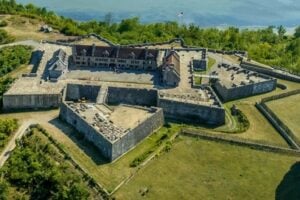

Saratoga National Historical Park in Saratoga County, New York, site of the 1777 Battles of Saratoga. Photo: Enrico Della Pietra / Shutterstock.com.
As a lifelong New Yorker, I’ve always found it remarkable that two battles fought on farmland near Saratoga in 1777 helped change the course of the American Revolution. Fought along the bluffs and farmland of the upper Hudson River Valley in the autumn of 1777, the twin encounters at Freeman’s Farm and Bemis Heights culminated in the surrender of a British field army under Lieutenant General John Burgoyne. While traditional military histories often evaluate Saratoga through tactical maneuvering and American resilience, its true historical magnitude also lies in its geopolitical shockwave. Saratoga was not merely a battle won; it became the decisive pivot that secured an open alliance with France and turned a colonial rebellion into a wider imperial war.
The battles took place on September 19 and October 7, 1777, near present-day Stillwater in Saratoga County, New York. Burgoyne surrendered farther north, at Saratoga, near today’s Schuylerville, on October 17. Those dates and locations matter: the Battles of Saratoga were two separate engagements, followed by the encirclement and negotiated surrender of Burgoyne’s army, not a single day of fighting.
I. The British Grand Strategy and the Fatal Flaws of 1777
To understand Saratoga’s significance, one must first examine the strategy British commanders and war planners pursued in 1777. A major British objective was to control the Hudson River corridor and separate New England, widely regarded as a center of resistance, from the middle colonies. The plan was to make the rebellion harder to supply, reinforce, and coordinate.
Lieutenant General John “Gentleman Johnny” Burgoyne proposed an invasion southward from Canada through the Lake Champlain corridor, with the ultimate objective of reaching Albany. A secondary force under Lieutenant Colonel Barry St. Leger would advance from the west through the Mohawk Valley. Burgoyne also expected that General Sir William Howe’s army, based in New York City, would cooperate by moving north along the Hudson. However, the familiar description of a perfectly synchronized three-pronged campaign makes British planning seem more unified than it was. London approved Burgoyne’s northern expedition while also permitting Howe to pursue Philadelphia, and the two commanders had no clear, enforceable timetable for joining forces at Albany.
The resulting campaign exposed serious weaknesses in British coordination and assumptions about the terrain. Howe sailed south and captured Philadelphia in September instead of advancing toward Albany. He made this decision after a campaign that had received approval from British authorities; it cannot be explained simply as a personal whim. Sir Henry Clinton later mounted an expedition up the lower Hudson, capturing Forts Clinton and Montgomery in October, but it came too late and too far south to rescue Burgoyne.
St. Leger’s expedition also failed to reach Albany. Fighting at the Battle of Oriskany in August inflicted heavy losses on American militia and on Native American participants on both sides. Yet the British-led force could not take Fort Stanwix, also known as Fort Schuyler. Its siege collapsed as St. Leger’s Native allies withdrew and a relief force under Benedict Arnold approached. Those events should not be mistaken for a straightforward American battlefield triumph at Oriskany itself; the larger result was the failure of the western British advance.
Meanwhile, Burgoyne’s army suffered another serious reverse when American forces defeated a detachment sent toward Bennington for supplies in August. The British campaign depended on moving men, artillery, animals, and provisions through difficult country while maintaining vulnerable communications with Canada. By the time Burgoyne committed to advancing south of Saratoga, American militia forces were growing, his prospects for reinforcement were shrinking, and an increasingly powerful Continental Army defended the route to Albany.
II. The Engagements: Freeman’s Farm and Bemis Heights
By September 1777, Major General Horatio Gates commanded the American Northern Army, which had established strong defensive positions on Bemis Heights near Stillwater. On September 13, Burgoyne crossed the Hudson River near Saratoga and continued south. On September 19, his columns advanced toward the American defenses and collided with troops near Freeman’s Farm. The first engagement became a brutal, attritional struggle through fields and woods.
British regulars and German auxiliary troops, including soldiers from Brunswick and Hesse-Hanau, faced American Continental soldiers, militia, and the riflemen commanded by Colonel Daniel Morgan. Calling all of the German troops “Hessians” obscures their different places of origin and military units. American troops struck hard at the advancing columns, but British and German reinforcements helped Burgoyne retain the field by nightfall. It was a costly and limited success rather than a breakthrough: the National Park Service estimates about 580 British-side casualties and approximately 320 American casualties. Gates’s army still blocked the road to Albany.
For more than two weeks, Burgoyne waited before the American lines as supplies dwindled and American reinforcements arrived. On October 7, he ordered a reconnaissance in force to test the American position. Instead of opening a path around the defenses, this move sparked the Second Battle of Saratoga, commonly called the Battle of Bemis Heights. American forces attacked the advancing British and German troops, drove them back, and pressed toward their fortified positions.
The fighting also brought the complicated relationship between Gates and Major General Benedict Arnold to the foreground. The two officers quarreled bitterly after Freeman’s Farm, and Arnold was relieved of his field command. Accounts differ over precisely how his return to the action on October 7 was authorized, but his presence and leadership on the battlefield are well established. He joined the fighting as American troops attacked the British positions, culminating in the capture of the German-held Breymann Redoubt. Arnold was wounded in the leg during the assault.
Losing that position made Burgoyne’s line increasingly vulnerable. His men withdrew north toward Saratoga, where American forces cut off escape routes. Burgoyne faced a larger enemy army, dwindling food, and no realistic prospect of timely relief. Under the Convention of Saratoga, terms were negotiated, and on October 17, 1777, nearly 6,000 British and German soldiers laid down their arms. Burgoyne formally surrendered to Gates near present-day Schuylerville. The surrender culminated a campaign, two major battles, and the steady collapse of Britain’s northern strategy.
III. The Diplomatic Earthquake: Securing the French Alliance
The surrender of Burgoyne’s army sent shockwaves across the Atlantic Ocean, altering the diplomatic calculations of Europe’s great powers. American commissioners in Paris, including Benjamin Franklin, had long sought recognition, military supplies, financial assistance, and a formal French alliance. French Foreign Minister Charles Gravier, Comte de Vergennes, recognized that the American rebellion offered an opportunity to weaken Britain after France’s defeat in the Seven Years’ War.
France had already been supplying assistance to the Americans before Saratoga, much of it secretly. The essential change after Burgoyne’s surrender was not that France suddenly became interested in the rebellion, but that the American victory made an open alliance more attractive and more urgent. News of the surrender reached Paris in December 1777. It demonstrated that an American army could defeat and capture a substantial British force, while the possibility of British peace negotiations with the Americans gave French officials additional reason to act.
On February 6, 1778, France and the United States signed the Treaty of Amity and Commerce and the Treaty of Alliance. The agreements recognized American independence, established commercial relations, and committed France to the American cause in the struggle against Britain. Benjamin Franklin, Silas Deane, and Arthur Lee signed on behalf of the United States. The alliance was a diplomatic breakthrough that promised resources the Americans could not readily supply on their own.
France’s intervention helped draw the war into a much wider international contest, but the other European powers entered on different terms and at different times. Spain went to war against Britain in 1779 as France’s ally, not as a formal ally of the United States under the 1778 Franco-American treaty. The Dutch Republic became involved in a separate war with Britain in 1780. These distinctions matter because the wider conflict did not become a single, unified coalition overnight.
IV. The Globalization of the Conflict
France’s entry changed the American Revolution from a struggle concentrated in the British colonies into one theater of a much larger imperial war. Britain now had to defend interests far beyond the North American mainland, including Caribbean colonies, Atlantic shipping routes, and positions connected to trade in India. The prospect of French and Spanish naval operations also compelled Britain to devote attention and resources to European waters.
France furnished the nascent United States with military equipment, financing, trained troops, and crucial naval support. This assistance did not eliminate American sacrifices or automatically guarantee independence. It did, however, create possibilities unavailable to an American army fighting Britain alone. By 1781, cooperation among General George Washington, French General Rochambeau, and Admiral de Grasse made a major combined operation possible.
The connection between Saratoga and the outcome at Yorktown became particularly clear during the Battle of the Chesapeake in September 1781. De Grasse’s French fleet prevented the Royal Navy from relieving Lord Cornwallis by sea while American and French land forces converged on Yorktown, Virginia. Cornwallis surrendered in October. That victory effectively ended major fighting in the mainland American colonies, although the wider war continued until the peace agreements of 1783.
Thus, the Battles of Saratoga stand as a turning point of the American Revolution. By stopping Burgoyne’s invading army in upstate New York, American soldiers accomplished more than a regional victory. They provided a powerful demonstration of military viability that helped unlock France’s diplomatic and naval support. The victory alone did not win American independence, but it changed the international conditions under which independence could be achieved.
For more on the struggle for American independence in New York, read our coverage of the Battle of Sag Harbor, the British raid at Pound Ridge, and the preservation of Fishkill’s Revolutionary War history. Each reveals a different part of New York’s place in the war.