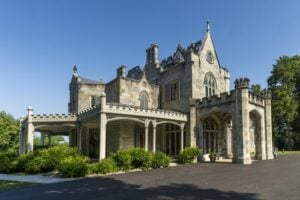
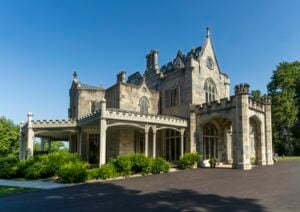
Lyndhurst Mansion, a historic Gothic Revival estate in Tarrytown, New York. Photo: Brian Logan Photography / Shutterstock.com
The Hudson Valley has been home to some of New York’s most remarkable country houses for more than three centuries. Long before the Gilded Age brought railroad fortunes, elaborate gardens, and grand weekend retreats to the river, colonial landowning families were establishing farms, trading centers, and estates along its banks. The Hudson was both a transportation route and a source of wealth. Land, agriculture, river commerce, and the labor of enslaved people and tenant farmers helped sustain the households that later became known for their imposing mansions.
The American Revolution gave several of those properties a new place in history. Clermont was burned by British troops because of the Livingston family’s support for independence. The Verplanck house at Mount Gulian became a military headquarters and the birthplace of the Society of the Cincinnati. Later, Washington Irving turned an older riverside cottage into Sunnyside, while artists Thomas Cole and Frederic Edwin Church made their Hudson Valley homes part of an emerging national landscape tradition.
By the late 19th century, industrialists and financiers built or transformed houses that reflected a changing country’s wealth. The Rockefellers, Vanderbilts, Goulds, and Mills family maintained estates overlooking the river. Yet these properties were never only stories about the wealthy people whose names appeared on the deeds. Servants, craftspeople, gardeners, farmworkers, and enslaved residents made life on the estates possible, and modern historic sites increasingly interpret those lives alongside the architecture and the families who owned the land.
Some of the houses on this list remain remarkably intact. Others survived demolition threats, were rebuilt after fires, or were moved to new locations. A few are privately held or available only by special tour arrangement, rather than as ordinary walk-in attractions. These 25 estates, mansions, and historic homes share a documented connection to the Hudson Valley’s political, artistic, architectural, and social history. Their stories reveal why the region remains such an important part of New York’s past.
1. Kykuit (Pocantico Hills / Sleepy Hollow)
High above the Hudson near Sleepy Hollow stands Kykuit, the Rockefeller family’s celebrated country estate. Delano & Aldrich initially designed the house, and William Welles Bosworth later reworked it, resulting in the four-story Beaux-Arts villa seen today in 1913. Its Dutch-derived name means “lookout,” fitting for a property overlooking the river and the Palisades. John D. Rockefeller, the Standard Oil founder, established the estate, and the family lived there for four generations.
Bosworth also laid out terraces and formal gardens that made the landscape as important as the house. Later, Nelson Rockefeller added extensive displays of modern painting and sculpture, including work by Alexander Calder and Henry Moore, as well as Picasso tapestries. The site blends the history of one of America’s wealthiest families with a remarkable collection of 20th-century art.
2. Olana (Hudson)
Frederic Edwin Church, a leading painter of the Hudson River School, turned his hilltop estate near Hudson into a work of art. He bought the land for its sweeping views of the river and the Catskill Mountains and worked with architect Calvert Vaux on an unusually colorful house influenced by architecture he had seen while traveling abroad. Church and his family moved into the new residence in 1872, although decorative work continued afterward.
The painter devoted extraordinary attention to the setting, shaping paths, tree plantings, and framed views so visitors would encounter the grounds almost as a succession of landscapes. Olana is therefore more than a picturesque mansion. It preserves the setting in which an American artist deliberately united architecture, painting, and the natural scenery that made him famous.
3. Vanderbilt Mansion (Hyde Park)
Frederick and Louise Vanderbilt bought a Hudson River property at Hyde Park in 1895 and commissioned McKim, Mead & White to design a new country mansion. They completed the house in 1898 and furnished it the following year. With 54 rooms and an enormous service operation, it illustrates the separation between the luxurious spaces enjoyed by the owners and guests and the working areas necessary to support them.
Its conveniences were striking for the period, including electric lighting powered by an estate hydroelectric plant, indoor plumbing, and central systems designed for comfort. The Vanderbilts generally used Hyde Park in spring and autumn rather than living there year-round. Now preserved by the National Park Service, the mansion offers a revealing record of Gilded Age architecture, technology, wealth, and domestic labor.
4. Springwood, Home of Franklin D. Roosevelt (Hyde Park)
Franklin D. Roosevelt was born at Springwood in 1882, when it was still an Italianate-style house, and he returned to the Hyde Park property throughout his life. In 1915, Roosevelt and his mother, Sara Delano Roosevelt, worked with architects Hoppin & Koen to enlarge and remodel the residence in the Colonial Revival style; they completed the transformation in 1916. During Roosevelt’s presidency, Springwood became a family home, a political gathering place, and a retreat.
The rooms also preserve reminders of how FDR adapted daily life after contracting polio, including accessibility equipment and house modifications. The property now forms the Home of Franklin D. Roosevelt National Historic Site, and Franklin and Eleanor Roosevelt are buried in its rose garden. Few American houses are so closely linked to both a president’s private life and a momentous period of national history.
5. Lyndhurst (Tarrytown)
With its asymmetrical towers and dramatic Gothic Revival details, Lyndhurst is among the Hudson Valley’s most recognizable mansions. Architect Alexander Jackson Davis originally designed the house for former New York City mayor William Paulding, beginning in the late 1830s. A later owner, merchant George Merritt, enlarged the property, and financier Jay Gould purchased it in 1880. Gould enjoyed the estate’s landscape and greenhouse, where orchids became an important part of the family’s horticultural interests.
After a fire, the family rebuilt the greenhouse in cast iron and steel, reflecting a new approach to such structures. The residence remained associated with the Gould family for decades and eventually became a historic property open to the public. Its interiors, grounds, and appearances in film and television have helped preserve interest in one of America’s best-known Gothic Revival houses.
6. Boscobel (Garrison)
Boscobel’s remarkable story concerns not only its architecture but also its survival. Elizabeth and States Dyckman built the Federal-style house between 1804 and 1808 at Montrose in Westchester County. By the mid-20th century, it had deteriorated so badly that a demolition contractor bought it for only $35 in 1955. Preservationists intervened, recovered architectural materials, and organized an extraordinary rescue.
With major financial support from Reader’s Digest co-founder Lila Acheson Wallace, they dismantled the house and moved it about 15 miles north to Garrison, where they reconstructed it overlooking the Hudson Highlands. Boscobel therefore does not stand on its original site, an important distinction that makes its preservation campaign even more impressive. Today its restored rooms and gardens help interpret early American design and the value of architectural conservation.
7. Washington Irving’s Sunnyside (Irvington / Tarrytown)
Washington Irving, the author of “The Legend of Sleepy Hollow” and “Rip Van Winkle,” bought an older cottage on the Hudson in 1835 and gradually turned it into one of the country’s most distinctive literary homes. Irving collaborated on the picturesque transformation, mixing Dutch-influenced stepped gables with romantic architectural details and an unmistakable Spanish-style tower.
The house became known as Sunnyside, a retreat where he worked, entertained visitors, and embraced the landscape that had already figured so prominently in his writing. Its gardens and paths were part of the carefully arranged setting, not merely decorative additions. Visitors today encounter a house that reflects the writer’s tastes and imagination rather than the ambitions of an industrial fortune. Sunnyside connects the Hudson Valley’s geography to an enduring tradition of American storytelling.
8. Montgomery Place (Red Hook / Annandale-on-Hudson)
Janet Livingston Montgomery, widow of Revolutionary War General Richard Montgomery, established Montgomery Place after buying Hudson River property in 1802. The early house was built around 1804–1805, and later Livingston family members expanded both the residence and its ambitious landscape.
In the 1840s, architect Alexander Jackson Davis added new architectural features, while landscape designer Andrew Jackson Downing helped shape the grounds. The estate supported orchards, farming, gardens, and a workforce that included enslaved people, indentured servants, and paid laborers. Livingston descendants remained associated with it for generations, but not indefinitely: Bard College acquired Montgomery Place in 2016. Its survival allows us to examine the Hudson Valley estate as both a working agricultural enterprise and a fashionable country retreat.
9. Clermont (Germantown)
Clermont was the country seat of the Livingston family for generations, a dynasty central to Hudson Valley politics and landownership. British troops burned the house in 1777 during the Revolutionary War, targeting a family prominent in the American independence movement. Margaret Beekman Livingston directed its rebuilding between 1779 and 1782. Her son, Chancellor Robert R. Livingston, served on the committee appointed to draft the Declaration of Independence and later helped advance steamboat navigation in partnership with Robert Fulton.
The estate was also home to enslaved people, tenant farmers, and paid workers whose labor supported the family. Modern interpretations at Clermont place those lives within the property’s broader political and economic story. The rebuilt mansion survives as a New York State historic site and an especially direct connection to the Revolution on the Hudson.
10. Wilderstein (Rhinebeck)
Wilderstein began as an Italianate country house designed for Thomas Suckley in the 1850s, but its familiar Queen Anne appearance dates largely to an ambitious 1888 transformation. Architect Arnout Cannon enlarged the residence, adding its dramatic circular tower, varied rooflines, and extensive verandas. Designer Joseph Burr Tiffany contributed to the interior decoration, and Calvert Vaux shaped the surrounding grounds.
The estate’s best-known later resident was Margaret “Daisy” Suckley, a distant cousin and close confidante of Franklin D. Roosevelt. She gave FDR his Scottish terrier Fala and helped with his presidential library. After her death in 1991, her papers, including letters exchanged with Roosevelt, deepened historians’ understanding of their friendship. Wilderstein preserves both late-Victorian design and the private world surrounding one of America’s most consequential presidents.
11. Staatsburgh State Historic Site / Mills Mansion (Staatsburg)
The Mills Mansion shows how Gilded Age wealth transformed an older Hudson Valley family property. Ruth Livingston Mills inherited the estate, which had longstanding connections to her Livingston ancestors, and she and her husband, financier Ogden Mills, commissioned McKim, Mead & White to enlarge and remodel the existing residence. Work undertaken in 1895–1896 produced an imposing Beaux-Arts mansion with elaborate French-inspired rooms and modern conveniences.
The house became a setting for seasonal entertaining among New York’s affluent families, yet it required a large staff to maintain its rooms, furnishings, gardens, and grounds. Staatsburgh’s interpretation now examines both the Mills family’s privileged world and the people who worked there. Because historical and modern site descriptions count its rooms differently, the more important facts are the building’s documented transformation and the social history it preserves.
12. Val-Kill, Eleanor Roosevelt National Historic Site (Hyde Park)
Val-Kill occupies a different place in Hudson Valley estate history: it was Eleanor Roosevelt’s retreat, where she developed interests beyond the obligations of the larger Roosevelt household. In the mid-1920s, Eleanor and friends Nancy Cook and Marion Dickerman established a cottage on land near Springwood. An adjacent building housed Val-Kill Industries, a small venture intended to support local craftsmanship and employment.
After the business closed in 1936, they converted the former workshop into the residence now called Val-Kill Cottage. Eleanor spent considerable time there and lived there after Franklin Roosevelt’s death, welcoming guests and continuing her public work. The National Park Service preserves Val-Kill to help visitors understand her independence, political engagement, and influence. The original stone cottage and the converted factory building are not the same.
13. Edgewater (Barrytown)
Edgewater sits unusually close to the Hudson River, its classical columns visible from the water, a setting that distinguishes it from the region’s larger hilltop estates. Built in 1824 for Rawlins Lowndes Brown and Margaretta Livingston Brown, the house gained a substantial octagonal library in the mid-19th century. Writer Gore Vidal purchased Edgewater in 1950 and made the property a home and gathering place during an important period of his literary career.
Financier and preservationist Richard Hampton Jenrette acquired it in 1969 and invested in restoring and furnishing it. Unlike some state-operated mansions, Edgewater has a more complicated history of private ownership and preservation. Its successive occupants connect the estate to the Livingston family, American literature, and the 20th-century movement to protect historic houses.
14. Philipsburg Manor (Sleepy Hollow)
Philipsburg Manor was not simply a gracious colonial homestead. It was the center of a profitable milling, farming, and trading enterprise connected to the Philipse family’s far-reaching landholdings. A 1750 inventory records 23 enslaved Africans at the Upper Mills complex, among them Caesar, an experienced miller, and women whose work supported commercial dairy production. This community and surrounding tenant farmers produced flour, butter, and other goods that traveled through Atlantic trading networks.
The site has been preserved as a historic complex with a manor house, millpond, gristmill, and farm buildings. Modern interpretation places enslaved people and their families at the center of the story rather than presenting colonial wealth as the achievement of the owners alone. That makes Philipsburg Manor one of the Hudson Valley’s most important places for understanding slavery in northern colonial America.
15. Locust Grove (Poughkeepsie)
Artist and inventor Samuel F. B. Morse commissioned Alexander Jackson Davis to design an Italianate villa at Locust Grove, the estate overlooking the Hudson south of Poughkeepsie. The house was planned in 1850, built beginning in 1851, and completed in 1852. Morse was already celebrated for his contributions to telegraphy, but he had strong artistic interests as well and took a close personal role in shaping the appearance of his country residence.
After Morse’s death, the property passed through other hands; William and Martha Young acquired it in 1901 and enlarged and modernized the house. Their daughter, Annette Innis Young, later helped secure the estate’s preservation as a museum. Much of the interior interpretation reflects the Young family’s period rather than presenting every room as it looked during Morse’s occupancy. Consequently, Locust Grove tells the story of several generations of owners and changing ideas of country-house living.
16. Cedar Grove / Thomas Cole National Historic Site (Catskill)
Cedar Grove was the Catskill home of painter Thomas Cole, often regarded as the founder of the Hudson River School. The main house dates to 1815, before Cole settled there. He first spent time in the area sketching, then rented space on the property, making it his permanent home after marrying Maria Bartow in 1836. The views toward the Catskills informed his vision of American scenery, and his studios connected the farm to an emerging artistic movement.
Frederic Edwin Church studied with Cole here in the 1840s. The site’s history extends well beyond the famous painter, however: the Thomson family, into which Cole married, had enslaved people in New York and elsewhere, and the property relied on household and farm labor. Preserving Cedar Grove lets visitors study the creation of American landscape art alongside the household’s full social history.
17. Lindenwald (Kinderhook)
Martin Van Buren, the eighth president of the United States, purchased Lindenwald near his hometown of Kinderhook in 1839 and returned there after leaving the White House. The original residence had been built around 1797, and Van Buren developed the property as a working farm, family home, and political headquarters. In 1849, his son hired architect Richard Upjohn to make major alterations, including a prominent tower and new stylistic details that created the mixture of Federal, Italianate, and Gothic features visible today.
Van Buren remained politically active at Lindenwald, including during unsuccessful attempts to return to the presidency. The estate also depended on workers who farmed the land and maintained the household. Preserved by the National Park Service, Lindenwald offers an unusually personal view of a president’s life after public office.
18. Mount Gulian (Beacon)
Mount Gulian, a Verplanck family home overlooking the Hudson, became part of national history during the final months of the Revolutionary War. General Friedrich Wilhelm von Steuben used the property as a headquarters, and on May 13, 1783, officers formally established the Society of the Cincinnati there. The organization was created to preserve the memory of their service and support fellow veterans.
The Verplanck family owned the original house, built around 1730 and later enlarged, until a devastating fire in 1931. For decades it survived only as ruins and rescued materials. A preservation campaign begun in the 1960s led to a reconstruction representing the house during the Revolutionary era, and the restored site opened in 1975. Mount Gulian’s significance is genuine, but the building standing today is a reconstruction rather than an intact colonial survivor.
19. Caramoor (Katonah)
Caramoor began as Walter and Lucie Rosen’s country retreat, and their interests in European art, architecture, and music shaped its unusual character. They bought the Katonah property in 1928 and gradually developed the Mediterranean-style Rosen House between 1929 and 1939. They incorporated architectural fragments and decorative works collected abroad into rooms intended for family life, entertaining, and musical performance. Lucie Rosen also became known for her interest in the theremin, an early electronic musical instrument.
After losing their son during World War II, the Rosens developed plans for Caramoor’s future as a music and arts institution. Public concerts grew into a festival, and the estate’s grounds became an important performance setting. Caramoor is a Hudson Valley mansion whose greatest legacy is not simply its architecture, but the cultural life that emerged from its owners’ passions.
20. Knox’s Headquarters / John Ellison House (Vails Gate)
The John Ellison House at Vails Gate is a Georgian-style stone residence dating to 1754. During the Revolutionary War, it served several times as headquarters for Major General Henry Knox, the Continental Army’s chief of artillery, and was associated with other American officers in the Hudson Highlands theater of operations. Knox had earlier become famous for bringing captured cannon from Fort Ticonderoga to support the American siege of Boston.
The house survived the war and retains important features of an 18th-century residence. As a state historic site, it helps connect the domestic world of a prosperous colonial family with the military movements that passed through the region. Its importance lies not only in the officers who stayed there but also in the house’s rare survival.
21. Rokeby (Barrytown)
Rokeby, also known historically as La Bergerie, was established in the early 19th century by John Armstrong Jr. and his wife, Alida Livingston. The property later became entwined with the Astor and Livingston families, and its additions and alterations reflect changing tastes across generations. Unlike many carefully staged historic-house museums, Rokeby retains the character of a family house that continued to be occupied and adapted long after its original construction.
Its history includes the complex relationships among Hudson Valley landowning families, prominent national figures, and the workers who sustained their households. The mansion is privately held, so it should not be treated as a routine public touring destination. Rokeby nevertheless remains a significant part of the Barrytown estate landscape and the wider story of the Hudson River families.
22. Philipse Manor Hall (Yonkers)
Dating in part to the 1680s, Philipse Manor Hall stands in downtown Yonkers as an extraordinary survival from colonial New York. The Philipse family’s estates and commercial interests extended far beyond the house, supported by enslaved Africans, tenant farmers, and other laborers. During the Revolutionary War, the family’s Loyalist allegiance cost it property in New York.
The building later served a different public purpose, first as Yonkers Village Hall and then as City Hall. Today, it is a state historic site that interprets the many Indigenous, African, and European lives tied to the property, rather than focusing exclusively on the wealth of its former owners. Its layered uses make it one of the clearest examples of how a colonial mansion could become a civic landmark.
23. Glenview (Yonkers)
Glenview was built in 1877 for Wall Street financier John Bond Trevor and his family, who preferred the accessible suburbs of Yonkers to spending the entire year in New York City. Architect Charles W. Clinton designed the house, which combined fashionable Victorian influences with elaborate woodwork, decorative tiles, and richly finished interiors.
The Trevor family owned it for 45 years, and its preserved first-floor rooms still convey early Gilded Age design tastes. After the family left, the City of Yonkers acquired the building, and it became part of the Hudson River Museum. More recently, HBO’s The Gilded Age has used Glenview, giving its interiors another association with the period they were designed to represent. The museum has also undertaken restoration work, so check tour access before visiting.
24. Gomez Mill House (Marlboro)
The Gomez Mill House in Marlboro is associated with Luis Moses Gomez, a Sephardic Jewish merchant who established a trading operation here in 1714. Its early stone structure supported commercial activities tied to the Hudson River, and subsequent owners adapted the property for different uses over the centuries. Among them were Wolfert Ecker, associated with the Revolutionary-era Patriot movement, and later residents connected to agriculture and the arts.
The site is notable as one of the oldest surviving Jewish-associated residences in North America and for the layered history reflected in the building. Although its postal address is Marlboro, the property is in Orange County near the Ulster County border. The National Register lists the Mill House under Orange County. Its story adds colonial commerce, religious history, and changing ownership to a list otherwise dominated by large 19th-century estates.
25. Armour-Stiner Octagon House (Irvington)
Few Hudson Valley houses are as immediately recognizable as the Armour-Stiner Octagon House in Irvington. Financier Paul J. Armour built a two-story octagonal house on the property in the late 1850s; later owner Joseph Stiner expanded it during the 1870s into the striking domed residence seen today. The design belongs to a 19th-century enthusiasm for eight-sided houses, which promoters believed offered better light, ventilation, and interior planning.
Its elaborate roof, dome, and ornamental detailing set it apart from the more conventional villas and mansions nearby. Years of neglect and damaging alterations eventually threatened the building, but a determined restoration campaign saved the landmark and returned much of its 1870s appearance. Its story reminds us that unusual architecture survives only when successive owners and preservationists recognize its value.
For more Hudson Valley history, read our articles on 5 U.S. Presidents Born in New York State, 10 Haunted Historic Locations in the Hudson Valley You Can Actually Visit, and 10 Historic Small Towns in Upstate New York Worth Visiting.