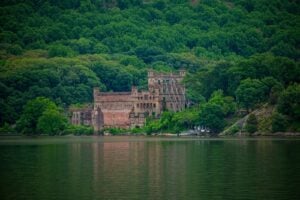
Bannerman Castle on Pollepel Island in the Hudson River. Photo: capt.efird / Shutterstock
The Hudson Valley is steeped in an atmospheric, shadowy past unmatched by almost any other part of New York. Long before Washington Irving penned tales of headless horsemen galloping through Sleepy Hollow, this winding stretch of the Hudson River was a theater of colonial conflict, Revolutionary War intrigue, vanished hotels, old inns, fires, shipwrecks, and generations of local folklore.
Unlike modern theatrical haunted houses with mechanical jump scares, the places on this list are real historic locations. Their documented histories can be separated from their ghost stories, which come from literary tradition, local folklore, staff and visitor accounts, paranormal investigations, and seasonal historical programs. Whether or not you believe in ghosts, these are ten historic Hudson Valley locations with enduring supernatural reputations that the public can legally visit through regular hours, tours, reservations, or public trails.
1. Sleepy Hollow Cemetery & the Old Dutch Church (Sleepy Hollow, Westchester County)
- The History: Frederick Philipse had the Old Dutch Church constructed around 1685 along the Pocantico River. The neighboring Sleepy Hollow Cemetery was established in 1849 and today covers roughly 90 acres. Washington Irving is buried there, along with Andrew Carnegie, William Rockefeller, and many other notable figures.
- The Lore: Washington Irving drew heavily from the landscape, customs, and stories of Sleepy Hollow when writing “The Legend of Sleepy Hollow.” The Headless Horseman became forever associated with the Old Dutch Church and its burying ground, although the tale is literature and folklore rather than a documented account of a specific Hessian grave.
- The Phenomena: Stories of phantom hoofbeats, shadowy figures, and Revolutionary-era spirits have become part of Sleepy Hollow’s ghost tradition. The atmosphere is especially powerful after dark, when the cemetery conducts its official lantern tours.
- Visiting: Sleepy Hollow Cemetery is open to individual visitors daily during posted hours. Guided daytime tours and evening lantern tours are offered, with an expanded schedule during the fall.
2. The Historic Shanley Hotel (Napanoch, Ulster County)
- The History: The present-day Shanley Hotel was rebuilt in 1895 after an earlier hotel on the site burned. James Louis Shanley purchased the property in 1906 and expanded it with a bowling alley, billiard room, barbershop, and additional rooms. The hotel’s history includes Prohibition-era activity and several genuine family tragedies.
- The Lore: James and Beatrice Shanley lost three infant children. Another tragedy involved Jeanette Roseanne “Rosie” Greger, the 3-year-old daughter of the hotel barber, who drowned in a well across the road in 1911. These events became intertwined over time with the building’s extensive ghost lore.
- The Phenomena: Visitors and investigators have reported footsteps, unexplained voices, piano music, cold spots, scents of perfume and tobacco, and the sound of children. The hotel openly embraces its paranormal reputation and has become one of New York’s best-known destinations for ghost investigations.
- Visiting: The Shanley offers public day tours, overnight paranormal investigations, and other ghost-themed events by reservation.
3. Bannerman Castle on Pollepel Island (Beacon, Dutchess County)
- The History: Military surplus dealer Francis Bannerman VI developed Pollepel Island as an arsenal and storage complex beginning in 1900. The castle-like structures were built between 1900 and 1918, creating one of the Hudson River’s most recognizable ruins.
- The Lore: Bannerman Castle’s own preservation organization acknowledges supernatural stories associated with the island. Dutch sailors told stories of the “Heer of Dunderberg,” a goblin-like figure connected to storms and dangerous conditions in the Hudson Highlands. A later island story tells of an old sea captain haunting the lodge.
- The Phenomena: Bannerman’s reputation comes less from one famous apparition than from centuries of river folklore layered over the isolated arsenal ruins, fires, explosions, and abandoned structures.
- Visiting: The Bannerman Castle Trust operates public cruise-and-walking tours from Beacon. Advance reservations are required, and visitors should be prepared for uneven terrain and stairs.
4. Historic Huguenot Street (New Paltz, Ulster County)
- The History: Historic Huguenot Street is a 10-acre National Historic Landmark District preserving more than 300 years of New Paltz history. Its early 18th-century stone houses tell the stories of Huguenot and Dutch settlers as well as Indigenous people, enslaved people, and later generations who lived in the community.
- The Lore: The organization has incorporated ghost stories into its interpretation for years. Earlier Haunted Huguenot Street programs drew directly from local legends, historical records, family stories, and what the organization described as decades of reported paranormal experiences.
- The Phenomena: The Deyo House has been a particular focus of the site’s paranormal lore, including stories associated with Gertrude Deyo and unexplained activity inside the historic home.
- Visiting: Historic Huguenot Street offers guided museum tours during its regular season, with special evening and autumn programming offered on selected dates.
5. The Beekman Arms (Rhinebeck, Dutchess County)
- The History: The property traces its tavern history to William Traphagen’s establishment in 1704. The Beekman Arms was added in 1766 and has operated ever since. During the Revolutionary era, Continental troops drilled on the property, and the inn has hosted generations of prominent travelers and political figures.
- The Lore: With centuries of continuous activity inside its timber-and-stone walls, the Beekman Arms has naturally accumulated ghost stories. Reports often center on the old tavern rooms, stairways, and guest accommodations.
- The Phenomena: Accounts collected by paranormal-history researchers include footsteps in empty hallways, unexplained cold spots, flickering lights, and the apparition of a man near the original tavern fireplace. These remain reported experiences, not documented historical facts.
- Visiting: The Beekman Arms remains a functioning hotel and tavern in Rhinebeck, open to the public for lodging, dining, and drinks.
6. The Bird & Bottle Inn (Garrison, Putnam County)
- The History: Established in 1761 on the Old Albany Post Road, the Bird & Bottle began as Warren’s Tavern, a stagecoach stop between New York City and Albany. During the Revolutionary War, it became a gathering place for soldiers and was eventually used by the Continental Army as a regional headquarters.
- The Lore: A recurring ghost story centers on a female presence often called “Emily.” The name has been connected in later retellings to the Warren family, although the exact historical identity behind the legend is uncertain.
- The Phenomena: Stories associated with the inn include a hazy female figure, soft singing or humming after hours, and objects or curtains appearing to have been moved when rooms were empty.
- Visiting: The restored Bird & Bottle operates as a restaurant, inn, and event property. The restaurant is generally open Wednesday through Sunday, and overnight rooms are available by reservation.
7. Tarrytown Music Hall (Tarrytown, Westchester County)
- The History: Built in 1885 during the Hudson Valley’s Gilded Age, Tarrytown Music Hall has hosted concerts, public gatherings, political speeches, women’s suffrage events, films, and live theater for well over a century.
- The Lore: Staff members and performers have long shared stories of unexplained activity in the historic theater, from lights switching back on after closing to voices and a mysterious presence in backstage areas.
- The Phenomena: The Music Hall is an official stop on New York State’s Haunted History Trail. The Gotham Paranormal Research Society has investigated the building several times, and the theater says those investigations produced unusual EVP audio and EMF readings.
- Visiting: The theater operates year-round for public performances. It also offers official ghost tours on selected dates, including special tours during October.
8. Clermont State Historic Site (Germantown, Columbia County)
- The History: Clermont was the Hudson River estate of the Livingston family. The original mansion was built around 1740 and was burned by British forces in 1777 because of the family’s support for the American cause. Margaret Beekman Livingston oversaw the rebuilding of the estate during the Revolutionary period.
- The Lore: Clermont openly incorporates its ghost stories into seasonal interpretation. Its recurring “Legends by Candlelight” program sends visitors through the historic mansion and grounds while stories connected to generations of people who lived and worked there are told after dark.
- The Phenomena: Former site director Susan Boudreau has described an unexplained sudden temperature drop inside the mansion and the sound of footsteps climbing the stairs while she was alone in the building.
- Visiting: Clermont’s mansion is open for guided tours year-round Thursday through Sunday, while its gardens and grounds are open daily. Special candlelight ghost programs are offered on selected October dates.
9. Old Dutch Church Cemetery (Kingston, Ulster County)
- The History: Kingston’s Old Dutch Church congregation dates to the 17th century, and its historic burying ground contains the graves of generations of local residents, including Revolutionary-era figures and George Clinton, New York’s first governor. The surrounding Stockade District was at the center of Kingston when British troops burned the city in 1777.
- The Lore: The cemetery has accumulated ghost stories connected to Kingston’s colonial and Revolutionary past. Its long history, old gravestones, and proximity to the surviving streets of the Stockade have made it one of the city’s natural centers for haunted-history storytelling.
- The Phenomena: Local traditions include stories of apparitions and other unexplained encounters in and around the churchyard. The site’s haunted reputation is interpreted through historical storytelling rather than presented as proven fact.
- Visiting: The cemetery can be visited during appropriate daytime hours, and candlelit haunted-history tours are traditionally offered on selected dates in October.
10. Overlook Mountain House Ruins (Woodstock, Ulster County)
- The History: The ruins on Overlook Mountain are the remains of an ambitious 20th-century attempt to rebuild a grand Catskills resort hotel on a site where earlier mountain houses had stood. The unfinished concrete shell was abandoned and gradually became one of the region’s most striking ruins.
- The Lore: The isolated hotel ruins have attracted ghost stories and dark folklore for decades. Hudson Valley tourism sources regularly include Overlook Mountain among the region’s haunted hikes, combining the remains of the old hotel with the mountain’s secluded setting.
- The Phenomena: Much of the “haunting” here is atmosphere and folklore rather than a single documented apparition. The roofless walls, empty window openings, old carriage road, and surrounding forest have nevertheless made the ruins one of the Hudson Valley’s most memorable eerie historic sites.
- Visiting: The ruins are reached by the public Overlook Mountain trail near Woodstock. New York State advises visitors to observe the ruins from the outside for safety and to remain on the designated trail.
Hudson Valley Haunted Sites Field Guide
| Historic Site | Town & County | Primary Historical Era | Best Season / Access Type |
|---|---|---|---|
| Sleepy Hollow Cemetery & Old Dutch Church | Sleepy Hollow (Westchester) | Colonial / Revolutionary Era | Daily cemetery access; fall lantern tours |
| The Shanley Hotel | Napanoch (Ulster) | Late 19th Century / Prohibition Era | Day tours and overnight ghost hunts by reservation |
| Bannerman Castle | Beacon / Pollepel Island (Dutchess) | Early 20th-Century Arsenal | Seasonal cruise-and-walking tours from Beacon |
| Historic Huguenot Street | New Paltz (Ulster) | Colonial Settlement | Regular museum tours; seasonal evening programs |
| The Beekman Arms | Rhinebeck (Dutchess) | Colonial / Revolutionary Era | Year-round dining and lodging |
| The Bird & Bottle Inn | Garrison (Putnam) | Colonial / Revolutionary Era | Restaurant and overnight lodging |
| Tarrytown Music Hall | Tarrytown (Westchester) | Gilded Age / 1885 | Year-round performances; selected ghost tours |
| Clermont State Historic Site | Germantown (Columbia) | Colonial / Revolutionary Era | Year-round house tours; October candlelight events |
| Old Dutch Church Cemetery | Kingston (Ulster) | Colonial / Revolutionary Era | Daytime visits; selected October haunted-history tours |
| Overlook Mountain House Ruins | Woodstock (Ulster) | 19th- and 20th-Century Resort Era | Public hiking trail; observe ruins from outside |
For more eerie New York history, read our history of the Shanley Hotel, history and ghost stories of the Smalley Inn, 10 Famous New York City Ghost Stories and Haunted Places, and 10 Unsolved New York City Mysteries That Still Haunt Us.
Sources
- Village of Sleepy Hollow — History of the Village
- Sleepy Hollow Cemetery — Walking Tours
- The Haunted Shanley Hotel — History
- The Haunted Shanley Hotel — Public Ghost Hunts
- Bannerman Castle Trust — FAQ and Island Lore
- Bannerman Castle Trust — Island Cruise & Walking Tour
- Historic Huguenot Street — Visit
- Historic Huguenot Street — Haunted Huguenot Street
- Beekman Arms & Delamater Inn — History
- The Bird & Bottle Inn — History
- Tarrytown Music Hall — Ghost Tours of the Music Hall
- New York State Parks — Clermont State Historic Site
- Friends of Clermont — Legends by Candlelight
- Haunted History Trail of New York State — Old Dutch Church Cemetery
- New York State Department of Environmental Conservation — Overlook Mountain Wild Forest
- Hudson Valley Tourism — Haunted Hikes
Updated September 24, 2026.