Feature Photo: nito / Shutterstock.com
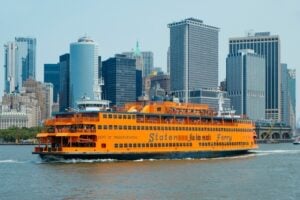
There are few sights in New York Harbor more familiar than the big orange boats of the Staten Island Ferry. On any given morning, thousands of Staten Islanders board them on their way to work in Manhattan. Alongside the commuters are visitors from around the world, many of whom are about to get their first good look at the Statue of Liberty. Few forms of public transportation in New York offer such spectacular scenery, and even fewer allow you to enjoy it without spending a penny.
The history of the Staten Island Ferry stretches back centuries. Its earliest predecessors carried passengers across the harbor in sailing boats during the colonial era. Steam ferry service began in 1817, and New York City took over the principal route between Staten Island and Manhattan in 1905. Along the way, the ferry helped launch the career of Cornelius Vanderbilt, survived the disappearance of many other New York ferry routes, and became one of the city’s most recognizable institutions.
Early Ferry Service Between Staten Island and Manhattan
Long before steam engines arrived in New York Harbor, Staten Island residents depended on privately operated boats to transport people and goods to Manhattan. A 2004 report prepared for the New York City Council traces ferry service to as early as 1650 and regular service to 1745. During the 18th century, shallow-draft sailing vessels known as periaugers were commonly used in the harbor. Crossing the bay in one of these boats was a very different experience from traveling aboard a modern ferry, particularly when the weather turned bad.
In 1810, a 16-year-old Staten Island resident named Cornelius Vanderbilt entered the ferry business. According to his biography in American National Biography, his parents lent him $100 to acquire a small sailing boat. He transported passengers and freight between Staten Island and Manhattan, earning money and gaining the experience that would eventually help him build one of the greatest transportation fortunes in American history. Although Vanderbilt did not establish the first Staten Island ferry, his association with the route is an important part of its story.
The Arrival of Steam Power in 1817
Daniel D. Tompkins, who served as governor of New York and later as vice president of the United States, became involved in the development of Staten Island’s northeastern shore. His Richmond Turnpike Company obtained the right to operate a ferry to Manhattan as well as to construct a road across the island. In 1817, the company introduced the Nautilus, the first steam-powered ferry to serve the route. Its captain was John De Forest, Vanderbilt’s brother-in-law.
Steam propulsion reduced the ferry’s dependence on favorable winds and made more regular service possible. Vanderbilt acquired the Richmond Turnpike Company in 1838, by which time his interests in the steamboat business extended well beyond Staten Island. The ferry service became increasingly important as communities developed along the island’s shore. The opening of the Staten Island Railroad in 1860 brought additional passengers to the waterfront and made it possible for residents farther south to reach Manhattan by a combination of train and ferry.
The Westfield Disaster of 1871
Despite the technological improvements brought by steam power, the 19th-century ferries could be dangerous. On July 30, 1871, the boiler of the ferryboat Westfield exploded at its Manhattan slip near Whitehall Street. The vessel was crowded with Sunday passengers, many of whom were heading to Staten Island for an excursion. The explosion tore through the boat and sent people into the water. Dozens were killed, and many more were injured.
Newspapers across the country reported the tragedy. Contemporary accounts and later histories differ on the final death toll, but there is no question that the explosion was among the worst disasters in the ferry’s history. It demonstrated the terrible consequences of a boiler failure on a crowded passenger vessel.
The Municipal Takeover of 1905
By the late 19th century, the Staten Island ferries had become part of a transportation network associated with the Baltimore and Ohio Railroad and the Staten Island Rapid Transit Railroad. The consolidation of New York City in 1898 brought Staten Island into the newly expanded municipality, giving its residents a stronger claim to public transportation comparable to that available in the other boroughs.
Another serious accident occurred on June 14, 1901, when the Staten Island ferryboat Northfield collided with the Central Railroad of New Jersey ferry Mauch Chunk near Whitehall. The Northfield sank, and five passengers were reported missing. The rapid response of the crews prevented a much greater loss of life. The collision intensified demands for the city to assume responsibility for the service.
In 1905, New York City acquired the St. George-to-Whitehall route from Staten Island Rapid Transit. The Department of Docks and Ferries introduced a fleet of five boats named for the city’s five boroughs: Manhattan, Brooklyn, Bronx, Queens, and Richmond. For Staten Islanders, municipal ownership marked a turning point in the history of their daily transportation. The New York City Municipal Archives preserves photographs of the early city-operated ferries and their terminals.
Why Did the Staten Island Ferry Survive?
During the first decades of the 20th century, ferries were everywhere in New York Harbor. They connected railroad terminals, industrial waterfronts, and neighborhoods on opposite sides of the rivers and bay. The opening of bridges, tunnels, and subway lines gradually made many of those crossings redundant. By the middle of the century, the Staten Island Ferry was the last surviving route of the original municipal ferry network.
The opening of the Verrazano-Narrows Bridge in 1964 gave Staten Island a direct road connection to Brooklyn, but it did not create a direct route to Lower Manhattan. For residents working in the financial district, the ferry remained a convenient alternative to traveling through Brooklyn. At St. George, passengers could transfer between ferries, buses, and the Staten Island Railway. This connection helped preserve the ferry’s importance long after many other historic services had disappeared.
Why Are the Staten Island Ferry Boats Orange?
The boats were not always orange. Early municipal ferries were painted white. In 1926, the city switched to a maroon color, later adopting the distinctive orange paint that became the fleet’s trademark. The change had a practical purpose: brighter vessels were easier to see in the fog and snow that could reduce visibility in New York Harbor. Today, the orange boats stand out against the water and the Manhattan skyline.
When Did the Staten Island Ferry Become Free?
For much of the 20th century, the Staten Island Ferry was one of New York’s great transportation bargains. A five-cent fare introduced in 1897 remained in place until 1972. The price then rose to ten cents, followed by a 25-cent fare in 1975 and a 50-cent fare in 1990.
On July 4, 1997, New York City eliminated the passenger fare as part of Mayor Rudy Giuliani’s One City, One Fare initiative. Staten Island commuters often had to pay for another form of transportation in addition to the ferry, and eliminating its fare reduced the cost of their daily trips. The city’s 1997 management report estimated that regular ferry commuters would save $120 a year.
The change also made the crossing an especially attractive outing for visitors. The ferry travels past Governors Island and offers views of the Statue of Liberty and Ellis Island. Unlike a sightseeing cruise, however, it is primarily a public transportation service and does not stop at Liberty Island.
The 2003 Ferry Disaster and Safety Reforms
On October 15, 2003, the ferryboat Andrew J. Barberi struck a maintenance pier at the Staten Island terminal near the end of its trip from Manhattan. Ten passengers died, and approximately 70 were injured. An eleventh passenger subsequently died from injuries sustained in the accident.
The National Transportation Safety Board’s investigation found that the assistant captain had become incapacitated and that failures in the city’s operating procedures and oversight contributed to the collision. The disaster led to renewed attention to wheelhouse staffing, crew responsibilities, and safety management. It remains a somber chapter in the history of a service that millions of New Yorkers depend upon.
The Staten Island Ferry Today
The ferry’s terminals have undergone major changes in the 21st century. The Whitehall Terminal in Manhattan was rebuilt following a 1991 fire, while the St. George Terminal underwent extensive modernization. Both projects were completed in 2005. The new facilities provided larger waiting areas and improved connections to other forms of transportation. The ferry once carried automobiles, but that service ended following the September 11, 2001, terrorist attacks.
New boats have also joined the fleet. The first two vessels of the Ollis class, Staff Sergeant Michael H. Ollis and Sandy Ground, began carrying passengers in 2022. The Dorothy Day followed in 2023. Each name has a connection to Staten Island history. Ollis was a soldier from New Dorp who died saving another soldier in Afghanistan. Sandy Ground commemorates one of the island’s historic free Black communities, while Dorothy Day honors the Catholic Worker movement’s co-founder, who lived and worked on the island.
The New York City Department of Transportation reports that the ferry serves more than 16 million passengers annually. Its 5.2-mile route connects Whitehall Terminal in Lower Manhattan with St. George Terminal on Staten Island, and the crossing takes approximately 25 minutes. Boats operate around the clock throughout the year, with more frequent departures during weekday rush hours. Passengers can consult the official Staten Island Ferry schedule before traveling.
New York has changed dramatically since the days when a young Cornelius Vanderbilt carried passengers across the harbor in a sailboat. The skyline has been rebuilt many times, the harbor’s great passenger liners have largely disappeared, and many of the waterfront’s industrial facilities have given way to parks and residential buildings. Through all those changes, the Staten Island Ferry has continued to carry people between the two islands. It remains one of the most enjoyable ways to experience the city and one of the few New York institutions that can still be enjoyed for free.
For more New York transportation history, explore our articles on 10 Lost New York Transit Lines, Terminals & Ferries That Built the City, How Staten Island Neighborhoods Got Their Names, the Outerbridge Crossing and Goethals Bridges, and 10 Secret Islands in New York City Waters You Probably Never Heard Of.