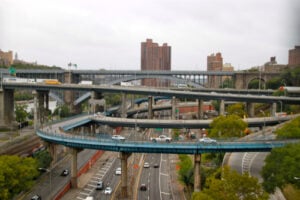

Aerial view of the George Washington Bridge crossing the Hudson River between New York and New Jersey at sunset. Photo: Terelyuk / Shutterstock.com
New York and New Jersey are connected by some of the busiest bridges, tunnels, highways, rail lines, and ferry routes in the country. Around New York City, the Hudson River and the waterways surrounding Staten Island create the most familiar crossings. Farther north, the state line becomes a land boundary running through Rockland and Orange counties toward the tri-state area near Port Jervis.
This guide focuses on the major public crossings between New York and New Jersey rather than every local street that happens to cross the state line. For drivers, one of the most important distinctions is whether a crossing is operated by the Port Authority of New York and New Jersey or is simply a toll-free highway at the state line.
Travel note: Toll rates, lane restrictions, construction schedules, and transit fares can change. Drivers and transit riders should check the appropriate transportation agency before traveling.
Port Authority Tolls Between New Jersey and New York
The George Washington Bridge, Lincoln Tunnel, Holland Tunnel, Bayonne Bridge, Goethals Bridge, and Outerbridge Crossing are operated by the Port Authority of New York and New Jersey. All six use cashless tolling, and tolls are collected only when traveling into New York. There is no Port Authority toll when traveling from New York into New Jersey.
As of 2026, the standard passenger-car toll for a properly read E-ZPass issued through a New York or New Jersey E-ZPass Customer Service Center is $16.79 during peak hours and $14.79 during off-peak hours. The Tolls by Mail rate is $23.30. Peak periods are weekdays from 6:00 a.m. to 10:00 a.m. and 4:00 p.m. to 8:00 p.m., and weekends from 11:00 a.m. to 9:00 p.m. Because rates are adjusted periodically, travelers should confirm current pricing before relying on these figures.
How E-ZPass and Tolls by Mail Work
There are no cash tollbooths at the six Port Authority crossings. Drivers with a properly mounted E-ZPass simply pass beneath the overhead tolling equipment, which reads the transponder and charges the toll to the account. Drivers without E-ZPass do not have to stop or pull over to pay. They continue through the crossing normally, cameras photograph the vehicle’s license plate, and a Tolls by Mail bill is sent to the registered owner of the vehicle.
The price difference can be significant. New York and New Jersey E-ZPass customers receive the Port Authority’s discounted E-ZPass rates when their tags are read properly, while drivers using Tolls by Mail pay the higher full rate. The Port Authority also uses a mid-tier toll for New York and New Jersey E-ZPass customers whose transponder is not read correctly and whose transaction must instead be matched through the vehicle’s license plate. That rate is higher than the normal E-ZPass rate because additional processing is required.
Another detail that can surprise travelers is that owning an E-ZPass does not automatically guarantee the same discount at every Port Authority crossing. E-ZPass is accepted across a multistate network, but the Port Authority states that its discounted E-ZPass toll rates apply only to accounts issued through the New York or New Jersey E-ZPass Customer Service Centers. A driver using an E-ZPass issued by another participating state can still use the electronic tolling system, but should not assume that the lower New York/New Jersey Port Authority discount will apply. Drivers should also make sure that their transponder is mounted correctly, their license plate is listed accurately on the account, and the account is properly funded.
Drivers entering Manhattan through the Lincoln or Holland tunnels should also remember that the Port Authority toll and New York City’s Congestion Relief Zone toll are separate charges. Vehicles entering the Manhattan congestion zone may be subject to an additional MTA toll, although eligible E-ZPass vehicles entering through the Lincoln and Holland tunnels can receive a crossing credit during peak periods.
George Washington Bridge — Fort Lee to Upper Manhattan
The George Washington Bridge connects Fort Lee, New Jersey, with Washington Heights in Upper Manhattan and carries Interstate 95 along with U.S. Routes 1 and 9. The Port Authority describes it as the busiest bridge in the world. Its two levels provide fourteen traffic lanes, with eight on the upper level and six on the lower level. Commercial trucks must use the upper level.
The bridge also provides a route across the Hudson for pedestrians and bicyclists. The rebuilt North Walk opened in 2023 with accessible ramps and viewing areas. Work on the South Walk has continued as part of the larger rehabilitation program, with completion scheduled for late 2026. For the deeper story behind the bridge itself, see our History of the George Washington Bridge.
Lincoln Tunnel — Weehawken to Midtown Manhattan
The Lincoln Tunnel connects Weehawken, New Jersey, with Midtown Manhattan through three vehicular tubes beneath the Hudson River. The first tube opened in 1937, the second followed in 1945, and the third opened in 1957. The crossing is one of the principal routes used by cars, buses, and commercial vehicles traveling into Midtown.
The center tube is also associated with the Exclusive Bus Lane used by New Jersey commuter buses traveling into Manhattan during the weekday morning rush. Trucks are prohibited from the center tube, although permitted commercial vehicles may use the other tubes subject to Port Authority size and cargo restrictions. Propane is prohibited through the Lincoln Tunnel.
Holland Tunnel — Jersey City to Lower Manhattan
The Holland Tunnel connects Jersey City with Lower Manhattan and opened in 1927. It became the first mechanically ventilated underwater vehicular tunnel in the world, an engineering breakthrough made necessary by the exhaust generated inside its long enclosed tubes.
The Holland Tunnel is not limited to passenger cars. The Port Authority permits two- and three-axle single-unit trucks. Tractor-trailers, three-axle dual-unit trucks, vehicles with four or more axles, and prohibited hazardous materials are not allowed. The tunnel has a height limit of 12 feet 6 inches, so larger commercial vehicles should use another crossing.
Goethals Bridge — Elizabeth to Staten Island
The Goethals Bridge carries Interstate 278 across the Arthur Kill between Elizabeth, New Jersey, and Staten Island. The original 1928 cantilever bridge was replaced by the current twin cable-stayed spans. The first new span opened in 2017, and the completed six-lane crossing opened in 2018 with three 12-foot lanes in each direction, shoulders, and a shared-use path for pedestrians and bicyclists.
The Goethals is an important commercial route because it links the New Jersey Turnpike area with Staten Island, the Verrazzano-Narrows Bridge, and Brooklyn. We have a separate article on the history of Staten Island’s Outerbridge Crossing and Goethals Bridge.
Bayonne Bridge — Bayonne to Staten Island
The Bayonne Bridge crosses the Kill Van Kull between Bayonne, New Jersey, and Port Richmond on Staten Island. Trucks are permitted on the bridge, subject to Port Authority size and hazardous-material regulations. Pedestrians and bicyclists may also use the designated bridge pathway.
One of the bridge’s most unusual chapters came when the Port Authority raised the roadway within the existing steel arch. The new roadway opened in 2017 at 215 feet above the water, 64 feet higher than the original deck, allowing much larger container ships to reach the ports of Newark and Elizabeth. Our separate History of the Bayonne Bridge looks at the structure in greater detail.
Outerbridge Crossing — Perth Amboy to Staten Island
The Outerbridge Crossing connects Perth Amboy, New Jersey, with Tottenville on Staten Island across the Arthur Kill. Opened in 1928, the bridge was named for Eugenius H. Outerbridge, the first chairman of the Port of New York Authority. It carries Route 440 and handles passenger vehicles, buses, and commercial freight.
The Outerbridge is especially useful for travelers moving between southern Staten Island and central or southern New Jersey. Unlike the George Washington, Bayonne, and Goethals bridges, the Outerbridge does not have a pedestrian or bicycle pathway.
Toll-Free Land Crossings Between New York and New Jersey
North of the Hudson River crossings, New York and New Jersey share a land boundary through Rockland and Orange counties. These crossings do not have state-line tolls, although a traveler may encounter tolls elsewhere on a connecting highway.
I-287 — Suffern, New York to Mahwah, New Jersey
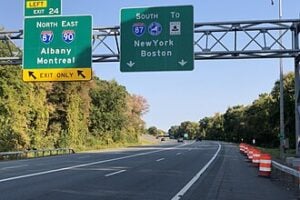
Interstate 287 is the principal high-speed highway crossing between Rockland County and northern New Jersey. Near Suffern, the New York State Thruway carries both I-87 and I-287, but this is an important distinction: I-287 continues across the state line into New Jersey while I-87 turns north and remains in New York. The interchange also connects with New Jersey Route 17, making this one of the busiest overland gateways between the two states.
U.S. Route 202 — Suffern to Mahwah
U.S. Route 202 provides a slower local alternative between Suffern and Mahwah. The road crosses the state line on the west side of Suffern and continues through northern New Jersey toward Oakland, Wayne, and points farther south. It is useful for local traffic but should not be confused with I-287, which carries most interstate through traffic in this area.
Palisades Interstate Parkway
The Palisades Interstate Parkway crosses the New York–New Jersey state line between Rockland County and Bergen County while following the Hudson River Palisades. The parkway is toll-free and provides one of the most scenic driving routes between the two states. Commercial vehicles are prohibited, making it primarily a passenger-car and motorcycle route.
U.S. Route 9W — Rockland County to Bergen County
U.S. Route 9W crosses the state line between the Palisades area of Rockland County and Alpine in Bergen County. It serves local communities along the Hudson and provides an alternative to the Palisades Interstate Parkway for vehicles that cannot use the parkway, including local commercial traffic.
New York Route 94 / New Jersey Route 94 — Warwick to Vernon
Route 94 crosses directly from Warwick, New York, into northern New Jersey and continues toward Vernon. This is one of the principal rural crossings between Orange County and Sussex County. It is heavily used by local residents and by travelers headed toward the Warwick Valley, Vernon, Mountain Creek, and the surrounding recreation areas.
New York Route 210 / New Jersey County Route 511 — Greenwood Lake
New York Route 210 reaches the New Jersey state line near Greenwood Lake, where the roadway continues into New Jersey as County Route 511. This crossing connects the village of Greenwood Lake with West Milford and provides an important local route through the lake and mountain communities on both sides of the border.
New York Route 284 / New Jersey Route 284 — Unionville
New York Route 284 crosses the state line at Unionville in Orange County and continues south as New Jersey Route 284 into Sussex County. This is a quieter rural crossing than Route 94, but it is a direct state-highway connection between the two states. New York State has also been planning pavement, drainage, resiliency, and safety work along Route 284 near the state line.
New Jersey Route 23 and the Port Jervis State Line
Near Port Jervis, New Jersey Route 23 reaches the New York state line in Montague Township. The roadway continues a short distance into Orange County as County Route 15 before connecting with U.S. Route 6 and the nearby I-84 interchange.
This area causes some confusion because the New York, New Jersey, and Pennsylvania borders come together within a very small area. Interstate 84 does not cross New Jersey. It crosses directly between New York and Pennsylvania just north of New Jersey’s northern tip. The Tri-States Monument near Port Jervis marks the meeting point of the three states, but it should not be described as an I-84 New York–New Jersey crossing.
PATH Trains Between New Jersey and New York
PATH provides one of the most heavily used rail connections between New Jersey and Manhattan. Trains serve Newark, Harrison, Journal Square, Grove Street, Exchange Place, Newport, and Hoboken in New Jersey, with New York stations at the World Trade Center and along the line to 33rd Street.
The standard PATH fare increased to $3.25 on May 3, 2026. Another important change took effect on September 1, 2026: MetroCards and SmartLink cards are no longer accepted on PATH. Riders now use TAPP, the system’s contactless payment method, at the turnstiles.
Amtrak and NJ Transit Through the North River Tunnels
Amtrak and NJ Transit trains cross beneath the Hudson River through the North River Tunnels into New York Penn Station. The twin single-track tubes were completed by the Pennsylvania Railroad in 1910 and remain the only passenger-rail connection between Manhattan, New Jersey, and the Northeast Corridor to the south and west.
The Gateway Program is building a new Hudson River rail tunnel and planning the rehabilitation of the existing North River Tunnel. The project is intended to improve reliability and eventually provide four mainline tracks between New Jersey and New York Penn Station instead of the two tracks available today.
NY Waterway Ferries Across the Hudson
Passenger ferries provide another way to cross between New Jersey and Manhattan without using the bridges, tunnels, or rail system. NY Waterway operates routes from terminals including Port Imperial in Weehawken, Hoboken, Paulus Hook in Jersey City, Edgewater, and other New Jersey locations to Midtown, Brookfield Place, and Pier 11/Wall Street.
Fares vary substantially by route and can also be affected by fuel surcharges, so it is better to check the current fare for a specific terminal pair rather than rely on one general price. Ferries are especially useful when highway traffic or rail disruptions make the Hudson crossings difficult.
For more on the crossings and transportation systems mentioned here, read our History of the George Washington Bridge, History of the Bayonne Bridge, History of Staten Island’s Outerbridge Crossing and Goethals Bridges, The Story of E-ZPass in New York and How to Sign Up, and How to Get Around NYC.
Sources
Port Authority of New York and New Jersey — Bridge and Tunnel Tolls
Port Authority of New York and New Jersey — 2026 Truckers’ Guide and Crossing Restrictions
Port Authority of New York and New Jersey — Cashless Tolling and Tolls by Mail Guide
Port Authority of New York and New Jersey — George Washington Bridge
Port Authority of New York and New Jersey — PATH Service Information
Port Authority of New York and New Jersey — PATH Fare Changes Effective May 3, 2026
Metropolitan Transportation Authority — Congestion Relief Zone Toll Information
Amtrak — Hudson Tunnel Project
New York State Department of Transportation — Route 284 State-Line Project
NY Waterway — Ferry Routes, Schedules, and Fares