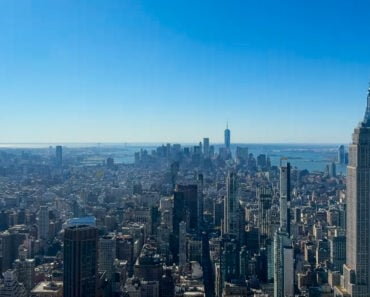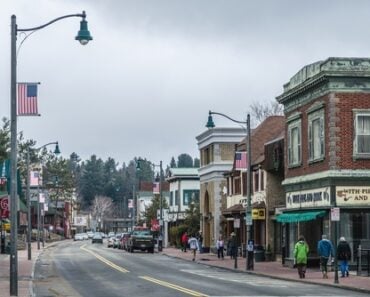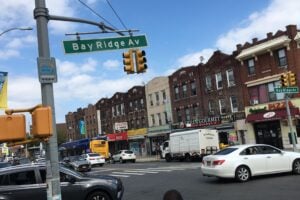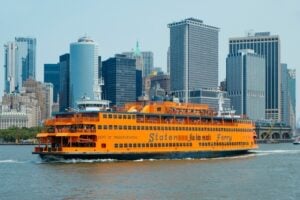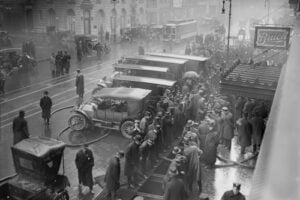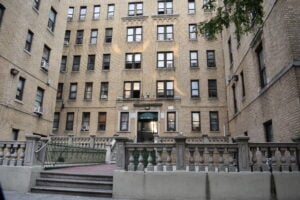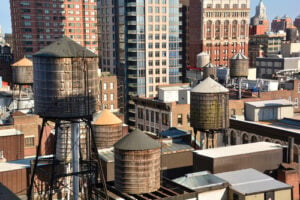
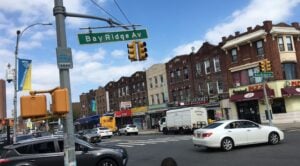
A view of Bay Ridge Avenue in Brooklyn, New York, a neighborhood that has been home to generations of notable New Yorkers. Photo by Brian Kachejian / ClassicNewYorkHistory.com.
There is something about Bay Ridge that has always made it feel like a small town tucked inside a very large city. Its streets slope toward the Narrows, its shopping avenues have long been meeting places for neighbors, and its blocks contain generations of family histories. From the homes around Shore Road to the busy commercial stretches of Third and Fifth Avenues, this corner of southwestern Brooklyn has held on to an identity that New Yorkers recognize immediately.
For much of the twentieth century, Bay Ridge was associated with Norwegian, Irish, Italian and other immigrant families who built their lives around its churches, schools, stores and waterfront. Later generations brought still more languages and traditions, including flourishing Arab and Middle Eastern communities. The neighborhood that appeared on movie screens in Saturday Night Fever was only one version of a place whose actual history is considerably richer.
What is especially striking is how many very different careers have begun here. A girl who attended P.S. 102 would eventually run the Federal Reserve and the United States Treasury. A young man raised among neighborhood movie theaters would become the star of a classic television Western. A teenage jewelry seller would build a major fashion label. Another Bay Ridge student would help give the world one of television’s funniest robots. These are not variations of the same story. They are examples of just how many paths can begin on the same Brooklyn streets.
For this collection, we have looked for a genuine Bay Ridge connection through birth, childhood, upbringing or education, rather than including someone merely because they lived here after becoming famous or represented the neighborhood in public office. A few people were born in Bay Ridge and moved away very young; others spent formative years here after being born somewhere else. Those distinctions matter, and they are explained in the biographies below. Here are 25 famous people whose lives have a documented connection to Bay Ridge, Brooklyn.
1. Jimmy Fallon
Jimmy Fallon was born in Bay Ridge, Brooklyn, in September 1974. His family’s time in the neighborhood was brief: his father, who had worked around Brooklyn and was a singer in local doo-wop groups as a young man, found employment with IBM farther north. In 1975, the Fallons moved to Saugerties in the Hudson Valley, where Jimmy and his sister spent most of their childhoods.
In Saugerties, Fallon developed a fascination with comedy and music, recording television programs and practicing impressions. He pursued comedy after college and reached a national audience when he joined Saturday Night Live in 1998. His impressions, musical performances and sketches helped make him one of the show’s defining cast members of that period.
Fallon took over Late Night in 2009 and became host of The Tonight Show in 2014, bringing the program back to New York. His Bay Ridge connection is one of birth and family beginnings, not a claim that he spent his school years in the neighborhood. His story also connects Brooklyn to the Upstate New York community where his career interests developed.
2. Janet Yellen
Janet Yellen was born in Bay Ridge in 1946 and grew up in a household where education and public life were important. Her father worked as a physician, and she attended P.S. 102 and Fort Hamilton High School. In an oral-history interview with the Federal Reserve, she recalled her own years in those Bay Ridge classrooms. She graduated from Fort Hamilton as valedictorian in 1963.
Yellen studied economics at Brown University before pursuing a doctorate at Yale. She developed an academic career as an economist, taught at the University of California, Berkeley, and served in government as chair of the Council of Economic Advisers. In 2014, she became the first woman to chair the Federal Reserve, guiding the central bank during the recovery that followed the financial crisis.
She made history again in 2021, becoming the first woman to serve as United States secretary of the Treasury, a position she held until 2025. She is also the first person to have led the Council of Economic Advisers, the Federal Reserve and the Treasury Department. Few graduates of a neighborhood public high school have gone on to hold such consequential positions in American economic policy.
3. Lorraine Bracco
Lorraine Bracco was born in Bay Ridge in 1954 and spent her early childhood in the neighborhood. Her family later moved to Long Island, where she attended school in Hicksville. She has spoken about the contrasts between the Brooklyn neighborhood she first knew and the Long Island community where she grew older, experiences that became part of her understanding of New York personalities.
Bracco went to France as a young woman and found work as a model before moving into acting. Her breakthrough American film role came as Karen Hill in Martin Scorsese’s Goodfellas, for which she received an Academy Award nomination. The character’s suburban Long Island background had a special resonance for an actress who had herself moved there from Brooklyn.
Another major role followed when she played psychiatrist Dr. Jennifer Melfi on HBO’s The Sopranos. Her scenes opposite James Gandolfini became a defining part of the series, exploring the psychology behind the violence and family loyalties of its central character. Bay Ridge was Bracco’s birthplace and earliest home, even though her adolescence belonged to Long Island.
4. Scott Baio
Scott Baio was born in the Bay Ridge section of Brooklyn in 1960, but his upbringing is more closely associated with neighboring Bensonhurst. He attended Xaverian High School in Bay Ridge, giving him an additional connection to the neighborhood. That distinction is worth making: a Brooklyn birthplace and a local school do not necessarily mean someone grew up on the same Bay Ridge block.
Baio began acting while still young and made his film debut as the title character in Alan Parker’s Bugsy Malone in 1976. Television soon brought much greater fame. As Chachi Arcola on Happy Days, he became a teen idol, and the role led to the spin-off Joanie Loves Chachi.
He subsequently starred in Charles in Charge, which became another familiar sitcom for viewers during the 1980s. He also worked as a television director and producer. Baio belongs in the Bay Ridge story through his documented birth and education, while his childhood home life is more accurately described in our companion feature about famous people from Bensonhurst.
5. Maria Bartiromo
Maria Bartiromo grew up in Dyker Heights and Bay Ridge, part of a family whose restaurant and catering business was a neighborhood institution. Her father operated Rex Manor, and as a girl she helped with work such as checking customers’ coats. In an interview presented by the Museum of the City of New York, Bartiromo described the family business and the expectations that came with it.
She attended Fontbonne Hall Academy and later earned a degree from New York University. Bartiromo entered financial journalism at a time when the New York Stock Exchange floor was overwhelmingly male. At CNBC, she became the first television reporter to broadcast live from the exchange floor, introducing a wide audience to the movement and personalities of Wall Street.
After many years at CNBC, she joined Fox Business Network and Fox News. Her broadcasting career has included interviews with business leaders, politicians and policymakers. For a journalist who became identified with the nation’s financial center, the path began in the family-run business world of southwestern Brooklyn.
6. Chuck Connors
Chuck Connors was born Kevin Joseph Connors in Bay Ridge in 1921. He grew up on Senator Street, between Third and Fourth Avenues, and attended Adelphi Academy. The future star of television Westerns was a gifted young athlete whose early years were shaped by neighborhood games and the opportunities available to a talented player in Brooklyn.
His professional athletic career was unusually varied. Connors played basketball for the Boston Celtics and baseball in the major leagues with the Brooklyn Dodgers and Chicago Cubs. Although he eventually became far better known as an actor, his experience in professional sports was substantial, and his physical presence helped him secure roles in Hollywood.
Connors became a television fixture playing Lucas McCain in The Rifleman, which ran from 1958 to 1963. The character was a widowed rancher raising his son in the American West, a world far removed from the streets around Senator Street. Yet the performer who made that role famous had learned his earliest lessons in competition and showmanship in Bay Ridge.
7. Henny Youngman
Henny Youngman came to Brooklyn with his family as an infant and grew up in Bay Ridge when the neighborhood included a large population of Irish and Norwegian families. He learned the violin and found ways to perform in local settings. In a 1961 interview with The New Yorker, he said plainly that Bay Ridge was the neighborhood where he had been brought up.
Youngman developed an act that combined violin playing with a rapid succession of jokes. His approach to comedy relied on timing and economy: a setup, a punch line and a quick move to the next subject. He worked in clubs and theaters and became particularly associated with the resort entertainment circuit in the Catskills.
His famous one-liner about his wife became part of American comedy folklore, but it was only one example of a performance style he sustained for decades. Youngman was a frequent guest on television variety shows and remained active well into old age. Behind the familiar tuxedo and violin was a comedian whose sense of rhythm had developed in the entertainment world surrounding Brooklyn.
8. Richard Bright
Richard Bright was born in Bay Ridge in 1937 into a family connected to the city’s working waterfront; his father was a shipbuilder. He entered acting during the era when New York theaters and independent film productions offered opportunities for performers capable of bringing an unmistakably urban presence to a role.
Bright appeared in The Panic in Needle Park and Sam Peckinpah’s The Getaway before taking on the part for which he is best remembered. As Al Neri, the quiet enforcer associated with Michael Corleone, he appeared in all three films of Francis Ford Coppola’s The Godfather trilogy. His character seldom needed dialogue to communicate danger.
His other credits included Marathon Man, Once Upon a Time in America and television appearances on The Sopranos. Bright maintained a career as a character actor rather than a conventional leading man. He died in 2006, leaving behind a body of work that made his face instantly recognizable to generations of crime-film viewers.
9. James Foley
Film director James Foley was born in Bay Ridge in December 1953, although his family later moved to Staten Island, where he grew up. After studying at the University at Buffalo, he pursued filmmaking at the University of Southern California. His birthplace connects him to Brooklyn, but his later childhood and education took place elsewhere.
Foley made his feature-film debut with Reckless in 1984 and followed it with At Close Range, starring Sean Penn and Christopher Walken. He also directed music videos for Madonna, including “Live to Tell” and “Papa Don’t Preach”, demonstrating an ability to work across feature films and the developing visual language of MTV.
His best-known films include the 1992 adaptation of David Mamet’s Glengarry Glen Ross, celebrated for its extraordinary ensemble cast and dialogue. Later work included episodes of House of Cards and two Fifty Shades sequels. Foley died in May 2025, after a career that began with the ambitions of a young New York filmmaker and eventually reached international audiences.
10. C.C. DeVille
Before becoming the guitarist of Poison, C.C. DeVille was Bruce Anthony Johannesson, a Brooklyn teenager who grew up in Bay Ridge. His education included P.S. 102, McKinley Junior High School and Fort Hamilton High School. He was part of a generation of young musicians who learned rock songs while the music changed from the hard rock of the 1970s to the glam-metal scene of the following decade.
DeVille eventually moved to Los Angeles, where he joined Poison. His guitar work helped define the group’s sound on songs including “Talk Dirty to Me”, “Nothin’ but a Good Time” and “Every Rose Has Its Thorn”. Poison became one of the era’s most visible arena-rock bands, its videos receiving constant exposure on MTV.
The band experienced personnel changes and personal conflicts, but DeVille remained inseparable from its best-known recordings and later reunions. His flamboyant stage image might seem far removed from his Brooklyn school days, yet his route to national rock fame began in a neighborhood with a surprisingly rich musical history.
11. Paul Jabara
Paul Jabara was born in Brooklyn in 1948 and grew up in Bay Ridge in a family of Lebanese heritage. He developed interests in acting, dance and music, performing at a young age before making his way into theatrical productions and the entertainment industry. His career eventually placed him at the center of one of the most influential periods in American dance music.
Jabara wrote “Last Dance”, the song sung by Donna Summer in the 1978 film Thank God It’s Friday. The recording won the Academy Award for Best Original Song. He also wrote with Bruce Roberts on “No More Tears (Enough Is Enough)”, the hugely successful duet recorded by Summer and Barbra Streisand.
Another of his enduring songs was “It’s Raining Men”, recorded by the Weather Girls and later embraced as a dance-floor anthem. He appeared as a performer as well as working behind the scenes, and he died in 1992. From Bay Ridge to Broadway and the disco era, Jabara helped give popular music several songs that outlived the original moment of their release.
12. Dave Anderson
Dave Anderson was born in Troy, New York, in 1929. His family moved to Bay Ridge in 1938 when he was nine years old, and the neighborhood became the setting for much of his childhood. In a recorded interview with the Shirley Povich Center for Sports Journalism, he recalled the move and how his father’s work in newspapers helped shape his ambitions.
Anderson began covering sports for the Brooklyn Eagle and later joined the New York Journal-American. In 1966, he moved to The New York Times, where he developed into one of the most respected columnists in American sports journalism. His writing combined reporting, a knowledge of sporting history and an ability to reveal the personalities behind the results.
In 1981, Anderson received the Pulitzer Prize for Commentary, an extraordinary distinction for a sports columnist. He covered major events in baseball, boxing, football and golf and became a model for generations of younger writers. His journey from Troy to Bay Ridge and then to the city’s most prominent newspaper is an important part of New York’s journalistic history.
13. Calvert DeForest
Calvert DeForest was born in Brooklyn in 1921 and raised in Bay Ridge. Long before he became a late-night comedy sensation, he lived a largely ordinary working life, including years as a file clerk. He did occasional acting work, but nothing in his early career suggested that he would become a familiar face to a national television audience in his sixties.
That changed when David Letterman’s Late Night began in 1982. DeForest appeared as Larry “Bud” Melman, a character whose awkward manner and deadpan delivery contrasted perfectly with Letterman’s comedy. He took part in improbable stunts, unusual announcements and sketches that drew much of their humor from his sincere, unpolished delivery.
When Letterman moved to CBS in 1993, DeForest continued making appearances, although rights to the old character name complicated its use. He died in 2007. His rise from a Bay Ridge childhood to one of late-night television’s most recognizable recurring personalities remains one of New York entertainment’s more unlikely success stories.
14. Robert Anton Wilson
Writer Robert Anton Wilson was born in Brooklyn in 1932 and spent his younger years in Flatbush and Gerritsen Beach. His family moved to Bay Ridge when he was about thirteen, making the neighborhood part of his adolescence rather than his birthplace. He attended Brooklyn Technical High School and developed an appetite for literature, science and unconventional ideas.
Wilson eventually became a writer and editor associated with the counterculture of the 1960s and 1970s. With Robert Shea, he wrote The Illuminatus! Trilogy, a sprawling work that mixed satire, conspiracy theories, philosophy and science fiction. His books challenged readers to question certainty and examine the assumptions underlying political and cultural beliefs.
Among his other works were Cosmic Trigger and Prometheus Rising. Wilson’s ideas attracted enthusiastic readers in several overlapping literary and intellectual communities, and his influence extended to musicians and artists. Although his books explored subjects far removed from ordinary neighborhood life, his teenage years in Bay Ridge formed one stage in a distinctly Brooklyn intellectual journey.
15. Aileen Hernandez
Aileen Hernandez grew up in Brooklyn as the daughter of immigrants from Jamaica and attended Bay Ridge High School. She graduated with strong academic honors, eventually studying at Howard University. Her recollections of Brooklyn schools, family life and discrimination are preserved in an extensive oral-history interview with the HistoryMakers archive.
After beginning her professional life in labor and government work, Hernandez became an important figure in the movement for workplace equality. President Lyndon B. Johnson appointed her to the Equal Employment Opportunity Commission, where she was the only woman among its original commissioners. She challenged practices that restricted opportunities for women and people of color.
Hernandez later served as the second president of the National Organization for Women, succeeding Betty Friedan. Her leadership helped broaden the organization’s work on employment, civil rights and representation. The journey from a Brooklyn public high school to national advocacy illustrates a different kind of Bay Ridge success story from those of its actors and musicians.
16. Jason Calacanis
Entrepreneur Jason Calacanis grew up in Bay Ridge, where his father operated a neighborhood bar and his mother worked in nursing. Calacanis has described learning about business and human behavior by watching the conversations and transactions around his father’s establishment. In interviews, he has emphasized how different the working-class Brooklyn he knew was from the circles of money and influence he later entered.
During New York’s early internet boom, Calacanis founded the Silicon Alley Reporter, a publication covering the city’s growing technology industry. He later co-founded Weblogs, Inc., the blog network acquired by AOL in 2005. Those ventures made him a recognizable figure in digital media before he developed a career as an angel investor.
Calacanis became an early investor in technology companies including Uber and has hosted This Week in Startups while also participating in the All-In podcast. His account of growing up in Bay Ridge frequently returns to his family’s bar and the resourcefulness he believed it encouraged. In his case, the connection to the neighborhood is one he has documented in his own words.
17. Timothy Carey
Timothy Carey was born in Bay Ridge in 1929 and built one of the most unconventional careers in American film. His height, expressive face and willingness to play disturbing characters made him a distinctive screen presence. Rather than fitting into the traditional leading-man mold, Carey often gave the impression that his characters were capable of unpredictable behavior.
Director Stanley Kubrick cast him in The Killing in 1956 and again in Paths of Glory in 1957. He also appeared in East of Eden and later worked with John Cassavetes on films such as The Killing of a Chinese Bookie. His performances became especially admired by filmmakers and film enthusiasts interested in the stranger corners of American cinema.
Carey also wrote, directed and starred in the extraordinary independent film The World’s Greatest Sinner. Commercially, he remained a character actor rather than a household name, but his work achieved cult status. His path from Bay Ridge to Hollywood was a reminder that New York has produced artists whose influence is not measured simply by ticket sales.
18. Waris Ahluwalia
Waris Ahluwalia was born in Amritsar, India, and moved to New York with his family when he was five. He grew up in Bay Ridge at a time when relatively few children in his schools shared his Sikh background. In interviews, he has described being visibly different from many of his classmates and learning to negotiate the expectations of family, community and the larger city.
Ahluwalia eventually entered New York’s fashion and creative worlds, founding the House of Waris brand and becoming known for jewelry and design work inspired by a mixture of cultural traditions. His professional interests extended beyond conventional fashion, including hospitality, art and creative collaborations.
Film audiences encountered him through performances in Wes Anderson’s The Life Aquatic with Steve Zissou, The Darjeeling Limited and The Grand Budapest Hotel. His childhood is also a reminder that Bay Ridge’s story extends beyond its older European immigrant communities. The neighborhood has been a starting point for people whose backgrounds and creative work reflect a much broader world.
19. James Hayden
James Hayden was a young actor from Bay Ridge whose career ended tragically early. Born in 1953, he spent time in military service before turning seriously toward acting in New York. He trained at the American Academy of Dramatic Arts and worked to establish himself onstage during the late 1970s and early 1980s.
Hayden gained attention through his work in David Mamet’s American Buffalo, appearing on Broadway alongside Al Pacino. He also appeared in Sergio Leone’s Once Upon a Time in America, playing the young Patsy. The film’s release came after his death, making the performance one of the lasting records of a promising career.
Hayden died in 1983 at the age of twenty-nine. His story is remembered by theater and film enthusiasts partly because of the work he achieved in such a short time and partly because of the possibilities that were lost. The Brooklyn actor had begun to establish himself at the center of serious New York theater when his life ended.
20. Emmett Grogan
Emmett Grogan was born Eugene Grogan in Bay Ridge in 1942. His early life took place in Brooklyn, but the wider story of his childhood and adolescence became difficult to separate from the larger-than-life tales he later told about himself. The New York Public Library preserves his papers and confirms the Bay Ridge family background.
Grogan moved west and became one of the founders of the Diggers, the San Francisco group associated with the Haight-Ashbury counterculture of the 1960s. The Diggers promoted free food distribution, street theater and community projects built around the idea that people could organize outside conventional commercial relationships.
His autobiographical book Ringolevio: A Life Played for Keeps appeared in 1972 and became an enduring account of the era, although its extraordinary personal episodes have often been treated cautiously by historians. Grogan died in 1978. His life connected a Brooklyn childhood with one of the most famous experiments in communal culture of the American 1960s.
21. Hubert Selby Jr.
Hubert Selby Jr. grew up in Bay Ridge, the son of a merchant seaman. His childhood was spent in a neighborhood of working families and waterfront connections, but he came to know the more troubled streets of southwestern Brooklyn as well. His schooling included P.S. 102, and his early experiences became part of the emotional landscape from which he later drew as a novelist.
Selby’s first major book, Last Exit to Brooklyn, was published in 1964 and provoked intense controversy for its portrayal of violence, poverty, addiction and marginalized lives. The stories are set largely in industrial neighborhoods north of Bay Ridge, rather than simply reproducing the comfortable residential streets of his childhood. Their uncompromising language and subject matter made the book both celebrated and condemned.
He later wrote Requiem for a Dream, published in 1978 and adapted into a 2000 film by Darren Aronofsky. Selby’s work had an unmistakable literary voice, different from the more familiar images of Brooklyn found in film and television. He died in 2004, leaving behind novels that continue to challenge and disturb readers.
22. Jean Balukas
Jean Balukas developed her extraordinary talent for billiards in a family deeply connected to the sport. Her father, Albert, operated a pool hall on Ovington Avenue in Bay Ridge, and she began playing while still a child. The business, later known as Hall of Fame Billiards, became both a neighborhood institution and a training ground for an athlete who would dominate professional pool.
Balukas won major championships while still very young and went on to establish herself as one of the greatest women’s players in the history of the game. She competed against leading male players at a time when the sport’s opportunities for women were limited. The Billiard Congress of America inducted her into its Hall of Fame in 1985, recognizing the scale of her achievement.
She later returned to manage the family pool hall, maintaining its Bay Ridge presence until the business closed in 2020. For decades, local customers could walk into a neighborhood establishment owned by one of the game’s most celebrated players. Her story is unusually rooted in a specific place: the Ovington Avenue rooms where a remarkable sports career began.
23. Alexis Bittar
Designer Alexis Bittar grew up in Bay Ridge in a household where antiques, art and history were part of everyday life. His parents encouraged entrepreneurial experiments at a young age, and he began selling flowers and other items from a cart in the neighborhood. What might have seemed like a small childhood business became an early lesson in talking to customers and identifying unusual objects.
As a teenager, Bittar became interested in New York’s downtown fashion and nightlife scene. He began making jewelry, developing pieces in Lucite that stood apart from the materials and styles popular at the time. Buyers at Bergdorf Goodman recognized his work in the early 1990s, helping establish his name in the fashion industry.
Bittar built a nationally recognized accessories label, collaborated with designers and later expanded into handbags and other products. His work has been honored by the Council of Fashion Designers of America. The former Bay Ridge boy who once sold items on neighborhood streets eventually became a designer whose pieces appeared in major stores and international fashion publications.
24. Bill Corbett
Bill Corbett grew up in Bay Ridge and attended Xaverian High School before continuing his education at Yale. He studied theater and earned a graduate degree in drama, an unlikely beginning for someone who would become best known for making jokes about spectacularly bad movies. His Brooklyn upbringing and education gave him a very different background from some of the performers who joined the cult television series that made him famous.
Corbett became a writer and performer on Mystery Science Theater 3000, taking over the voice of Crow T. Robot in 1997. His work helped sustain the show’s combination of science-fiction parody, film criticism and rapid-fire comedy during its later seasons. He also played the character Brain Guy, adding another memorable figure to the series.
After Mystery Science Theater 3000, Corbett joined former cast members Mike Nelson and Kevin Murphy in movie-commentary projects including RiffTrax. The group’s humor reached a new audience through digital releases and live theatrical events. Behind Crow’s wisecracks and the movie riffs was another performer with roots in the schools and streets of Bay Ridge.
25. Ron Chernow
Ron Chernow was born in Bay Ridge in 1949, although he spent his childhood in Forest Hills, Queens. He attended Forest Hills High School and went on to Yale and Cambridge University, studying literature before developing a career in journalism and historical biography. Bay Ridge was his birthplace, rather than the neighborhood where he came of age.
Chernow established himself as a major historian with The House of Morgan, an account of the banking dynasty that won the National Book Award. He later wrote biographies of John D. Rockefeller and Alexander Hamilton. His work combined extensive archival research with narratives that brought historical personalities and institutions to a broad audience.
His biography of George Washington won the Pulitzer Prize in 2011, and his Hamilton biography inspired Lin-Manuel Miranda’s Broadway musical Hamilton. That musical created an extraordinary connection between New York historical scholarship and theatrical culture. Chernow’s life is a fitting reminder that even a brief connection to Bay Ridge can form one part of a much larger New York story.
Bay Ridge’s history also belongs to the larger story of Brooklyn’s neighborhoods and the remarkable people who have come from them. You can explore that wider picture in our 25 Famous People You Didn’t Know Were From Brooklyn, learn how Brooklyn neighborhoods got their names, and discover more familiar faces from nearby streets in 25 Famous People You Didn’t Know Were From Bensonhurst, Brooklyn. We also look at another side of the borough’s past in 25 Famous People You Didn’t Know Were From Flatbush, Brooklyn.