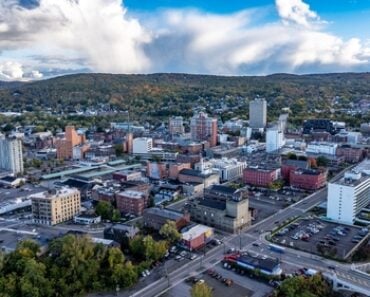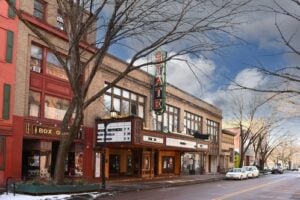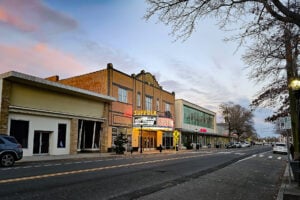
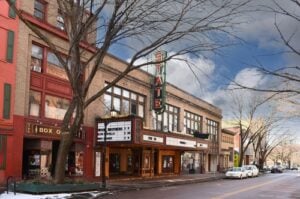
The historic State Theatre in downtown Ithaca, New York, photographed February 26, 2023. Photo: Steve Cukrov / Shutterstock.
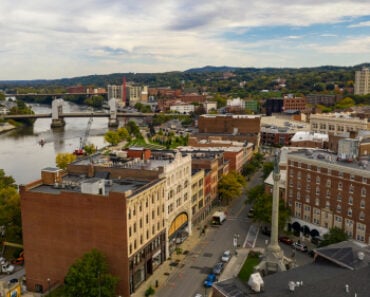
Ithaca sits at the southern end of Cayuga Lake, where Fall Creek and Six Mile Creek cut through steep gorges as they head toward the lake. Long before it became known nationally as a college town, Ithaca grew around mills, workshops, transportation routes, and Tompkins County farms. Cornell University opened in 1868, Ithaca College developed from a music conservatory established in 1892, and generations of local families built lives in the neighborhoods below the campuses. That combination of town life, education, and independent culture has produced some remarkably accomplished people.
When people talk about famous Ithacans, it is easy to name someone who spent a semester at Cornell or gave a lecture in town. That is not the same thing as being from Ithaca. This list focuses on people born in the city, who grew up there, or who made it their home for a substantial part of their lives. The distinction matters. Alex Haley and David Foster Wallace were born in Ithaca but grew up elsewhere. Mary McDonnell and Greg Graffin came to the city as children. Carl Sagan and Hans Bethe moved there as adults and remained for decades. Their connections are different, but each is a real part of Ithaca’s story.
Some names will be familiar immediately. Others are surprises: a pioneering bird artist, an influential mentalist, a creator of modern comic-book classics, and musicians who turned memories of Ithaca into a successful record. The city has also produced Stanley Cup champions, Olympic medalists, writers, scientists, and people who reshaped American education. Here are 25 famous people you might not have realized were from Ithaca, New York, and the particular ties that connect each one to the city.
1. Alex Haley
Alex Haley was born on August 11, 1921, in Ithaca while his parents were pursuing their educations there. His father, Simon Haley, studied at Cornell University, and his mother, Bertha Palmer Haley, studied music at the institution that eventually became Ithaca College. The family’s address at 212 Cascadilla Street is especially significant in local history: it was also the birthplace of Tuskegee Airman Verdelle Louis Payne. Although Haley spent much of his childhood in Henning, Tennessee, university records document his birthplace, and the community has marked it.
Haley became internationally known through The Autobiography of Malcolm X, developed with Malcolm X and published in 1965, and Roots: The Saga of an American Family, published in 1976. The television adaptation of Roots brought the story of slavery and family history into millions of American homes. His writing drew on oral history, interviews, and the search for personal ancestry. Ithaca wasn’t where he developed his literary career, but it is where one of the country’s best-known storytellers was born.
2. David Foster Wallace
David Foster Wallace was born in Ithaca on February 21, 1962, while his father was completing graduate work at Cornell. His family later moved to Illinois, where Wallace grew up, so his inclusion here rests on a birthplace connection rather than an Ithaca upbringing. He became one of the most discussed American writers of his generation, first drawing significant attention with The Broom of the System in 1987. His interests ranged from philosophy and language to competitive tennis and the increasingly complicated experience of modern life.
His enormous 1996 novel Infinite Jest became a landmark of contemporary fiction, admired for its ambition, inventiveness, and exploration of entertainment and addiction. Essays collected in books such as A Supposedly Fun Thing I’ll Never Do Again found a wide readership beyond literary fiction. Wallace spent most of his childhood and career elsewhere, but biographical accounts consistently identify Ithaca as his birthplace. That unexpected detail links one of the late-20th-century’s distinctive literary voices to the Finger Lakes city.
3. Carl Sagan
Carl Sagan was born in Brooklyn in 1934, but he made Ithaca his professional and family home. He joined the Cornell faculty in 1968 and spent the following decades studying the planets, teaching, writing, and making astronomy understandable to people far outside university classrooms. His research ranged from planetary atmospheres to the search for extraterrestrial intelligence. He was also a prominent public voice in debates over science, nuclear war, and humanity’s place in the universe.
Sagan won a Pulitzer Prize for The Dragons of Eden and became a household name as the presenter and co-writer of the 1980 television series Cosmos: A Personal Voyage. His book Contact was later adapted into a major motion picture. Although he died in Seattle in December 1996, admirers continue to leave small tributes at his burial site in Ithaca’s Lake View Cemetery. Unlike a visiting professor whose only local connection is an academic appointment, Sagan made Ithaca home for nearly three decades.
4. Mary McDonnell
Actress Mary McDonnell was born in Wilkes-Barre, Pennsylvania, in 1952, but her family moved to Ithaca while she was young, and she grew up there. She attended local schools, played sports, and took part in activities that she later credited with encouraging a sense of teamwork. After graduating from SUNY Fredonia, she developed her craft in regional and nonprofit theater rather than trying to find immediate success on a Hollywood soundstage. Her years in Ithaca shaped the upbringing that preceded that long theatrical apprenticeship.
McDonnell eventually earned Academy Award nominations for Dances with Wolves and Passion Fish. Television audiences also know her as President Laura Roslin on Battlestar Galactica and as a lead on The Closer and Major Crimes. She continued taking varied stage and screen roles throughout her career. Because she was raised in Ithaca rather than merely attending a college there, she is a particularly strong example of a familiar Hollywood name with genuine roots in the city.
5. Dustin Brown
Dustin Brown was born in Ithaca in 1984 and grew up playing hockey in the area. He attended Ithaca High School and developed into one of the most accomplished athletes to emerge from the city’s youth sports programs. The Los Angeles Kings selected him with the 1st-round pick in the 2003 NHL draft. His blend of physical play, consistent scoring, and leadership made him an important part of the franchise for nearly two decades.
As captain, Brown helped lead the Kings to Stanley Cup championships in 2012 and 2014, the team’s first two titles. He spent his entire NHL playing career with Los Angeles before retiring in 2022. The team later retired his number 23 and unveiled a statue celebrating his contributions. His story reminds us that Ithaca’s claim to notable residents isn’t limited to professors or authors. A young player from its local rinks became the captain of a championship NHL team.
6. Sam Harris
Sam Nelson Harris grew up in Ithaca and began making music there with his brother Casey and childhood friend Noah Feldshuh. Their early projects grew out of school friendships, rehearsal sessions, and a local arts community that offered performance opportunities. Sam later moved to New York City, where the group that became X Ambassadors expanded its sound and audience. As the band’s lead vocalist and principal songwriter, he brought a strong mix of rock, pop, and R&B influences to its records.
X Ambassadors broke through nationally with songs like “Renegades” and “Unsteady,” and the group’s 2015 album VHS made them widely known. Their 2024 album Townie turned directly back toward Ithaca, using childhood memories and places around the city as material for new songs. In interviews, Sam has said he wanted to escape a small college town when he was younger, but later recognized how much its people shaped him. This is one of the clearest musical homecomings on the list.
7. Casey Harris
Casey Harris, Sam Harris’s older brother, also grew up in Ithaca and became the keyboardist for X Ambassadors. Blind from birth, he built his musical life around his ear for harmony, piano, and electronic keyboards. He performed with local musicians before becoming a central member of the band he shared with Sam and Noah Feldshuh. Their mother was a jazz singer, and music was an important part of their household long before they had recording contracts.
Casey’s keyboard work has been essential to the band’s arrangements on songs such as “Renegades” and “Unsteady.” On Townie, the group revisited the emotional and musical surroundings in which the brothers grew up. The song “Follow the Sound of My Voice” deals directly with Sam and Casey’s relationship. The brothers are listed separately because both became professional musicians and can trace their formative years to the same Ithaca home.
8. Noah Feldshuh
Noah Feldshuh grew up in Ithaca alongside Sam and Casey Harris and helped form the group that eventually became X Ambassadors. He and Sam met in kindergarten, years before they rehearsed together and began imagining a future beyond their hometown. Feldshuh continued playing guitar with the group as its sound developed, then attended the New School in New York City, where the musicians met drummer Adam Levin. His connection with the Harris brothers reaches back to childhood rather than the later recording business.
Feldshuh was an original guitarist and collaborator during the band’s early recordings and breakthrough period. He was part of the lineup behind the rise of X Ambassadors and VHS, though he later stepped away from regular membership. Interviews with the musicians repeatedly return to the fact that their collaboration started in Ithaca classrooms and homes. For this article, that childhood connection matters more than any claim that the band originated in Brooklyn.
9. Julius Eastman
Julius Eastman was born in New York City in 1940, but grew up in Ithaca, where his extraordinary musical abilities became apparent. He sang as a boy soprano at St. John’s Episcopal Church and began seriously studying piano in his teens. After early studies in Ithaca, he attended the Curtis Institute of Music in Philadelphia. Eastman became an accomplished pianist, vocalist, and composer whose interests carried him beyond conventional classical forms.
He later worked with experimental musicians in Buffalo and New York City, creating intense compositions that combined repetition, improvisational freedom, and an individual approach to musical structure. Works such as Stay On It and Gay Guerrilla gained renewed attention after his death in 1990, helping restore his place in contemporary music history. One important correction to older biographical summaries is that Eastman was not born in Ithaca. The city was where he grew up and where his musical life began.
10. Asia Kate Dillon
Asia Kate Dillon was born and raised in Ithaca, where they studied acting while still a teenager. They trained at the Actor’s Workshop of Ithaca before continuing their education in New York City. Their local upbringing and early theater training provided the beginning of a career that would later bring them to major television series and films. Dillon’s connection to Ithaca is not an incidental college affiliation; it is both their birthplace and childhood home.
They became widely known for playing Brandy Epps on Orange Is the New Black and Taylor Mason on Showtime’s Billions. The role of Taylor Mason was especially significant as a prominent nonbinary character in an American television drama. Dillon also appeared in John Wick: Chapter 3 – Parabellum. Their rise from local Ithaca theater training to internationally watched productions makes them one of the city’s most recognizable contemporary performers.
11. Greg Graffin
Greg Graffin, the singer and co-founder of Bad Religion, was born in Wisconsin but moved to Ithaca at about age 11. He spent important teenage years there and attended Ithaca High School before heading west, where Bad Religion became one of the defining bands of American punk rock. Graffin’s sharp lyrics and energetic stage performances helped establish a sound that influenced later generations of punk musicians.
His interests never stopped at music. Graffin earned a doctorate in zoology at Cornell University in 2003, giving him a second, professional reason to return to the city of his youth. He later taught a Cornell course examining evolutionary thinking. The combination of a punk-rock career and serious scientific work is unusual, but both chapters connect to Ithaca. The city shaped him as a student, and Cornell later became part of his academic life.
12. Ezra Cornell
Ezra Cornell was born in what is now the Bronx in 1807 and arrived in Ithaca in 1828. He initially worked as a carpenter and mechanic in the growing mill town, later becoming involved in building and managing water-powered industrial facilities along Fall Creek. His mechanical skills and business instincts eventually led him into the emerging telegraph industry. Success in that field helped give him the resources to pursue an ambitious vision for education in the community he had made his permanent home.
Together with Andrew Dickson White, Cornell founded Cornell University, which opened in 1868. He also supported a public library in downtown Ithaca and participated in state politics. The university would become one of the most recognizable features of the city, but Ezra Cornell’s personal connection went far deeper than putting his name on a campus. He lived and raised his family in Ithaca for decades and died there in 1874. Few individuals have had a greater influence on the city’s development.
13. Bre Pettis
Bre Pettis grew up in Ithaca before moving with his family to the Seattle area at about age 13. His later interests in making objects, teaching, and sharing practical skills have clear roots in a childhood that encouraged experimentation and independence. He worked as an art teacher and created instructional videos before entering the growing community of people experimenting with inexpensive desktop manufacturing.
Pettis helped found MakerBot Industries in 2009, bringing three-dimensional printing to a much wider audience of schools, hobbyists, designers, and small businesses. His work connected a hands-on approach to making things with the possibilities of digital design. MakerBot was acquired by Stratasys in 2013, and Pettis later pursued other manufacturing ventures. Although some summaries describe him as born in Ithaca, the strongest readily accessible accounts establish that he was raised there, which is sufficient for this list.
14. Hans Bethe
German-born physicist Hans Bethe joined Cornell University in 1935 after leaving Europe during the rise of Nazi persecution. He settled in Ithaca and remained a member of its scientific community for nearly seven decades. Bethe made foundational contributions to theoretical physics, especially by explaining the nuclear reactions that power stars. He received the Nobel Prize in Physics in 1967 for that work.
During World War II, Bethe headed the theoretical division at Los Alamos as part of the Manhattan Project. In later years he became an influential voice on scientific responsibility and nuclear arms policy, while continuing his research and teaching at Cornell. Bethe died at his home in Ithaca in 2005 at age 98. He was not born in New York, but his long residence makes him an authentic figure in Ithaca history and an example of how the city became home to major scientists from around the world.
15. Urie Bronfenbrenner
Developmental psychologist Urie Bronfenbrenner came to Cornell in 1948 and made Ithaca his home for the rest of his life. His work challenged the idea that children’s development could be understood by studying a child in isolation. Instead, he examined families, schools, neighborhoods, social policies, and the relationships connecting them. His ecological approach to development became influential well beyond university psychology departments.
Bronfenbrenner was also among the important figures behind Head Start, the federal early-childhood program launched in 1965. His research helped establish that social conditions and public policy play significant roles in children’s opportunities. He died at his home in Ithaca in 2005. The lasting local connection matters: he did not simply visit Cornell to give a lecture but spent decades doing research, teaching students, and living in the surrounding community.
16. Tim Sale
Comic-book artist Tim Sale was born in Ithaca on May 1, 1956. His family moved to Seattle when he was a child, and much of his life and career unfolded outside New York. He later studied art and developed a distinctive approach to comics based on dramatic contrast, expressive figures, and powerful page composition. Although his Ithaca connection was limited to his early childhood, the birthplace is confirmed by his publisher and by interviews with Sale himself.
His collaborations with writer Jeph Loeb included Batman: The Long Halloween, Batman: Dark Victory, and Superman for All Seasons. These books earned a reputation for bringing film-noir atmosphere and psychological depth to familiar superheroes, and his art influenced later screen interpretations of Batman. Sale died in 2022. For comic-book readers, the discovery that a major visual storyteller was born in Ithaca may be one of the more unexpected entries on this list.
17. Juan Pablo Galavis
Juan Pablo Galavis was born in Ithaca in August 1981 to Venezuelan parents. His family moved to Venezuela when he was about two years old, so he did not grow up within Ithaca’s school system. His early birthplace nevertheless provides a real connection to the city. He later returned to the United States for college soccer at Roberts Wesleyan before playing professionally, including in Venezuela and with Miami FC.
Galavis became widely known to television viewers after appearing on The Bachelorette and being selected to lead the 18th season of The Bachelor, which aired in 2014. The attention surrounding the program was often controversial, but it made him a familiar figure far beyond soccer. He is included here strictly because Ithaca was his birthplace, not because his adult athletic or television career developed in the city.
18. Louis Agassiz Fuertes
Louis Agassiz Fuertes was born in Ithaca in 1874 and grew up in a household connected to Cornell, where his father taught engineering. As a young boy he became fascinated by birds, learning to recognize their songs and carefully studying their shapes and behavior. He attended Ithaca schools and later Cornell University, developing a talent for drawing animals with remarkable accuracy. His interest in nature and art became a lifelong profession.
Fuertes traveled widely on scientific expeditions and produced bird paintings celebrated for their detail, movement, and natural appearance. His work established him among the leading American wildlife artists after John James Audubon. Cornell’s collections preserve materials related to his life and art, and the university’s ornithology community continues to honor his legacy. Unlike visitors who passed briefly through the campus, Fuertes belonged to Ithaca from birth and built a career from interests first developed there.
19. Paul Wolfowitz
Paul Wolfowitz grew up primarily in Ithaca, where his father, Jacob Wolfowitz, was a professor at Cornell University. Although some lists incorrectly give Ithaca as Paul’s birthplace, biographical accounts identify his birth in Brooklyn in 1943. He attended Ithaca schools, graduated from Ithaca High School, and later earned a mathematics degree from Cornell. His upbringing in a university community formed an important part of his early education.
Wolfowitz held senior positions in American foreign policy, including U.S. ambassador to Indonesia and deputy secretary of defense under President George W. Bush. He became closely associated with the planning and justification of the 2003 invasion of Iraq, a role that remains strongly debated. He subsequently served as president of the World Bank. His Ithaca childhood is historically relevant regardless of how readers evaluate his political decisions; the article should distinguish the facts of his upbringing from opinions about his public career.
20. Kyle Dake
Wrestler Kyle Dake was born in Ithaca in 1991 and grew up in nearby Lansing, part of the same Tompkins County community. He attended Lansing High School, where his father helped coach him, and went on to wrestle at Cornell University. Dake made college wrestling history by winning four consecutive NCAA Division I titles in four different weight classes. His accomplishments put him among the most successful athletes in the university’s history.
Dake later won four world freestyle wrestling championships and earned bronze medals at both the Tokyo and Paris Olympics. USA Wrestling identifies Ithaca as his hometown, while his schooling and early training connect him specifically with nearby Lansing. That distinction is worth stating because being born in Ithaca does not mean he grew up within city limits. His achievements nonetheless belong to the region’s remarkable sporting history.
21. Max Maven
Max Maven, born Philip Goldstein in 1950, is identified as an Ithaca native in film and specialist magic references. He became one of the most influential performers and creators in the art of mentalism, using psychology, language, and theatrical presentation to create apparent mind-reading effects. His severe stage persona, dark clothing, and carefully controlled voice became recognizable to audiences who saw him on television and in live performances.
Maven was also highly respected within the magic profession as a writer, consultant, and inventor of effects used by other performers. His work influenced stage magicians and mentalists around the world, and he appeared regularly on television specials and programs. He died in 2022. While some biographical sources differ over his earliest family history, specialist magic listings and entertainment references connect his birth with Ithaca, making the city an intriguing part of the story behind a performer whose career took him far beyond New York.
22. Sasha Sagan
Writer Sasha Sagan is a native of Ithaca and the daughter of astronomer Carl Sagan and writer Ann Druyan. Growing up in a household deeply engaged with science and public communication shaped her own interests in how people understand the world. She later studied at New York University and worked in film, television, and writing. Her story adds a second generation to the history of the Sagan family in Ithaca, where Carl Sagan made his long professional home.
Her 2019 book For Small Creatures Such as We explores the ways people can create rituals, find meaning, and celebrate life’s turning points without relying on traditional religious explanations. The book mixes memoir with observations about history, family, and science. Sasha Sagan has also written essays and worked on screen projects. Her own biography identifies her as an Ithaca native, so her inclusion rests on more than the fame of her father.
23. Stephen L. Carter
Stephen L. Carter was born in Washington, D.C., in 1954, but part of his childhood and adolescence unfolded in Ithaca, where his father held a senior position at Cornell. Carter graduated from Ithaca High School in 1972 and later attended Stanford University and Yale Law School. In interviews, he has recalled his experiences as a student in Ithaca, including the challenges he encountered in school and the importance education assumed in his life.
Carter became a distinguished Yale law professor, writing about constitutional law, religion, ethics, and public life. His books include Reflections of an Affirmative Action Baby and the bestselling novel The Emperor of Ocean Park. He has discussed how experiences from his youth informed his writing and sense of identity. Carter belongs on this list as someone educated and raised in Ithaca during important formative years, rather than as a Cornell alumnus included simply because of the university’s location.
24. Steven Strogatz
Mathematician Steven Strogatz joined the Cornell faculty in 1994 and built a long career in Ithaca as a researcher and teacher. His specialties include nonlinear dynamics, synchronization, and the mathematical patterns that arise in nature and society. He has studied how crickets chirp together, how groups of oscillators synchronize, and how seemingly complicated networks produce recognizable behavior. His decades at Cornell make him a longtime member of the Ithaca community.
Strogatz also developed a wide public audience through books including Sync, The Joy of x, and Infinite Powers. He has written essays and hosted conversations intended to help people who may have disliked mathematics in school appreciate its beauty and usefulness. His involvement with Cornell connects Ithaca to some important advances in the public understanding of science. He was not born in the city, but few people have represented its intellectual life more consistently over the past three decades.
25. Johnny Dowd
Johnny Dowd built an unconventional music career while living and working in Ithaca. Born elsewhere, he became part of the city’s independent scene and spent years making a living through a local moving company. Rather than emerging as a teenage star, he released his first album when he was well into adulthood. His songs developed a distinctive combination of alternative country, blues, rock, and unsettling character-driven storytelling.
His 1997 album Wrong Side of Memphis brought his music to wider attention, especially among critics and audiences drawn to artists working outside commercial country conventions. He continued recording and performing, building a following in the United States and Europe. His day job, independent recording career, and commitment to Ithaca’s music community make him an appropriate final entry. He represents a side of the city’s creative culture that is less visible than Cornell’s international reputation but just as important to local life.
These names do not all share the same kind of Ithaca connection. Some were born there, some learned their craft in its schools, and others settled for most of their adult lives. But all three groups shape a city’s history. Ithaca is a place where local families, small businesses, the arts, and major institutions have continually crossed paths. This list reflects that larger story.
For more stories from this part of the state, read our articles on 25 famous people from the Finger Lakes, 25 famous people from Upstate New York, and the history of the Erie Canal, which helped shape the region’s communities.