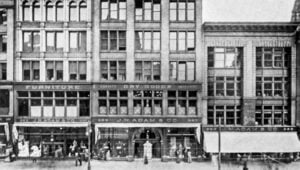
. N. Adam & Co. department store in Buffalo, New York, circa 1908. Photograph from A History of the City of Buffalo: Its Men and Institutions. Public domain, via Wikimedia Commons
There was a time when a trip downtown was one of the biggest events of the week for families across Upstate New York. Rochester had Sibley’s and McCurdy’s. Buffalo had AM&A’s, Hengerer’s, and Sattler’s. Syracuse shoppers knew Dey Brothers and Edwards, while families in Albany, Schenectady, Binghamton, Elmira, and Ithaca had stores that meant just as much to their communities. Their names appeared on shopping bags, newspaper advertisements, delivery trucks, and the sides of buildings that dominated entire blocks.
These department stores were different from today’s big-box retailers. Families could shop for winter coats, wedding gifts, school supplies, bedding, furniture, and Christmas toys without visiting half a dozen businesses. Some had restaurants, beauty salons, bakeries, and elaborate holiday displays. An elevator ride or a meal in the store’s dining room could be part of the outing. Employees sometimes spent most of their careers behind the same counters, learning the names and preferences of generations of customers.
The stores were also important to the history of Upstate New York’s cities. They employed thousands of people and helped keep downtown sidewalks busy. Many expanded outward as suburban shopping centers became popular after World War II, opening branches at plazas and enclosed malls. That strategy helped some survive longer, but it also weakened the downtown districts where they had built their reputations. By the 1970s, 1980s, and 1990s, changing shopping habits, expensive buildings, corporate mergers, and new retail competition had brought many familiar names to an end.
Not every department store on this list disappeared in the same fashion. Some closed permanently. Others were purchased by larger companies and lost their names, while a few historic buildings were reused as offices, apartments, schools, or different stores. It is important to distinguish the original retailer from whatever later occupied its address. The histories below follow 25 department-store names that no longer operate as the businesses generations of Upstate New Yorkers knew, with the real stories behind their rise, decline, and disappearance.
1. Sibley, Lindsay & Curr Co. (Sibley’s) — Rochester
Sibley, Lindsay & Curr began in Rochester in 1868 and grew into one of the city’s defining businesses. The story of its downtown flagship includes a devastating 1904 fire at the Granite Building, which destroyed the store and much of the surrounding block. The company rebuilt at East Main Street and North Clinton Avenue, opening an enormous new store in 1905. Its six-story building occupied an entire city block and contained an extraordinary range of merchandise and services, including a bakery, grocery department, and the elegant Tower Restaurant. For people who grew up in Rochester, the Christmas displays were often as memorable as the shopping itself.
Sibley’s began expanding into suburban locations during the 1950s, eventually operating a substantial regional chain. Yet the downtown flagship gradually contracted as more customers chose the malls. Its bakery closed in 1980, the grocery department in 1981, and entire floors were put to other uses. The May Department Stores Company acquired its parent organization in 1986, and the Rochester downtown store closed in 1990 as the other locations were folded into Kaufmann’s. The landmark building later served Monroe Community College and became part of the Sibley Square redevelopment. The building survives, but the store whose name stood over Main Street does not.
2. Adam, Meldrum & Anderson Co. (AM&A’s) — Buffalo
AM&A’s traced its origins to an 1867 Buffalo dry-goods business associated with Robert B. Adam and his partners. Its Main Street stores grew into one of Western New York’s most familiar shopping institutions, offering clothing, furniture, household goods, toys, and the services associated with a full department store. Holiday window displays were a major tradition. Buffalo residents also remembered the Yankee Doodle Room, a dining area that became part of the experience of shopping downtown. The company was still closely associated with the Adam family well into the late 20th century.
An important detail in the store’s history is that the building later called the AM&A’s flagship had first been the home of J. N. Adam & Company, a separate business founded by the brother of AM&A’s Robert Adam. When J. N. Adam closed in 1960, AM&A’s moved across Main Street into its larger building. The Bon-Ton acquired the company in 1994 and closed the downtown store in 1995. The old AM&A’s business disappeared even though its former building later attracted plans for reuse. These changes also explain why historical photographs of the same Main Street building sometimes bear two different store names.
3. Dey Brothers — Syracuse
The Dey brothers had been in the dry-goods business in Elmira before establishing their Syracuse firm in the spring of 1883. An early history of Onondaga County identifies Robert, Donald, and James Dey with the operation and records its first Syracuse address at 205–207 South Salina Street. In 1894, the company moved into a major new building at South Salina and East Jefferson Streets, one of the most prominent commercial corners in the city. The store developed a reputation for fashion, household goods, and an imposing shopping environment that helped establish Syracuse’s downtown as the retail center of Central New York.
The larger Dey Brothers business continued into the suburban-mall era, but its fate became tied to a series of corporate changes. After earlier ownership by Allied Stores and subsequent corporate restructuring, the Dey name was combined with rival Addis in 1989. The Addis & Dey’s operation was then drawn into additional consolidation, and the historic downtown department store closed in 1992. The original Dey’s building remained a recognizable part of Syracuse architecture even after the retail business ended. One important historical distinction is that the brothers began their earlier Elmira operation in 1877; the Syracuse Dey Brothers store dates to 1883.
4. William Hengerer Co. (Hengerer’s) — Buffalo
Hengerer’s evolved from a Buffalo dry-goods business that began in the 1860s and became one of the city’s most important department stores. William Hengerer joined the firm during the 1870s, and the name eventually became synonymous with shopping on Main Street. Its growth was reflected in substantial store buildings, including an 1889 structure designed by Cyrus K. Porter and a new building erected in the early 20th century. Shoppers encountered the extensive merchandise departments and personal service that made downtown department stores destinations for families throughout Western New York.
Hengerer’s became part of Associated Dry Goods, and suburban expansion allowed the name to remain familiar well beyond downtown Buffalo. The important corporate turning point came in 1981, when the Hengerer’s division was merged into Rochester-based Sibley’s. The familiar Hengerer’s name disappeared, even though stores continued under successor banners, and the downtown location ultimately closed later in the decade. Parts of its historic Main Street architectural heritage were subsequently restored. Unlike a retailer that went bankrupt overnight, Hengerer’s was lost through consolidation that gradually replaced its regional identity with other department-store names.
5. McCurdy & Co. — Rochester
McCurdy & Company was founded in Rochester in 1901 and became one of the city’s major competitors to Sibley, Lindsay & Curr. Its downtown East Main Street store offered the range of fashion, household merchandise, gifts, and services that made a department store a destination. McCurdy’s was also central to the creation of Midtown Plaza, the indoor shopping center developed with B. Forman that opened in 1962. The venture attempted to give downtown Rochester some of the convenience that growing suburban malls promised, without abandoning the traditional shopping district.
McCurdy’s bought B. Forman in 1968 and kept the fashion-oriented name operating within the larger company. By 1994, however, McCurdy’s announced that it would sell or close its 12 McCurdy’s and Forman locations, including the downtown businesses. A federal court decision from that year records the proposed sale of eight McCurdy’s stores to May Department Stores and the antitrust objections raised by Bon-Ton. The eventual transfer of certain locations to successor chains should not be mistaken for the survival of McCurdy’s as an independent Rochester retailer. Its disappearance also deprived Midtown Plaza of one of the original stores around which it had been designed.
6. E. W. Edwards & Son — Syracuse and Rochester
E. W. Edwards & Son was a familiar department-store name in Central and Western New York, with a major Syracuse flagship and branches that reached Rochester and Buffalo. Its stores competed for everyday purchases as well as holiday business, offering clothing, household goods, furnishings, and departments that could keep shoppers occupied for hours. As the company spread into suburban plazas, it became part of the same postwar retail transformation that was affecting Dey Brothers, Sibley’s, and other long-established stores. The Syracuse store’s holiday toy displays, including memories of its Toyland Rocket, remained especially vivid to former customers.
Edwards provides a striking example of how quickly fortunes could change. In November 1972 the company moved its downtown Syracuse operation into a new building, intending to modernize its presentation and compete more effectively. Within little more than a year, that downtown store had closed in February 1974; other Edwards locations were also affected by the company’s financial problems and restructuring. The opening of a modern flagship could not recover the traditions, finances, or customers the company had lost. Its disappearance marked another stage in the unraveling of Syracuse’s older department-store district.
7. John G. Myers Co. — Albany
The John G. Myers department store was one of the retail giants of Albany’s North Pearl Street. John Gillespy Myers had worked in the dry-goods trade and briefly partnered with William M. Whitney before establishing his own competing enterprise. The store expanded into an important destination for fashion, household goods, and downtown shopping. Its history includes one of Albany’s most terrible commercial disasters. On August 8, 1905, part of its building collapsed during construction and excavation work, killing 13 people and injuring many more.
The catastrophe brought intense scrutiny to building practices and remains an important event in Albany’s civic history. Myers rebuilt and continued trading on North Pearl Street, becoming a familiar destination for decades. Like other downtown stores, it later faced competition from the growing suburban shopping centers of the Capital Region. Myers closed in 1970. The former shopping experience disappeared, but accounts of the 1905 disaster and the store’s role in Albany business history make it much more than another name on an old shopping bag.
8. Fowler, Dick & Walker (The Boston Store) — Binghamton
The department store known in Binghamton as Fowler’s or the Boston Store belonged to the Fowler, Dick & Walker business, which originated in Wilkes-Barre, Pennsylvania, in 1879. Its Binghamton branch opened in the 1880s and occupied a prominent downtown site at Court and Water Streets. For generations, shoppers came for clothing, gifts, furniture, and other departments that made the downtown store a major part of the city’s commercial life. Fowler’s eventually expanded to Oakdale Mall, reflecting the same shift from downtown streets to enclosed shopping centers that affected many other regional retailers.
The old Fowler’s identity was lost amid financial difficulties and changes in ownership. The history of its downtown building is especially easy to confuse with the Pennsylvania stores: Boscov’s bought parts of the wider Fowler business in 1980, but the Binghamton location did not open under the Boscov’s name until August 13, 1984. Local radio reporting commemorating the store’s 30th anniversary reproduced the original 1984 newspaper announcement. That distinction matters because the historic Court Street department-store building continued to serve shoppers, while the business remembered as Fowler’s had ended. The store’s history should not be described as a simple, uninterrupted change of names in 1980.
9. Chappell’s — Syracuse
Chappell’s was a family department-store business established in Syracuse in the 1890s. Unlike the much larger chains that dominated downtown shopping, Chappell’s built a reputation through its own regional identity and a network of stores serving different Central New York communities. It sold clothing, accessories, and household merchandise and eventually opened branches in shopping centers that became familiar to families throughout Onondaga County. Its reach extended to places such as Watertown, Auburn, and other Upstate shopping districts.
As suburban malls became the dominant shopping destinations, Chappell’s tried to compete through expansion, but the business faced serious financial difficulties. It sought Chapter 11 bankruptcy protection in 1992. In 1994 the remaining chain was sold to The Bon-Ton, which ended the Chappell’s name as an independent regional department-store brand. The original draft treated the transition almost as a routine merger, but the bankruptcy and sale were an important part of the story. For shoppers who grew up with Chappell’s, its stores represented a personal alternative to the increasingly uniform national chains.
10. The Carl Company — Schenectady
The Carl Company became closely connected to Schenectady’s downtown prosperity. Charles W. Carl began his dry-goods career in Medina in 1891 and built a group of stores before concentrating on Schenectady in 1906. The local business first operated on State Street and moved into a prominent new building at 430 State Street, beside Proctors Theatre, in 1916. The property became a major retail landmark, and its surviving photographs show the bustling counters and merchandise departments that served generations of local residents.
Carl’s eventually expanded to suburban locations in Rotterdam, Clifton Park, Saratoga Springs, Amsterdam, and Troy, while remaining closely associated with its State Street headquarters. Although the Carl family sold the business in 1984, the store continued operating for several more years. The downtown location finally closed in May 1991, not 1998 as the original draft stated. The building was later incorporated into the expanding Proctors cultural complex. The continued use of the structure is a welcome example of adaptation, but Schenectady’s familiar Carl Company department store belongs to history.
11. W. M. Whitney & Co. — Albany
Whitney’s was one of Albany’s leading department stores on North Pearl Street and a longtime rival of John G. Myers. The earlier dry-goods establishment on the site dated to 1859, and William M. Whitney became involved in the business in the 1860s before developing it under his own name. Its large downtown building served the region’s clothing, household, and gift-shopping needs, and its spacious departments represented the confidence of Albany’s late-19th-century retail economy. The store’s history was intertwined with the city’s growth as a regional commercial center.
Whitney’s was also famous for sponsoring Albany’s Christmas parade for many years, helping to establish a downtown holiday tradition that brought families onto the streets. Its flagship closed in 1968, although the name survived briefly at a suburban Stuyvesant Plaza location. The North Pearl Street building was later demolished as downtown redevelopment changed the district. Whitney’s is a reminder that the loss of a department store also meant the loss of its civic events, neighborhood traditions, and the daily employment it provided.
12. Sattler’s — Buffalo
Few Upstate department stores had a more memorable address than Sattler’s at 998 Broadway. John G. Sattler began with a small shoe business and gradually built a large, bargain-oriented store serving Buffalo’s Broadway-Fillmore neighborhood. The store became a regional institution through its aggressive advertising, elaborate promotions, seasonal parades, and wide assortment of goods. Its radio jingle repeatedly urged listeners to shop and save at 998 Broadway, making the address familiar even to people who rarely visited the store.
Sattler’s expanded into suburban shopping centers during the 1960s, but the downtown store and the broader chain struggled in the years that followed. The Broadway location was renamed the 998 Clearance Center during its final period, and the Sattler’s business closed in 1982. The original building was demolished later in the decade. Historian Steve Cichon’s Buffalo Stories archive preserves advertisements, photographs, and recollections of the store’s distinctive marketing. Its history demonstrates how a discount-oriented department store could become just as beloved as Buffalo’s most elegant retailers.
13. B. Forman Co. — Rochester
B. Forman was one of Rochester’s best-known names for women’s apparel and fashion retail. Its downtown store became a familiar destination for shoppers seeking clothing, accessories, and personal service. The Forman family joined with the McCurdy organization in developing Midtown Plaza, which opened in 1962 and attempted to preserve downtown Rochester as a major shopping destination. Although smaller and more specialized than a full-line department store such as Sibley’s, B. Forman belonged to the city’s recognizable department-store landscape and maintained its own name and clientele.
McCurdy & Company bought B. Forman in 1968 but continued to operate it as a separate retail identity. During the 1980s, the Forman operation expanded into other Upstate New York markets, including stores acquired from Flah’s. The relationship is documented in later company histories and in the legal record of McCurdy’s attempted sale in 1994. The Midtown B. Forman store closed that year along with McCurdy’s, and a brief attempt to revive the name did not bring back the old chain. The end of Forman’s was therefore connected to the same troubled corporate restructuring that brought Rochester’s other major downtown department-store name to an end.
14. L. L. Berger — Buffalo
Louis L. Berger opened his clothing business in downtown Buffalo in 1905 with a particular focus on fashionable ready-to-wear apparel. The company expanded into larger quarters on Main Street and built a reputation as one of Western New York’s most prestigious fashion retailers. Its downtown flagship appealed to shoppers seeking higher-end clothing and personal service, distinguishing Berger’s from more general department stores. Over time the business grew into a regional chain with locations in suburban shopping centers.
The company continued expanding through the 1970s and 1980s, but costly competition and changes in the apparel business placed increasing pressure on its finances. L. L. Berger filed for bankruptcy in 1991, bringing an end to the well-known regional retail name. The older Main Street buildings were later adapted for other uses. Its history contrasts with that of Sattler’s: Buffalo supported stores at different price levels, each with a loyal following, and both eventually disappeared as the region’s retail landscape changed.
15. Hens & Kelly — Buffalo
Hens & Kelly opened in Buffalo in 1892 and developed into a major department store on Main Street near Mohawk Street. It offered clothing, household goods, and many other categories of merchandise, giving local families another reason to shop downtown. The company invested in substantial store improvements during the early 20th century and later became closely connected with S&H Green Stamps, which shoppers collected and redeemed for merchandise. That familiar promotional system was one of the ways regional retailers encouraged customers to keep coming back.
Like other Buffalo businesses, Hens & Kelly opened branches in growing suburbs, including a large Hamburg location. Its ownership changed after Sperry & Hutchinson acquired the company, and later under Twin Fair. By the early 1980s, declining sales and a difficult regional economy made continuation impossible. The final Hens & Kelly stores closed in 1982. One unusual reminder of its history surfaced during later demolition work at the former Hamburg store, when materials from a time capsule were recovered. Such artifacts preserve the personal and business history behind a name that once appeared on shopping bags throughout Western New York.
16. Rothschild Brothers — Ithaca
Rothschild Brothers began in Ithaca in 1882 as the Boston Variety Store and established a department-store operation on East State Street, later known as part of the Ithaca Commons. In 1889 it moved to the Wilgus Block at 155–159 East State Street, where it operated for most of the next century. Generations of local families and Cornell-area shoppers knew the store’s departments and window displays. The business became deeply connected to the evolving commercial heart of the city.
In 1975, Rothschild’s left its longtime building and opened a new store at 215 East State Street, part of an ambitious urban-renewal project. Contemporary coverage describes a modern two-floor shopping space and Ithaca’s first escalators, while the older Wilgus Block was demolished. The new building could not guarantee the business’s future: Rothschild’s closed in 1982. Its story is especially revealing because the company tried to modernize downtown retail only a few years before its name disappeared. The building and street have changed, but the earlier Rothschild’s remains an important part of local memory.
17. The Addis Company — Syracuse
The W. I. Addis Company was a major Syracuse department store, remembered for fashion, personal service, and its imposing building at 449 South Salina Street. The Cayuga Museum of History and Art preserves a 1932 wedding dress bearing an Addis label, a tangible example of the merchandise women traveled to Syracuse to purchase. For more than 60 years the Addis Building was associated with upscale shopping on the city’s principal commercial corridor. Addis also followed customers to suburban locations, including Shoppingtown in DeWitt, where its arrival helped establish an alternative to shopping downtown.
By the late 1980s, the traditional Syracuse department-store economy had become increasingly difficult. A contemporary May 1989 account in the Syracuse Herald-Journal described Dey Brothers taking over the Addis stores, with the downtown Addis location and two other branches scheduled to close. Brides who had ordered dresses and other longtime customers needed reassurance that their purchases would still be honored. The combined Addis & Dey’s business ultimately left downtown in 1992. The original Addis name and its separate shopping traditions disappeared well before that final closing.
18. S. F. Iszard Co. — Elmira
Samuel French Iszard purchased the Reynolds Brothers department store at East Water and Baldwin Streets in Elmira in 1904. The business prospered, and in 1924 it moved into a handsome new building at 150 North Main Street. Iszard’s became one of the Twin Tiers’ best-loved department stores, known for its Tea Room, elevator service, elaborate merchandise departments, and special holiday events. The local historian’s account of the store recalls brown bread in the Tea Room, an old-fashioned elevator gate, and the excitement of watching cash move through an overhead tube system.
The store’s annual holiday parade was especially important to Elmira families. Historical accounts report that thousands lined the route before heading to the store’s Toyland displays and Santa Claus. The last Iszard’s-sponsored parade took place in 1988, and McCurdy’s acquired the business in 1989, ending the Iszard’s name as a separate retailer. The later Elmira department-store location became involved in the wider McCurdy’s and Bon-Ton transactions of the 1990s. For the families who remember Iszard’s, the original store name and its traditions mattered more than the successor sign above the door.
19. Luckey, Platt & Company — Poughkeepsie
Luckey, Platt & Company was one of the great department stores of Poughkeepsie and the Hudson Valley. Its roots stretch back to earlier dry-goods businesses, with the Luckey and Platt partnership established in 1869. The company occupied buildings along Main Street near Academy Street and expanded steadily as Poughkeepsie became an important regional shopping center. Historic accounts describe a store with dozens of departments, an extensive selling floor, hundreds of employees, and merchandise ranging from clothing to furniture and household goods. It was exactly the kind of downtown, full-line department store that this article sets out to remember.
The large Classical Revival building at Main and Academy was constructed during the early 1920s and later listed on the National Register of Historic Places. As suburban shopping malls drew customers away and the city’s Main Mall struggled, Luckey Platt filed for bankruptcy protection in the 1970s and closed in 1981. The vacant building suffered severe deterioration before being rehabilitated for residences and ground-floor commercial use. Its restored exterior is a reminder of the thriving retail business that once anchored downtown Poughkeepsie, even though the original store and its shopping traditions are gone.
20. William H. Frear & Co. (Frear’s) — Troy
Frear’s Troy Cash Bazaar grew into one of the most imposing retail institutions of downtown Troy. William H. Frear developed the store during the city’s industrial boom, and the business occupied a building on Third Street remembered for its ornate ironwork, grand staircase, and dramatic commercial interior. The department store served a city that was then prosperous from manufacturing and regional trade, when a shopping trip downtown meant walking among busy shops and substantial Victorian buildings.
Frear’s passed to Rowley Department Stores in 1941, although the Frear name continued for a time. As Troy’s downtown commerce declined and urban renewal reshaped nearby blocks, the business eventually disappeared in the mid-20th century. Some related structures were demolished, but the principal historic Frear building survived and found new commercial uses. Its retained architectural details show what an extraordinary setting a department store could once offer. The loss of Frear’s as a retailer and the survival of the building are two distinct parts of Troy’s history.
21. McLean’s Department Store — Binghamton
McLean’s was the other great department-store name of downtown Binghamton, competing for shoppers with Fowler’s on Court Street. Its principal location was at Court and Chenango Streets, across from the civic buildings that helped define the downtown district. The McLean family gave the store its familiar name and built a reputation for dependable merchandise and personal service. The company belonged to the era when Binghamton’s downtown businesses attracted families from across Broome County and the surrounding communities.
McLean’s was also part of a larger national buying network, an arrangement that helped regional merchants obtain merchandise while remaining locally identified. In the 1970s, new suburban shopping centers and changing consumer habits threatened both of Binghamton’s older department stores. Local historical reporting says McLean’s closed in 1981 following an unsuccessful attempt to sell or preserve the business. Its old Court Street identity was gone even as downtown Binghamton continued evolving. Together, the disappearance of McLean’s and Fowler’s marked the end of an era when two independent department stores anchored the city’s shopping district.
22. J. N. Adam & Co. — Buffalo
James Noble Adam opened his Buffalo department-store business in 1881. He was the brother of Robert Adam, one of the founders of AM&A’s, meaning two competing Main Street retailers came from the same family. J. N. Adam built an important downtown operation at Main and Eagle Streets, with a store that grew into an extensive complex of interconnected buildings. Its modern conveniences, display windows, and substantial shopping floors made it one of Buffalo’s best-known retailers.
J. N. Adam closed in 1960, but the building’s retail life continued. The owners of AM&A’s moved their operation from across Main Street into the former J. N. Adam premises, where that company remained for another 35 years. The former J. N. Adam building thus became more famous to later generations under a different store’s name. Buffalo historian Steve Cichon has documented the relationship between the two businesses and the brothers who founded them. The story is a good example of how one lost department store could physically become the home of another.
23. Wallace Company — Schenectady, Poughkeepsie, and Kingston
Wallace’s was a well-established department-store name in more than one Upstate community. In Schenectady, its State Street history reached back to the earlier William McManus dry-goods business, and the store eventually operated at 413–417 State Street. The Schenectady County Historical Society documents a retail landmark that modernized its building and added escalators in the 1950s. Wallace stores also operated in Poughkeepsie and Kingston within the wider Forbes & Wallace organization, though those were separate local storefronts whose histories and closing dates should not be treated as identical.
The Schenectady Wallace’s closed in 1973, according to the Schenectady County Historical Society. The Poughkeepsie Wallace store at 331 Main Street closed in 1975; its old building has since become the subject of historic redevelopment. Those different dates are important because the previous article incorrectly combined the histories into a single 1975 ending. The company name may be gone, but its commercial buildings and archival photographs still reveal the scale of the downtown shopping districts that Wallace’s once served.
24. The Boston Store — Utica
Utica’s Boston Store was a separate business from the Fowler’s Boston Store in Binghamton. It began in 1918 as the Leader Store and grew into a major downtown retailer known for clothing, home goods, and extensive merchandise departments. In 1941 the company built a new store in Franklin Square with substantial frontage along Genesee and Bleecker Streets. The modern building included air conditioning, illuminated windows, and other amenities intended to keep the department store competitive with businesses elsewhere in the Mohawk Valley.
The Boston Store expanded its premises and parking facilities during the 1960s, but the region’s economic difficulties and the movement of shopping toward suburban malls put increasing pressure on downtown operations. It closed in December 1976 after its parent company’s bankruptcy. An attempt to revive shopping at the property under the name One-Thirty-One Boston Place in 1984 lasted only a short time. The original Boston Store never returned. Its history is especially worth remembering because it shows that even a substantial, modernized building could not necessarily preserve a department store’s business or its downtown customer base.
25. Denby’s — Troy and the Capital Region
Denby’s began in Troy in 1936 when Isaac Honigsbaum established a small clothing store. Over time it grew from a 3,000-square-foot operation into a regional chain of family-apparel department stores. A March 30, 1972, issue of The Spotlight, preserved by Bethlehem Public Library, described plans for a 25,000-square-foot Denby’s at Delaware Plaza in Delmar. The contemporary announcement listed separate women’s, men’s, teenagers’, children’s, footwear, and other departments, along with alterations, delivery, gift wrapping, and charge-account services. Denby’s therefore fits this article as a family-apparel department-store business, even though it did not sell everything found at a giant downtown general-merchandise store.
Sanford Huston helped founder Isaac Honigsbaum build the business, and contemporary reporting documents expansion to locations such as Stuyvesant Plaza and Colonie Center. By 1976 the chain had nine Capital Region stores. It was sold to the Outlet Company in 1977, a transaction confirmed in Huston’s obituary and contemporary newspaper accounts. Some Denby’s stores continued after the sale; the 1977 transaction should not be described as the exact day the name disappeared. What is clear is that the original family-controlled retailer eventually vanished from the area’s shopping landscape, leaving a particularly strong association with Troy and the older Capital Region malls.
Looking back at these businesses also means remembering what happened to the downtowns around them. Rochester, Buffalo, Syracuse, Albany, Troy, Schenectady, Binghamton, Elmira, and Ithaca all changed as department stores lost customers or disappeared through corporate mergers. Some buildings were saved and adapted, while others were demolished. Many of the old shopping districts eventually found different ways to attract people, but a major department store once had the power to bring thousands of customers onto downtown streets each day.
For more about the history of retail in New York, read our articles on 10 famous department stores in New York City history, the history of Stern’s department stores, and New York supermarkets past and present.
Check out more of our Upstate articles…..
15 Historic Diners in Upstate New York Worth Visiting
20 Foods That Were Invented in Upstate New York
25 Famous Movies You Didn’t Know Were Filmed in Upstate New York
10 Historic Small Towns in Upstate New York Worth Visiting
10 Submerged and Vanished Communities of Upstate New York
12 Most Charming Main Streets in Upstate New York That Feel Like a Movie Set
15 Historic Great Camps of the Adirondacks and Their Remarkable Architecture
20 Inventions and Innovations From Upstate New York That Changed the World