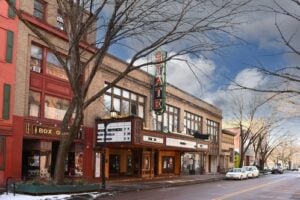
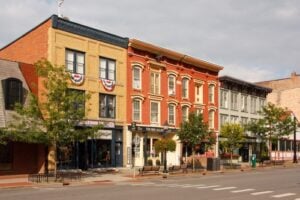
Historic storefronts, shops, and restaurants along Main Street in Cooperstown, New York. Photo: danf0505 / Shutterstock.com
Across Upstate New York, some downtown streets still preserve the scale and texture that made the traditional American Main Street such a powerful part of everyday life. The best examples are not simply pretty blocks of old buildings. They combine historic architecture with bookstores, bakeries, independent shops, restaurants, parks, museums, theaters, and public spaces that still function as the center of town.
That is what makes the twelve streets below feel cinematic. Each has a strong visual identity, but each also has enough real history and active street life to keep it from feeling like a preserved stage set. From Cooperstown’s baseball-filled storefronts to Hudson’s antiques district, Lake Placid’s Olympic Main Street, and Hammondsport’s wine-country village square, these are twelve of the most charming downtown streets in Upstate New York.
1. Main Street, Cooperstown (Otsego County)
Main Street in Cooperstown has one of the strongest small-town identities in New York because the village’s architecture and its most famous institution occupy the same compact downtown. The Cooperstown Historic District, which includes Main Street, is listed on the National Register of Historic Places and contains Greek Revival, Italianate, and later revival architecture spanning much of the nineteenth and early twentieth centuries. At 25 Main Street, the National Baseball Hall of Fame and Museum anchors the eastern end of the commercial district, while Lakefront Park and Otsego Lake are only a short walk beyond the downtown blocks.
The businesses make Main Street more than a backdrop for the Hall of Fame. Cooperstown Bat Company operates a retail shop at 118 Main Street, while Mickey’s Place at 74 Main Street specializes in baseball caps and memorabilia and Dave & Adam’s Card World at 65 Main Street sells cards and collectibles. Schneider’s Bakery at 157 Main Street remains a traditional stop for baked goods. In 2026, the Baseball Hall of Fame also opened a greatly expanded Main Street-facing Museum Store, adding another active storefront to a street already packed with baseball culture. During summer, the village trolley stops directly along Main Street, making the compact downtown especially easy to explore on foot.
2. Warren Street, Hudson (Columbia County)
Warren Street is not simply attractive; it is one of the most architecturally important commercial streets in the Hudson Valley. National Register documentation describes the nine-block street as Hudson’s primary architectural resource and an unusually intact record of the city’s development. Federal-era buildings near the lower end of town give way to Greek Revival, Italianate, Victorian, and later commercial architecture as the street climbs toward Seventh Street Park. That gradual architectural progression is one reason Warren Street feels less like a recreated historic district and more like a complete nineteenth-century city that simply kept evolving.
Hudson’s modern identity as an antiques and design destination is still visible door after door. FINCH at 427 Warren Street mixes furniture, art, lighting, and home design, while Red Chair on Warren at 606 specializes in French antiques and Bavier Brook at 621 focuses on antique and vintage jewelry. Battle Brown at 528 Warren Street and numerous other dealers continue the street’s long-established antiques trade. Between those shops are galleries, restaurants, cafes, and restored upper-floor residences. The western end of Warren Street also leads toward Promenade Hill, where views open across the Hudson River toward the Catskills.
3. Main Street, Cold Spring (Putnam County)
Cold Spring’s Main Street is one of the best-preserved nineteenth-century commercial streets in the Hudson River corridor. The village’s own historic-preservation documents emphasize the unusually intact concentration of nineteenth-century buildings along Main Street, and the Cold Spring Historic District was added to the National Register in 1982. The commercial core runs for roughly eight blocks toward the Hudson, where the riverfront park and bandstand look across the water toward West Point and the western Hudson Highlands.
The street still has the kind of independent businesses that make a historic downtown feel lived in rather than staged. Split Rock Books at 97 Main Street, founded in 2018, carries new books with a focus on literary fiction, small presses, local interest, and children’s titles. Nearby, Cold Spring Cheese Shop at 104 Main Street, Brass Monkey at 101 Main Street, and other small gift, food, vintage, and home-goods stores fill the narrow storefronts. Metro-North’s Cold Spring station sits only steps from downtown, which helps explain why Main Street can feel busy on weekends without losing its village scale.
4. Market Street, Corning (Steuben County)
Market Street is one of the strongest examples in New York of a historic downtown that was deliberately rebuilt rather than simply left to decline. After the devastating 1972 flood, Corning created the Market Street Restoration Agency in 1974, beginning a long downtown revitalization effort that helped shape today’s Gaffer District. Brick sidewalks, restored commercial facades, public art, trees, and decorative lighting now frame a street whose identity remains closely tied to Corning’s glassmaking history.
Current businesses give Market Street considerable variety. Bacalles Glass Shop, opened in 1967 and still operating at 10 West Market Street, sells decorative glass and locally made pieces. F.L.X. Provisions at 2–4 East Market Street serves Finger Lakes wine, beer, spirits, cheese, charcuterie, and other regional products. Donna’s Restaurant at 58 East Market Street keeps an old-school diner presence downtown, while Market Street Antiques at 98 East Market Street and Stained Glass Works & Antiques at 85 East Market Street add another layer of history. The nearby Centerway Walking Bridge crosses the Chemung River, and free museum shuttles link downtown with the Corning Museum of Glass and the Rockwell Museum.
5. West Genesee Street, Skaneateles (Onondaga County)
Skaneateles has the rare advantage of placing its historic commercial district directly beside one of the clearest and most scenic Finger Lakes. East and West Genesee streets are part of the Skaneateles Historic District, listed on the National Register for its Federal, Greek Revival, and Italianate architecture. West Genesee Street is also part of historic U.S. Route 20, giving this compact resort village a direct connection to one of the great east-west roads across New York State.
The Sherwood Inn at 26 West Genesee Street is the street’s most recognizable historic anchor. Its history dates to 1807, when Isaac Sherwood had a tavern built for his stagecoach business. Across the road, Clift Park and the village pier open directly onto Skaneateles Lake. Around the corner, Skaneateles Bakery at 19 Jordan Street remains a popular downtown stop, while Gallery 54 at 54 East Genesee Street showcases regional art and craft. The village’s tight network of Genesee, Jordan, and Fennell streets means shoppers, diners, boat passengers, and park visitors all circulate through the same few walkable blocks.
6. Main Street, Lake Placid (Essex County)
Lake Placid’s Main Street is unusual because it combines a working village center, an Adirondack resort district, and internationally important sports history along one walkable mile. Much of the street follows the edge of Mirror Lake, so storefronts and restaurants regularly open toward water and mountain views. At the southern end, the Lake Placid Olympic Center at 2634 Main Street preserves the village’s connection to both the 1932 and 1980 Winter Olympics, including the rink associated with the 1980 “Miracle on Ice.”
The street’s businesses give it character beyond the Olympic sites. The Bookstore Plus at 2491 Main Street has been locally owned for more than forty years and carries Adirondack titles alongside fiction, nonfiction, children’s books, stationery, and art supplies. Big Mountain Deli & Creperie at 2475 Main Street serves breakfast, crepes, and a menu of sandwiches named for Adirondack peaks and landmarks. Smoke Signals sits nearby with a view toward Mirror Lake, while outdoor outfitters and specialty shops reflect the town’s role as a base for hiking, skiing, and winter sports. Few Upstate streets shift so naturally from bookstore to lakefront to Olympic arena within a few blocks.
7. Main Street, East Aurora (Erie County)
East Aurora’s Main Street has the architectural polish of a movie set for a good reason: its historic character has actually attracted holiday-film production. The village itself describes a walk down Main Street as a step back in time, with specialty shops, restaurants, churches, civic buildings, and preserved homes lining the corridor. The nearby Roycroft Campus gives the street an unusually strong Arts and Crafts identity. Designated a National Historic Landmark district in 1986, the campus preserves nine of the original fourteen Roycroft buildings associated with Elbert Hubbard and the American Arts and Crafts movement.
Vidler’s 5 & 10 is the essential Main Street stop. Founded in 1930, the store occupies four connected nineteenth-century buildings at 676–694 East Main Street and still has wooden floors, old counters, red-and-white awnings, novelty merchandise, toys, housewares, and candy. The Aurora Theatre, opened in 1925, adds a classic neon-marquee movie house to the same streetscape. A short walk away, Elm Street Bakery and the Roycroft Campus’s Copper Shop Gallery extend the downtown experience beyond Main Street itself. Visit Buffalo’s 2026 guide even notes that the Hallmark Channel has used East Aurora for holiday filming, which makes the “movie set” description unusually literal here.
8. Tinker Street, Woodstock (Ulster County)
Tinker Street reflects Woodstock’s identity as an arts town far more accurately than the mythology surrounding the 1969 music festival, which was actually held nearly sixty miles away in Bethel. Woodstock’s artistic reputation predates that event by generations. The Byrdcliffe Arts Colony was established here in 1902 and began operating in 1903 as a year-round Arts and Crafts community for painters, furniture makers, printmakers, ceramicists, writers, musicians, and other artists. That creative culture still spills directly into the village center.
The Golden Notebook at 29 Tinker Street remains one of Woodstock’s signature independent bookstores. Pure Hart Studio operates at 128 Tinker Street with prints, paintings, cards, and locally themed work, while Ad Astra at 54 Tinker Street sells handmade and vintage home goods, many sourced in the Hudson Valley. Oriole 9 at 17 Tinker Street adds a popular cafe to the same central stretch. Tinker Street’s mix of galleries, vintage clothing, spiritual shops, cafes, bookstores, and handcraft businesses keeps the street visually eclectic without turning it into a museum piece.
9. Main Street, Geneseo (Livingston County)
Main Street in Geneseo was planned to function as the physical center of the village, and that structure is still visible today. The broad street links the Village Park at the south end with the Livingston County courthouse area to the north, with the historic commercial district between them. Geneseo received National Historic Landmark recognition in 1991 for the exceptional integrity of its historic village landscape, and the town continues to promote Main Street as the focal point connecting SUNY Geneseo with the surrounding community.
The Bear Fountain remains one of the street’s most familiar landmarks, while businesses give the district a strong everyday rhythm. Big Tree Inn at 46 Main Street combines lodging with a restaurant and tavern in one of the village’s best-known historic properties. Sweet Arts Bakery at 95 Main Street serves breakfast pastries and baked goods, Pizza Paul’s operates at 110 Main Street, and YoBerry Frozen Yogurt is at 56 Main Street. With SUNY Geneseo only steps away, the street has an unusual blend of college-town activity and preserved nineteenth-century village architecture.
10. Broadway, Saratoga Springs (Saratoga County)
Broadway is bigger and busier than most streets on this list, but its architecture and walkability still give it the feel of a grand resort promenade. The Broadway Historic District was added to the National Register in 1979 and contains Greek Revival, Classical Revival, and Victorian architecture. At the southern end, Broadway meets Congress Park, itself part of a historic district tied to Saratoga Springs’ development as a nineteenth-century spa and resort destination.
Northshire Bookstore at 424 Broadway has been part of downtown Saratoga since 2013, with a large children’s floor, vinyl records, gifts, and frequent author events. Putnam Market sells specialty foods and regional products, while long-established Menges & Curtis Apothecary adds another distinctly local storefront to the downtown mix. Just off Broadway on Phila Street, Caffè Lena has operated since 1960 and describes itself as the oldest continuously operating folk music venue in the country. The combination of bookstores, restaurants, mineral-spring history, hotels, shops, and Congress Park gives Broadway the richest full-day street experience of any downtown on this list.
11. Albany Street, Cazenovia (Madison County)
Albany Street is the historic commercial spine of Cazenovia and is part of a preservation landscape with unusual depth. The Albany Street Historic District was listed on the National Register in 1978 and was later incorporated into the larger Cazenovia Village Historic District. That broader district contains hundreds of historic resources representing Classical Revival, Greek Revival, Victorian, commercial, civic, and residential architecture.
The 1835 Lincklaen House at 79 Albany Street remains the street’s major architectural landmark and still operates as a hotel and dining destination. Current businesses make the surrounding blocks feel active rather than purely historic: Purpose Coffee Co. operates at 35 Albany Street, Four Daughters Thrift at 53 Albany Street, J.S. Hight & Sons at 58 Albany Street, and the Pewter Spoon Cafe at 87 Albany Street. Around the corner on Lincklaen Street, Ink & Paper Bookstore and HeartStone Artisan Bakery add books and scratch-made breads and pastries to the village center. Cazenovia Lake is close enough that the entire commercial district retains the atmosphere of a small lakeside town.
12. Pulteney Square and Shethar Street, Hammondsport (Steuben County)
Hammondsport is the one place on this list where the most charming “Main Street” experience is really a compact network of streets surrounding Pulteney Square rather than one long commercial avenue. The Village of Hammondsport Historic District was added to the National Register in 2024 and includes nearly 450 historic resources representing styles ranging from Victorian and Queen Anne to Classical Revival, Craftsman, and American Foursquare. The village’s history is inseparable from both aviation and wine: Glenn Curtiss developed and tested early aircraft here, while the first Finger Lakes vineyard was planted in Hammondsport in 1829 and Pleasant Valley Wine Company was established nearby in 1860.
Shethar Street and the blocks surrounding the square carry much of today’s downtown activity. The Park Inn at 37 Shethar Street, Crooked Lake Ice Cream Company at 35 Shethar, Patina at 57 Shethar, and Opera House Antiques at 61–63 Shethar give the village center a mix of dining, dessert, and antique shopping. The Cinnamon Stick operates nearby on Mechanic Street, while Service Station FLX occupies 43 Main Street. From the square, Keuka Lake’s southern shore is only a short walk away. The combination of wine-country history, Curtiss aviation history, an intact village square, and independent storefronts gives Hammondsport one of the most complete small-town settings in the Finger Lakes.
For more Upstate New York downtowns and historic communities, see 10 Historic Small Towns in Upstate New York Worth Visiting. Two of the communities on this list also sit directly along one of the state’s most important old highways, explored in The Real Main Street of New York: The History of U.S. Route 20.
Sources
National Park Service — Cooperstown Historic District
This Is Cooperstown — Cooperstown Shopping
National Baseball Hall of Fame — 2026 Main Street Museum Store
National Park Service — Hudson Historic District and Warren Street
Visit Hudson NY — Warren Street Antiques and Design Businesses
Village of Cold Spring — Historic District
Split Rock Books — Cold Spring
Putnam County — Cold Spring Businesses
Corning’s Gaffer District — Downtown History
Corning’s Gaffer District — Downtown Business Directory
National Park Service — Skaneateles Historic District
Lake Placid — Main Street Guide
Lake Placid — The Bookstore Plus
Village of East Aurora — History and Main Street
Roycroft Campus Corporation — National Historic Landmark Campus
Vidler’s 5 & 10 — Store History
New York State Museum — Byrdcliffe Arts Colony
Association for the Preservation of Geneseo — Main Street History
SUNY Geneseo — Current Geneseo Businesses
National Park Service — Saratoga Springs Broadway Historic District
Northshire Bookstore — Saratoga Springs
Caz Heritage — Albany Street and Cazenovia Historic Districts
Village of Cazenovia — History
Cazenovia Chamber — Restaurants and Cafes
Cazenovia Chamber — Retail and Shopping
National Park Service — Village of Hammondsport Historic District
Hammondsport Chamber — Shopping and Arts
Hammondsport Chamber — Restaurants
Finger Lakes Wine Alliance — Hammondsport Wine History
Updated September 22, 2026.