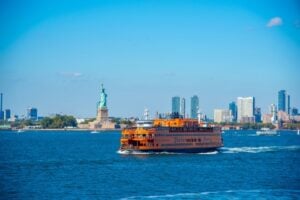
The Staten Island Ferry crosses New York Harbor with the Statue of Liberty in the background. The ferry remains one of New York City’s best free sightseeing experiences. Photo: Gabriele Maltinti / Shutterstock.com
New York City has a reputation for being one of the most expensive destinations in the world, with observation decks, sightseeing cruises, museum tickets, tours, and entertainment adding up quickly. Yet many of the city’s most memorable experiences cost absolutely nothing.
From a harbor crossing and world-famous architecture to public parks, museum collections, kayaking, live performances, and historic landmarks, these 20 free New York experiences can compete with attractions that charge substantial admission. Some require advance reservations, lotteries, or specific travel times, so visitors should always check the official website before heading out.
1. The Staten Island Ferry Instead of a Paid Harbor Cruise
What It Is: The municipal ferry between Whitehall Terminal in Lower Manhattan and St. George on Staten Island. NYC DOT operates the ferry every day of the year, 24 hours a day, and the ride takes about 25 minutes each way.
Why It’s Better: The Staten Island Ferry is completely free. From the water, passengers get broad views of New York Harbor, the Statue of Liberty, Ellis Island, Governors Island, and the Lower Manhattan skyline without purchasing a sightseeing-cruise ticket. For a first-time visitor trying to see the harbor on a budget, it remains one of the best deals in New York because there is no deal at all: the fare is zero.
2. The New York Public Library and Rose Main Reading Room Instead of a Paid Architecture Tour
What It Is: The Stephen A. Schwarzman Building at Fifth Avenue and 42nd Street, the Beaux-Arts flagship of The New York Public Library, guarded outside by the marble lions Patience and Fortitude.
Why It’s Better: Visitors can enter the building for free and see spaces including Astor Hall, McGraw Rotunda, exhibitions, and other public areas. The magnificent Rose Main Reading Room is a working research room rather than an unrestricted tourist attraction, but NYPL offers a free visiting hour from 10:00 to 11:00 a.m. Monday through Saturday, along with free docent-led building and reading-room tours. Tour capacity is limited, so plan ahead.
3. Walking the Brooklyn Bridge Instead of Riding a Tour Bus
What It Is: The famous pedestrian promenade across the Brooklyn Bridge, connecting Lower Manhattan and Brooklyn across the East River.
Why It’s Better: Walking puts you directly beneath the bridge’s Gothic arches and web of suspension cables while opening panoramic views toward Lower Manhattan, New York Harbor, and the surrounding bridges. Completed in 1883, the Brooklyn Bridge remains both a transportation link and one of New York’s greatest architectural achievements. For more on the structure itself, read our History of the Brooklyn Bridge.
4. Pier 57 Rooftop Park Instead of a Paid Observation Deck
What It Is: A nearly two-acre public rooftop park above Pier 57 on the Hudson River at West 15th Street.
Why It’s Better: The rooftop provides open-air views across the Hudson and toward Lower Manhattan, New York Harbor, Little Island, and the surrounding West Side without an admission charge. There are lawns, seating areas, and room to linger rather than being moved through a ticketed observation-deck experience.
5. The Ramble in Central Park Instead of a Commercial Garden
What It Is: A 36-acre woodland in the middle of Central Park between approximately 73rd and 79th Streets.
Why It’s Better: Frederick Law Olmsted and Calvert Vaux designed the Ramble to feel deliberately wild. Its twisting paths, rustic bridges, rocky terrain, dense plantings, stream, and small cascade create an extraordinary sense of escape in the center of Manhattan. It is also one of Central Park’s great birding areas. For the larger story of the landscape, read our History of New York’s Central Park.
6. A Chelsea Art Gallery Crawl Instead of a High-Priced Art Exhibit
What It Is: The concentration of contemporary-art galleries in West Chelsea, particularly between roughly West 20th and West 28th Streets near Tenth and Eleventh Avenues.
Why It’s Better: Many commercial galleries charge no admission, allowing visitors to see changing exhibitions by major contemporary artists without buying a museum ticket. Galleries including David Zwirner, Gagosian, Hauser & Wirth, Pace, and many smaller spaces make the neighborhood one of the best places in New York to spend several hours looking at art for free. Individual galleries maintain their own schedules and may close between exhibitions, so check hours before going.
7. Free Kayaking on the Hudson and East Rivers Instead of Renting a Boat
What It Is: Seasonal volunteer-run kayaking programs that provide boats, life jackets, instruction, and public access to New York’s waterfront.
Why It’s Better: The Downtown Boathouse at Pier 26 offers free kayaking on the Hudson during its 2026 season from May through early October. Brooklyn Bridge Park and the Brooklyn Bridge Park Boathouse also offer free kayaking from Pier 2, with approximately 20-minute sessions and advance reservations highly recommended. Manhattan Community Boathouse also offers a free program from Pier 96. These programs make getting onto New York’s waterways possible without paying commercial rental prices.
8. The High Line Instead of a Tour Trolley
What It Is: The elevated public park built along a former freight rail line through Chelsea and the Meatpacking District.
Why It’s Better: Walking the High Line places you above street traffic amid gardens, public art, historic industrial buildings, contemporary architecture, and Hudson River views. The park is free to enter, and walking it at your own pace provides a much more intimate look at the changing West Side than seeing the neighborhood through the window of a tour vehicle.
9. Grand Central Terminal Instead of Paying for a Landmark Tour
What It Is: The monumental 1913 terminal at East 42nd Street and Park Avenue, one of New York City’s greatest public interiors.
Why It’s Better: Grand Central is open to the public, so it costs nothing to stand in the Main Concourse beneath the celestial ceiling, see the famous four-faced information-booth clock, wander its passages, and try the acoustic effect in the Whispering Gallery near the Oyster Bar. Paid guided tours are available, but simply exploring the terminal remains free. Read more in Grand Central Terminal, A Postmodern Cathedral.
10. Sunset at Brooklyn Bridge Park and Pebble Beach Instead of an Expensive Waterfront Bar
What It Is: Brooklyn Bridge Park’s waterfront spaces in DUMBO and Brooklyn Heights, including Pebble Beach and the lawns around Pier 1.
Why It’s Better: Few paid rooftop bars can improve on the view across the East River toward the Brooklyn Bridge and Lower Manhattan. Bring a camera, sit along the waterfront, and watch the light change across the skyline without ordering an expensive drink just to keep the table.
11. Governors Island on a Free Weekend Morning Ferry Instead of a Paid Day Trip
What It Is: A car-free former military installation in New York Harbor with historic buildings, Fort Jay, Castle Williams, Nolan Park, Hammock Grove, and the Hills.
Why It’s Better: Governors Island itself is open to the public without an admission charge, but the ferry normally has a fare. The key budget trick is timing: Trust for Governors Island ferries are free for everyone on Saturdays and Sundays before 11:00 a.m. in 2026. Children 12 and under, adults 65 and older, NYCHA residents, IDNYC holders, military service members, and several other qualifying groups also ride Trust-operated ferries free. Reservations are still recommended.
12. Free Shakespeare in the Park and Free SummerStage Concerts Instead of Expensive Show Tickets
What It Is: The Public Theater’s Free Shakespeare in the Park productions at the Delacorte Theater and City Parks Foundation’s SummerStage performances in parks around New York City.
Why It’s Better: The Public Theater continues to distribute free Shakespeare in the Park tickets through multiple day-of methods, including in-person distributions and a digital lottery. SummerStage presents dozens of free performances each season across Central Park and neighborhood parks. Not every SummerStage event is free because the schedule also includes benefit concerts, so visitors should look for events specifically marked “Free.”
13. The National Museum of the American Indian Instead of a $30 Museum Ticket
What It Is: The Smithsonian’s National Museum of the American Indian in the Alexander Hamilton U.S. Custom House at One Bowling Green in Lower Manhattan.
Why It’s Better: Admission is always free. Visitors can explore exhibitions devoted to Indigenous cultures of the Americas while also experiencing the monumental architecture of the historic Custom House. Because it is part of the Smithsonian Institution, no general-admission ticket price stands between the visitor and the collections.
14. Green-Wood Cemetery Instead of a Commercial History Tour
What It Is: The 478-acre historic cemetery in Brooklyn, founded in 1838 and now both a National Historic Landmark and an extraordinary landscaped open space.
Why It’s Better: Admission to Green-Wood is always free, and visitors can walk through rolling hills, old trees, monumental sculpture, historic graves, and landscapes connected to the Battle of Brooklyn. Leonard Bernstein, Jean-Michel Basquiat, DeWitt Clinton, and William “Boss” Tweed are among the notable people buried there. Green-Wood also provides a free mobile guide for self-guided exploration.
15. Franklin D. Roosevelt Four Freedoms State Park Instead of Paying for a Skyline View
What It Is: Louis Kahn’s monumental memorial to Franklin D. Roosevelt at the southern tip of Roosevelt Island.
Why It’s Better: The park provides dramatic open views of the East River, United Nations, Queens, and Midtown Manhattan in a quiet architectural setting. Admission to the park is free, although special exhibitions may use free timed-entry reservations when capacity is limited.
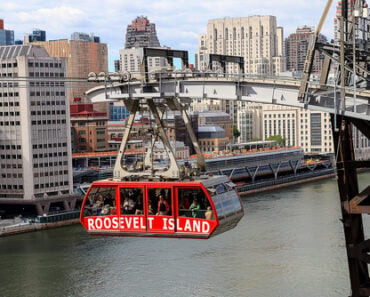
The Roosevelt Island Tramway itself is not free. It uses the same fare structure as the MTA and accepts MetroCard and OMNY. The free attraction on this entry is Four Freedoms State Park, not the tram ride.
16. Free Tickets to New York TV Tapings Instead of Paying for a Comedy Show
What It Is: Free studio-audience opportunities for television programs taped in New York, including The Tonight Show Starring Jimmy Fallon, Late Night with Seth Meyers, Saturday Night Live, The Daily Show, and other productions depending on the current television season.
Why It’s Better: Audience tickets and ticket requests for many television tapings are free, although getting one can require an advance request, lottery, standby line, or a little luck. Availability changes constantly and a request does not guarantee admission. One important 2026 change: The Late Show with Stephen Colbert, which appeared in older New York taping guides, ended with its series finale on May 21, 2026.
17. Federal Hall National Memorial Instead of a Paid Financial District Tour
What It Is: The National Park Service site at 26 Wall Street marking the location of the earlier Federal Hall where George Washington took the oath of office as the first President of the United States on April 30, 1789.
Why It’s Better: Admission is free, and National Park Service programs are also free. One important historical distinction is that the Greek Revival building visitors see today is not the structure in which Washington was inaugurated. The present building was completed in 1842 as the U.S. Custom House on the same historic site.
18. St. Patrick’s Cathedral Instead of Paying for an Architectural Tour
What It Is: The great Gothic Revival cathedral on Fifth Avenue between East 50th and 51st Streets, directly across from Rockefeller Center.
Why It’s Better: St. Patrick’s Cathedral is free to enter for prayer and worship, giving visitors access to one of Midtown Manhattan’s most famous sacred interiors without purchasing an admission ticket. Official audio and guided-tour experiences cost extra, so tourists should respect the church’s rules and religious purpose. For its history, read our History of St. Patrick’s Cathedral in NYC.
19. Walking Through DUMBO and the Washington Street View Instead of a Paid Photo Tour
What It Is: A walk through DUMBO’s cobblestone streets, converted industrial buildings, waterfront parks, and the famous Washington Street view framing the Manhattan Bridge.
Why It’s Better: The neighborhood gives photographers and sightseers some of Brooklyn’s most recognizable urban views without a tour fee. From Washington Street, it is only a short walk to Brooklyn Bridge Park, Empire Fulton Ferry, Jane’s Carousel, and the waterfront below the Brooklyn and Manhattan Bridges.
20. Prospect Park’s Long Meadow and Ravine Instead of a Ticketed Garden
What It Is: Frederick Law Olmsted and Calvert Vaux’s 526-acre Brooklyn park, built around broad lawns, woodland, water, and recreational spaces.
Why It’s Better: Prospect Park offers an enormous landscape without an admission fee. The Long Meadow provides a sweeping open lawn, while the Ravine creates a deeply wooded experience with streams, paths, and rustic scenery. It can feel considerably removed from city streets despite being surrounded by Brooklyn neighborhoods. Read more in our History of Brooklyn’s Prospect Park.
More Free and Historic New York Experiences
Many of New York’s best free experiences are also among its most historic places. For more, explore our History of the Brooklyn Bridge, History of New York’s Central Park, Grand Central Terminal, A Postmodern Cathedral, History of Brooklyn’s Prospect Park, and History of St. Patrick’s Cathedral in NYC.
Sources
NYC Department of Transportation: Staten Island Ferry
The New York Public Library: Stephen A. Schwarzman Building Tours and Rose Main Reading Room Access
NYC Department of Transportation: Brooklyn Bridge
Central Park Conservancy: The Ramble
Downtown Boathouse: Free Kayaking at Pier 26
Brooklyn Bridge Park: Free Public Kayaking
The High Line: Visitor Information
Grand Central Terminal: Visitor Information
Brooklyn Bridge Park: Visitor Information
Governors Island: Ferry Fares and Schedules
The Public Theater: Free Shakespeare in the Park
City Parks Foundation: SummerStage
Smithsonian National Museum of the American Indian: New York Visitor Information
Green-Wood Cemetery: Plan a Visit
Four Freedoms Park Conservancy: Franklin D. Roosevelt Four Freedoms State Park
Roosevelt Island Operating Corporation: Tram Fare Information
NBC: Live Studio Audience Ticket Information
1iota: Free Television Audience Tickets
CBS: The Late Show with Stephen Colbert Series Finale
National Park Service: Federal Hall National Memorial
St. Patrick’s Cathedral: Visitor and Tour Information