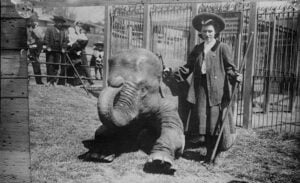
Hattie the elephant at the Central Park Zoo with Hattie Snyder. Photo: Bain News Service, Library of Congress, LC-DIG-ggbain-00286. No known restrictions on publication.
New York City may be known as a concrete jungle, but its history is filled with real animal celebrities. Some became famous because of extraordinary acts of courage. Others were zoo stars, urban wildlife pioneers, or unlikely creatures whose stories became inseparable from the city itself.
From Balto and Jumbo to Pale Male, Flaco, Ming, and even Pizza Rat, these animals became part of New York folklore in very different ways. Some were celebrated in their own lifetimes, some became symbols of larger changes in the way New Yorkers think about animals, and a few became famous almost overnight.
1. Balto the Sled Dog
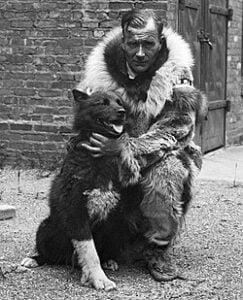
Photo: Brown Brothers, Public domain, via Wikimedia Commons
Era of Fame: 1925
New York Connection: Central Park
In January 1925, a diphtheria outbreak threatened Nome, Alaska. With severe winter conditions making air travel impossible, 20 sled-dog teams relayed antitoxin from Nenana to Nome across hundreds of miles of frozen terrain. Balto, a Siberian husky led by musher Gunnar Kaasen, headed the team that completed the final leg into Nome on February 2, 1925.
The rescue captured international attention, and New York quickly made Balto one of its own heroes. Sculptor Frederick George Richard Roth created the bronze Balto monument that stands near East Drive and 67th Street in Central Park. The statue was unveiled on December 17, 1925, with both Balto and Kaasen present. The Central Park Conservancy notes that Balto is the only honoree of a Central Park statue known to have been present for the unveiling of his own monument.
2. Jumbo the Elephant
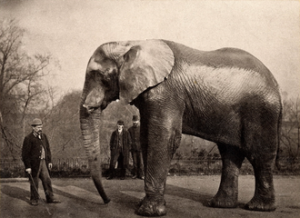
Photo: Edward Bierstadt, Public domain, via Wikimedia Commons
Era of Fame: 1882–1885
New York Connection: Madison Square Garden and the Brooklyn Bridge
P.T. Barnum purchased Jumbo from the Zoological Society of London in 1882 and brought the enormous African elephant to the United States, where he immediately became one of the biggest attractions in Barnum’s circus. Jumbo drew tremendous crowds during appearances at Madison Square Garden and became so famous that his name helped popularize “jumbo” as a word associated with enormous size.
Jumbo’s most famous New York appearance outside the circus came on May 17, 1884. A year after a deadly panic on the newly opened Brooklyn Bridge had intensified public fears about its safety, Barnum marched 21 elephants and 17 camels across the bridge from Manhattan to Brooklyn. Jumbo was part of the extraordinary procession, which became one of the most memorable publicity stunts in New York history.
3. Pale Male, the Red-Tailed Hawk of Fifth Avenue
Era of Fame: 1991–2023
New York Connection: Central Park and 927 Fifth Avenue
Pale Male was first noticed in Central Park as a juvenile red-tailed hawk in 1991 and became famous after establishing a nest on the apartment building at 927 Fifth Avenue. He was one of the first red-tailed hawks widely documented nesting on a New York City building rather than in a tree, and generations of New Yorkers gathered around Central Park’s Model Boat Pond to watch him and his mates raise young above Fifth Avenue.
His greatest public drama came in December 2004, when the building removed the nest and the anti-pigeon spikes that had supported it. Birdwatchers and conservation groups protested outside the building, and the nest support was restored. Pale Male became an international symbol of urban wildlife adapting to the city. A hawk believed to be Pale Male died in May 2023 after being found ill in Central Park, although because he was never banded, ornithologists note that his identity in his final years cannot be established with absolute certainty.
4. Pattycake the Gorilla
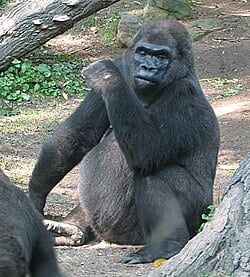
GothEric from Italy, CC BY-SA 2.0 <https://creativecommons.org/licenses/by-sa/2.0>, via Wikimedia Commons
Era of Fame: 1972–2013
New York Connection: Central Park Zoo and Bronx Zoo
Pattycake was born at the Central Park Zoo on September 3, 1972, becoming the first gorilla born in New York City. Her birth made her an immediate celebrity, and New Yorkers closely followed her life from infancy. When she broke an arm at five months old, the story received extensive press coverage as she was taken to the Bronx Zoo’s animal hospital for treatment.
Pattycake moved permanently to the Bronx Zoo in 1983. She eventually had 10 offspring, including twins, and became one of the zoo’s best-known animals. When she died in 2013 at age 40, the Wildlife Conservation Society described her as an institution in New York City and noted that millions of children had grown up visiting her.
5. Buddy, the First Seeing Eye Dog
Era of Fame: 1928
New York Connection: West Street in Manhattan
In 1928, Morris Frank, a young blind man from Tennessee, traveled to Switzerland to learn how to work with a German shepherd trained by Dorothy Harrison Eustis and Jack Humphrey. The dog’s original name was Kiss, but Frank renamed her Buddy.
Frank and Buddy arrived in New York City on June 11, 1928, where skeptical reporters gathered to see whether a dog could really guide a blind person safely through city traffic. Buddy led Frank across dangerous West Street in Manhattan, astonishing the onlookers. Frank sent Eustis a one-word telegram: “Success.” Their demonstration helped lead to the creation of The Seeing Eye in 1929, the world’s oldest existing guide-dog school.
6. Flaco the Eurasian Eagle-Owl
Era of Fame: 2023–2024
New York Connection: Central Park and Manhattan
Flaco became one of New York’s most famous wild-living animals after his enclosure at the Central Park Zoo was vandalized on February 2, 2023. Someone cut through the enclosure’s stainless-steel mesh, allowing the Eurasian eagle-owl to escape into Central Park.
Zoo staff initially worried about whether an owl that had lived in captivity could survive on its own, but Flaco began hunting successfully and spent more than a year moving through Central Park and other Manhattan neighborhoods. His flights, roosts, and nighttime calls attracted enormous public attention. Flaco died on February 23, 2024, after reportedly colliding with a building on West 89th Street. Later testing by the Wildlife Conservation Society found that he had also suffered from severe pigeon herpesvirus infection and exposure to four anticoagulant rodenticides, underscoring the dangers urban wildlife faces even when it appears to be thriving.
7. Ming the Harlem Tiger
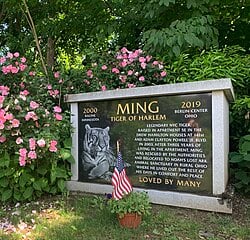
Photo: HenryJonesnyc, CC BY-SA 4.0 <https://creativecommons.org/licenses/by-sa/4.0>, via Wikimedia Commons
Era of Fame: 2003
New York Connection: Drew-Hamilton Houses, Harlem
In October 2003, New Yorkers learned that an adult tiger had been living inside a Harlem apartment. Ming was kept by Antoine Yates in a fifth-floor apartment in the Drew-Hamilton Houses, along with other animals that included an alligator named Al. The astonishing story became national news after Yates sought medical treatment for injuries caused by the tiger.
NYPD officers eventually located Ming inside the apartment. Officer Martin Duffy rappelled down the exterior of the building so the tiger could be tranquilized and removed safely. Contemporary reports described Ming as weighing roughly 400 pounds. Later genomic research showed that Ming did not belong neatly to a simple “Siberian-Bengal hybrid” category; his ancestry was admixed across several tiger subspecies. Ming spent the rest of his life at an animal sanctuary in Ohio and died in 2019.
8. Hattie the Elephant
Hattie the elephant at the Central Park Zoo with Hattie Snyder. Photo: Bain News Service, Library of Congress, LC-DIG-ggbain-00286. No known restrictions on publication.
Era of Fame: 1903–1922
New York Connection: Central Park Menagerie
Long before the modern Central Park Zoo, Hattie was one of the great stars of the old Central Park Menagerie. She arrived in New York in 1903 after being brought from Ceylon, now Sri Lanka, and was trained by longtime animal keeper Bill Snyder.
Hattie became famous for her intelligence and performances, attracting generations of New Yorkers to the menagerie. Newspapers of the period described her in extraordinary terms, and surviving photographs show the elephant with members of the Snyder family. Hattie died in November 1922 after nearly two decades as one of Central Park’s most beloved animals. The Library of Congress preserves a remarkable Bain News Service photograph of Hattie and trainer Hattie Snyder with no known restrictions on publication.
9. Gus the Polar Bear
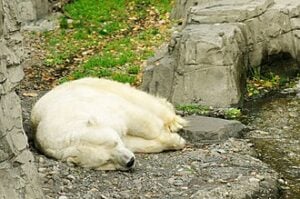
Photo: Marie-Lan Nguyen, CC BY 2.0 <https://creativecommons.org/licenses/by/2.0>, via Wikimedia Commons
Era of Fame: 1988–2013
New York Connection: Central Park Zoo
Gus arrived at the newly redesigned Central Park Zoo in 1988 and became one of its defining animals. The Wildlife Conservation Society estimated that more than 20 million people saw him during his years in Manhattan, making him one of the most widely recognized zoo animals in New York history.
In 1994, Gus attracted national attention because of a repetitive swimming pattern that raised concerns about his well-being. Zoo staff responded with an enrichment program that included movable objects, foraging activities, positive-reinforcement training, and other changes designed to keep him mentally and physically active. The episode turned Gus into an unlikely symbol of the pressures of life in New York while also drawing attention to changing standards of animal care. He died in 2013 at age 27 after veterinarians discovered an inoperable tumor.
10. Pizza Rat
Era of Fame: 2015
New York Connection: First Avenue L train station, East Village
Unlike every other animal on this list, nobody knew Pizza Rat’s name, age, history, or what happened after the cameras stopped rolling. None of that mattered. In September 2015, comedian Matt Little recorded a rat dragging a slice of pizza down the stairs at the First Avenue L train station in the East Village.
The 14-second clip went viral almost immediately. Within hours, Pizza Rat was being treated as a miniature symbol of New York determination: overmatched, hungry, carrying too much, but refusing to give up. The video generated millions of views, memes, Halloween costumes, parody accounts, and international coverage. A performance artist later claimed that the episode had been staged with a trained rat, but Little denied any involvement in a hoax. Whatever the truth behind the encounter, Pizza Rat had already entered New York folklore.
More New York Parks, Zoos, and Animal History
Many of New York’s most famous animal stories are inseparable from the city’s parks and public institutions. For more, read our History of New York’s Central Park, explore the History of the Bronx Zoo, and revisit the extraordinary history of the Brooklyn Bridge.
Sources
Central Park Conservancy: From Alaska to Central Park — Balto the Siberian Husky
History: P.T. Barnum, Jumbo, and the Brooklyn Bridge Elephant Procession
NYC Bird Alliance: Red-Tailed Hawks in New York City and Pale Male
National Audubon Society: Pale Male and the 2004 Fifth Avenue Nest Protest
Wildlife Conservation Society: Pattycake, First Gorilla Born in New York City
The Seeing Eye: Morris Frank and Buddy
Wildlife Conservation Society: Flaco Postmortem Testing Results
CBS New York: Ming, the Harlem Apartment Tiger
Journal of Heredity: Genomic Ancestry of Ming, the Harlem Tiger
Library of Congress: Hattie the Elephant and Hattie Snyder
Wildlife Conservation Society: Gus the Central Park Zoo Polar Bear
The Washington Post: The Rise of Pizza Rat
FOX 5 New York: Pizza Rat at the First Avenue L Station