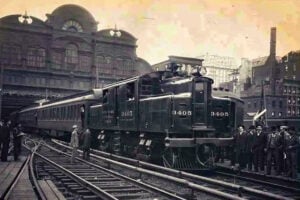
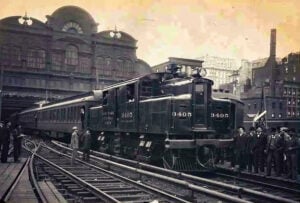
An early New York Central electric train at Grand Central in 1906, during the railroad’s transition from steam to electric power. Public domain, via the New York Public Library.
Two disasters helped define the transformation of the railroad complex at 42nd Street from the steam era into the electric age, but they did so in very different ways. The first was the deadly Park Avenue Tunnel collision of January 8, 1902, which intensified public pressure to eliminate steam locomotives from the approach to Grand Central. The second was the Pintsch gas explosion of December 19, 1910, which struck the railroad yards while the new Grand Central Terminal was still under construction.
The two events are sometimes blended together in retellings of Grand Central history, but the chronology matters. The 1902 crash was the catastrophe directly associated with the push toward railroad electrification and the rebuilding of Grand Central. The 1910 explosion came years after that decision had already been made and electric service was already operating. Its immediate legacy was different: it exposed the danger of storing and handling compressed illuminating gas in the middle of Manhattan.
Grand Central Before Electrification
Cornelius Vanderbilt’s Grand Central Depot opened at 42nd Street in 1871. The complex was expanded and rebuilt near the end of the 19th century and became known as Grand Central Station. Despite those improvements, steam locomotives still approached the station through the Park Avenue tunnel and open-cut railroad corridor north of 42nd Street.
The smoke, soot, and steam produced by those locomotives had become more than a nuisance. Visibility inside the tunnel could deteriorate badly, making railroad signals difficult for engineers to see. New York Central chief engineer William J. Wilgus had already advocated electrifying the approach to Grand Central before 1902, but the expense of such a massive conversion had delayed action.
The 1902 Park Avenue Tunnel Crash
On the morning of January 8, 1902, a commuter train from Danbury, Connecticut, was stopped in the smoke-filled Park Avenue Tunnel near 56th Street while waiting to proceed toward Grand Central. The train carried many passengers who had boarded in New Rochelle.
A New York Central express from White Plains entered the tunnel behind it. Engineer John M. Wisker failed to see warning signals in the poor visibility, and his locomotive crashed into the rear of the stopped train. The engine drove into the wooden passenger cars with devastating force.
Fifteen people were killed in the immediate collision and dozens were injured. Later contemporary reports and the coroner’s proceedings placed the final death toll at 17. Wisker was initially blamed, but a coroner’s jury ultimately exonerated him and his fireman and placed responsibility for the dangerous conditions on the railroad.
How the Crash Accelerated Grand Central Electrification
The crash produced enormous public outrage, but it did not create the idea of electrification from nothing. Wilgus and other engineers had already been studying electric operation. What the disaster did was make continued steam operation politically and publicly unacceptable.
In 1903, New York State enacted legislation requiring the New York Central’s Park Avenue approach south of the Harlem River to abandon normal steam-locomotive operation after the railroad completed the required reconstruction, effectively setting a 1908 deadline for the conversion. The railroad began introducing electric service before that deadline.
Electrification made it possible for Wilgus to propose something far more ambitious than simply replacing locomotives. The tracks approaching Grand Central could be buried, stacked on two underground levels, and covered by valuable real estate. The enormous project allowed the railroad to rebuild the terminal while creating what became Terminal City above the tracks.
The 1910 Grand Central Pintsch Gas Explosion
By December 1910, the transformation of Grand Central was already well underway. The old Grand Central Station was being demolished in stages, construction of the new terminal continued around active railroad operations, and electric trains were already using the rebuilt approach.
Passenger railroad cars of the period, however, still commonly used Pintsch gas for lighting. The compressed illuminating gas was stored and distributed through equipment in the railroad yards. That system created a very different hazard from the steam smoke that had contributed to the 1902 crash.
On the morning of December 19, 1910, a railroad movement near 50th Street and Lexington Avenue overran a bumper and damaged piping connected to the Pintsch gas system. Contemporary investigations reported that a large quantity of gas escaped for roughly half an hour before it ignited. The precise ignition source was never established with certainty.
The Explosion at 50th Street and Lexington Avenue
The resulting blast devastated part of the railroad’s substation and power-house complex and sent debris into the surrounding streets. Windows were shattered across the neighborhood, buildings were damaged, and people outside the railroad property were caught in the explosion.
A Lexington Avenue streetcar passing the area was lifted from the tracks and thrown onto an automobile. Four streetcar passengers were among those killed. Later contemporary accounts settled on a death toll of 10 people with 117 injured, although early newspaper reports varied as rescuers searched the wreckage and hospitals treated the wounded.
The blast was widely reported throughout the country and immediately raised questions about why large quantities of compressed illuminating gas were being stored and distributed in such a dense section of Manhattan.
What the 1910 Explosion Actually Changed
The 1910 explosion did not cause Grand Central’s conversion from steam to electric trains. That transition had been set in motion years earlier following the 1902 crash, and electric railroad service was already operating by the time of the gas disaster.
The explosion instead focused attention on the Pintsch gas system. New York City’s Municipal Explosives Commission investigated the disaster and concluded that railroad cars should no longer be supplied with Pintsch gas inside Manhattan. The commission specifically recommended that the railroad arrange to gas its cars somewhere outside the borough.
This distinction is important. The 1902 crash exposed the danger of steam locomotive operation in the Park Avenue approach. The 1910 explosion exposed the danger of compressed illuminating gas in the Grand Central yards. They were separate disasters involving different technologies and different safety failures.
Grand Central Terminal Opens in 1913
Grand Central Terminal officially opened on February 2, 1913. Its underground tracks, electric railroad operation, two-level track layout, ramps, concourses, and development above the rail yards represented a dramatic break with the 19th-century terminal that had preceded it.
The new terminal was not created by one disaster alone. Increasing passenger traffic, rising land values, competition from the Pennsylvania Railroad, advances in electric traction, and William J. Wilgus’s ambitious engineering and real-estate strategy all played major roles. But the 1902 Park Avenue Tunnel crash gave electrification an urgency that could no longer be ignored, while the 1910 explosion became another stark reminder of the dangers created by older railroad technologies in the heart of Manhattan.
Readers interested in more New York railroad history can also explore our Grand Central Terminal, A Postmodern Cathedral, History of New York’s Pennsylvania Station (Penn Station), 10 Lost New York Transit Lines, Terminals & Ferries That Built the City, and 10 Oldest Subway Stations in NYC Still Operating.