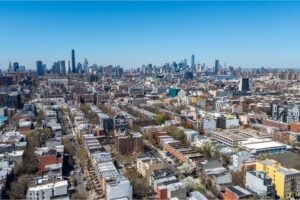
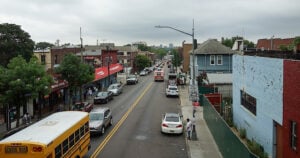
 Featured photograph: Tdorante10 / Wikimedia Commons, licensed under CC BY-SA 4.0. Cropped and resized from the original photograph.
On a residential block of 107th Street in Corona, Queens, stands the house where Louis Armstrong lived for nearly three decades. A short distance away, Dizzy Gillespie maintained a home with a basement rehearsal space. Several other jazz musicians settled in the neighborhood, including Cannonball and Nat Adderley, Jimmy Heath, and Clark Terry. The concentration of musical talent was extraordinary, but it was only one part of Corona’s story.
This Queens neighborhood has also been home to a pioneering scientist, a cosmetics entrepreneur, an Academy Award-winning filmmaker, Broadway performers, hip-hop artists, public officials, and a future pop superstar who briefly rehearsed with a band in a converted religious building. Their connections to Corona span different generations and very different experiences of New York City. Some grew up on its streets; others found a home there after they had already become famous.
That distinction matters. This is not a list of 25 people who were all born in Corona. Each person below has a documented connection through birth, childhood, or actual residence in the neighborhood. It also matters that Corona and neighboring East Elmhurst are not interchangeable names. Both have remarkable histories, but this list concentrates on people whose ties can be traced specifically to Corona.
1. Louis Armstrong
Louis Armstrong was born in New Orleans, not Queens, but Corona became his permanent New York home. In 1943, his wife Lucille arranged to buy the house at 34-56 107th Street while the trumpet player and singer was frequently away on the road. Armstrong embraced the neighborhood and remained there until his death in 1971. His worldwide fame did not persuade the couple to abandon the modest residential block for a more fashionable Manhattan address.
By the time he settled in Corona, Armstrong had already transformed jazz through the Hot Five and Hot Seven recordings and his exceptional ability as a soloist. Later generations knew his unmistakable singing voice from recordings such as “Hello, Dolly!” and “What a Wonderful World.” He also made recordings and home tapes in Corona, preserving the sounds of his household and neighborhood. The Louis Armstrong House Museum now preserves the residence and gives visitors a rare opportunity to connect the musician’s public career with his everyday life in Queens.
2. Martin Scorsese
Martin Scorsese is so closely associated with Manhattan’s Little Italy that his early childhood in Corona is often overlooked. His family lived in a house in the Queens neighborhood during the first years of his life. In an interview with the National Endowment for the Humanities, Scorsese remembered Corona as something close to paradise for a child, with a yard and room to explore. A dispute involving the family’s landlord eventually led them back to Elizabeth Street in Manhattan when Martin was still young.
Manhattan became the setting for much of the filmmaker’s early work, especially Mean Streets, but Corona remained part of the family story that preceded those films. Scorsese went on to direct Taxi Driver, Raging Bull, Goodfellas, The Departed, and many other major pictures. He won the Academy Award for Best Director for The Departed. The Corona connection should not be mistaken for a claim that he grew up entirely in Queens; it was an important early chapter before his family returned to Little Italy.
3. Estée Lauder
Long before Estée Lauder’s name appeared on cosmetics counters around the world, she was Josephine Esther Mentzer, a girl growing up in Corona. Her parents lived above the hardware business operated by her father, Max Mentzer. Accounts of her childhood describe a lively immigrant neighborhood and a family business that gave her an early view of merchandising, display, and the relationship between shopkeepers and customers.
Lauder later developed her interest in skincare products into one of the most recognizable beauty companies in the world. With her husband, Joseph Lauder, she established the company in 1946. Sampling products, direct demonstrations, and gifts with purchases became important elements of its marketing. The scale of the business she built is remarkable, but the contrast is even more striking when set beside its beginnings: a young woman above a Corona hardware store who learned that presentation and personal attention could be as important as the merchandise itself.
4. Dizzy Gillespie
John Birks “Dizzy” Gillespie grew up in South Carolina and developed his career in the jazz world of New York, but one of his most important homes was in Corona. In 1953, he purchased a property at 105-19 37th Avenue and lived there until 1965. The house included a basement rehearsal studio where other musicians could gather, work through arrangements, and exchange ideas. In 2023, New York City designated the property an individual landmark in recognition of that history.
Gillespie helped develop bebop with musicians including Charlie Parker and became known for his remarkable trumpet technique, compositions such as “A Night in Tunisia,” and the bent-bell instrument that became his trademark. During his Corona years, he also represented American jazz abroad, including on a State Department-sponsored tour in 1956. The fact that he lived only a short distance from Louis Armstrong captures something special about the neighborhood: two artists from different generations of jazz made their homes on ordinary Queens streets.
5. Madonna
Madonna’s childhood was in Michigan, but an early and formative stage of her music career unfolded in Corona. In 1979, before she was famous, she moved in with musician Dan Gilroy and his brother Ed, who used a former religious-school building on 53rd Avenue as living and rehearsal space. Historic preservation records identify the property near Congregation Tifereth Israel and document Madonna’s time there during 1979 and 1980.
She played drums and worked on music with the Gilroys’ band, Breakfast Club, while developing skills and confidence that would serve her later solo career. The cramped, improvised setting was a world away from the large venues and elaborate productions she eventually commanded. That is what makes her Corona connection interesting: it belongs to the period when Madonna was still a young performer trying to establish herself in New York, not to the years when she was already a global star.
6. Burt Young
Actor Burt Young grew up in Corona and spoke openly about his Queens childhood and family. Born in 1940, he was raised in a working-class household and developed an early interest in boxing. He served in the Marine Corps before training as an actor under Lee Strasberg. His route into the movies was hardly conventional, and his experience outside the theater helped him establish a natural, convincing screen presence.
Young became internationally recognized for playing Paulie Pennino, Rocky Balboa’s brother-in-law and friend, in the Rocky films. The first picture earned him an Academy Award nomination for Best Supporting Actor. He also appeared in Chinatown, Once Upon a Time in America, and many other productions, and he pursued painting and writing. His roles often involved complicated, rough-edged characters, but his Corona upbringing is a concrete biographical connection rather than a reason to reduce either the neighborhood or the actor to a stereotype.
7. Marie Maynard Daly
Marie Maynard Daly grew up in Corona in a family that placed enormous importance on education. Her father, Ivan Daly, had pursued chemistry at Cornell University but was unable to complete his studies for financial reasons. Marie developed her own interest in science, attended Hunter College High School in Manhattan, and graduated from Queens College in 1942 before earning a master’s degree at New York University.
In 1947, Daly became the first Black woman in the United States to earn a Ph.D. in chemistry, receiving the degree from Columbia University. Her subsequent research investigated the chemistry of cells, the synthesis of proteins, and the connections between cholesterol, diet, and cardiovascular disease. She also worked to expand educational opportunities for students underrepresented in scientific careers. The American Chemical Society honored her achievements with a National Historic Chemical Landmark designation in 2023. Corona’s history includes this pioneering scientist just as surely as it includes the neighborhood’s better-known musicians.
8. Kool G Rap
Rapper Kool G Rap, born Nathaniel Wilson, has spoken directly about growing up in Corona during the early years of hip-hop. In interviews, he recalled the neighborhood’s tensions and street life, but also the excitement of encountering DJs and rappers at local gatherings. One of his formative memories was hearing music and seeing a DJ working with breakbeats at a neighborhood event while he was still a boy.
As part of the Juice Crew and later in recordings with DJ Polo, Kool G Rap developed a reputation for dense rhyme patterns and vividly detailed storytelling. The duo’s 1989 album Road to the Riches became an influential hip-hop release. His impact on later rappers extends well beyond Queens, but his account of discovering the music in Corona is especially valuable because it comes from the artist himself rather than from a generalized claim that the neighborhood must have inspired him.
9. Cannonball Adderley
Julian “Cannonball” Adderley was born in Florida and became one of jazz’s great alto saxophonists. As an established musician, he made his home in Corona at the Dorie Miller Cooperative Houses on Northern Boulevard. The development, built in the early 1950s, is an important part of the neighborhood’s history because it offered integrated housing at a time when discrimination limited residential choices in many parts of the city.
Adderley’s playing brought together bebop technique, the blues, and a warm, immediately recognizable sound. He worked with Miles Davis, appearing on the celebrated album Kind of Blue, and led successful groups with his brother Nat. Recordings such as “Mercy, Mercy, Mercy” made his music familiar to audiences well beyond the jazz-club circuit. The brothers’ residence in the same Corona cooperative as other musicians illustrates how the neighborhood became a real community of working artists, not merely a collection of unrelated celebrity addresses.
10. Nat Adderley
Nat Adderley, Cannonball’s younger brother, was an accomplished cornetist and composer in his own right. Like Cannonball, he lived in Corona’s Dorie Miller Cooperative Houses. That address provides a clear neighborhood connection; he was not a native-born Queens musician. Living near colleagues and fellow performers was part of a broader pattern in which professional jazz players established homes in Corona while continuing to work in Manhattan and travel extensively.
Nat contributed an unmistakable sound to the Cannonball Adderley Quintet and composed “Work Song,” one of the most enduring jazz pieces associated with his name. He also wrote “Jive Samba” and recorded as a bandleader, showing that his career was far more than an extension of his brother’s. His place in Corona’s history reflects both family collaboration and the professional relationships that helped make the neighborhood such an unusual center of jazz talent.
11. Jimmy Heath
Jimmy Heath came from Philadelphia and had already built a serious career as a saxophonist and arranger before settling in Corona. In a JazzTimes interview, he explained that Clark Terry helped him obtain an application for the Dorie Miller cooperative in 1964. Heath and his wife made their home there, and he continued composing and practicing in a home studio long after other well-known musicians had moved away or died.
Heath worked with leading jazz figures, wrote compositions performed by major artists, and became a respected educator. His brothers Percy Heath and Albert “Tootie” Heath were also accomplished musicians, and together they formed the Heath Brothers. Known for his melodic writing and inventive arrangements, Jimmy Heath remained active well into later life. His long residence gives Corona a connection that goes beyond the celebrated jazz boom of the 1950s: he helped carry that musical tradition into subsequent generations.
12. Donna Murphy
Broadway actress Donna Murphy was born in Corona, Queens, although her family did not remain there throughout her childhood. She was subsequently raised in Hauppauge on Long Island and in Topsfield, Massachusetts. That makes her an example of a genuine Corona birthplace rather than someone whose entire early education or artistic development took place in the neighborhood.
Murphy became one of the American musical theater’s most admired leading performers. She won Tony Awards for her work in Stephen Sondheim and James Lapine’s Passion in 1994 and a revival of The King and I in 1996. Her later career has included film and television work, among it voicing Mother Gothel in Disney’s Tangled. She belongs on this list because her birthplace is documented, while her later upbringing should be described accurately rather than rewritten as a lifelong Corona story.
13. Cecil Taylor
Pianist Cecil Taylor was born in Long Island City and raised in Corona. His family encouraged an early musical education, and he studied classical piano while growing up in Queens. His mother was particularly important in introducing him to music and other arts. Those formative experiences preceded his later studies at the New England Conservatory and his emergence as one of the most uncompromising performers in modern jazz.
Taylor’s 1956 recording Jazz Advance introduced an approach to improvisation that broke sharply with many established jazz conventions. His fiercely percussive piano style, long-form performances, and interest in musical structure helped shape free jazz and experimental performance. He was named a National Endowment for the Arts Jazz Master in 1990 and received a MacArthur Fellowship in 1991. Unlike the musicians who moved to Corona after their careers were established, Taylor’s connection goes back to the neighborhood in which he grew up.
14. Calvin O. Butts III
The Reverend Calvin O. Butts III spent part of his childhood in Corona after his family moved from Manhattan to Queens. His education included traveling from Corona to Russell Sage Junior High School in Forest Hills, followed by Flushing High School, where he became senior-class president. His early life connected him with the changing educational and social landscape of postwar Queens, even though his future ministry would become closely associated with Harlem.
Butts went on to study at Morehouse College and Union Theological Seminary. He became the influential pastor of Harlem’s Abyssinian Baptist Church and also served as president of SUNY Old Westbury, combining religious leadership with a sustained commitment to higher education and community development. His work reached across New York City and Long Island. The Corona connection is specific to his upbringing, not a claim that his later professional career was centered in the neighborhood.
15. Crockett Johnson
The artist known as Crockett Johnson was born David Johnson Leisk in Manhattan, but much of his childhood took place in Corona. His family moved to a house at what is now 104-11 39th Avenue when he was about six years old. Biographer Philip Nel has documented the address and the years Johnson spent in Queens, and local preservation advocates later called attention to the building because of its connection to the future author and illustrator.
Johnson became known for the comic strip Barnaby and, above all, for his 1955 children’s book Harold and the Purple Crayon. The book’s spare drawings and imaginative story have remained popular through generations of readers. In later life, Johnson also pursued mathematical paintings that reflected his interest in visual form and ideas. His Corona childhood is worth telling precisely because it places a familiar figure from children’s literature in a recognizable Queens neighborhood long before his best-known book appeared.
16. Omar Minaya
Baseball executive Omar Minaya was born in the Dominican Republic and grew up in Corona after moving to New York as a child. The neighborhood’s proximity to Shea Stadium gave him a connection to baseball’s Queens setting long before he became a major league executive. When he returned to the Mets organization in 2017, he spoke about his continuing ties to Corona and nearby Jackson Heights.
Minaya worked his way through baseball scouting and front-office positions, becoming Major League Baseball’s first Latino general manager when the Montreal Expos appointed him in 2002. He later served as general manager of the New York Mets, building a roster that reached the National League Championship Series in 2006. His story is a reminder that Corona’s contributions extend beyond music and the arts to the leadership of professional sports.
17. Arnold Friedman
Painter Arnold Friedman lived and worked in Corona while supporting his family through a long career in the United States Postal Service. His attic studio allowed him to paint outside the hours of his regular job. Art historians have documented his local home and his studies with Robert Henri at the Art Students League of New York. The contrast between postal work and artistic experimentation was part of his life, not evidence that he was unknown to every serious collector.
Friedman developed a personal approach to landscapes, portraits, and still lifes, and his work attracted the attention of critics including Clement Greenberg. In 1940, the Metropolitan Museum of Art acquired his painting Unemployable, a significant recognition for an artist whose career had followed an unconventional course. His story adds another dimension to Corona’s cultural history: an artist whose home studio was in the neighborhood while his professional recognition unfolded in Manhattan galleries and museums.
18. Clark Terry
Clark Terry, the celebrated trumpeter and flugelhorn player, was born in St. Louis and established his career long before becoming a Corona resident. He lived at the Dorie Miller Cooperative Houses, the same development associated with Cannonball and Nat Adderley and Jimmy Heath. It was a genuine residential community for jazz musicians, and Terry’s role in helping Heath obtain a home there illustrates how personal connections contributed to that concentration of talent.
Terry performed with the bands of Count Basie and Duke Ellington and became a familiar figure to television audiences through NBC’s The Tonight Show orchestra. He was among the pioneering Black musicians who broke barriers in network television and later devoted considerable energy to teaching younger players. His warmth as a mentor became as important to many musicians as his recorded work. Corona was one of the places where this busy performer established a life away from the stage.
19. N.O.R.E. (Victor Santiago Jr.)
Rapper N.O.R.E., formerly known as Noreaga, has repeatedly identified himself with LeFrak City, the large residential complex in Corona. He has described growing up there while spending time in other parts of Queens as well. That specificity matters: his connection is to a known neighborhood residence, not simply to the borough in general.
As one half of Capone-N-Noreaga, he helped establish a distinctive Queens sound with the album The War Report in 1997. His solo career produced tracks including “Superthug” and “Nothin’,” and he later reached a new audience through Drink Champs, the long-form interview program he co-founded and hosts with DJ EFN. The move from recording artist to interviewer has made him a prominent figure in conversations about hip-hop history. His LeFrak City roots remain part of the identity he discusses in interviews.
20. Helen Marshall
Helen Marshall was not born in Corona. Her family moved to Queens in 1949 and settled first in Corona before moving to East Elmhurst. Those are separate neighborhoods, and the sequence is documented in materials from Queens Public Library. Marshall became active in community life and education before moving into elected office. Her work with the Langston Hughes Community Library and Cultural Center was an early expression of her commitment to public institutions.
After serving in the New York State Assembly and New York City Council, Marshall became the first Black person to serve as Queens borough president, holding the office from 2002 through 2013. She was an especially determined advocate for libraries, cultural facilities, and public services. A street corner in Corona was later co-named in her honor. Her connection to the neighborhood belongs to her adult residence and early community work, not to a claim that she spent her entire life there.
21. Archie Bleyer
Archie Bleyer was born in Corona in 1909 and grew up in a household where music was familiar. His father had played trumpet professionally, and Bleyer began studying piano as a boy. He enrolled at Columbia University with plans to study engineering but moved toward arranging and professional music instead. His career eventually took him into radio and television as an orchestra leader and musical director.
Bleyer worked with entertainer Arthur Godfrey and founded Cadence Records, which became an important independent label during the 1950s and early 1960s. The company released recordings by the Everly Brothers, Andy Williams, and the Chordettes, among others. His name is less familiar to casual listeners than many of the artists he recorded, but his decisions helped bring their music to a national audience. That is a substantial connection to American popular music for a man whose story began in Corona.
22. Johnny LoBianco
Boxing referee Johnny LoBianco was born in Sicily in 1915 and came to the United States as a young child. He was raised in Corona, where he developed his interest in boxing before moving into professional competition and later officiating. Accounts of his life also describe his work in the family barbershop, an occupation that continued alongside his early involvement in the sport.
LoBianco officiated major fights involving Muhammad Ali, Emile Griffith, and Roberto Durán. His decision in Durán’s 1972 championship victory over Ken Buchanan remains controversial because of the disputed low blow at the end of the fight. Rather than turning his biography into unqualified praise, that episode belongs in an accurate account of his career. He was inducted into the National Italian American Sports Hall of Fame’s 2024 class, a later recognition of a long and sometimes disputed career in boxing.
23. Frankie Manning
Frankie Manning was born in Jacksonville, Florida, and grew up in Harlem, where he encountered the social-dance culture that would shape his career. Corona became his home later in life. The National Endowment for the Arts identified him with Corona when honoring him as a National Heritage Fellow in 2000, and he was still a Corona resident at the time of his death in 2009.
At Harlem’s Savoy Ballroom, Manning became one of the central innovators of the Lindy Hop. As a leading dancer and choreographer with Whitey’s Lindy Hoppers, he helped develop aerial movements and ensemble routines that influenced swing dancing around the world. After years working outside professional dance, he became a major teacher during the swing revival and received a Tony Award for his choreography in Black and Blue in 1989. His later residence gives Corona a direct connection to the preservation and worldwide revival of Lindy Hop.
24. John F. Scileppi
John Francis Scileppi was born in Corona in 1902, the son of Italian immigrant parents. He attended New York City public schools and established a legal career that moved through several levels of the state’s judicial system. Unlike figures who moved to Corona after becoming established elsewhere, his connection begins with his birth and early education in the neighborhood.
Scileppi was elected to the New York Court of Appeals in 1962, becoming the first Italian American to serve on the state’s highest court in the twentieth century and the second in the court’s history. He also served as a trial judge and continued judicial work after his Court of Appeals tenure. The Historical Society of the New York Courts has documented his background and career in detail, making him one of the better-supported legal figures in Corona’s history.
25. Peter T. Farrell
Peter T. Farrell was born in Manhattan in 1900 but grew up in Corona, where he attended school before graduating from Newtown High School. He went on to Cornell University and Fordham Law School, then built a career that included service in the New York State Assembly and Senate. His political and legal work grew out of a longstanding connection to Queens rather than an incidental appearance in the borough.
Farrell later became a judge in Queens and presided over the 1952 trial of bank robber Willie Sutton, who received a lengthy prison sentence. In 1969, Farrell suspended that sentence because of Sutton’s health and record in prison, a decision that attracted renewed attention to the famous case. Farrell remained on the bench for decades. He is another reminder that Corona’s notable residents included people whose careers unfolded in government and the courts, far from the music venues that dominate many accounts of the neighborhood.
Corona’s Place in New York History
What makes Corona unusual is not simply the number of recognizable names associated with it. Different generations found different reasons to live there. Early residents grew up in a developing Queens neighborhood. Jazz musicians established homes at a time when integrated housing opportunities mattered greatly. Later residents built careers in hip-hop, public service, film, and professional sports. No single explanation fits every life on this list.
The Louis Armstrong House Museum and the landmark designation of Dizzy Gillespie’s home preserve two of the most visible connections. Other stories are less obvious: an illustrator’s childhood apartment, a scientist’s family home, a young musician’s temporary rehearsal space, or the Queens upbringing of a judge. Together they show why Corona deserves recognition as a neighborhood with a history of its own, rather than simply a place passed on the way to Flushing Meadows or Manhattan.
Readers interested in the wider borough can explore our 25 Famous People You Didn’t Know Were From Queens, NY and our article on How Queens Neighborhoods Got Their Names, which explains how the name Corona replaced West Flushing. Both provide additional context for the people and places in this neighborhood’s history.