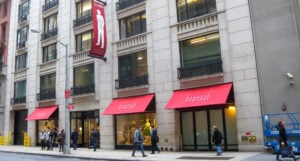
Barneys New York’s former Madison Avenue flagship in Manhattan, photographed in April 2010. Photo by Jim Henderson / Wikimedia Commons (CC0 1.0).
For decades, Barneys New York was one of the few stores in Manhattan that seemed to have a personality all its own. Its Madison Avenue flagship sold expensive designer clothing, but shopping there was about more than finding a suit or a dress. There were the unusual window displays, the carefully chosen designers, and the feeling that you might discover something you had never seen anywhere else. It became a destination for people who followed fashion and for New Yorkers who simply wanted to look around.
That makes its disappearance all the more striking. Barneys began in 1923 as a small discount men’s clothing store in Chelsea, became an influential luxury retailer, and eventually occupied one of the grandest shopping addresses in the city. Yet in 2019 it filed for bankruptcy for the second time, and by February 2020 its remaining American department stores were closed. The name survived through a licensing company and overseas stores, but the New York business that generations knew was gone.
So what happened to Barneys New York? The short answer involves two very different bankruptcies, expensive expansion, changing owners, increasing competition, and a dramatic rent increase at its Madison Avenue flagship. To understand why a store with such a powerful reputation disappeared, it helps to go back to a much more modest corner of Seventh Avenue.
Barney Pressman and the Original Chelsea Store
The story of Barneys begins with Barney Pressman, who opened a men’s clothing store near Seventh Avenue and West 17th Street in 1923. According to the longstanding family account, he raised $500 by pawning his wife Bertha’s engagement ring. The money helped him take over a small storefront and establish Barney’s Clothes, an entirely different kind of business from the luxurious department store that would eventually carry his name.
Pressman understood the customers he wanted to reach. He sold good-quality men’s suits at discounts, obtaining merchandise through manufacturers’ closeouts, overstocks, and other opportunities that enabled him to offer lower prices. His early advertising promised that customers would not have to choose between a respectable suit and a manageable price. Free alterations also gave shoppers a reason to return.
He knew how to get New Yorkers’ attention. Pressman used loud, humorous advertising, including radio spots, and promoted the store with the slogan “No Bunk, No Junk, No Imitations.” It was the opposite of the hushed, exclusive image associated with luxury shopping. The original Barneys was a place where a working New Yorker could buy a suit without feeling that the store was meant for somebody else.
The shop grew along Seventh Avenue as the business attracted more customers. By the middle of the twentieth century, Barneys had established a strong reputation in menswear. But the next generation of the Pressman family would take it in a direction that Barney himself could hardly have imagined when he opened that first storefront.
How Fred Pressman Turned Barneys Into a Fashion Institution
Barney’s son Fred Pressman gradually took a larger role in the family business and began transforming it during the 1960s and 1970s. Instead of building the company’s future around discounted suits, Fred saw an opportunity in designer fashion, particularly clothing coming from Europe. The store expanded its selection and introduced New Yorkers to labels and styles that were not yet readily available in conventional American department stores.
Among the most important relationships was the one Barneys developed with Giorgio Armani. The retailer became an early American champion of Armani’s clothing, helping introduce a more relaxed approach to tailored menswear. By the 1970s, Barneys also moved further into women’s fashion. What had been a discount store was becoming a place where serious fashion customers went to see what was new.
Fred’s sons, Gene and Robert Pressman, later became prominent figures in the business. Robert was closely associated with its financial operations, while Gene helped shape the creative identity that made Barneys such an influential name in fashion. Their approach was not simply to stock every famous designer. They wanted the selection itself to distinguish the store from its competitors.
That curatorial reputation mattered to emerging designers. A place on a Barneys clothing rack could help introduce a relatively unfamiliar label to an audience willing to try something different. The store became associated with discovering talent rather than merely following established fashions, and its influence reached well beyond the customers who could afford to shop there regularly.
What Made Barneys New York Different?
Other New York department stores sold luxury merchandise, but Barneys developed a sharper, more playful identity. Fashion was treated as something that could be adventurous and occasionally funny. The clothes mattered, of course, but so did the presentation, the architecture, and the attitude of the people choosing what appeared on the sales floor.
The window displays became a particularly memorable part of that identity. Simon Doonan began working with Barneys in 1986 and became famous for arrangements that mixed celebrity references, satire, art, and unexpected humor. During the holiday season, those windows provided an alternative to the more traditional Christmas displays elsewhere in Manhattan. You did not have to purchase anything to appreciate what was happening behind the glass.
Then there was Freds, the in-store restaurant that became an important part of the Barneys experience. A shopping trip could turn into lunch, an afternoon with friends, or a chance encounter with somebody from the city’s fashion and entertainment world. Barneys was never simply another building filled with expensive clothes. At its best, it had the atmosphere of a gathering place built around a particular idea of New York style.
The Madison Avenue Gamble
In September 1993, Barneys opened its new flagship at 660 Madison Avenue, near East 61st Street. It was an extraordinary change from the small Chelsea shop that had started the business seventy years earlier. The nine-floor retail palace featured limestone, elaborate interior finishes, and a scale that announced Barneys’ arrival among the city’s leading luxury stores. Contemporary accounts put the cost of the project at approximately $267 million.
The building made a statement, but the financial arrangements behind Barneys’ expansion were complicated. During the late 1980s, the company had entered into a partnership with the Japanese retailer Isetan to finance major projects. The relationship helped fund ambitious stores in Manhattan, Chicago, and Beverly Hills. The Madison Avenue flagship was therefore part of a much larger expansion plan rather than an isolated extravagance.
The new location attracted attention and customers, but expanding so quickly came with substantial obligations. New stores were expensive to build and operate, and strong sales did not automatically translate into enough cash to cover the financing. Meanwhile, the relationship between the Pressman family and Isetan was deteriorating. The problems would soon lead to Barneys’ first trip to bankruptcy court.
Why Barneys Filed for Bankruptcy in 1996
Barneys filed for Chapter 11 bankruptcy protection on January 10, 1996. It is tempting to explain that filing as the unavoidable result of building an extravagant Madison Avenue store. The actual situation was more involved. Barneys and Isetan were engaged in a bitter dispute over loans, financing commitments, and payments connected with the newer properties. Each side accused the other of failing to meet its obligations.
According to contemporary reporting, Isetan sought repayment of approximately $168 million in short-term loans, while Barneys claimed that its partner had withdrawn promised financial support. The dispute unfolded against the larger expense of a rapidly expanded retail business. The Madison Avenue building was part of the story, but the bankruptcy cannot accurately be reduced to one store simply failing to earn enough money.
Barneys continued operating during its restructuring. In December 1998, a bankruptcy judge approved a reorganization that brought in new capital and shifted control toward creditors. The company emerged from bankruptcy in January 1999, but the Pressman family’s era of control had effectively ended. The business survived, even though the family that created it no longer determined its future.
There was another symbolic loss. The original Chelsea store, where Barneys had begun in 1923, closed in 1997. The name remained associated with New York, but the company’s focus had moved far from the corner where Barney Pressman had once sold discounted men’s suits.
The Years of Changing Owners
Following the first bankruptcy, Barneys continued to operate as an upscale fashion retailer. It still had a respected name and an audience of devoted customers. What it no longer had was the stability of a family-owned business pursuing one long-term vision. Its next two decades brought a series of ownership changes, each accompanied by plans to grow, strengthen, or reposition the company.
In December 2004, Jones Apparel Group acquired Barneys in a transaction valued at approximately $397 million, including the repayment of outstanding debt. Jones sold the business in 2007 to an affiliate of the Dubai investment company Istithmar in a deal valued at roughly $942 million before adjustments. The enormous difference between the two transaction prices demonstrated how valuable investors believed the Barneys name could become.
But a high purchase price also created financial pressure. In 2012, another restructuring reduced Barneys’ long-term debt from approximately $590 million to $50 million, with Perry Capital becoming the majority owner. The agreement provided relief, but it was also evidence of how heavily the company had been burdened by its financing.
There were attempts to recapture some of the store’s New York character. In February 2016, Barneys opened a new downtown flagship on Seventh Avenue between West 16th and 17th Streets, returning to the block where the business had begun. The new five-floor store included designer merchandise, a dramatic staircase, and a Freds restaurant. It was a homecoming of sorts, but it came at a time when the economics of department-store retailing were becoming increasingly difficult.
The Madison Avenue Rent Increase and the Final Bankruptcy
By 2019, Barneys faced a combination of falling sales, intense competition, expensive store operations, and serious problems with its leases. Shoppers could find luxury clothing through designer-owned boutiques, online retailers, and competing department stores. A business built around carefully selecting desirable merchandise was finding that customers had many more ways to buy those same brands.
One of the most damaging developments involved the Madison Avenue flagship. Following a rent dispute and arbitration, the store’s annual rent rose from approximately $16.2 million to $27.9 million in 2019, an increase of about 72 percent. That additional expense was especially difficult to absorb when the company was already short of cash. The rent increase became the most visible explanation for the collapse, but company filings and contemporary reporting point to broader operational difficulties as well.
On August 6, 2019, Barneys filed for Chapter 11 bankruptcy protection again. The company initially hoped to keep certain major stores open while seeking a buyer or a new financial arrangement. Other locations and warehouse stores were slated for closure. Unlike the first bankruptcy, however, there would be no reorganization that preserved the familiar American Barneys department-store chain.
Who Bought Barneys New York?
In the autumn of 2019, Authentic Brands Group, working with B. Riley Financial and liquidation partners, acquired the Barneys intellectual property in a deal valued at approximately $271.4 million. The transaction was primarily about the value of the name, trademarks, and licensing opportunities. It was not a purchase intended to keep the original department-store chain operating as New Yorkers had known it.
Liquidation sales followed at the remaining American locations. In February 2020, the last Barneys New York department stores closed, including the Madison Avenue flagship and the downtown Chelsea store. For a company that had opened with a modest men’s clothing shop in 1923, it was an extraordinary ending. The expensive fashion empire had lasted nearly a century, yet its American stores were gone.
The closures also meant the loss of the Barneys experience that could not be reproduced simply by putting its label on another retailer’s shelves. The window displays, the restaurants, the salespeople, and the sense of discovery had all been part of what customers remembered. A trademark could survive the bankruptcy; the original business culture was much harder to preserve.
Is Barneys New York Still Open Anywhere?
The Barneys name did not disappear entirely. Authentic Brands Group acquired the intellectual-property rights and arranged licensing partnerships, including a relationship with Saks Fifth Avenue that led to Barneys-branded shopping areas. That arrangement was very different from an independent Barneys flagship. The American department-store chain itself had closed.
There is also an important international distinction. Licensed Barneys New York stores continued operating in Japan after the American bankruptcy. The official Barneys Japan website currently lists nine stores, including outlet locations, along with an online business. So it would be inaccurate to say that every Barneys store worldwide closed or that the name exists only within Saks.
The American licensing situation changed again in 2026. Following Saks Global’s January bankruptcy filing, reporting indicated that the exclusive U.S. retail rights previously held by Saks had returned to Authentic Brands Group. That development opened the possibility of a new approach to Barneys in the United States, although it did not by itself reopen a store.
Could Barneys New York Return to Madison Avenue?
In April 2026, fashion-business reporting described discussions about a possible return to the former Barneys flagship at 660 Madison Avenue. Authentic Brands Group was reportedly exploring the idea and seeking an operating partner. Other reports discussed the possibility of smaller Barneys stores in the United States. Neither proposal should be confused with a completed reopening or a guarantee that Barneys will again occupy its old Madison Avenue address.
There is an obvious attraction to bringing back a name that many New Yorkers still associate with a particular era of fashion and shopping. Yet reopening a store would require more than putting the familiar black-and-white sign over a doorway. Barneys earned its reputation through its merchandise, the people who selected it, the designers it supported, and the experience of being in the building. Re-creating that combination would be a much bigger undertaking than reviving the trademark.
Why New Yorkers Still Remember Barneys
Barneys New York began with an idea that would have sounded perfectly ordinary to its first customers: sell good clothing for a price people could afford. Over time, the family turned that business into something almost unimaginable from its modest beginnings. It became one of the country’s most influential luxury retailers and helped make Madison Avenue a destination for fashion customers from around the world.
Its end was not caused by one bad decision. The costly expansion of the 1990s, the struggle with Isetan, the loss of family control, successive ownership changes, intense competition, and the 2019 rent increase all played their parts. The second bankruptcy closed the stores, but the business had been under pressure for years.
For anyone who remembers Barneys’ displays or browsing its floors, that is the part of the story that can be hardest to replace. New York has no shortage of places to buy expensive clothing. What it lost was a store with a distinctive sensibility and a history that stretched from discount suits in Chelsea to the height of Madison Avenue luxury. Whether the Barneys name eventually returns to Manhattan or not, the original institution belongs to a very particular chapter of New York retail history.
For more stories about the city’s changing shopping landscape, see our look at 10 Most Famous Department Stores in NYC History and What Happened to Them, our history of Saks Fifth Avenue, and our article on Henri Bendel department stores. Together, these histories show how much New York’s shopping districts have changed and how strongly certain stores remain in the city’s memory.