There are a handful of New York City institutions that feel as though they have always been part of the city and always will be. Saks Fifth Avenue is one of them.
I have gone to Saks my entire life. Everyone remembers Macy’s at Herald Square as the great Christmas store, the place where crowds gathered to look at the windows, and that is true. But Saks Fifth Avenue holds an equally special place in my memory. The windows, the shopping, and the sheer sense of occasion that came with walking through those doors on Fifth Avenue made it more than just a store.
What follows is a deep history of Saks Fifth Avenue, with the focus squarely on the flagship that has anchored Fifth Avenue and 50th Street for more than a century. It is a story of immigrant ambition, two great merchant families, holiday magic, and one very hard year that I will never forget.
The Man Who Started It All: Andrew Saks
The Saks story begins not with luxury but with a poor kid selling newspapers. Andrew Saks was born in Baltimore in 1847 to a German Jewish immigrant family. Before he was out of his teens, he was already working as a peddler and newspaper boy.
In 1867, at just 20 years old, Andrew opened a small men’s clothing store in Washington, D.C., with his brother Isadore under the name A. Saks & Co. The country was only two years removed from the Civil War, and money was tight everywhere.
Andrew had ideas that were ahead of his time. He believed in quality goods, fair dealing, fixed prices, and treating the customer well. That reputation carried the business, and over the next few decades, the Saks name spread to other cities.
From Washington to New York: The Herald Square Store
Andrew Saks set his sights on New York, the largest and most competitive retail market in the country. In 1902, he opened Saks & Company at Herald Square, near Broadway and 34th Street, in the center of the city’s booming shopping district.
He ran it as a true family business, with his brother Isadore and his sons Horace and William all involved. The store stood among the giants of the day, including Macy’s and Gimbels, and it held its own.
Andrew Saks died in 1912. Leadership passed to his Princeton-educated son Horace Saks, who had bigger dreams than 34th Street could contain.
The Merger That Made History: Saks and Gimbels
Here is where the story takes a turn that surprises many people. Saks Fifth Avenue was not born from Saks alone. It emerged through a partnership with the family behind one of its great Herald Square rivals, Gimbels.
In 1923, Saks & Company merged with Gimbel Brothers. Bernard Gimbel, Horace Saks’s cousin, paid off Saks’s debt and acquired approximately $8 million in company stock, while Saks continued operating as a separate business.
The two cousins shared a vision. They wanted to build a specialty store unlike anything else in America, a place that would be synonymous with fashionable and gracious living. They set their sights on a stretch of upper Fifth Avenue that almost no serious retailer would have considered at the time.
The Dream Store: Building the Flagship
The site the partners chose occupied the Fifth Avenue blockfront between 49th and 50th Streets. In the early 1920s, this remained largely a residential and institutional district. The site included the Buckingham Hotel, the Belgravia Apartments, and the National Democratic Club.
It was a gamble. No major department store had opened this far north on Fifth Avenue. Saks and Gimbel were betting that luxury shoppers would follow them uptown and that the address itself would become part of the attraction.
On September 15, 1924, the doors opened, and Saks Fifth Avenue was born. The store took its name from its street, and that name eventually became the identity of the entire chain. Opening day drew enormous crowds, and the gamble on Fifth Avenue was vindicated almost immediately.
The Architecture: A Palace on Fifth Avenue
The building was designed by Starrett & Van Vleck, an architectural firm that specialized in grand department stores. The architects gave Saks a dignified neo-Renaissance palazzo appearance rather than an aggressively commercial facade.
The ten-story structure was faced in Indiana limestone, brick, and cast stone, with elegant chamfered corners at 49th and 50th Streets. Large bronze-framed display windows lined the ground floor and presented merchandise to the crowds moving along Fifth Avenue.
Saks Fifth Avenue also earned a place in New York planning history. It was the first department-store building designed to comply with the setback requirements of the 1916 Zoning Resolution, which caused the upper stories to step back as the building rose. The original structure was designated a New York City landmark in 1984.
Another piece of New York history rose directly across the avenue during the 1930s. Rockefeller Center transformed the neighborhood and placed Saks opposite one of the most famous complexes in the world. Its location near St. Patrick’s Cathedral and the Rockefeller Center Christmas Tree would shape the store’s holiday identity for generations.
The Gimbel Era and the Reign of Sophie Gimbel
Horace Saks did not get to enjoy his dream store for long. He died suddenly in 1926, and Adam Gimbel stepped in as president. Adam led Saks Fifth Avenue for more than 40 years, until his retirement in 1969, and helped turn it into a national luxury powerhouse.
Adam remade portions of the flagship in the luxurious modern style inspired by the 1925 Paris Exposition. He filled the store with elegant specialty departments and traveled widely in search of merchandise that would distinguish Saks from its competitors.
The store’s creative soul, however, belonged to a woman. In 1929, designer Sophie Haas took charge of the flagship’s custom department, the Salon Moderne. Two years later, she married Adam Gimbel and became Sophie Gimbel.
Sophie directed the Salon Moderne from 1929 to 1969. She designed under the Sophie Originals label, dressed some of America’s most glamorous women, and helped introduce culottes to the American market. Her salon offered her own work alongside Paris couture by designers including Chanel, Vionnet, and Schiaparelli. In 1947, she became the first American fashion designer to appear on the cover of Time magazine.
Innovation and the Famous Shoe Floor
Saks built its reputation on more than beautiful clothes. It became known for personal shopping, attentive service, and designer boutiques that gave individual fashion houses a distinctive presence within the larger store.
One of the most famous pieces of Saks trivia involves its shoe department. In 2007, the expanded eighth-floor women’s shoe salon was promoted as “10022-SHOE.” Saks worked with the United States Postal Service on customized postage and a major advertising campaign built around the idea that the shoe floor was large enough to deserve its own destination.
The clever name was never an official ZIP Code. The store’s actual ZIP Code remained 10022, and the Postal Service made clear that the additional letters were part of the marketing campaign rather than a valid mailing designation. Even so, “10022-SHOE” became one of the best-known retail promotions in New York.
The flagship modernized steadily over the decades. A major renovation and expansion program was announced in 1979, and the store’s first escalators opened later that year. A 36-story office and retail tower at 623 Fifth Avenue was completed behind and above portions of the flagship in 1990, expanding the complex while preserving the historic 1924 facade.
The Holiday Windows and the Snowflake Light Show
For me, and for millions of New Yorkers, Saks means Christmas. Every year, the store dresses its Fifth Avenue windows in elaborate and imaginative holiday scenes, often telling a story panel by panel as visitors walk along the block. It is a tradition that can stop foot traffic cold in December.
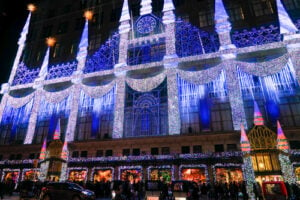
In 2004, Saks added something even grander. It introduced a synchronized holiday light show across the building’s ten-story facade facing Rockefeller Center. The first version featured 50 enormous illuminated snowflakes flickering to an arrangement of “Carol of the Bells.”
The production evolved with technology, moving to digital projection in 2010 and later combining physical and digital effects. It became one of the most photographed holiday sights in New York, drawing crowds to the sidewalks between St. Patrick’s Cathedral and Rockefeller Center.
Saks paused the synchronized light show during the flagship’s 100th anniversary season in 2024, choosing instead to illuminate the architecture and emphasize its holiday windows. The full light show returned on November 24, 2025, with a redesigned presentation and an opening-night appearance by the Radio City Rockettes.
Changing Hands: The Ownership Story
For all its glamour, Saks Fifth Avenue has changed corporate hands many times. The Gimbel connection lasted for decades, but the business was sold to a subsidiary of British American Tobacco in 1973. Saks later passed to Investcorp in 1990 and to Proffitt’s, Inc. in 1998. Proffitt’s subsequently adopted the Saks, Inc. name.
Hudson’s Bay Company acquired Saks in 2013. In 2024, Saks became part of Saks Global, the parent company created around Saks Fifth Avenue, Neiman Marcus, Bergdorf Goodman, and related luxury businesses.
Saks Global filed for Chapter 11 bankruptcy protection in January 2026 while keeping the Fifth Avenue flagship and its other operating stores open. The company emerged from bankruptcy in June 2026 after reducing its debt and securing new financing. The reorganized parent company adopted the name Exemplar Luxury Group, while the Saks Fifth Avenue name remained on the store and retail chain.
Through every transaction and corporate restructuring, one thing remained constant: the flagship at 611 Fifth Avenue continued to serve as the crown jewel of the Saks business.
The Modern Flagship
In 2015, Saks began an ambitious $250 million renovation of the Fifth Avenue flagship, one of the largest store makeovers in New York retail history. The project reworked the main floor, beauty departments, handbag areas, restaurants, and other major portions of the building for a new era of luxury shopping.
One of the renovation’s showpieces was a dramatic escalator installation designed by Rem Koolhaas and the architecture firm OMA. Coated in iridescent material and arranged in a diamond-like formation between the first and second floors, it gave the century-old building a burst of contemporary drama while preserving its historic exterior.
2020: The Year the Windows Went Dark
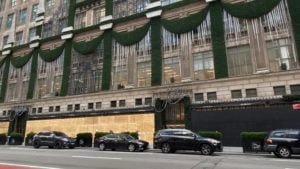
Photo: Brian Kachejian©2020
I have to tell you about the hardest Saks memory I carry because it is burned into my mind.
In 2020, the pandemic emptied New York City in a way I had never witnessed in my life. I remember walking through Midtown when the streets were bare and silent. I felt like the last man on earth, like a character out of The Omega Man, moving through a Manhattan that had gone completely still.
Then came the boarding up. During the unrest that followed the murder of George Floyd, Saks covered its famous display windows with plywood. Private security guards stood outside. Retailers again boarded windows as the presidential election approached that November.
I walked over to Saks around that time, and the whole place was boarded up. It hit me hard. This was the store I had loved my entire life, the store of glittering holiday windows and Fifth Avenue elegance, and there it stood barricaded like a fortress. I had lived through some rough years in this city, including the difficult days of the 1970s, but I had never seen anything like this.
Other retailers throughout Fifth Avenue and Manhattan took defensive measures that year, but it was Saks that hit me the hardest. Seeing those windows covered on that empty and anxious avenue felt like watching a piece of New York’s soul go dark. I will never forget it.
For more pictures of what New York City looked like during the pandemic, check out my work in New York City 2020 Pandemic in Pictures.
Saks Fifth Avenue Today
The good news is that the lights came back on. The crowds returned to Fifth Avenue, the holiday windows filled with wonder again, and the synchronized light show returned in 2025. The store that had disappeared behind plywood and fencing in 2020 once again became a sparkling anchor of the avenue.
Saks Fifth Avenue has survived the Great Depression, the movement of retail to the suburbs, repeated changes of ownership, a global pandemic, and a major corporate bankruptcy and reorganization. Through it all, the limestone palazzo at 611 Fifth Avenue has stood its ground, just as it has since 1924.
For a native New Yorker like me, that continuity means everything. Andrew Saks started with a newspaper route and a small menswear shop in Washington. What his family and the Gimbels built on Fifth Avenue became a permanent part of the New York experience, and I feel lucky to have walked through those doors my entire life.
Classic NYC History Fact: Saks Fifth Avenue promoted its enormous eighth-floor women’s shoe salon as “10022-SHOE” in 2007. Despite the popular legend, it was not an official ZIP Code. The United States Postal Service confirmed that the store’s valid ZIP Code remained 10022 and that “SHOE” was part of a creative advertising campaign.
Saks Fifth Avenue Flagship: Quick Facts
| Detail | Information |
|---|---|
| Founder | Andrew Saks; first store opened in Washington, D.C., in 1867 |
| Flagship Address | 611 Fifth Avenue, between 49th and 50th Streets |
| Flagship Opened | September 15, 1924 |
| Architects | Starrett & Van Vleck |
| Architectural Style | Neo-Renaissance retail palazzo |
| NYC Landmark Status | Designated in 1984 |
| Legendary Designer | Sophie Gimbel, Salon Moderne, 1929 to 1969 |
| Holiday Light Show | Debuted in 2004; paused in 2024; returned in 2025 |
| Current Parent Company | Exemplar Luxury Group, following the 2026 reorganization |
| Current Status | Open and operating as the Saks Fifth Avenue flagship |
The Deep History of Saks Fifth Avenue article published on ClassicNewYorkHistory.com © 2026