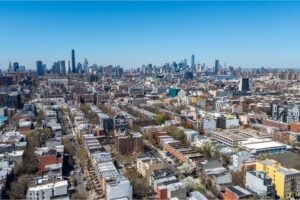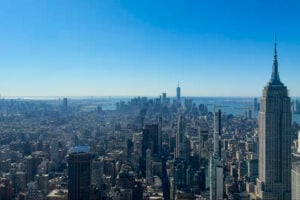
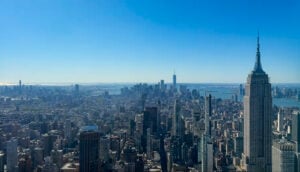
A panoramic view of Manhattan from SUMMIT One Vanderbilt, featuring the Empire State Building and One World Trade Center in the distance. Photo by Brian Kachejian.
New York City has produced some of the world’s most influential scientists, physicians, engineers, and inventors. Their names are associated with Nobel Prizes, medical breakthroughs, computers, radio, and discoveries about the universe. Yet the New York neighborhoods where many of them grew up are often left out of their stories. A physicist who helped explain the forces of nature went to high school in the Bronx. A future pioneer of electronic music built instruments in a Queens basement. A woman whose research changed medicine worked for years in a Bronx hospital.
These connections reach beyond famous university laboratories. Public schools, libraries, museums, family workshops, and tuition-free colleges played important roles in developing scientific talent. The Bronx High School of Science appears repeatedly in the biographies below, but so do ordinary neighborhood schools in Brooklyn, Queens, and Manhattan. Some of these New Yorkers went elsewhere to make their discoveries; others returned to the city to do their most important work.
For this list, “from New York City” means born or substantially raised in one of the five boroughs, rather than someone who simply moved here as an established professional. That distinction matters in a city where so many important discoveries have been made by people who came from somewhere else. Here are twenty-five remarkable scientists and innovators whose personal histories genuinely begin, or take decisive shape, in New York City.
1. Neil deGrasse Tyson
Neil deGrasse Tyson grew up in the Bronx, where his interest in the night sky developed despite the city’s bright lights. At nine, a visit to the Hayden Planetarium at the American Museum of Natural History gave him an experience he would remember for the rest of his life. He later attended the Bronx High School of Science, a public school that has educated an extraordinary number of future researchers. His early fascination with the stars was rooted not in a remote observatory, but in New York City itself.
Tyson studied physics at Harvard and earned a doctorate in astrophysics from Columbia University. In 1996, he became director of the same Hayden Planetarium that had inspired him as a child. His research has included stars and galactic structure, but his broader reputation rests on making astronomy accessible to audiences through books, lectures, and television, including Cosmos: A Spacetime Odyssey. Few scientists have such a direct connection between a childhood New York institution and the place where they later built their public careers.
2. Carl Sagan
Carl Sagan was born in Brooklyn in 1934 and spent much of his childhood there before his family moved to Rahway, New Jersey, when he was a teenager. Growing up in a working-class household, he became absorbed in questions about stars, planets, and the possibility of life beyond Earth. Libraries and a visit to the Hayden Planetarium helped expand his imagination. His Brooklyn years were therefore more than a biographical footnote: they were part of the period when he began asking the questions that would define his career.
Sagan became a planetary scientist and Cornell University professor who contributed to research and public understanding of the solar system. He advised NASA and worked with missions involving Venus, Mars, and the outer planets. To a much larger audience, he became the voice of the 1980 television series Cosmos, using clear explanations and a sense of wonder to show why scientific inquiry mattered. His influence on science communication continued long after his death in 1996.
3. Richard Feynman
Richard Feynman was born in New York City in 1918 and grew up in Far Rockaway, Queens. Long before he became a Nobel Prize-winning physicist, he was the neighborhood youngster who liked taking things apart and figuring out why they worked. He developed a reputation for repairing radios, and at Far Rockaway High School he excelled in mathematics and science. The inquisitive, sometimes playful approach for which he became famous was already evident in those early years.
After studying at MIT and Princeton, Feynman worked on the Manhattan Project and later taught at Cornell and Caltech. He shared the 1965 Nobel Prize in Physics for work in quantum electrodynamics, including mathematical methods that helped physicists describe interactions between light and matter. He also became a celebrated teacher and public explainer. In 1986, his participation in the investigation of the Challenger disaster brought his characteristic insistence on experimental evidence to a national television audience.
4. J. Robert Oppenheimer
J. Robert Oppenheimer was born in Manhattan in 1904 and grew up in an affluent apartment on Riverside Drive. His education at the Ethical Culture School introduced him to rigorous academic work, literature, and a broad range of intellectual interests. As a boy, he collected minerals and showed a remarkable appetite for learning. These Manhattan years were an important early chapter in the life of a scientist who would eventually become one of the most discussed figures of the twentieth century.
Oppenheimer studied at Harvard and in Europe before establishing himself as a theoretical physicist. During World War II, he directed the Los Alamos laboratory of the Manhattan Project, where scientists and engineers developed the first atomic bombs. His later opposition to aspects of the nuclear arms race and the 1954 revocation of his security clearance made his public life controversial. His story cannot be reduced to a single scientific accomplishment: it is also about the moral and political responsibilities that can follow a discovery.
5. Jonas Salk
Jonas Salk was born in New York City in 1914, spent his early childhood in East Harlem, and later lived in the Bronx. The son of immigrant parents, he attended Townsend Harris High School and entered City College at fifteen. He went on to New York University School of Medicine. His path illustrates how the city’s public education system opened a route into medicine for a young man whose family did not have a tradition of college education.
At the University of Pittsburgh, Salk led the research that produced the first widely successful inactivated poliovirus vaccine. The announcement of the vaccine’s effectiveness in 1955 was an enormous moment in public health, although eliminating polio has required the continuing work of many researchers, vaccination programs, and health organizations. Salk later founded the Salk Institute for Biological Studies in California. His achievement is inseparable from the larger effort against polio, but his scientific education began in New York classrooms.
6. Grace Hopper
Grace Hopper was born in New York City in 1906 and grew up in a family that encouraged curiosity and education. One of the best-known stories from her childhood concerns her dismantling several alarm clocks to learn how they operated. She studied mathematics and physics at Vassar and earned a doctorate in mathematics from Yale. At a time when women faced serious professional barriers, she pursued an unusually demanding mathematical career.
During World War II, Hopper joined the Navy Reserve and worked on early computing projects at Harvard. She later contributed to the development of compilers, which made programming less dependent on instructions written directly in machine code. She was also an influential participant in the creation and promotion of COBOL, a business programming language developed through a collaborative effort rather than by one inventor alone. Hopper eventually retired from the Navy with the rank of rear admiral. Her career helped transform computers from specialized calculating machines into tools that businesses and institutions could use more broadly.
7. Marie Van Brittan Brown
Marie Van Brittan Brown was born in Jamaica, Queens, in 1922 and worked as a nurse. Her irregular hours, together with those of her husband, Albert Brown, an electronics technician, made security at their home a practical concern. Rather than simply accepting the limitations of a conventional door lock and peephole, the Browns devised a way to see and communicate with visitors while remaining safely inside. Their invention grew out of an everyday problem in a Queens neighborhood.
The system used a movable camera, multiple viewing openings, television monitors, two-way communication, and a remote-controlled door mechanism. Marie and Albert Brown received a U.S. patent for their home security system in 1969. It would be inaccurate to say that they invented every component of modern surveillance, but their patented combination anticipated important features of video doorbells and residential security installations. Brown deserves recognition as a New York inventor whose thinking reached far beyond her own front door.
8. Rosalyn Yalow
Rosalyn Yalow was born in the Bronx in 1921 and attended Walton High School before studying at Hunter College. Her family valued education even though her parents had not attended college. Fascinated by mathematics and the emerging field of nuclear physics, she pursued advanced scientific study at a time when opportunities for women in physics were limited. Much of the career for which she is remembered would also unfold in her home borough.
At the Bronx Veterans Administration Hospital, Yalow worked closely with physician Solomon Berson to develop radioimmunoassay, a technique capable of measuring tiny amounts of hormones and other substances in the body. Their partnership transformed laboratory medicine and endocrinology. Berson died before the work was recognized with a Nobel Prize, which Yalow received in 1977. Her story is particularly striking because research performed in a Bronx hospital became fundamental to medical testing around the world.
9. Mildred Dresselhaus
Mildred Dresselhaus was born in Brooklyn in 1930 and grew up in the Bronx. Her early interest in music led to violin lessons, but education opened another path. She attended Hunter College High School and Hunter College, where Rosalyn Yalow encouraged her to consider physics. Dresselhaus went on to graduate study at Radcliffe and the University of Chicago, building a career in a field where women were still greatly underrepresented.
At MIT, Dresselhaus became a leading authority on the electronic and thermal properties of carbon and other materials. Her research helped establish foundations for the study of graphite, carbon nanotubes, and related nanoscale structures. Often called the “Queen of Carbon Science,” she also advocated for women’s participation in scientific fields. Her Bronx upbringing and the encouragement she received from another New York-born physicist show how one generation of scientists can help create the next.
10. George Lerner
George Lerner, the Brooklyn-born inventor associated with Mr. Potato Head, brought a very different kind of creativity to this list. An artist, designer, and model maker, he developed an assortment of plastic facial features that children could insert into real vegetables and fruit. The concept was simple, but it recognized that a successful toy did not have to dictate the character a child played with: the child could invent it.
Lerner’s idea eventually reached Hassenfeld Brothers, the company later known as Hasbro. Mr. Potato Head went on sale in 1952 and became a major commercial success, with television advertising playing an important part in its popularity. The familiar molded plastic potato body came later; the earliest product was a collection of accessories intended for actual produce. That distinction restores an interesting part of the invention’s history and makes Lerner a fitting example of the consumer-product innovators who came out of Brooklyn.
11. Barbara McClintock
Barbara McClintock was born in Hartford, Connecticut, in 1902, but spent much of her childhood in Brooklyn and graduated from Erasmus Hall High School. Her years in New York therefore meet the meaningful-upbringing test for this list, even though she was not born in the city. She attended Cornell University, where her interest in genetics and the study of plant chromosomes developed into a lifelong scientific pursuit.
McClintock’s experiments with maize revealed that certain segments of genetic material can move within a chromosome or between chromosomes. These mobile genetic elements, often described as “jumping genes,” challenged prevailing assumptions about how genetic information behaved. The significance of her discoveries became more fully appreciated over time, and she received the 1983 Nobel Prize in Physiology or Medicine. Her work is a reminder that a revolutionary idea can be scientifically sound long before it receives widespread recognition.
12. Clarence Birdseye
Clarence Birdseye was born in Brooklyn in 1886. His curiosity about animals, the natural world, and practical science eventually took him far beyond the borough, including work in Labrador. There, he observed how fish frozen rapidly in extreme cold could retain qualities that were often lost through slower methods of freezing. That observation gave him a problem worth solving: how could the advantages of quick freezing be made practical for commercial food distribution?
Birdseye developed machinery and methods that helped make high-quality frozen food available to consumers. He did not invent the physical process of freezing food, and earlier methods existed, but his advances helped create a viable modern industry. By the early 1930s, frozen products were reaching retail markets. The results can still be seen in supermarket freezer aisles. For a publication concerned with New York retail history, Birdseye’s Brooklyn origin adds a particularly interesting connection to the evolution of everyday shopping.
13. Robert Moog
Robert “Bob” Moog was born in Flushing, Queens, in 1934. His father, an electrical engineer, encouraged him to experiment with electronics, and Moog began building radios and musical devices while still young. He attended P.S. 24 in Flushing and then the Bronx High School of Science, where his projects included electronic instruments. Music and engineering were not separate interests for him; even as a teenager, he wanted to discover what new sounds circuits could create.
Moog pursued further studies at Queens College, Columbia, and Cornell, and his later collaborations with musicians helped develop the synthesizers associated with his name. The instruments did not mark the invention of electronic music itself, which had earlier pioneers, but they made new methods of sound generation and performance increasingly accessible. The Minimoog became especially influential in rock, funk, progressive music, and recording studios. His journey from a Queens basement workshop to an instrument heard around the world is one of New York’s great intersections of science and music.
14. Edwin Howard Armstrong
Edwin Howard Armstrong was born in Manhattan’s Chelsea neighborhood in 1890 and later grew up in Yonkers. As a teenager, he became fascinated with wireless communication and built experimental equipment. He returned to the city for engineering studies at Columbia University, where he began making contributions that would change radio technology. His New York story extends from his Manhattan birthplace to the classrooms and laboratories of Morningside Heights.
Armstrong developed important radio receiver circuits, including the regenerative and superheterodyne systems, and became the leading pioneer of wideband FM radio. His work on frequency modulation offered a way to transmit sound with much less static than conventional AM broadcasting. The technology eventually became central to music radio and other communication systems. His career also involved prolonged patent and business disputes, showing that an inventor’s technical success does not always lead to an easy personal or commercial life.
15. Patricia Bath
Patricia Bath was born in Harlem in 1942 and attended Charles Evans Hughes High School in Manhattan. Her interest in science was nurtured by her family, and while still in high school she participated in a science program associated with Harlem Hospital and Yeshiva University. She later studied medicine at Howard University and completed specialist training in ophthalmology in New York. Her early experience with the city and its medical institutions helped shape her concern for people who lacked adequate access to eye care.
Bath became a pioneering ophthalmologist and developed the Laserphaco device and technique for cataract surgery, receiving a U.S. patent in 1988. She also advocated for community eye-health programs and helped advance the idea that preventable blindness was a public-health issue, not merely a problem for individual patients. Her achievements combined medical engineering with a sustained concern for equitable treatment. Harlem can claim an important place in the early life of an inventor whose work improved ophthalmic surgery.
16. Marie Maynard Daly
Marie Maynard Daly was born and raised in Queens in 1921. Her father had studied chemistry but was unable to complete his college education, and his interest in the subject helped inspire her. Daly attended Hunter College High School, earned a chemistry degree from Queens College, and continued at New York University and Columbia. In 1947, she became the first Black woman in the United States to earn a Ph.D. in chemistry, a distinction recognized by the American Chemical Society.
Daly’s later research explored important biochemical questions, including the relationship between cholesterol and cardiovascular disease, the chemistry of cell nuclei, and the synthesis of proteins. She taught and conducted research at major institutions, including the Albert Einstein College of Medicine in the Bronx. Beyond her laboratory work, she supported opportunities for students from underrepresented communities and established a scholarship at Queens College in honor of her father. Her career connects scientific accomplishment with the educational possibilities offered by New York’s public colleges.
17. Richard Axel
Richard Axel was born in Brooklyn in 1946 and attended Stuyvesant High School in Manhattan. His intellectual interests initially ranged widely across literature and the arts, and he did not begin college with a fixed plan to become a neuroscientist. At Columbia, a job washing laboratory glassware eventually led him into scientific research. The episode offers a useful reminder that a career in science sometimes begins with access to a laboratory and the chance to ask questions, rather than a perfectly planned academic route.
Axel later developed important gene-transfer methods with colleagues and turned to questions about how the brain understands sensory information. Working with Linda Buck, he helped identify a large family of genes encoding odor receptors and explain the organization of the sense of smell. They shared the 2004 Nobel Prize in Physiology or Medicine. Axel’s work at Columbia makes his story both that of a Brooklyn-born scientist and that of a researcher whose major discoveries helped strengthen New York City’s place in modern neuroscience.
18. Paul Berg
Paul Berg was born in Brooklyn in 1926 and attended Abraham Lincoln High School. In his youth, reading about medical discoveries and participating in science activities helped convince him that research offered a way to solve fascinating problems. He studied at Pennsylvania State University and later earned a doctorate at Western Reserve University. His early Brooklyn education preceded a career that would profoundly influence genetics and biotechnology.
At Stanford University, Berg performed pioneering work in recombinant DNA, showing how genetic material from different sources could be joined. He received the 1980 Nobel Prize in Chemistry for this research. Importantly, Berg also became a leading voice in discussions of laboratory safety and the risks of manipulating genetic material. He helped organize the 1975 Asilomar conference, where scientists considered principles for responsible research. His legacy includes both a revolutionary technique and an example of scientists debating the consequences of their own discoveries.
19. Eric Kandel
Eric Kandel was born in Vienna in 1929 and came to the United States as a child after his family fled Nazi persecution. He settled in Brooklyn in 1939, attended the Yeshiva of Flatbush, and continued his education in New York before studying at Harvard. Because he was substantially raised and educated in Brooklyn, his place on this list reflects his New York upbringing, not an inaccurate claim that he was born here. His experiences as a refugee later influenced his interest in the human mind and memory.
Kandel became a leading neuroscientist who investigated how learning produces lasting changes in nerve cells. Using relatively simple nervous systems, particularly those of the sea slug Aplysia, he helped identify cellular mechanisms involved in forming memory. He shared the 2000 Nobel Prize in Physiology or Medicine and spent much of his professional life at Columbia University. His career forms an unusual circle: a young refugee who built a new life in Brooklyn ultimately made some of the century’s most important contributions to the science of memory in New York City.
20. Gertrude B. Elion
Gertrude Elion was born in Manhattan in 1918 and moved to the Bronx as a child. She attended public school and entered Hunter College at fifteen, choosing chemistry partly because the death of her grandfather from cancer had made a lasting impression. During the Depression, her family’s finances were difficult, and Hunter’s tuition-free education was important to her opportunities. She encountered significant barriers to laboratory employment because she was a woman but persisted in building a research career.
Working with George Hitchings and colleagues, Elion developed approaches to drug design that contributed to treatments for leukemia, organ transplantation, and other serious conditions. She shared the 1988 Nobel Prize in Physiology or Medicine with Hitchings and Sir James Black. It would be misleading to assign every medicine to Elion alone: much of her achievement came through sustained collaborative research. Nevertheless, her path from Manhattan and the Bronx to Nobel recognition makes her one of New York City’s most consequential medical innovators.
21. Murray Gell-Mann
Murray Gell-Mann was born in Manhattan in 1929 and displayed an astonishing range of interests as a child, from natural history and birds to languages and mathematics. He attended Columbia Grammar School and entered Yale at fourteen. His precocious education is often mentioned in profiles of his later work, but his childhood interests also show that a future theoretical physicist could be intensely curious about subjects far outside physics.
Gell-Mann helped bring order to the growing collection of subatomic particles discovered in twentieth-century experiments. His classification work, known as the eightfold way, and his proposal that particles such as protons and neutrons contain smaller constituents called quarks changed particle physics. He received the 1969 Nobel Prize in Physics. Later in life he pursued questions about complexity and the relationships among different scientific fields. His intellectual range made him one of the most distinctive scientists to emerge from Manhattan.
22. Sheldon Lee Glashow
Sheldon Lee Glashow was born in Manhattan in 1932, the son of immigrant parents, and attended the Bronx High School of Science. His interest in scientific questions developed early, encouraged by his family and classmates. One of those classmates was Steven Weinberg, who would later share a Nobel Prize with him. The fact that two major contributors to fundamental physics came through the same New York public high school class is one of the city’s more remarkable educational stories.
Glashow’s theoretical work helped establish the framework in which the electromagnetic force and the weak nuclear force are understood as parts of a unified electroweak interaction. The theory was developed through contributions by multiple physicists, including Weinberg and Abdus Salam. All three shared the 1979 Nobel Prize in Physics. Glashow’s scientific career took him to Cornell, Harvard, and other institutions, but the friendships and academic ambitions of his Bronx school years remained part of his own account of becoming a physicist.
23. Steven Weinberg
Steven Weinberg was born in New York City in 1933 and graduated from the Bronx High School of Science in 1950. At school, he found peers who shared his intense interest in physics, including Sheldon Glashow. He went on to Cornell and Princeton, eventually becoming a leading figure in theoretical physics. The classroom connection between Weinberg and Glashow demonstrates that the city’s scientific history is not simply a collection of individual success stories; it includes relationships that began in its schools.
Weinberg’s research was central to the development of electroweak theory, which explains how two seemingly different fundamental interactions are related. He shared the 1979 Nobel Prize in Physics with Glashow and Abdus Salam. Beyond his technical research, Weinberg wrote influential books for general readers, including The First Three Minutes, about the early universe. He became known for insisting that scientific explanations should be both mathematically rigorous and open to critical examination.
24. Arthur Kornberg
Arthur Kornberg was born in Brooklyn in 1918 and grew up in an immigrant family that valued education. He attended Abraham Lincoln High School, graduated early, and earned a degree at City College of New York while still a teenager. His family’s working-class circumstances meant that he held jobs while pursuing his education. He later attended the University of Rochester School of Medicine, where his interest in research began developing alongside his medical training.
Kornberg’s most celebrated achievement was the discovery of DNA polymerase, an enzyme essential to copying DNA. His experimental work helped explain how genetic material can be replicated, a foundation for later developments in molecular biology. He shared the 1959 Nobel Prize in Physiology or Medicine with Severo Ochoa. Kornberg eventually established a major research program at Stanford, but his early path through Brooklyn schools and City College illustrates the importance of New York’s public educational institutions in twentieth-century science.
25. Julius Axelrod
Julius Axelrod was born in 1912 in a tenement on East Houston Street on Manhattan’s Lower East Side. His father made and sold baskets, and the family had limited financial resources. Axelrod attended Seward Park High School and City College of New York, graduating in 1933. He hoped to become a physician but was not admitted to medical school. Instead, he found laboratory work with the city’s health department, where he learned techniques that would prove valuable in his later research.
Axelrod eventually joined the National Institutes of Health and became an important figure in pharmacology and neuroscience. His investigations clarified how nerve-signaling chemicals, including norepinephrine, are processed and taken back up after release. He shared the 1970 Nobel Prize in Physiology or Medicine with Bernard Katz and Ulf von Euler. His path was anything but conventional: a Lower East Side public-school student who was rejected by medical schools went on to help explain some of the body’s most important chemical signaling mechanisms.
New York City’s Remarkable Scientific Legacy
These twenty-five lives do not follow a single pattern. Some scientists benefited from demanding specialized schools; others found their direction through neighborhood libraries, family encouragement, an unexpected job, or a practical problem that needed solving. Their discoveries were often made far from their childhood homes, and many depended on colleagues whose contributions deserve recognition too. What connects them here is something more precise than a laboratory address: each had a genuine personal history in New York City before becoming known for scientific or technological work.
For more stories about the New Yorkers behind major discoveries, explore our articles on scientists and innovators from Upstate New York, famous inventions created in New York, famous people from the Bronx, and famous people from Brooklyn.