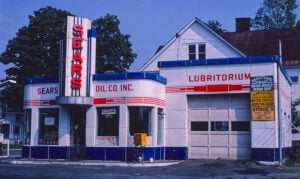
Sears gas station on North James Street in Rome, New York, in 1983. Photo: John Margolies / Roadside America Photograph Archive / Library of Congress, Prints and Photographs Division.
Before interstate exits across Upstate New York were dominated by towering national travel centers and chain convenience stores, filling up the tank was often a distinctly regional and deeply personal experience. Along the two-lane highways of the Southern Tier, the main streets of the Mohawk Valley, and the bustling avenues of Buffalo, Rochester, Syracuse, and Albany, motorists pulled up to porcelain-enamel service stations, miniature roadside lighthouses, and neighborhood garages where attendants wiped windshields, checked oil dipsticks, and handed out free foldout road maps.
For many New Yorkers, a service station was as much a part of the neighborhood as the local diner or grocery store. You knew the people who worked there, and they knew your car. Some stations sold gasoline under the name of a major oil company, while others belonged to regional businesses that grew out of local petroleum distribution, automobile repair, or grocery retailing. The rise of self-service gasoline and convenience stores gradually changed that relationship.
In 1979, I was attending Sullivan County Community College in Loch Sheldrake, New York. It was a time when the country was going through a gasoline crisis brought on by the Iranian Revolution. Little did I know that I would wind up working at a gas station right off Exit 100 of Route 17 in Liberty, New York. The station was called Agway Gas. There was no garage, just a few pumps outside and a small office. I don’t even remember us selling food or beverages. We just sold gas. It was about as simple as you could get.
One of my responsibilities was to make sure that the money I took in matched the dollar amounts recorded at the pumps. Remember, back in those days, most people paid for their gas in cash. However, the most challenging part of working there was dealing with the odd-even gasoline restrictions. If your license plate ended in an odd number, you could buy gas on an odd-numbered day of the month, and vice versa for even-numbered plates.
Of course, not everybody was willing to follow those rules. Some customers would give me a pretty hard time when I told them I couldn’t pump their gas because it was the wrong day for their license plate. A few could get downright threatening. Eventually, I learned just to roll with it. If they wanted gas that badly, I’d pump it for them. It was better than getting beaten up over a tank of gasoline.
Every time I drive up Route 17, I think back with a great deal of nostalgia to my college days in Sullivan County. Among those memories is the time I spent working at that little Agway gas station off Exit 100. The station is no longer there, but more than four decades later, I still think about the place every time I pass that exit.
Over the past century, oil-industry consolidation and corporate buyouts have erased many familiar regional operators and petroleum emblems from the Upstate landscape. Some of the buildings have survived, and several former gasoline brands continue to exist elsewhere or in other forms. From Western New York’s neighborhood convenience stores to the elaborate service stations of the early automobile age, here are 25 lost gas station names and networks that once formed part of everyday life in Upstate New York.
1. Hess
Few corporate disappearances stung Upstate New York drivers quite like the exit of Hess. For decades, the green-and-white canopies of Hess and Hess Express served motorists across the Hudson Valley, Capital Region, Central New York, and other parts of the state. Families didn’t just stop there for gasoline and coffee. Every holiday season, the annual Hess Toy Truck brought another generation of customers into the stores, including many who had grown up collecting the trucks themselves.
Hess expanded its East Coast retail operation over several decades, acquiring regional competitors along the way. On September 30, 2014, Marathon Petroleum’s Speedway subsidiary completed its $2.82 billion acquisition of Hess’s retail and related transportation operations. Former Hess stations were gradually converted to Speedway, ending the era of those familiar green-and-white signs. The toy trucks survived the transition, continuing to be sold independently of the former gas station network.
2. NOCO Express
In Buffalo and across the Niagara Frontier, NOCO Express was a familiar hometown name. Its parent company traced its roots to a family fuel business established in 1933, long before the modern combination of gasoline pumps and convenience stores became common. Based in Tonawanda, NOCO eventually developed an extensive network of neighborhood stores serving Western New York motorists.
In April 2019, Marathon Petroleum announced an agreement to acquire 33 NOCO Express stores and a petroleum terminal. The stores were transferred to Speedway in July of that year, and the local retail identity began disappearing. NOCO itself did not go out of business. It continued operating in the energy industry, but its former chain of gasoline and convenience stores became part of a much larger national network.
3. Nice N Easy Grocery Shoppes
Across Central New York and the Mohawk Valley, Nice N Easy Grocery Shoppes became an indispensable part of daily driving. Headquartered in Canastota in Madison County, the chain served rural crossroads and suburban communities around Syracuse, Utica, Rome, and Oneida. Its combination of fuel, groceries, and prepared food made it a regular stop for commuters and residents of small towns.
In November 2014, CST Brands and CrossAmerica Partners completed the acquisition of the business, which then comprised 77 company-operated and franchised stores. After Alimentation Couche-Tard acquired CST Brands in 2017, many former Nice N Easy locations became Circle K stores. Other operators followed different paths. Clifford Fuel, a longtime Nice N Easy franchisee, introduced its own Cliff’s Local Market identity. The disappearance of the familiar name therefore involved several different retail transitions rather than one uniform conversion.
4. Wilson Farms and Wilson Farms Xpress
Wilson Farms was a quintessential neighborhood stop for generations of Western New Yorkers. Associated for years with Tops Friendly Markets, the business grew beyond small stores selling milk, bread, and other essentials. Many locations added gasoline, and the Wilson Farms Xpress banner became part of the company’s roadside presence.
In 2005, Royal Ahold sold the Wilson Farms and Sugar Creek operations to an investment group that included members of the Nanula family and former Tops executives. In June 2011, 7-Eleven completed its acquisition of the resulting 188-store business. Many Wilson Farms stores were remodeled and renamed, while other properties were sold or closed. The familiar Buffalo-area brand disappeared even though some of the same neighborhood stores remained in operation.
5. Sugar Creek Stores
What Wilson Farms was to Buffalo, Sugar Creek was to many motorists in the Rochester area and surrounding Finger Lakes communities. The stores combined everyday grocery and convenience purchases with gasoline at many locations. Their regional identity distinguished them from the national chains that would eventually become increasingly common throughout Upstate New York.
Tops acquired the Sugar Creek stores in 2000, and they subsequently became part of the same retail organization as Wilson Farms. Both banners were included in the 2011 sale to 7-Eleven. Not all former locations became 7-Eleven stores, however. Stewart’s Shops acquired five former Wilson Farms and Sugar Creek properties in the North Country in 2012, illustrating how the disappearance of a regional brand could produce different outcomes from one town to another.
6. H.P. Sears Oil Company
Motorists who pulled into a Sears service station in the Mohawk Valley weren’t dealing with Sears, Roebuck and Co. They were buying fuel from a business founded by local entrepreneur Howard P. Sears. The company, whose history dates to 1913, developed a network of service stations in Central New York. Some of its later stations employed the streamlined forms and porcelain-enamel surfaces that characterized the roadside architecture of the 1930s and 1940s.
One of the best surviving reminders of the company stands at 201 North George Street in Rome. The small station, dating to around 1929–1930, was restored and opened as a museum in 2005. Its vintage gasoline pumps, oil-change pit, and period equipment recall a time when the attendant performed many of the tasks that drivers now do for themselves. The old Sears retail identity is gone, but this remarkable building preserves an important piece of Central New York’s motoring history.
7. Rotary Service Stations
Drivers traveling through Chemung County and the Southern Tier once knew Rotary as a regional gasoline name. The Southern Oil Company of New York was incorporated in 1923 and operated out of Horseheads. A 1953 Horseheads Chamber of Commerce publication lists the company on West Franklin Street and the Pioneer Rotary Service Station at 119 North Main Street, documenting its place in the local business community.
Rotary also issued road maps featuring its stations and photographs of regional attractions. These surviving maps offer a particularly interesting record of the chain’s presence in New York and Pennsylvania. By the period covered in a federal court case decided in 1980, Southern Oil was among the retail subsidiaries associated with Ashland Oil. The Rotary name eventually disappeared, leaving behind the maps, signs, and other artifacts of a once-familiar Southern Tier business.
8. Larkin Gasoline Stations
Most Western New Yorkers know Buffalo’s Larkin Company for its soap manufacturing, mail-order empire, and Frank Lloyd Wright’s celebrated Administration Building. During the 1920s, however, the company also entered the gasoline business. Its petroleum operation grew out of the need to fuel its own delivery vehicles, and Larkin went on to market gasoline to the general public under its own name, including the Larkin Hammerless Gasoline brand.
The broader company’s financial difficulties eventually caught up with its petroleum business. In January 1940, Larkin announced the sale of its Buffalo gasoline division to Gulf Oil. A surviving former filling station on Seneca Street later became part of the redevelopment of the Larkin district. Its transformation into a restaurant space was an unusual example of Buffalo finding a new use for a building associated with an earlier era of automobile travel.
9. Frontier Oil
Long before suburban highways crisscrossed Erie County, Frontier Oil developed a petroleum business in Western New York. Its Tonawanda refining operation dated to 1928, and the company established a market for its branded petroleum products in the Buffalo area. The proximity of a local refinery helped make Frontier a distinct regional name in an industry increasingly dominated by larger corporations.
In 1950, Ashland Oil acquired Frontier, including its Tonawanda refinery. The acquisition brought the Kentucky-based company a substantial foothold in Western New York. As the former Frontier operation became part of Ashland’s expanding business, the local petroleum identity faded. The history of the site can still be traced through industrial and environmental records maintained by New York State and federal agencies.
10. Ashland Oil and Its Discount Stations
The acquisition of Frontier Oil in 1950 gave Ashland Oil a major presence in Western New York. Its Tonawanda refinery served the regional petroleum market, and Ashland was also involved in the retail gasoline business. A 1960s municipal record from Hamburg, for example, documents the company’s plans for a gasoline station without traditional service bays.
Ashland also supplied several retail subsidiaries operating in New York under names such as Bi-Lo, Hi-Fy, Payless, and Rotary. Those operations reflected an important change in the gasoline business as discount outlets competed with the established full-service stations. In 1992, United Refining purchased a former Ashland refinery in Tonawanda and converted it into a petroleum distribution terminal. The original Ashland-era retail and refining network is now part of Western New York’s industrial history.
11. Colonial Beacon Oil
Nothing on some early Upstate New York highways caught a driver’s eye quite like a miniature lighthouse perched on a filling station. Beacon Oil was founded in Boston in 1919 and expanded into New York. Its Colonial-style buildings were designed to give motorists an immediately recognizable roadside landmark. By 1929, the company controlled hundreds of locations across New York and much of New England.
Standard Oil of New Jersey acquired control of Beacon in 1929 and formally absorbed Colonial Beacon in 1947. The old lighthouse design outlasted the original business identity. Former stations associated with this architectural tradition have been documented in communities including Cooperstown, Sherburne, Endicott, Binghamton, and Eaton, where an old lighthouse station became a post office. The buildings are among the most unusual surviving reminders of the competition for motorists’ attention during the early automobile age.
12. Agway Gas Stations
For many Upstate New Yorkers, the Agway name brings back memories of farm supplies, garden centers, and home heating oil. Gasoline was also part of the business. Based in Syracuse, Agway was formed in 1964 through the merger of two agricultural cooperatives, the Grange League Federation and the Eastern States Farmers’ Exchange. Its petroleum business served rural communities as well as towns and cities across the Northeast. The little Agway station where I worked in Liberty in 1979 was one example of how the company was also part of the everyday lives of motorists in Upstate New York.
Agway filed for bankruptcy in 2002. On December 23, 2003, Suburban Propane acquired substantially all of the assets and operations of Agway’s energy businesses, which included gasoline, diesel fuel, heating oil, and propane distribution. The Agway name survived in other lines of business, but the modest gasoline station I remember off Route 17 is gone. I don’t know exactly when it closed, but it remains a personal reminder of a very different era in the history of New York’s roadside businesses.
13. Socony and Mobilgas
Few petroleum names were as deeply tied to the Empire State as Socony, an abbreviation of Standard Oil Company of New York. After the 1911 breakup of the Standard Oil Trust, Socony emerged as an independent company. Its 1931 merger with Vacuum Oil brought together two businesses with deep New York roots and established the company known as Socony-Vacuum.
Upstate motorists became familiar with Mobilgas and the flying red Pegasus that appeared on station signs. In 1955, the company became Socony Mobil Oil Company, and in 1966 it adopted the name Mobil Oil Corporation. Mobil remains a familiar gasoline brand across New York, but the older Socony and Mobilgas identities belong to an earlier generation of motoring. Their disappearance was a change in corporate and retail identity, not the wholesale closure of the company’s stations.
14. Esso
Pronounced from the initials S.O. for Standard Oil, Esso was the familiar retail name of Standard Oil of New Jersey across much of the Northeast. For generations of Upstate New Yorkers, its red-and-blue oval sign was a regular sight on family road trips. The company’s 1960s advertising campaign featuring a tiger became one of the most memorable pieces of gasoline marketing of its era.
Restrictions on the use of the Standard Oil name meant that the company marketed its gasoline under different identities in different parts of the United States. In 1972, it adopted Exxon as its national retail and corporate identity, and the old Esso signs were gradually replaced. Esso remains in use in international markets, but the original network of Esso-branded service stations that generations of Upstate motorists knew gave way to Exxon.
15. Tydol and Flying A
Tydol gasoline was marketed in the eastern United States by Tidewater Oil. As the company’s business developed through its association with Associated Oil, the distinctive Flying A emblem became another familiar roadside identity. The names appeared on gasoline stations and garages across the Northeast, including New York.
Buffalo holds a remarkable chapter in Tydol history. In 1927, Frank Lloyd Wright designed an ambitious filling station with a copper roof, elevated customer lounge, fireplace, and overhead fuel distribution. It was never built during his lifetime. A full-scale realization of the design opened in 2014 inside Buffalo’s Transportation Pierce-Arrow Museum. Meanwhile, Tidewater’s eastern Flying A network had long since disappeared, with the Getty name replacing Flying A around 1970.
16. Express Mart
Express Mart was one of the more substantial homegrown convenience and gasoline businesses in modern Upstate New York. Its parent company, Petr-All Petroleum, was founded in Dryden in 1975 by Francis Borer. The business expanded from its Central New York beginnings into a network of company-operated stores, particularly in the Syracuse, Rochester, and Buffalo markets.
In November 2018, Speedway completed its acquisition of 78 Express Mart locations for a reported $266 million. The purchase preceded the acquisition of the NOCO Express stores the following year. For motorists who had watched Express Mart grow from a regional operation, the transaction marked another major consolidation of Upstate’s convenience-store and gasoline industry.
17. Atlantic Refining
The Atlantic Refining Company traced its roots to nineteenth-century Philadelphia and became an independent oil company following the breakup of Standard Oil in 1911. Its gasoline was marketed across the Northeast, including Upstate New York. Surviving advertisements and station memorabilia recall a time when Atlantic was one of the familiar names competing for motorists’ loyalty.
Atlantic’s history took several unexpected turns. In 1966, the company merged with Richfield Oil to create Atlantic Richfield. When ARCO withdrew from much of its eastern retail and refining business in 1985, a portion of that operation became part of the newly established Atlantic Petroleum company. Sun acquired Atlantic Petroleum in 1988, and its stations were subsequently converted to Sunoco. The transaction ended the historic regional Atlantic retail network after its relatively brief revival.
18. ARCO
Formed through the 1966 merger of Atlantic Refining and Richfield Oil, Atlantic Richfield introduced the ARCO name and its recognizable red diamond emblem. For a period, that new corporate identity appeared on service stations across the Northeast. It was another example of a familiar petroleum network acquiring a completely different roadside appearance through a corporate merger.
In 1985, ARCO began withdrawing from refining and marketing operations east of the Mississippi River. It agreed to sell hundreds of eastern stations to Shell, while another transaction transferred a substantial network of stations and other petroleum assets in Pennsylvania and New York to Atlantic Petroleum. ARCO continued as a gasoline brand elsewhere in the country, particularly in the West, but its original eastern retail network largely disappeared from Upstate New York.
19. Richfield Oil Corporation of New York
Richfield was already a familiar gasoline name in New York long before the western Richfield company merged with Atlantic. Historical newspaper records maintained by Genesee County document Richfield stations at 343 West Main Street and 244 West Main Street in Batavia in the early 1930s. A New York court decision from 1931 also documents the Richfield Oil Corporation of New York’s arrangements for leasing gasoline station properties.
The history of the eastern Richfield business was distinct from that of the better-known California company. Its stations were associated with the Sinclair network, and the old Richfield name eventually gave way to other retail identities. Consequently, the disappearance of Richfield from New York cannot simply be attributed to the later Atlantic-Richfield merger. Its surviving advertisements offer a glimpse into the wide variety of gasoline suppliers that once competed in smaller Upstate cities.
20. Texaco
For decades, the red star of Texaco was a familiar sight along Upstate New York roads. Many of the company’s older stations featured white exteriors, prominent service bays, and the distinctive signage associated with the golden age of automobile travel. Former Texaco buildings have been documented in communities including Middletown, Unionville, and Buffalo, where some retained recognizable features long after gasoline sales ended.
After the 2001 merger of Chevron and Texaco, Shell acquired Texaco’s interests in two American refining and marketing joint ventures. A large rebranding program began in 2002, converting thousands of former Texaco outlets to Shell by 2004. Texaco continues to exist as a gasoline brand in the United States, but the extensive old Texaco retail network and its distinctive full-service stations are largely memories for Upstate New York drivers.
21. Cities Service
Founded in 1910, Cities Service developed into a major energy company with gasoline stations across the United States. Its distinctive green-and-white station identity became a familiar part of the New York roadside landscape. In Webster, a 1960 advertisement for Don Quinn’s Cities Service station at the village’s Four Corners offers a small but telling example of the company’s relationship with local service station operators.
In 1965, Cities Service introduced Citgo as its new gasoline marketing identity, replacing the older station signage with a modern red triangular emblem. By 1970, a station at the same Webster address was advertising under the Citgo name. The transformation from Cities Service to Citgo was not the end of the underlying gasoline business, but it marked the disappearance of one of the most recognizable retail names of an earlier generation.
22. Calso and Chevron
Motorists who associate Chevron primarily with the western United States may be surprised to learn that its predecessor, Standard Oil of California, expanded into the Northeast. The company’s eastern marketing operation initially used the Calso name, which was later replaced by Chevron. For a period, the company competed with other major oil brands for New York motorists.
Chevron’s 1984 acquisition of Gulf Oil set in motion another extensive rearrangement of the eastern gasoline market. In 1986, Chevron transferred a large group of northeastern marketing properties, distribution facilities, and dealer arrangements to Cumberland Farms. Federal court records from subsequent dealer disputes document the scope of this transaction. Gulf continued as a familiar eastern gasoline name, while the original Calso and Chevron regional network ceased to operate in its former form.
23. Merit
Merit was one of the discount gasoline names familiar to motorists in the Northeast, including New York. Its emphasis was on competitively priced gasoline rather than the elaborate service facilities found at some traditional stations. That business model reflected the increasing importance of price and convenience as motorists became accustomed to pumping their own fuel.
The brand was operated by the Meadville Corporation. In May 2000, Amerada Hess completed the purchase of the remaining ownership interest in Meadville, bringing 178 Merit retail gasoline stations into its business. The acquisition helped expand Hess’s retail presence, and the Merit name gradually disappeared. Just 14 years later, Hess’s own retail network would be sold to Speedway.
24. Blueox Neighborhood Market
Based in Oxford in Chenango County, Blueox grew out of the regional fuel business and developed convenience stores serving Central New York’s smaller communities. Its history included both Nice N Easy franchises and stores operating under the Big Blue convenience-store identity. The Blueox Neighborhood Market name became a familiar part of the company’s later retail operation.
In September 2021, Stewart’s Shops completed its purchase of the Blueox convenience-store business and rebranded six locations. For customers in the region, the change replaced one local retail name with another that also had deep Upstate New York roots. Blueox’s disappearance from the convenience-store landscape was separate from the continuation of its other energy-related business activities.
25. Kendall Service Stations
Few oil brands felt more closely tied to Western New York and the Southern Tier than Kendall. The company’s refining history began in Bradford, Pennsylvania, in 1881, just south of the New York border. Kendall became known for its long-lasting motor oil and its distinctive two-finger emblem. Its gasoline and oil were also sold at service stations on the New York side of the state line, including a documented station on Main Street in the Buffalo area.
The Bradford refinery eventually passed into different ownership, and the Kendall brand was sold separately during the 1990s. The refinery remains in operation under American Refining Group, while Kendall lubricants continue to be marketed by Phillips 66. The classic Kendall gasoline and service station identity, however, belongs to a different era of Western New York and Southern Tier motoring, when a relatively small regional refining operation could develop a recognizable presence on local roads.
For more memories of the businesses that once served generations of Upstate New Yorkers, explore our articles on 25 Lost Supermarkets Upstate New Yorkers Still Miss, 25 Lost Department Stores Upstate New Yorkers Still Remember, and 25 Lost Restaurants Upstate New Yorkers Wish Were Still Open. Our history of U.S. Route 20 in New York also looks back at one of the great highways that helped shape the state’s roadside businesses.