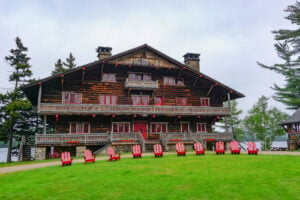
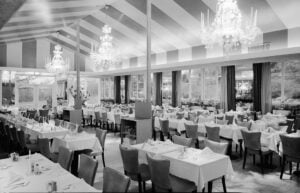
Patricia Murphy’s Candlelight Restaurant in Yonkers, New York, October 1954. Photo: Gottscho-Schleisner Collection, Library of Congress.
For much of the twentieth century, going out to eat in Westchester County meant choosing among places that had become part of the local landscape. Central Avenue in Yonkers had large restaurants with parking lots, lavish dining rooms, and salad bars that could occupy an entire wall. Along the Hudson River, smaller restaurants became neighborhood gathering places. In the county’s villages, diners, ice cream parlors, and takeout counters drew customers who returned week after week, sometimes for decades.
The growth of suburban Westchester after World War II helped shape that restaurant scene. Families moving north from New York City found new shopping centers, busy commercial roads, and restaurants designed for a night out without driving back into Manhattan. Some establishments were destinations for weddings, anniversaries, and holiday dinners. Others were where teenagers went after a football game or where parents took their children for a birthday sundae. A few survived well into the twenty-first century; others disappeared long before the internet gave customers an easy way to preserve their memories.
There was no single reason these restaurants vanished. Properties were redeveloped, owners retired, families sold their businesses, and dining habits changed. Fire ended the history of some buildings. In other cases, a familiar restaurant gave way to an entirely different concept. The following 25 establishments no longer operate under their original names at the locations discussed. Some restaurant companies associated with them still have other locations, but these are the particular Westchester places people remember.
1. Patricia Murphy’s Candlelight Restaurant (Yonkers)
Patricia Murphy’s Candlelight Restaurant was one of the most ambitious dining establishments Westchester ever had. The vast restaurant on Central Park Avenue stood amid landscaped grounds, gardens, ponds, and greenhouses. Dining there could feel like an afternoon excursion rather than a stop for dinner. Families celebrated graduations, weddings, and holidays in rooms large enough to accommodate crowds, while the grounds and gift shop gave guests somewhere to wander before being seated.
The food had its own following, especially the hot popovers served by waitresses making their way through the dining rooms. Former employees have recalled the pace of service and the scale of the operation, which could be overwhelming on busy weekends. The restaurant eventually closed, and its original building was demolished as the area was redeveloped. Its elaborate setting makes it difficult to compare with an ordinary suburban restaurant. For many residents, it represented an era when a special dinner required dressing up and making an entire evening of it.
2. Cooky’s Steak Pub (Yonkers)
Cooky’s Steak Pub on Central Avenue had an entirely different attraction: an enormous salad bar that customers still mention whenever the old Yonkers dining scene comes up. The restaurant was known for steaks and other hearty entrees, but the selection available before the main course was often the real event. A period advertisement listed peel-and-eat shrimp, chopped liver, macaroni salad, homemade soup, banana bread, and numerous other dishes among its offerings.
Cooky’s was part of the era when a suburban family steakhouse promised abundance. People who remember it frequently talk about repeated trips to the salad bar and the shrimp piled high for diners to help themselves. The restaurant has long since disappeared from Central Avenue, and the site later took on other retail uses. What remains in local memory is less the name of any one steak than the extraordinary amount of food that seemed to arrive before dinner had even begun.
3. Red Coach Grill (Yonkers)
The Red Coach Grill occupied a prominent location near the Cross County Shopping Center and offered a more formal dining experience than many of the casual restaurants that later came to dominate the area. Its menus featured prime rib, seafood, and traditional American restaurant dishes. A meal there could be part of a family celebration or the conclusion of an afternoon spent shopping at Cross County, which became one of southern Westchester’s major retail destinations after opening in the 1950s.
Local recollections preserve details of the menu, including lobster Newburg, clam chowder, and the restaurant’s cheese spread served with bread. Those details help explain why a regional chain restaurant could become a personal landmark: regular customers associated certain foods with a particular dining room and a particular occasion. The Yonkers Red Coach Grill eventually closed and was succeeded by other restaurant operations. Its name survives in conversations about the large dining rooms that once served shoppers and families along Westchester’s busiest corridors.
4. Jahn’s Ice Cream Parlor (Eastchester)
Jahn’s was the sort of ice cream parlor where ordering dessert could turn into a performance. The former Eastchester location on White Plains Road belonged to a chain that began in the Bronx in 1897 and spread through New York City and its suburbs. Its famous Kitchen Sink sundae came in a large serving vessel and was meant to be shared, making Jahn’s an obvious choice for birthday celebrations and group outings.
Residents recall the Eastchester shop as a place for teenagers and families, especially when a visit involved the anticipation of that oversized sundae. The Westchester location closed years ago, although the Jahn’s name has survived elsewhere, including in Jackson Heights, Queens. It is the Eastchester branch that belongs on this list. The attraction was as much about gathering a group around the table as it was about finishing the ice cream.
5. Giuseppe’s Restaurant (Ardsley)
Giuseppe’s on Saw Mill River Road was the kind of neighborhood Italian restaurant where the menu did not need to be reinvented every season. Opened in the early 1990s, it built a following around familiar dishes such as baked ziti, eggplant Parmesan, calamari, and pasta served with Bolognese or Alfredo sauce. It became one of several Ardsley restaurants that helped give the village its own dining identity rather than simply sending residents elsewhere for dinner.
Local historical research identifies Joe DeSalvo as the founder and records the restaurant’s closure in April 2012. A different Italian restaurant, the Italian Kitchen, followed at the address. Giuseppe’s is remembered for an uncomplicated reason: it offered the reliable, familiar Italian-American meals that brought families and regular customers back. Its loss was a change in the everyday dining choices of a village, not a headline-making event.
6. Hamburger Depot (New Rochelle)
Hamburger Depot in New Rochelle’s Wykagyl neighborhood offered something children rarely encountered at a restaurant: a model train carrying their food. Small flatbed cars moved around a track by the counter, delivering burgers and other orders to waiting customers. It was a simple idea, but the spectacle of a train arriving with lunch made the meal memorable in a way ordinary counter service never could.
Recollections of Hamburger Depot have survived in local discussions and even in a public-radio story about restaurant nostalgia. Former customers remember the moving train as clearly as the hamburgers. The restaurant is gone, and descriptions of its exact operating years are difficult to establish, so its story is best told through the feature that made it distinctive. For those who ate there as children, the appeal was watching a miniature railroad become part of an everyday meal.
7. Marty’s Mug & Munch (Ardsley)
Marty’s Mug & Munch opened in Ardsley in 1969 under Marty Engleman, a World War II veteran whose family had deep ties to the village. His wife, Francine, helped run the business. It became especially well known for hamburgers, winning local recognition for its burgers on more than one occasion. Unlike the elaborate destination restaurants elsewhere in Westchester, Marty’s earned its reputation as a comfortable local place.
The Englemans operated the restaurant until its closing in 1989. Marty also served in the Westchester County chapter of the New York State Restaurant Association. The restaurant’s significance lies in its connection to the community: a family business where meals, local conversations, and village life overlapped. Decades later, the name still appears when longtime Ardsley residents discuss the restaurants they wish could return.
8. Water Wheel Inn (Ardsley)
The Water Wheel Inn on Saw Mill River Road had a history that began before it became a restaurant. The property was used as a real estate office in the 1920s and later housed the Olde Saw Mill Tea House. William Lodes established the Water Wheel Inn there in 1955. With its rustic character and prominent water-wheel feature, it offered an atmosphere very different from the highway-oriented chains developing elsewhere in the county.
The inn served dinners and hosted gatherings for years, but business later declined. By 1990 the property had been offered for sale. A fire destroyed the building in December 1992, after the restaurant’s active years had ended. Those two dates matter because the fire is sometimes mistakenly described as the immediate reason the restaurant closed. It was the final loss of a building that had already been part of Ardsley’s restaurant history for decades.
9. Buffet de la Gare (Hastings-on-Hudson)
Buffet de la Gare brought traditional French dining to Hastings-on-Hudson in 1980. Gwenaël Goulet and his wife, Annie, established the restaurant near the village’s railroad station, creating a destination for people who valued a small, carefully run dining room rather than a large suburban establishment. Although its name included the word “buffet,” this was a French restaurant, not an all-you-can-eat operation.
The restaurant earned an enduring reputation for classical French cooking and hospitality. Gwenaël Goulet died in 2011, and Annie continued the business before retiring and closing it in 2013, after 33 years. A new restaurant later took over the location. Buffet de la Gare is remembered as evidence that an intimate village dining room could develop a reputation extending across Westchester and beyond without abandoning its neighborhood character.
10. El Dorado Diner (Tarrytown)
The El Dorado Diner on South Broadway in Tarrytown had the broad menu and long-hours identity associated with traditional New York-area diners. For commuters, families, and anyone looking for a dependable meal without a reservation, its attraction lay in the range of choices: breakfast dishes, burgers, sandwiches, salads, and dinner plates. The building had previously been a Howard Johnson’s, another reminder of how roadside dining locations can change hands while remaining familiar landmarks.
The Tarrytown El Dorado closed in February 2017 and was demolished later that year to make way for a Honda service center. Importantly, the closing did not mark the disappearance of every El Dorado Diner: other locations have operated in the area. What Westchester lost was this particular South Broadway diner and the everyday routine associated with its location.
11. Huber’s Hofbrau (Mamaroneck)
Huber’s Hofbrau opened on Mamaroneck Avenue in 1932, when German restaurants and beer halls were an established part of New York’s dining culture. For decades it served as a familiar place for German-style food, beer, and conversation. The restaurant’s long life placed it across several generations of village history, with its name appearing in old business listings and photographs preserved by the Mamaroneck Historical Society.
Huber’s closed in 2004, but the story of its interior did not end there. For years afterward, the shuttered bar and dining room remained strikingly intact. The historical society records that the family continued tending the space, including polishing the bar, long after the final meals had been served. That unusual survival made Huber’s a visible reminder of a vanished restaurant, rather than simply another business name on an old map.
12. Manzi’s (Hastings-on-Hudson)
Manzi’s was established by Tony Manzi in the 1970s, first operating in Yonkers before moving to 19 Main Street in Hastings-on-Hudson in 1976. It became known for Italian food prepared and served in a setting that fit the village. Pasta was central to the menu, with traditional sauces and combinations of seafood, vegetables, and meat. Its appeal rested on the kind of cooking customers could return to over many years.
Manzi’s remained a fixture in Hastings until closing in 2009. Rainwater Grill followed at the Main Street location, beginning another chapter in the property’s restaurant history. Local historians have preserved the dates and the restaurant’s place in the village’s dining scene. The disappearance of Manzi’s meant losing a specific kind of familiar Italian dining room at a location people had come to associate with the name.
13. The Flying Pig (Mount Kisco)
The Flying Pig helped make locally sourced food a major part of Mount Kisco’s restaurant conversation before the phrase “farm-to-table” became a routine marketing description. The restaurant opened in 2000 at the Mount Kisco train station and later moved to 251 Lexington Avenue. Its menus emphasized seasonal produce and ingredients from nearby farms, connecting the dining room to the Hudson Valley’s agricultural community.
After 11 years, the owners announced in November 2011 that the restaurant would close at the end of the year. Contemporary reporting cited the weak economy and several other business factors, rather than establishing a single rent increase as the cause. The Flying Pig is remembered not just for individual dishes but for the idea that a suburban restaurant could make the sources of its ingredients an important part of its identity.
14. Auberge Maxime (North Salem)
Auberge Maxime was a French country restaurant at 721 Titicus Road in North Salem. Its rural setting was part of the attraction, providing a different experience from the more commercial dining strips in southern Westchester. Under chef Bernard Le Bris, the restaurant was associated with traditional French preparations and a style of dining built around a full evening at the table.
A preserved collection of restaurant recipes identifies Le Bris with Auberge Maxime and includes his chocolate soufflé, a small but appealing surviving detail from its menu. The restaurant eventually closed, and a later establishment known as Vox occupied the location. Auberge Maxime is one of the names that still evokes an older northern Westchester restaurant scene, when a country-road address could itself be part of the appeal of dinner.
15. Bellizzi (Mount Kisco)
Bellizzi offered an unusually family-oriented combination of Italian food, pizza, and entertainment on East Main Street in Mount Kisco. The business began in 1991 under the name Pizza Pizzazz and developed into a local destination where the arcade was nearly as important to some families as the meals. Birthday celebrations and outings gave the restaurant a special place in the memories of children who grew up in northern Westchester.
In 2015, owner Isidoro “Isi” Albanese closed Bellizzi and began transforming the space into Exit 4 Food Hall, which opened in 2016. This was not simply a restaurant being forced out of its building; the owner chose a new dining concept, bringing multiple food stations under one roof. That distinction does not make the old Bellizzi any less missed. The arcade-and-Italian-restaurant experience that people remember was replaced by something fundamentally different.
16. Ben’s Kosher Deli (Scarsdale)
Ben’s Kosher Deli on Central Park Avenue brought the familiar New York Jewish delicatessen experience to the Scarsdale area. Opened in 2015, the location served corned beef and pastrami sandwiches, soup, pickles, and other traditional deli dishes. It offered suburban customers a full-service place to sit down over foods that had long been associated with the city’s delis.
The Scarsdale location closed in the aftermath of the COVID-19 pandemic, with the company acknowledging the disruption when it marked its fiftieth anniversary in 2022. Ben’s itself did not disappear: the business continued operating restaurants elsewhere in New York and Florida. The loss was local, and that is the important distinction for this list. Customers who had relied on the Central Avenue branch could no longer return to their familiar dining room.
17. Blockheads (White Plains)
Blockheads brought a casual burrito-centered restaurant format to downtown White Plains at 40 Mamaroneck Avenue. Its menu offered large burritos, Mexican-inspired dishes, vegetarian options, and drinks that appealed to groups looking for a relatively informal meal in the city’s restaurant district. Unlike the older steakhouses on this list, Blockheads belonged to a more recent era of Westchester dining.
The White Plains restaurant was reported closed in 2021. Its disappearance is a reminder that not every missed establishment needs to date from the 1950s or 1960s. For diners who spent their college years or early working lives in downtown White Plains, a favorite casual restaurant could become part of their local history just as surely as a long-established diner or inn.
18. Bengal Tiger (White Plains)
Bengal Tiger at 144 East Post Road was among the Indian restaurants that developed devoted followings in downtown White Plains. Customers remember its curries, lunch options, and the sense that it offered a dependable choice for Indian food at a time when the county’s restaurant scene was becoming increasingly diverse. It was a different kind of local institution from the steakhouses and diners that had defined an earlier generation.
The restaurant was lost after a fire, a fact documented in local coverage that also noted a separate takeout business, Ambadi, operating across the street afterward. Memories of Bengal Tiger continue to appear in discussions of vanished Westchester restaurants. Its inclusion recognizes the broader range of cuisines that shaped the county’s dining history, not merely the places that served traditional American fare.
19. Mont Parnasse Diner (Scarsdale)
The Mont Parnasse Diner, usually called “the Mont,” became a regular stop for young people and families in the Scarsdale area. It was associated with the familiar diner experience: booths, a large menu, desserts on display, and meals served well outside the hours of an ordinary family dinner. Former customers remember it as a place to meet after school events or a night out.
The diner was demolished in December 2009, with a Walgreens planned for the site. A local report published during the demolition recalled its banquettes, jukeboxes, breakfast dishes, and display cases full of cakes. Such details explain why people mourn the loss of diners even when other restaurants remain nearby. A diner could be a place to spend time without much ceremony, and losing that space meant losing a gathering spot as well.
20. Wobble Café (Ossining)
Wobble Café at 21 Campwoods Road in Ossining had a deliberately welcoming approach to family dining. Owners Rich Foshay and Beylka Krupp developed a place where parents could have a genuine breakfast or lunch while younger customers were accommodated with a play area and child-friendly service. The menu also offered vegetarian choices and other dishes beyond the usual children’s fare.
Contemporary accounts describe regular customers returning for breakfast and coffee, sometimes several times a week. The café was reported closed by 2018. Its importance was not based on celebrity chefs or elaborate decor; it was the ability to make an ordinary meal easier for families and comfortable for neighborhood regulars. That practical hospitality is the sort of quality people remember long after a small restaurant’s doors close.
21. Rainwater Grill (Hastings-on-Hudson)
Rainwater Grill opened at 19 Main Street in Hastings-on-Hudson after Manzi’s closed in 2009. It served contemporary American food and became known for substantial burgers and a relaxed village setting. The address had already supported a long-running restaurant, and Rainwater represented an attempt to give it a new identity without losing its place in the community.
The business closed in August 2013 after roughly four years. Reports at the time noted its sale and the expectation that another restaurant would follow. Rainwater’s relatively brief run contrasts with some establishments elsewhere on this list that lasted for generations, but its place in Hastings is still part of a sequence of changing restaurants at the same Main Street address. Those successive openings and closings tell their own story about the challenges of keeping a village restaurant in business.
22. Swagat Halal Indian Cuisine (Tarrytown)
Swagat Halal Indian Cuisine was a fixture at 19 North Broadway in Tarrytown for nearly 11 years. The restaurant served traditional Indian dishes and developed a loyal following among village residents and people looking for takeout meals. For a community with a compact downtown, losing a restaurant on a familiar block could change the everyday choices of diners who had made it part of their routine.
Swagat’s final service came at the end of 2021. Local reporting traced the closure to a difficult business environment and a disagreement over lease terms following the sale of the building, rather than simply labeling it another restaurant destroyed by the pandemic. Its owners had hoped to find a way to remain open. The closure was a loss for customers who had come to regard Swagat as one of Tarrytown’s dependable dining options.
23. Azuma Sushi (Hartsdale)
Azuma Sushi at 219 East Hartsdale Avenue served Japanese food in a community where restaurants could build a following through consistent service rather than advertising campaigns. Former patrons remember the sushi and sashimi, the familiarity of the staff, and the feeling of returning to a place where the experience rarely changed. At a time when sushi was steadily becoming more common in Westchester, Azuma had already developed its own regular clientele.
The original Hartsdale restaurant is no longer operating at that address. Surviving restaurant listings and customer reviews preserve its location and its reputation for sushi. Exact details of the closing are less firmly documented than those of some larger establishments, and no specific closure year is asserted here. Its place on the list rests on the remembered local restaurant that once operated on East Hartsdale Avenue.
24. Poultry Time (New Rochelle)
Poultry Time at 15 Quaker Ridge Road was a longtime New Rochelle takeout destination rather than an elaborate dining room. Its menu centered on fried and roasted chicken, along with other poultry, barbecue dishes, and sides that made it useful to families picking up dinner. The business traced its history to 1962, and local customers developed strong attachments to meals that became part of ordinary weeknight life.
Memories of Poultry Time still surface when New Rochelle residents discuss old neighborhood businesses. Some recall the fried chicken in particular, while others remember buying family meals to take home. The location has long since closed, and the original account’s description of it as primarily a rotisserie restaurant understates the range of food it served. It was precisely the dependable takeout quality that made the restaurant memorable.
25. Rudy’s Sports Bar (Hartsdale)
Rudy’s at 156 South Central Avenue in Hartsdale served as a neighborhood sports bar and casual gathering place. Customers came to watch games, meet friends, and order familiar bar food. It occupied a different place in Westchester’s social life from a special-occasion restaurant: the attraction was being able to return regularly, see familiar people, and follow a game together.
The Hartsdale location is now listed as closed, and its name continues to appear in local conversations about missing restaurants and bars. Specific claims about its closing date or reasons have not been established well enough to repeat. But the broader memory is clear: for its regulars, a local sports bar offered something that cannot always be replaced simply by finding another television showing the same game.
Westchester’s vanished restaurants tell part of the story of how the county changed. Some occupied acres of land and drew people from miles away; others fit into a single storefront and depended on their regular customers. For more on the people and places that shaped the region, read our articles about famous people from Westchester County, classic New York restaurants we still miss, and the history of Horn & Hardart Automats.