Feature Photo: Felix Lipov / Shutterstock
Upstate New York has no shortage of buildings and landscapes that once served a clear purpose and then fell silent. The remains of a Catskills resort, a shuttered hospital, an old Erie Canal aqueduct, and a disused railroad tunnel tell very different stories, but each reveals how communities changed. Factories lost industries, large institutions closed, transportation routes moved, and once-popular vacation destinations struggled to survive.
Some of these places remain vacant or are deteriorating. Others were demolished after years of neglect, and a remarkable number have been saved for entirely new uses. The distinction matters: the Richardson Olmsted Campus in Buffalo now welcomes guests, while other sites, including the former Hudson River State Hospital in Poughkeepsie, have suffered devastating losses. An abandoned place isn’t necessarily one that stays abandoned forever.
The following 25 locations span Western New York, the Finger Lakes, the Adirondacks, the Southern Tier, the Hudson Valley, and the Catskills. They include former institutions, military installations, hotels, industrial sites, transportation structures, and a deserted mining village. For each, the central question is the same: what stood there, why was it left behind, and what happened afterward?
1. The Buffalo State Asylum for the Insane (Buffalo)
Buffalo’s enormous former state asylum is one of Western New York’s most recognizable architectural landmarks. Architect Henry Hobson Richardson designed the monumental stone hospital buildings, while Frederick Law Olmsted and Calvert Vaux developed the surrounding landscape. The institution began receiving patients in the nineteenth century and grew into a major psychiatric campus. Its design reflected the era’s belief that carefully planned surroundings, light, and air could improve institutional care. That ambitious architectural vision did not prevent later overcrowding or the difficulties that accompanied changing standards of psychiatric treatment.
What happened: As hospital services moved elsewhere, parts of the Richardson complex sat unused and deteriorated for years. Preservationists eventually secured support for a major rehabilitation. The restored central buildings reopened as Hotel Henry in 2017 and subsequently became The Richardson Hotel. The surviving campus also supports cultural uses and public outdoor space. This is the story of a formerly abandoned building finding a new purpose, not an active ruin visitors can enter.
2. Letchworth Village (Thiells and Haverstraw)
Letchworth Village opened in Rockland County in 1911 as a residential institution for people with developmental disabilities. Its planners promoted a low-rise campus with farms, workshops, dormitories, and an appearance more like a rural village than an urban asylum. Overcrowding, segregation, and serious problems in the treatment of residents ultimately overtook the original ambitions. The institution’s history cannot be understood only through photographs of picturesque stone buildings; it is also the history of the people who lived there, often without meaningful control over their circumstances.
What happened: Letchworth Village closed in 1996 as part of New York’s long shift away from large state institutions toward community-based support. Some buildings were reused for public services and other purposes, while others remained vacant and deteriorated. Parts of the grounds became recreational property. The famous 1972 Geraldo Rivera investigation primarily exposed Willowbrook State School on Staten Island, although Letchworth was part of the wider scrutiny of institutional care. The remaining vacant buildings are not public attractions; access depends on property ownership and restrictions.
3. Seneca Army Depot (Romulus)
Between Seneca Lake and Cayuga Lake, the Seneca Army Depot once occupied thousands of fenced acres. Established during World War II, the installation stored military supplies and munitions in long rows of reinforced concrete storage bunkers commonly called igloos. Its secrecy fueled public speculation about the weapons stored there. During the 1980s, the depot also became a focus of national attention when the Women’s Encampment for a Future of Peace and Justice organized protests against nuclear weapons near its perimeter.
What happened: The military installation closed, and new owners took over the land and gave it new uses. Some sections were developed for businesses and other facilities, while Deer Haven Park preserved a large portion of the fenced landscape. White-coated white-tailed deer, which developed into an unusually visible herd inside the enclosure, became a defining feature of the place. Deer Haven offers authorized driving and guided tours, letting visitors learn about both the natural history and the former military depot without entering restricted areas.
4. Grossinger’s Catskill Resort Hotel (Liberty)
Grossinger’s was one of the defining resorts of the Catskills Borscht Belt. What began as a family boarding operation became a sprawling destination with hotel buildings, entertainment, recreation, and a reputation built through the efforts of Jennie Grossinger and her family. For generations, vacationers came from New York City and elsewhere to swim, attend shows, play sports, and spend summer holidays in Sullivan County. The resort became shorthand for an entire era of Jewish American vacation culture and remains frequently associated with the atmosphere later portrayed in Dirty Dancing.
What happened: The hotel operation closed in 1986 as vacation habits, travel costs, and the resort industry changed. Parts of the complex were demolished long before the twenty-first century, while remaining buildings deteriorated and some were destroyed by fire. A new developer purchased the property in 2025, and plans discussed in 2026 included a new hospitality and residential destination. A proposed redevelopment is not the same as a completed project; the historic Grossinger’s hotel has not been restored.
5. Halcyon Hall and Bennett College (Millbrook)
Halcyon Hall began in the 1890s as an elaborate hotel in Millbrook, Dutchess County. Its fanciful roofline and Queen Anne architecture gave it a striking appearance even among the Hudson Valley’s country resorts. The hotel eventually closed, and Bennett College made the building its centerpiece, a women’s school that later became a junior college with a broader campus. Generations of students knew Halcyon Hall as a college landmark rather than the resort it was originally built for.
What happened: Bennett College closed in 1978 amid severe financial problems. Halcyon Hall stood vacant for decades, its roof and structural fabric gradually failing despite public interest in saving it. By 2022, the building was demolished, along with other unsafe campus structures. The Bennett Park project retained parts of the former grounds for public use and incorporated recovered stone and other references to the school’s history. The famous abandoned mansion itself is gone, but the property has not simply been forgotten.
6. J. N. Adam Memorial Hospital (Perrysburg)
The former J. N. Adam Memorial Hospital stands in the rolling landscape of Cattaraugus County, where the City of Buffalo established a tuberculosis sanatorium early in the twentieth century. The complex opened in 1912 and included long, curved hospital wings and spaces designed around the fresh-air treatments used before effective antibiotics were available. It served as both a major medical facility and a workplace, and its distinctive architecture made it memorable to patients, staff, and local residents.
What happened: As tuberculosis treatment changed, the property became a state developmental-disability facility and later closed. A New York State appraisal documented abandonment beginning around 1991 and described years of weather damage and neglect. Ownership, cost, and the difficulty of finding a practical new use for such large buildings have complicated the hospital’s fate. It remains an important but endangered historic complex; it is not restored or safely open to the public.
7. Frontier Town (North Hudson)
For people who traveled the Adirondack Northway on summer vacations, Frontier Town was once a memorable stop. Opened in 1952, the Western-themed amusement park staged gunfights, carriage rides, and frontier spectacles against an Adirondack backdrop. It offered roadside entertainment from the decades before giant corporate theme parks became dominant. Recreated streets and shows drew many family vacations and remain familiar to New Yorkers who grew up in the 1950s, 1960s, and 1970s.
What happened: Attendance weakened, ownership changed, and the original park ultimately closed for good in 1998. Buildings and attractions deteriorated, and some memorabilia was sold or relocated. New York later developed the Frontier Town Campground, Equestrian and Day Use Area on part of the former property, formally opening the new campground in 2019. The Wild West theme park no longer operates, but the location has a second life in Adirondack recreation. Our separate history of Frontier Town explores the original attraction in greater detail.
8. Hudson River State Hospital (Poughkeepsie)
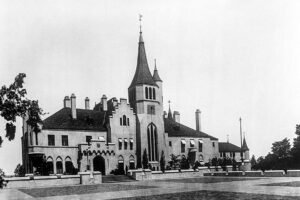
The Hudson River State Hospital occupied a broad hillside overlooking the Hudson near Poughkeepsie. Opened in the nineteenth century, it featured extraordinary High Victorian Gothic architecture by Frederick Clarke Withers and landscaped grounds planned by Frederick Law Olmsted and Calvert Vaux. The immense campus grew over generations as institutional treatment expanded. Later changes in psychiatric care left wards empty and buildings abandoned, while advocates argued over whether to preserve the most important surviving structures for new uses.
What happened: The abandoned campus suffered major fires, including a 2007 blaze and a 2018 fire that damaged the historic administration building. Redevelopment of portions of the grounds proceeded under the Hudson Heritage name, but the landmark complex’s preservation remained uncertain. Then, on June 3, 2026, another enormous fire devastated the abandoned historic buildings, including the Kirkbride administration structure. Earlier descriptions of that building as safely restored are now outdated. The losses intensified questions about how much of the remaining historic fabric could still be saved.
9. Willard Psychiatric Center (Willard)
On the eastern shore of Seneca Lake, Willard grew into an extensive psychiatric hospital campus with institutional buildings, utility structures, service roads, and landscaped grounds. It opened in the nineteenth century and served generations of patients under the mental-health policies of their respective eras. The larger story of Willard includes both changes in psychiatric treatment and the people who spent long portions of their lives in state institutions. After its original hospital role ended, some of the property was used for a state correctional facility.
What happened: The later correctional operation closed, leaving an enormous collection of aging buildings and extensive grounds with an uncertain future. A state-supported redevelopment vision drew attention, but by May 2026, local reporting described a stalled plan and growing concern about the campus’s physical condition. Willard has not simply been converted into a completed new neighborhood or resort. Local officials, preservation advocates, and the state still debate its history and potential reuse.
10. Silo City Grain Elevators (Buffalo)
Buffalo’s grain elevators form one of the country’s most distinctive industrial skylines. Along the Buffalo River, concrete towers, warehouses, and conveyors once handled grain moving between the Great Lakes and eastern markets. Several complexes later stood underused or vacant as transportation patterns and industrial operations changed. Their massive scale created major obstacles to reuse: concrete silos built for grain don’t easily become offices or apartments, and decades of exposure left some connected structures in poor condition.
What happened: Preservation through adaptation has transformed part of Silo City. The American Malting complex became the American Lofts at Silo City, with residential units opening in 2025, while other buildings host cultural and commercial activities. The redevelopment received further recognition in 2026. It would be inaccurate to say that every grain elevator has become housing or that the entire site was uniformly abandoned. The success lies in a phased effort to find new uses for individual structures without erasing the industrial landscape.
11. Overlook Mountain House (Woodstock)
High above Woodstock, the remains of the Overlook Mountain House are among the Catskills’ best-known resort ruins. Earlier hotels occupied the mountain, and fire repeatedly damaged the grand accommodation that once drew visitors. The surviving concrete structure dates to a twentieth-century rebuilding effort that never reached the intended completion. Unlike a deserted hotel full of former guest rooms, the present ruin is essentially the shell of a dream that was never fully realized.
What happened: The unfinished building was left exposed to the elements, and the surrounding land became part of protected Catskill public lands. Hikers encounter the ruined walls along the Overlook Mountain trail near the fire tower. Its appearance can make the site seem timeless, but the weathered masonry reminds visitors that construction plans ended decades ago. Visitors should follow posted trail guidance and avoid unstable sections rather than treating the ruin as an unrestricted climbing structure.
12. The Rochester Subway (Rochester)
Rochester once had its own rail rapid-transit system, built largely along the former Erie Canal route. Passenger service began in 1927, and the line carried commuters through sections of Rochester, including a tunnel beneath Broad Street. This was not a miniature copy of New York City’s subway; much of the route was open-cut rather than underground, and it also served an important freight function. Its history reflects how the city adapted canal infrastructure to a new transportation technology.
What happened: Passenger service ended June 30, 1956, as ridership fell and highway plans changed Rochester’s transportation priorities. Some tracks and right-of-way remained in freight service for years, while other portions were filled or converted for roadway use. Most of the tunnel beneath Broad Street has also been filled, although surviving sections and historic structures still recall the old line. The Rochester & Genesee Valley Railroad Museum preserves the surviving passenger car and the system’s history. The subway is gone as public transit, but not entirely erased from the city’s infrastructure.
13. The Former Beech-Nut Factory (Canajoharie)
For generations, the Beech-Nut factory was a defining feature of Canajoharie on the Mohawk River. A food-production business grew at the site during the late nineteenth century and eventually became associated with nationally recognized products, including baby food. The enormous complex expanded across much of the village center and provided jobs, taxes, and an identity that reached far beyond Montgomery County. Its size made the factory a landmark visible to motorists traveling on the Thruway.
What happened: Beech-Nut moved production to a newer facility in the region around 2010–2011, leaving behind an extensive industrial campus. Many buildings stood vacant for more than a decade and deteriorated badly. Montgomery County and local partners used public support to carry out environmental work and demolition, with major clearance completed by 2024. The Exit 29 redevelopment effort seeks a productive new use for the cleared site, but the former factory complex itself has largely disappeared. The project represents the difficulty of recovering after a village’s principal employer leaves.
14. Tahawus and the Village of Adirondac (Newcomb)
Deep in the Adirondack High Peaks region, the old mining settlement of Adirondac developed around nineteenth-century ironworks. Workers and their families lived far from major communities, with a blast furnace, workshops, and other buildings forming a settlement in the wilderness. The first period of iron production ended in the nineteenth century; later, nearby titanium mining revived industrial activity on the wider Tahawus property. The layered history of the site makes it more than a single abandoned mine.
What happened: Mining eventually ended, and deteriorated buildings and remnants of the old village became part of an Adirondack ghost-town landscape. The Open Space Institute acquired the larger Tahawus tract in 2003, transferred extensive areas to New York State, and retained a historic core for preservation and interpretation. Marked trails now help visitors understand the blast furnace and vanished community. Tahawus is a rare example of abandoned industrial history being protected within a major wilderness landscape.
15. The Pines Hotel (South Fallsburg)
The Pines was one of the Catskills’ major Borscht Belt resorts, where families returned year after year for swimming, dining, entertainment, and long summer stays. Its enormous buildings and recreation facilities reflected a vacation culture that once sustained much of Sullivan County’s hotel economy. The resort’s history was closely tied to the rise and eventual decline of the Catskills as a principal summer destination for Jewish families from New York City and elsewhere.
What happened: The Pines closed in 1998 and its sprawling grounds slipped into disuse. Snow, water damage, and repeated fires took a heavy toll on the vacant structures, including major fires reported in 2023 and 2024. Claims that every structure was already demolished and replaced by a completed housing development are not supported by the reports reviewed. The more defensible account is a long period of vacancy, serious fire losses, and uncertain redevelopment at the former resort site.
16. Bannerman Castle (Pollepel Island)
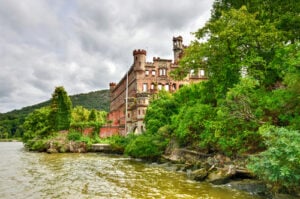
In the Hudson River near Beacon, the unmistakable silhouette of Bannerman Castle rises from Pollepel Island. The structure was not a royal residence. Frank Bannerman, a New York military-surplus merchant, developed the island as a storage complex for equipment and munitions in the early twentieth century. Its fanciful towers and stone walls were intended to advertise the Bannerman business as much as to serve practical storage needs. The location became one of the most unusual commercial sites in the Hudson Valley.
What happened: A 1920 explosion damaged parts of the complex, and a 1969 fire left the main building a roofless ruin. Preservation work has since stabilized important sections and made organized visits possible through the Bannerman Castle Trust. The island is part of Hudson Highlands State Park Preserve, and visitors must use authorized water access and guided tours; private boaters cannot simply land and enter the ruins. It remains a ruin, but one receiving active care rather than a forgotten or unclaimed property.
17. The New York State Inebriate Asylum (Binghamton)
The imposing stone building sometimes called Binghamton’s Castle on the Hill was designed by Isaac G. Perry for the New York State Inebriate Asylum. Completed in the 1860s, the institution was historically significant because it treated alcoholism as a medical condition rather than simply a moral defect. Its Gothic Revival architecture gave the asylum the appearance of a fortified institutional palace. Over time its purpose changed, and the building was incorporated into a broader state psychiatric hospital system.
What happened: The original asylum building closed in 1993 because of safety concerns and sat vacant for years. Binghamton University assumed stewardship in 2015, and preservation proposals sought to give it a future. The National Park Service continues to identify the landmark as not open to the public. Despite reports and proposals about restoration, I could not verify that the building has been fully converted into occupied university administrative offices; describing that conversion as complete would be misleading.
18. Mount McGregor Correctional Facility (Wilton)
Mount McGregor in Saratoga County has seen several distinctly different institutional lives. In the nineteenth century, its mountain location attracted visitors seeking scenery and cleaner air, and the area subsequently hosted medical and institutional uses. The site is especially well known because Ulysses S. Grant spent the final weeks of his life at nearby Grant Cottage in 1885, completing his memoirs while suffering from throat cancer. In the late twentieth century, a state correctional facility came to occupy the surrounding grounds.
What happened: New York closed the Mount McGregor Correctional Facility in 2014, leaving large prison structures and land awaiting a new long-term use. The closure did not include the end of the Grant Cottage story. That historic property was preserved separately and remains a public historical attraction. Visitors should distinguish the authorized Grant Cottage site from the former prison grounds; the closure of a correctional facility does not make its buildings publicly accessible.
19. Copake Iron Works (Copake Falls)
The Copake Iron Works began operating in the nineteenth century amid the wooded hills of eastern Columbia County. Its furnace, machinery, ore workings, and support buildings were part of an industry that transformed regional landscapes long before modern steelmaking. Iron production drew workers into Copake Falls and shaped nearby roads, housing, and commerce. When manufacturing shifted toward larger and more competitive industrial centers, the old works lost their economic purpose.
What happened: The ironworks ceased furnace operations in 1903, and the remaining industrial site eventually became part of Taconic State Park. Structures deteriorated, some were demolished, and the furnace survived in damaged form for many years. Since 2008, the Friends of Taconic State Park and public partners have stabilized buildings and developed the Copake Iron Works Museum and heritage trail. It is now an interpreted industrial ruin and historic attraction, rather than an abandoned factory that visitors must trespass to see.
20. Nevele Grande Resort (Ellenville)
The Nevele was one of the most recognizable grand Catskills hotels, particularly after it developed a modern high-rise tower and substantial recreation facilities. The large resort offered golf, skating, entertainment, and the kind of extended vacation packages that once brought tremendous business to Ulster County. Its architecture reflected different generations of expansion, from the older hotel buildings to the conspicuous tower that became a familiar part of the landscape around Ellenville.
What happened: The resort closed in 2009, followed by unsuccessful redevelopment proposals and years of deterioration. Fires in March 2024 and January 2025 destroyed or damaged remaining structures. A proposed new lodging and residential project has been discussed, but proposals and demolition schedules have changed repeatedly. The clearest account is that the old resort no longer operates, several buildings have been badly damaged, and the property’s future has remained unsettled. It should not be portrayed as an already completed redevelopment.
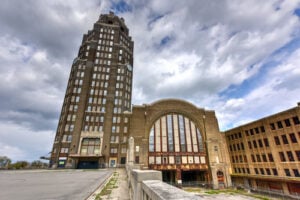
21. Buffalo Central Terminal (Buffalo)
When the Buffalo Central Terminal opened in 1929, its soaring Art Deco tower and great passenger concourse symbolized a city at the center of national rail travel. Designed to handle a large volume of travelers and trains, it was among the most ambitious railway buildings in the state. Over subsequent decades, passenger service declined as Americans increasingly traveled by car and plane. The station was left with far more space than a diminished railroad network needed, and much of the property ultimately fell vacant.
What happened: The final passenger train departed in 1979. After years of neglect and damage, the Central Terminal Restoration Corporation became an important steward of the landmark. A major preservation and redevelopment initiative has secured tens of millions of dollars for safety work, stabilization, and limited public use. Construction and long-range planning continue; the terminal has not been completely restored to its former glory, but neither is it simply an untouched abandoned station. Its preservation has become a central part of Buffalo’s East Side revitalization story.
22. Fort Montgomery (Fort Montgomery)
Fort Montgomery stood above the Hudson River near the entrance to the Highlands, where American forces attempted to prevent British warships from moving freely up the river during the Revolution. Built in 1776, the fort formed part of a defensive system that also included nearby Fort Clinton and a heavy iron chain stretched across the river. Its position reflected the strategic importance of controlling the Hudson, which connected New York’s coastal waterways with its inland military campaigns.
What happened: On October 6, 1777, British and allied forces overwhelmed the defenders, occupied the fortifications, and destroyed them. The surviving earthworks and foundations remained as historical ruins rather than as a functioning military base. Later archaeological study uncovered barracks foundations and other features, and the property became Fort Montgomery State Historic Site. Visitors can now see the excavated remains and museum displays during authorized hours. This is an eighteenth-century ruin preserved for education, not a modern derelict building.
23. The Schoharie Creek Aqueduct (Fort Hunter)
Near Fort Hunter in Montgomery County, remnants of the Schoharie Creek Aqueduct show how engineers once carried Erie Canal boats above a powerful creek. Built during the enlargement of the Erie Canal in the nineteenth century, the long stone structure replaced an earlier arrangement that left canal traffic vulnerable to high water. With its multiple arches, the aqueduct was both practical transportation infrastructure and an imposing work of masonry. It served a busy waterway in the age when canal boats linked New York’s interior communities with markets to the east and west.
What happened: The aqueduct was abandoned when the newer Barge Canal route supplanted it in 1916. Several arches were deliberately removed in the twentieth century to ease ice movement, and other sections collapsed over time. The remaining masonry is preserved and interpreted as part of Schoharie Crossing State Historic Site, with public trails and a visitor center. Readers interested in the broader transportation history can explore our history of the Erie Canal.
24. The Catskill Game Farm (Catskill)
For decades, the Catskill Game Farm was an important destination for families visiting Greene County. Opened in 1933, it grew into a large privately operated animal park with walks, enclosures, and a memorable entrance that generations of visitors associated with Catskills vacations. The attraction helped introduce children to animals they might otherwise have known only from books and television, and it became a recurring summer tradition for families from throughout New York and neighboring states.
What happened: The zoo closed in 2006 and stood unused long enough for vegetation and weather to transform many former enclosures. New owners subsequently developed lodging on part of the grounds, including a boutique inn in the former giraffe barn that opened in 2019. The property has not reopened as the old zoo, and the remaining animal structures still recall the abandoned park. Its owners specify that access to the former zoo grounds is for lodging guests, not for unrestricted public exploration.
25. Victory Mills (Village of Victory)
The brick Victory Mill helped define a small industrial community near Schuylerville in Saratoga County. Textile production began on the site in the nineteenth century, and the mill grew into a local economic anchor where generations found work. Its large masonry buildings reflected the importance of cotton manufacturing in a region more often associated with Revolutionary War battlefields and the Saratoga racing season. When the mill finally closed around 2000, the enormous complex was left with no straightforward industrial replacement.
What happened: The vacant buildings deteriorated, and redevelopment proposals confronted serious structural and financial obstacles. Contrary to earlier reports that the factory had already become finished residential loft apartments, the Village of Victory describes redevelopment as an ongoing project. State development records say emergency demolition began in June 2025 and describe further renovation stages extending into later years. The mill’s future therefore remains a work in progress, not a completed preservation success.
The stories of these abandoned places do not all end with a wrecking ball. Some locations were reclaimed as parks, museums, hotels, or housing; others remain threatened, and some have disappeared completely. For more of New York’s vanished history, read our look at submerged and vanished Upstate towns and 25 haunted places in Upstate New York and their histories. These related articles explore different kinds of places whose histories are still part of the landscape.