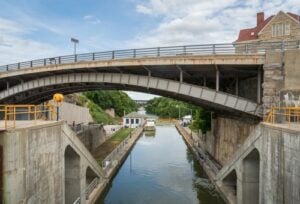
Feature Photo: Zack Frank / Shutterstock.com
When Governor DeWitt Clinton’s 363-mile engineering marvel opened in 1825, the Erie Canal did more than connect the Hudson River to Lake Erie. It helped transform Upstate New York into one of the great commercial and industrial regions of 19th-century America. Known to its critics as “Clinton’s Ditch,” the waterway opened a practical route between the Atlantic seaboard and the Great Lakes, dramatically lowering freight costs and encouraging settlement and investment along its banks.
Dozens of agricultural hamlets, river crossings, and mill sites developed into busy canal ports, boatbuilding centers, and manufacturing cities. Some communities were established long before the canal, while others grew directly from its construction. These 25 Erie Canal communities, arranged roughly from east to west, illustrate how a single transportation project reshaped the economy and geography of Upstate New York. For the broader story of the waterway itself, see our history of the Erie Canal.
1. Waterford
Municipality: Town and Village of Waterford, Saratoga County
Situated near the confluence of the Hudson and Mohawk rivers, Waterford is the eastern gateway of today’s Erie Canal. Its celebrated Waterford Flight of Locks, E-2 through E-6, lifts vessels a combined 169 feet in a short distance around the difficult terrain near Cohoes Falls. These modern locks belong to the 20th-century Barge Canal system, rather than the original 1825 Erie Canal, whose eastern terminus was at Albany. Waterford’s position at the meeting of the Erie and Champlain canal routes nevertheless made it an important center for canal traffic, supplies, and transportation. The flight remains one of the state’s most striking engineering landmarks.
2. Cohoes
Municipality: City of Cohoes, Albany County
Perched near the Mohawk River’s plunge over Cohoes Falls, Cohoes grew through a combination of waterpower and Erie Canal transportation. The original and enlarged canal routes passed through the city, using a series of locks to overcome the steep rise around the falls. The same industrial setting helped support the massive Harmony Mills textile complex and other factories. With dependable waterpower for machinery and canal access for freight, Cohoes developed into one of the country’s best-known textile manufacturing centers, earning the nickname “Spindle City.” Today’s Erie Canal follows a different alignment through the Mohawk River, but remnants of the older canal survive in Cohoes.
3. Schenectady
Municipality: City of Schenectady, Schenectady County
Long before the Erie Canal, Schenectady served as a gateway for Mohawk River trade and overland transport toward western New York. The canal changed the scale of that commerce by creating a more dependable connection to Albany, the Hudson River, and markets farther west. Warehouses, merchants, and manufacturers benefited from the improved transportation system. Later, railroads, industrial investment, and the arrival of major companies, including General Electric and the American Locomotive Company, transformed Schenectady into an industrial city. The canal did not create all of those industries, but it was a vital early part of the transportation network on which the city’s expansion depended.
4. Amsterdam
Municipality: City of Amsterdam, Montgomery County
Straddling the Mohawk River, Amsterdam used both waterpower and canal transportation to develop from a mill settlement into a manufacturing city. Textile and carpet producers found access to raw materials and distant markets, while factories attracted thousands of workers and immigrant families. By the late 19th century, Amsterdam had become closely associated with carpet production, especially through enterprises such as the Sanford mills. Its reputation as the “Carpet City” reflected an industrial economy sustained by waterways, rail connections, and successive waves of manufacturing growth. The Erie Canal helped establish the region’s early commercial advantages even as railroads later assumed a larger share of freight traffic.
5. Fultonville
Municipality: Village of Fultonville, Town of Glen, Montgomery County
Located on the south bank of the Mohawk River opposite Fonda, Fultonville grew dramatically with the arrival of the Erie Canal. The area’s earlier settlement was associated with Van Epps’ Swamp, but canal construction encouraged merchants and landowners to establish a more active village center. The Montgomery County Historian records that by the canal’s opening in 1825, the community supported enterprises including a flourmill, distillery, sawmill, blacksmith shop, and mercantile businesses. Local farm products could now reach markets much more easily, while travelers and boat traffic created opportunities for trade. Fultonville shows how the canal could transform a modest riverbank settlement without producing a major city.
6. Canajoharie
Municipality: Village of Canajoharie, Montgomery County
Canajoharie takes its name from a Mohawk place name often translated as “the pot that washes itself,” associated with distinctive potholes in Canajoharie Creek. The Erie Canal brought new commercial activity to this Mohawk Valley community, connecting local producers and merchants with the broader state economy. By the late 19th century, Canajoharie had developed an important food-processing industry. Bartlett Arkell helped establish the company that became Beech-Nut, known for products ranging from packaged foods and meats to baby food. The company belonged to a later industrial era, but the canal had already helped establish Canajoharie as a place where manufacturing and agricultural trade could reach markets far beyond the valley.
7. Fort Plain
Municipality: Village of Fort Plain, Town of Minden, Montgomery County
Fort Plain’s history reaches back to the Revolutionary War and its strategic location near Otsquago Creek and the Mohawk River. With the arrival of the Erie Canal, the village gained more efficient access to the movement of agricultural products, manufactured goods, and passengers through the valley. Farms in the surrounding countryside produced grain, dairy products, and other goods that could be shipped toward eastern cities. Stores, mills, and transportation businesses helped Fort Plain prosper as a regional commercial center. It was one of several Mohawk Valley communities whose existing importance was reinforced, rather than invented, by the new waterway.
8. Little Falls
Municipality: City of Little Falls, Herkimer County
Where the Mohawk River cuts through a rocky gorge, Little Falls presented canal engineers with one of the greatest obstacles along the route. The area had been an important carrying place before the Erie Canal, and the original canal required multiple locks to negotiate the change in elevation. An aqueduct across the Mohawk River connected the canal on the south bank with a boat basin serving businesses on the north bank. Canal transportation, local waterpower, and eventually rail connections encouraged mills and factories to expand. Little Falls also became a celebrated 19th-century cheese market, earning a reputation as a major center for the dairy trade. The city’s surviving canal features preserve this layered transportation history.
9. Ilion
Municipality: Village of Ilion, Town of German Flatts, Herkimer County
Ilion’s industrial expansion was closely tied to the Erie Canal. Eliphalet Remington began producing rifle barrels in the area in 1816, before the canal opened. In 1828, he acquired land near the waterway to take advantage of cheaper transportation for supplies and finished products; the manufacturing operation subsequently expanded at the new site. Remington’s Ilion works became nationally important in firearms production and later developed other lines of manufacturing, including typewriters. The canal helped a local workshop connect to distant markets, providing an early foundation for an industrial enterprise that shaped Ilion’s identity for generations.
10. Utica
Municipality: City of Utica, Oneida County
Positioned in the upper Mohawk Valley, Utica benefited early from the Erie Canal. In 1819, the section between Utica and Rome opened for navigation, several years before the completed route stretched across New York State. The canal helped support Utica’s commercial growth and the expansion of its textile, woolen, and manufacturing industries. The Chenango Canal, completed in 1837, added another connection by extending south from Utica to Binghamton and the Susquehanna River. Although an extension toward Pennsylvania’s canal system was proposed, the Chenango Canal did not provide a completed direct route to Pennsylvania’s coalfields. Together with railroads, these waterways made Utica an important transportation and industrial center.
11. Rome
Municipality: City of Rome, Oneida County
Rome occupies the historic Oneida Carry, the portage between the Mohawk River and Wood Creek used by Indigenous peoples, traders, and travelers long before the Erie Canal. Its geography made it an obvious place to begin construction of a water route across New York. On July 4, 1817, work officially began on the Erie Canal at Rome. The city later became a junction for the Black River Canal, which connected the Erie Canal with communities to the north. Rome also developed a major metalworking and manufacturing economy, particularly copper production, and gained the nickname “Copper City.” Few places can claim such a direct connection to the canal’s beginnings.
12. Chittenango
Municipality: Village of Chittenango, Town of Sullivan, Madison County
Chittenango developed as an important service and repair community on the Enlarged Erie Canal. At Chittenango Landing, a three-bay dry dock built in 1855 allowed workers to build, repair, and caulk the wooden boats that carried cargo along the waterway. Boatbuilding supported trades such as carpentry, blacksmithing, and woodworking, providing employment beyond the canal boats themselves. The historic dry dock remained in use into the early 20th century before the modern Barge Canal replaced this alignment. Today, the Chittenango Landing Canal Boat Museum preserves and interprets the site, giving visitors an unusually direct look at the work required to keep the Erie Canal operating.
13. Canastota
Municipality: Village of Canastota, Town of Lenox, Madison County
Canastota grew as a canal settlement where warehouses, shops, boat services, and local businesses served passing traffic. The Erie Canal helped connect the village to regional and eastern markets, while later railroad connections added to its commercial importance. The surrounding mucklands also became a major agricultural resource. By the early 20th century, onion growing in particular helped support the local economy and attracted new residents. The village’s Canastota Canal Town Museum, located beside a surviving section of the old canal, documents the area’s commercial, industrial, and agricultural history. Canastota offers a good example of how a canal town could change industries while retaining its historic identity.
14. Syracuse
Municipality: City of Syracuse, Onondaga County
Known as the “Salt City,” Syracuse owes much of its early commercial expansion to the Erie Canal. Salt production around Onondaga Lake was already important before the canal, but cheaper transportation allowed producers to send vastly greater quantities to distant markets. The Erie Canal passed through the heart of the growing city, bringing boat traffic, merchants, warehouses, and new industries. The Oswego Canal system also provided an important regional connection toward Lake Ontario through the waterways north of Syracuse. These improvements helped transform an expanding salt-producing settlement into one of Central New York’s major urban and manufacturing centers.
15. Jordan
Municipality: Village of Jordan, Town of Elbridge, Onondaga County
Jordan developed into a 19th-century canal community with flour mills, shops, hotels, and agricultural trade. One of its most distinctive engineering features was the stone aqueduct that carried the Enlarged Erie Canal over Skaneateles Creek. Built in the 1840s, the aqueduct helped canal boats pass through the village without interrupting the flow of the creek below. Grain milling and related businesses benefited from access to canal transportation, while travelers created demand for lodging and supplies. Portions of the aqueduct survive in the village today, preserving the physical evidence of Jordan’s role in the old canal system.
16. Weedsport
Municipality: Village of Weedsport, Town of Brutus, Cayuga County
Originally known as Weed’s Basin, Weedsport developed around a canal basin established in 1821 by brothers Elihu and Edward Weed. The basin provided a place for boats to turn, load, and unload, and the settlement soon attracted warehouses, merchants, and other businesses. Weedsport became an important canal landing for the nearby city of Auburn, with goods transferred between overland transportation and the waterway. Travelers also supported local hotels and service establishments. The village’s name records the importance of the Weed brothers and the canal basin that helped turn a small settlement into a busy commercial center.
17. Port Byron
Municipality: Village of Port Byron, Town of Mentz, Cayuga County
Port Byron prospered through canal traffic and the businesses that served boat crews and passengers. One of its best-preserved historic sites is Enlarged Erie Canal Lock 52, a double-chambered stone lock constructed during the canal enlargement work of 1849–1853. Canal operations supported lock tenders, blacksmiths, tavern keepers, and merchants. The lock remained in service until the larger Barge Canal replaced the old route in the early 20th century. Today, Lock 52 stands within the Port Byron Old Erie Canal Heritage Park, together with the historic Erie House and associated buildings. The site provides a direct connection to the everyday commercial life of a canal village.
18. Montezuma
Municipality: Town of Montezuma, Cayuga County
Near the marshlands and the Seneca River, Montezuma was the scene of one of the Erie Canal’s most ambitious 19th-century engineering works: the Richmond Aqueduct, also known as the Seneca River or Montezuma Aqueduct. Built during the enlargement of the Erie Canal and put into service in the mid-1850s, the structure extended approximately 840 feet across the river. Thirty-one stone arches supported its towpath, while a wooden trough carried the canal water. Part of the aqueduct was removed when the Barge Canal replaced the older route, but surviving arches remain a reminder of the enormous effort required to carry commercial traffic across the wetlands of Central New York.
19. Clyde
Municipality: Village of Clyde, Town of Galen, Wayne County
Clyde developed where waterways and agricultural trade made transportation especially valuable. The Erie Canal and the nearby Clyde River connected the surrounding farms and businesses with markets beyond Wayne County. Canal-era commerce supported warehouses, merchants, and mills, while local manufacturing included glass production. Agricultural products from the surrounding countryside could move through a transportation system that tied the Finger Lakes region to the Hudson River and the Great Lakes. Clyde’s development illustrates the role of smaller shipping communities, whose economic contributions were essential even when they never grew into major industrial cities.
20. Lyons
Municipality: Town of Lyons, Wayne County (formerly also the Village of Lyons)
As the county seat of Wayne County, Lyons prospered as a canal port and regional commercial center. Beyond shipping agricultural products, it became internationally known for peppermint oil. Hiram G. Hotchkiss established operations beside the Erie Canal, where finished oils could be shipped in fragile glass bottles more easily than by wagon over rough roads. The company’s products won international awards and helped earn Lyons the nickname “Peppermint Capital of the World.” The former Hotchkiss plant is preserved as a museum. One municipal detail deserves care: the incorporated Village of Lyons dissolved effective December 31, 2015, leaving the Town of Lyons as the municipality.
21. Newark
Municipality: Village of Newark, Town of Arcadia, Wayne County
Newark’s 19th-century growth was closely associated with canal commerce, agricultural production, and later rail transportation. Its waterways and access to markets encouraged merchants, processors, and nurseries to develop in the area. In 1872, Albert Jackson and his son-in-law Charles Perkins established the Jackson & Perkins nursery business in Newark. The enterprise grew from its early horticultural roots into an internationally recognized name, particularly in roses. Although the nursery became important long after the original canal was completed, it emerged in a village whose commercial opportunities had been strengthened by the canal era and subsequent improvements in transportation.
22. Palmyra
Municipality: Town and Village of Palmyra, Wayne County
Palmyra experienced a major economic surge as the Erie Canal reached the community in 1822, several years before the entire waterway opened. Contemporary accounts describe multiple basins and a dry dock serving boats near the village, illustrating how quickly canal commerce was taking hold. Local merchants could ship agricultural products to eastern markets, while westbound travelers and settlers passed through the area. Businesses, warehouses, and new transportation connections contributed to the community’s growth. Palmyra’s historic buildings and canal-era streetscape continue to reflect the commercial importance it acquired during the early years of the Erie Canal.
23. Pittsford
Municipality: Town and Village of Pittsford, Monroe County
As one of the early settlements in the Rochester region, Pittsford became an important local trade center when the Erie Canal opened through the community in 1822. The canal provided farmers, merchants, and mill operators with access to markets that previously required long and expensive overland journeys. Canal-side shipping facilities and warehouses supported grain and other agricultural commerce. Pittsford later benefited from rail connections as well, but the canal helped establish its enduring role as a prosperous village. The historic canal district, including Schoen Place, remains one of the places where visitors can see the relationship between the waterway and the community that developed beside it.
24. Rochester
Municipality: City of Rochester, Monroe County
Widely regarded as one of America’s great early inland boomtowns, Rochester grew rapidly through the combination of Genesee River waterpower and Erie Canal transportation. The river’s falls drove flour mills, while the canal made it practical to ship large quantities of flour to distant markets, earning Rochester the nickname “Flour City.” A stone aqueduct carried the original canal across the Genesee River in 1823; a larger replacement followed in the 1840s. The old downtown canal route eventually gave way to a different Barge Canal alignment south of the city. Rochester’s transformation from a small settlement into a major manufacturing center is among the clearest examples of the canal’s economic impact.
25. Lockport
Municipality: City of Lockport, Niagara County
Lockport grew around one of the greatest engineering challenges of the original Erie Canal: overcoming the Niagara Escarpment. In the 1820s, engineers built the celebrated Flight of Five, two parallel staircases of five locks that allowed canal boats to climb or descend approximately 60 feet. Workers also excavated a deep channel through hard rock west of the locks, helping make the continuous route to Lake Erie possible. The engineering project attracted workers, merchants, and manufacturers, while the canal’s waterpower supported mills and other industries. The surviving historic lock structures and the modern locks stand as reminders that Lockport’s very identity was shaped by the canal.
These 25 communities did not all begin with the Erie Canal, and they did not all prosper in the same way. Some became major manufacturing cities; others remained villages that supplied agricultural goods, repaired boats, or served travelers. Together, they show why the Erie Canal was more than an engineering project. It connected existing communities, created new opportunities, and helped shape the economic map of Upstate New York for generations.
For more New York history, read our history of the Erie Canal, explore the history of Route 20 in New York, and discover Upstate New York inventions and innovations that reached markets around the world.