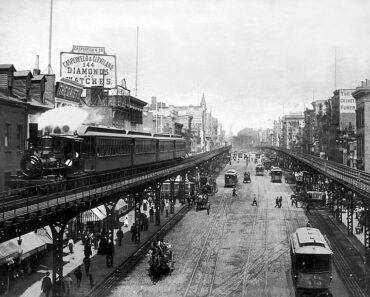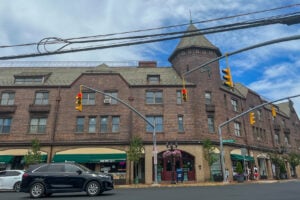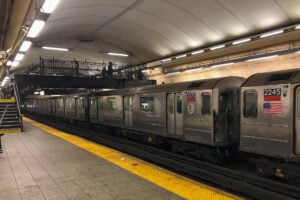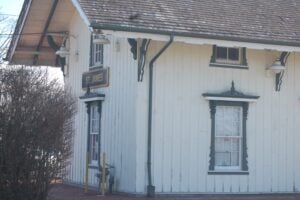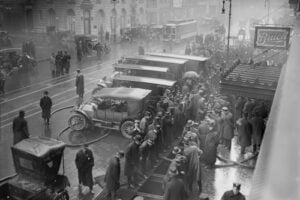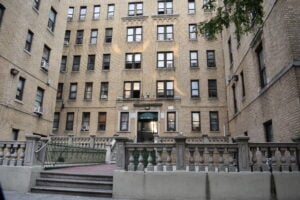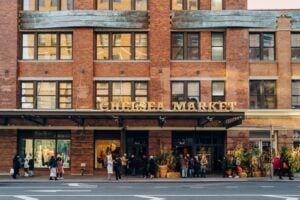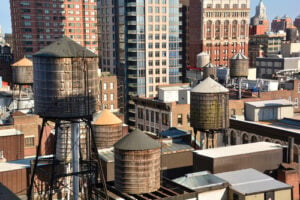
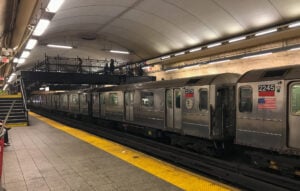
A 1 train at Manhattan’s historic 168th Street subway station in Washington Heights, which originally opened on April 14, 1906, as part of the IRT subway system. Photo by Brian Kachejian / ClassicNewYorkHistory.com.
There are very few places in New York City where the lives of so many different people intersect as naturally as they do on a subway platform. A musician carrying a guitar, a nurse coming off an overnight shift, a student on the way to school, a construction worker, a Wall Street executive, and a family headed to a baseball game may all be waiting for the same train. The destinations change, as do the trains and the neighborhoods around the stations, but the basic experience has connected generations of New Yorkers. It is one of the reasons the subway occupies a place in the identity of this city that goes well beyond transportation.
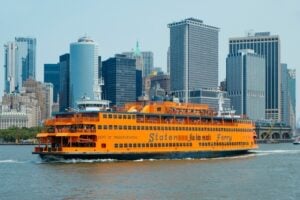
On October 27, 1904, New Yorkers paid a nickel to ride the first permanent subway line, a 9.1-mile railroad connecting City Hall with 145th Street and Broadway. Within a few decades, that modest beginning had developed into an extraordinary network of underground tunnels, elevated railways, bridges, open cuts, and stations. Today, the subway comprises 472 stations in Manhattan, Brooklyn, Queens, and the Bronx. Staten Island has its own separately operated railway. The distinction between the subway and the rest of the city’s transit system is important, but their combined effect has been to make life in a city of five boroughs possible on a scale that nineteenth-century New Yorkers could barely have imagined.
Building the subway required far more than digging holes beneath Manhattan. It required a political solution to the problem of who would pay for it, private companies willing to take substantial financial risks, engineers prepared to solve problems that had never been encountered on this scale, and thousands of workers whose names rarely appeared in the newspapers celebrating the finished railroad. It required new power stations, railcars, signals, bridges, underwater tunnels, and an entirely new architectural vocabulary for a world beneath the streets. Later generations had to figure out how to unite competing railroads, maintain them through depression and war, rescue them from near collapse, and keep them useful as the city changed around them.
To understand the history of the New York City subway is therefore to understand a great deal of the history of New York itself. The story begins long before 1904, in a city where the speed of a horse and the distance a person could comfortably walk determined the limits of daily life.
New York Before Rapid Transit
During the first half of the nineteenth century, New York’s commercial center was concentrated near the southern end of Manhattan. The waterfront, warehouses, countinghouses, markets, and docks brought thousands of people into an area where the street pattern had largely developed before anyone could anticipate the demands of an industrial metropolis. Wealthier residents gradually moved northward, but for people without a private carriage or the money to hire one, the distance between home and employment remained a serious consideration. Living close to one’s work was not simply a preference. For much of the population, it was a necessity.
Horse-drawn omnibuses and horse railways offered an early means of traveling farther. An omnibus carried passengers along a regular route, while a horsecar used rails laid in the street to reduce resistance and make it possible for animals to pull larger vehicles. Neither arrangement could overcome the central problem of sharing the roadway with pedestrians, freight wagons, private vehicles, and the rest of the city’s traffic. A crowded intersection could delay an entire line, and a horsecar had no independent path through the city. The animals themselves required stables, feed, handlers, and a system for removing enormous quantities of manure.
The extraordinary growth of Manhattan in the nineteenth century made these limitations increasingly apparent. The street grid extended northward, commercial districts followed it, and successive waves of immigration increased the demand for housing. The city’s population did not distribute itself evenly. High rents, proximity to employment, and limited transportation contributed to severe overcrowding in tenement districts. Faster transportation held out the possibility of distributing the population across a much larger area, although it could not by itself eliminate poverty or the other conditions that made tenement life difficult.
London opened its first underground railway in 1863, providing an example of rapid transit that did not have to compete with street traffic. New York had its own geographic and political complications. Manhattan was a narrow island with busy waterfronts, crowded streets, expensive real estate, and difficult ground conditions. Any large transportation project would have to contend with the owners of existing railways, property owners, elected officials, and the powerful financial interests that had already invested heavily in the way the city moved.
How Elevated Railroads Changed Manhattan
The first successful efforts to separate rapid transit from street traffic in New York took place above the streets rather than beneath them. Inventor and engineer Charles T. Harvey promoted an elevated railway along Greenwich Street in the late 1860s. His experimental operation used cable propulsion. The project encountered engineering and financial difficulties, and the practical development of the early elevated railroad ultimately depended on steam locomotives. By the 1870s, elevated rapid transit had begun to establish itself as a recognizable feature of the Manhattan streetscape.
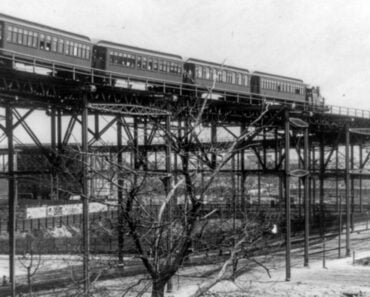
Lines eventually operated along Ninth, Sixth, Third, and Second Avenues. Their iron columns occupied portions of the streets, supporting tracks on which trains could travel independently of wagons and pedestrians below. Stations were reached by stairways from the sidewalk. To New Yorkers accustomed to surface transportation, the ability to travel several miles without having to stop at every intersection represented an extraordinary improvement. The elevated trains made neighborhoods farther uptown practical places to live and gave commercial districts a much larger pool of customers and workers.
The benefits were accompanied by considerable inconvenience for the people who lived and worked along the routes. Steam locomotives emitted smoke and soot. Their wheels and machinery produced noise that echoed between buildings, and the structures cast shadows over the streets. Property owners objected to the effect on light, air, and access. These disputes generated litigation and became part of a much larger debate about how the public benefits of a transportation system should be weighed against the private burdens placed upon the people living beside it.
The Manhattan Railway Company consolidated much of the elevated network in the late nineteenth century. Electrification in the early twentieth century eliminated the steam locomotives and substantially improved operating conditions. In 1903, the Interborough Rapid Transit Company took over the operation of the Manhattan elevated lines under a long-term lease, before its new subway had even opened. For decades afterward, the underground and elevated railroads operated alongside one another. The elevated system was not merely an unsuccessful predecessor to the subway. It had established travel corridors, operating practices, and patterns of development that the later subway inherited.
Brooklyn Had a Railroad History of Its Own
Any history of the New York City subway that begins and ends with the Manhattan IRT overlooks the independent origins of much of the network in Brooklyn. In the nineteenth century, Brooklyn was a separate city with a growing population, industries, waterfront businesses, and its own transportation needs. The opening of the Brooklyn Bridge in 1883 helped tie its economy more closely to Manhattan, but a substantial railway system was also developing within Brooklyn itself. Some of the lines that became part of the modern subway have roots in railroads built to serve destinations that were once well beyond the city’s dense urban districts.
The Brighton Beach, Sea Beach, West End, and Culver routes grew out of nineteenth-century transportation to the southern portion of Brooklyn and the resorts of Coney Island. Hotels, amusement enterprises, beaches, and seasonal crowds created a market for rail service that could carry large numbers of passengers from the urban neighborhoods farther north. Early trains did not necessarily follow the exact alignments of the subway routes that bear those names today. The railroads were rebuilt, relocated, electrified, and connected to other tracks over many years. The survival of their names is a reminder that the system developed in layers rather than from one master plan.
Brooklyn also acquired elevated lines along important streets, including Fulton Street, Myrtle Avenue, Lexington Avenue, and Fifth Avenue. These connected neighborhoods to downtown Brooklyn and, through later arrangements, to Manhattan. The Brooklyn Rapid Transit Company, organized in 1896, acquired or gained control of numerous existing transportation properties. Its combination of elevated railroads, surface lines, and former excursion railways gave it a large base from which to compete for future subway construction.
What the BRT needed was a way to move more trains across the East River and into the commercial districts of Manhattan. What New York City needed after the consolidation of 1898 was a transportation system capable of linking the formerly separate cities and towns. Those interests would eventually come together in the Dual Contracts of 1913. By then, Brooklyn’s earlier railroads had already helped establish many of the travel patterns that the new subway lines would follow. A ride on the modern Brighton or Sea Beach line is consequently a ride through a history that began before the first subway train left City Hall.
Alfred Ely Beach and the Subway That Ran on Air
In 1870, more than thirty years before the IRT opened, New Yorkers could experience a short ride on an experimental underground passenger railway beneath Broadway. Its creator, Alfred Ely Beach, was an inventor and an editor of Scientific American. Beach believed pneumatic propulsion could provide an alternative to conventional steam-driven railroads, particularly in underground passages where locomotive smoke would have been a serious concern. His work on pneumatic systems gave him a means of demonstrating the idea on a scale large enough to carry passengers.
The Beach Pneumatic Transit tunnel extended for roughly one city block beneath Broadway between Warren and Murray Streets, near City Hall. A large blower created air pressure that propelled a specially designed passenger car through the circular tunnel. Visitors entered an elaborately decorated underground waiting area that was intended to make the unfamiliar experience appealing rather than frightening. For the price of admission, they could take a short ride and see for themselves that a passenger railway could operate beneath one of the city’s busiest streets.
The demonstration attracted extensive public interest, but a successful experiment and a commercially viable transportation network were very different propositions. An actual rapid transit line would require vastly more capital, legal authority to use the streets, arrangements for stations and property access, and the ability to move many trains at useful intervals. The politics surrounding Broadway transportation were particularly contentious. Beach’s project has often been described as a personal battle with William M. Tweed, but the difficulties were broader than the opposition of one political figure. Financing, legislation, and the economic disruption of the 1870s all complicated the enterprise.
The railway never expanded into the network Beach envisioned. Nevertheless, its place in the history of New York is secure. It demonstrated an underground passenger experience at a time when an extensive subway seemed impractical to many people. Its tunnel was rediscovered during later subway construction, and the experiment has become one of the enduring stories of the city’s technological imagination. The IRT of 1904 did not descend directly from Beach’s propulsion system, but both projects addressed the same problem: how to move people through Manhattan without adding to the congestion on its streets.
The Great Blizzard of 1888 and the Politics of Building Underground
The Great Blizzard of March 1888 brought the Northeast to a standstill. In New York, wind-driven snow accumulated in the streets, communication lines failed, and transportation services were severely disrupted. Elevated railroads, which had seemed such a convincing solution to the shortcomings of street travel, were themselves exposed to the weather. A system that could carry passengers above ordinary traffic could not necessarily carry them through an extraordinary winter storm. The disaster gave additional force to arguments for underground transportation and underground utilities.
It would be too simple, however, to suggest that the storm immediately caused the construction of the subway. New Yorkers had been discussing underground rapid transit for years, and they continued arguing about it for more than a decade after the blizzard. One of the central questions concerned financing. Private companies had built elevated lines, but underground railroads presented a much larger initial investment and a less certain financial return. A developer would be expected to spend enormous sums before collecting the first passenger fare.
Mayor Abram S. Hewitt advocated a model in which the municipality would provide the basic infrastructure and a private company would operate the trains. This concept eventually became central to the solution adopted by New York. State legislation in 1891 created a rapid transit commission, and the revised statutory arrangements of 1894 provided the framework for municipal construction. In November 1894, city voters approved public financing of rapid transit by a substantial majority. The vote was an important demonstration that the public was willing to invest in a project whose benefits could extend beyond the profits of its eventual operator.
William Steinway, the piano manufacturer, was among the leading figures involved in the rapid transit deliberations of the 1890s. His surviving diaries, preserved by the Smithsonian Institution, illuminate the difficulties of bringing the competing political, financial, and engineering interests together. There were disputes over the city’s debt capacity, the proposed route, the rights of property owners, and the terms under which a private company would operate the railway. The celebrated opening of 1904 was made possible by years of less glamorous negotiations that took place in offices, legislative chambers, and courtrooms.
The Five-Borough City Creates a New Transportation Problem
On January 1, 1898, Manhattan, Brooklyn, the Bronx, Queens, and Richmond, now Staten Island, became the boroughs of the consolidated City of New York. The geographical size of the municipality increased dramatically. Consolidation united the boroughs politically, but there was no corresponding transportation network capable of knitting together all the communities within the new boundaries. The challenge was especially apparent in areas where traveling to Manhattan required a combination of railroads, ferries, streetcars, and considerable time.
The benefits of a new subway were consequently understood in several different ways. Manhattan business owners wanted better access to customers and employees. Real estate developers wanted transportation that would make more distant land attractive for construction. Residents of overcrowded districts wanted a practical way to live elsewhere without surrendering access to their jobs. Municipal officials recognized that the new city’s future growth would depend on infrastructure capable of carrying its expanding population.
The initial subway agreement was not a complete solution for the five-borough city. It concentrated service in Manhattan and provided for further connections, while a genuinely regional network would require later contracts. That limitation helps explain why the enormous expenditure of 1900 was followed so quickly by demands for still greater investment. The question was no longer whether a subway could be useful, but whether the city could build enough of it to serve the metropolis that consolidation had created.
There is also an important geographical qualification. Although the subway became central to the functioning of Greater New York, it never extended directly to Staten Island. Proposals to build tunnels connecting Staten Island with Brooklyn and other parts of the city repeatedly encountered financial and political obstacles. Staten Island’s rapid transit history developed separately, first under railroad ownership and eventually under the MTA. The city’s five boroughs have always relied on a mixture of transportation modes, not a single railroad connecting every community.
John B. McDonald, August Belmont Jr., and William Barclay Parsons
On February 21, 1900, the first major subway construction and operating contract was formally executed. Its central financial arrangement combined public ownership of the infrastructure with private construction and operation. The contractor would build the railroad with municipal financing, furnish the equipment required to run it, and operate the completed property under a long-term lease. The initial contract’s construction cost was approximately $35 million, an immense commitment for the period.
John B. McDonald was the contractor who obtained the agreement. His responsibilities included coordinating the many subcontractors and specialized trades involved in building the line, organizing the work across numerous sections, and meeting the obligations of the contract. McDonald brought practical construction experience, but he could not undertake the financial obligations of the entire enterprise alone. August Belmont Jr., a powerful New York financier, supplied the financial backing necessary to move the project forward. Belmont organized the Interborough Rapid Transit Company in 1902 to operate the railroad.
William Barclay Parsons, the chief engineer of the Rapid Transit Commission, directed the public engineering effort. Parsons had to establish a workable alignment, determine the construction methods appropriate to different ground conditions, and ensure that the railroad could operate with the capacity required by the city. His work was necessarily collaborative. Electrical engineers, structural engineers, architects, contractors, surveyors, and specialists in underwater construction each contributed to a project in which the success of one system depended upon the success of the others.
Mayor Robert A. Van Wyck participated in the ceremonial groundbreaking at City Hall on March 24, 1900. The tools and objects associated with the groundbreaking and contract signing became important civic keepsakes, several of which have survived in museum collections. The ceremony marked the end of decades of inconclusive proposals. It also marked the beginning of more than four years during which portions of Manhattan would become an enormous construction site.
Digging Up Manhattan: How the First Subway Was Built
One of the most striking features of photographs taken during construction of the original IRT is how much of the subway was built from the surface. Along substantial portions of the route, workers excavated trenches, installed structural steel and concrete, and reconstructed the roadway above the new railroad. This method, known as cut-and-cover construction, was particularly appropriate where a line could follow an existing street and where the depth of the excavation was relatively modest. It did not require the excavation of a continuous deep tunnel through solid rock, but it imposed a heavy burden on the city above.
Water mains, gas pipes, sewers, electrical conduits, and other utilities occupied the space beneath the streets long before the subway arrived. These services could not simply be destroyed to make room for the railroad. Engineers and laborers had to suspend, relocate, or rebuild them while maintaining essential services wherever possible. Temporary street decking allowed some traffic to continue over sections of the excavation, while bridges and walkways provided access across open work areas. Buildings beside the trenches sometimes required underpinning to protect their foundations.
The original railroad’s construction was not uniform. In some areas the route encountered solid Manhattan schist, requiring drilling and blasting. In others it passed through loose ground or below existing structures. Near Manhattan Valley at 125th Street and Broadway, the geography made an elevated crossing more practical than an underground alignment. The graceful steel viaduct that carries today’s 1 train above the valley is a surviving example of how the original engineers adapted the railroad to the landscape instead of insisting that every mile be built in the same fashion.
Farther north, the route included deep stations and tunnels where the terrain and street elevations presented different challenges. The 168th and 181st Street stations on the Broadway line illustrate the consequences of carrying the tracks deep beneath the high ground of Washington Heights. Elevator access became a necessity at stations where ordinary stairs from street level would have been extraordinarily long. These differences in construction depth are still part of the character of the subway today. A rider who uses a shallow station in Lower Manhattan and then travels to one of the deep stations uptown is experiencing the decisions made by the original railroad’s engineers.
The Workers Who Built the Subway
The photographs of subway construction also preserve the faces of the men who built it. They worked with picks, shovels, drills, hoists, construction railways, and machinery that would seem rudimentary beside modern equipment. Excavation crews removed earth and rock. Ironworkers erected the structural frameworks. Masons, carpenters, concrete workers, electricians, and many other trades transformed open trenches and tunnels into a railroad. The scale of the project required an enormous organization of labor distributed across the city.
Many of those workers came from immigrant communities whose members were already essential to the construction of New York’s bridges, buildings, and railroads. Working underground or at the bottom of a deep excavation exposed them to falling material, flooding, dust, explosives, and the dangers of heavy machinery. Safety regulations and working conditions were far different from those expected on contemporary public works projects. Accidents killed and injured workers, and the construction also posed risks to the people using the streets above.
Labor disagreements sometimes interrupted the project. The Historic American Engineering Record’s study of IRT construction documents disputes involving rock drillers and structural ironworkers during the early years of the work. Such episodes challenge the romantic picture of construction proceeding smoothly under the direction of a handful of famous men. The workers had their own interests, organizations, and concerns about wages and conditions. Their ability to withhold labor gave them an important, if often overlooked, role in determining how the railroad was built.
The New York Transit Museum’s Steel, Stone & Backbone exhibition has helped recover this part of the story by focusing on the trades and people behind the construction of the private subway lines. The accomplishment was not simply the vision of a financier or the technical brilliance of an engineer. It was the collective work of thousands of people whose daily efforts changed the physical structure of New York. Every surviving section of the original tunnel is a monument to that labor, even where no individual worker’s name can be recovered.
The Engineering of an Electric Railroad
The decision to operate the subway with electricity was fundamental to its success. Steam locomotives had worked on Manhattan’s elevated railroads, where smoke could escape into the open air. In a confined underground environment, that method would have created severe problems with air quality and ventilation. An electric railroad could provide faster acceleration, distribute power through a train, and avoid carrying the large steam locomotive that had traditionally pulled passenger cars.
The IRT required a substantial generating station to supply the energy needed by its trains, lighting, and other electrical equipment. The company built a major powerhouse near the Hudson River on Manhattan’s West Side, occupying the block between 58th and 59th Streets and Eleventh and Twelfth Avenues. Its riverside location facilitated the delivery of fuel and the provision of water needed by the generating equipment. Large boilers and steam-powered generating machinery produced electricity that could be distributed to substations along the railroad.
At those substations, the electrical supply was converted into the direct current required by the trains. A third rail alongside the running rails carried current to the cars, whose electric motors provided traction. Unlike a conventional locomotive pulling a long string of unpowered coaches, multiple-unit equipment permitted motors at different locations in a train to respond to a common controller. That made it possible to accelerate rapidly from stations, an essential characteristic on a railroad where frequent stops were necessary.
Engineers also had to design train signals, braking systems, station lighting, drainage, ventilation, and facilities for the storage and repair of equipment. The original IRT’s 1904 publication, The New York Subway, Its Construction and Equipment, devoted substantial space to these systems because the subway was not simply a pair of tracks inside a tunnel. Its ability to carry passengers depended on an interlocking collection of mechanical, electrical, and structural installations. Much of the work that continues to occupy transit maintainers today descends from the requirements established at that time.
Why the Original Subway Had Express Trains
One of the defining features of New York’s subway is its extensive provision for express and local service. The original designers recognized that a railroad serving a city as long and narrow as Manhattan would have to accommodate passengers with very different travel needs. A person traveling a few blocks required conveniently spaced stations. Someone traveling from downtown to the northern end of the island wanted to cover a much greater distance without stopping at every neighborhood along the way.
Along substantial portions of the original trunk line, four tracks allowed two types of service to operate alongside each other. The outer tracks generally carried local trains, which stopped at each station, while the inner tracks were used by express trains. Express stations provided access to the additional tracks. Not every portion of the railroad had four tracks: branches, curves, terminal arrangements, and elevated sections required different configurations. Nevertheless, the basic local-express concept became one of the system’s most recognizable engineering characteristics.
The additional tracks increased the initial construction cost and complicated the excavation. A four-track tunnel required much more space than a simple two-track railroad, and express stations had to be arranged to accommodate passenger transfers. Yet the benefits lasted far beyond the original period of operation. The separate tracks made it possible to combine short neighborhood journeys with longer trips along the same corridor, while also providing opportunities to maintain one set of tracks when the other could remain in operation.
For generations, New Yorkers have made practical use of this arrangement by learning which stations offer express service and where changing trains might save time. The distinction is not merely a feature of the route map. It is a result of early engineering decisions about the capacity and function of the railroad. The continuing use of four-track express corridors on the IRT, BMT, and IND reflects the remarkable foresight of the people who planned the system.
Subway Architecture and the Original City Hall Station
Those responsible for New York’s first subway understood that passengers would have to be persuaded to enter a new underground environment. The railroad’s architectural design was intended to create a reassuring, recognizable public space. George L. Heins and Christopher Grant LaFarge designed the original stations with distinctive ceramic tiles, terra-cotta plaques, mosaics, and decorative entrance structures. Their work gave individual stations identities that could be recognized even by passengers who were unfamiliar with the neighborhood above.
City Hall station was the architectural showpiece. Its curved platform occupied the turning loop at the southern end of the first line. Vaulted tile ceilings, decorative skylights, chandeliers, and elegant masonry made it unlike the conventional railway stations of the period. The Spanish-born builder Rafael Guastavino’s tile-vault construction contributed to the dramatic interior. The station was an expression of civic ambition at the very place where the new transportation enterprise would be formally inaugurated.
Elsewhere, the decoration incorporated symbols that reflected neighborhood history or the identity of the street. The beaver plaques at Astor Place recalled the fur trade associated with the Astor family. At Columbus Circle, ceramic ship motifs referred to the name of the traffic circle above. At 72nd Street, a handsome entrance building in the Broadway median gave the underground railroad a visible architectural presence in the neighborhood. These were functional pieces of infrastructure that were also designed to be worthy of the public realm.
As the subway expanded, its station designs evolved. Squire Vickers oversaw much of the decorative work of the later IRT and BMT expansion and contributed to the distinctive appearance of stations built during the IND era. Changes in taste, construction costs, materials, and maintenance requirements produced a different vocabulary from the more ornate work of the original stations. Yet the practice of identifying individual stations through tile work remained. Many of the surviving examples can still be seen by riders who take a moment to look at the walls rather than their phones.
October 27, 1904: The Day New York Went Underground
By the autumn of 1904, New Yorkers had spent years living around excavations, construction fences, and the inconveniences of the new railroad’s creation. On October 27, the city celebrated the opening with ceremonies at City Hall. The event brought together public officials, construction leaders, and representatives of the private company that would operate the subway. The significance of the occasion was apparent not only in New York but in newspaper reports across the country.
Mayor George B. McClellan Jr., the son of the Civil War general, took the controls of the ceremonial train shortly after 2:30 in the afternoon. A specially presented controller handle was used for the occasion. What had been intended as a brief symbolic turn at the controls became a much longer ride as the mayor continued operating the train northward. The historic journey began at the ornamental City Hall station and proceeded along the new railroad through Manhattan.
The public was admitted to regular passenger service beginning at seven that evening. Contemporary reports describe the crowds gathering around station entrances and the excitement of people experiencing their first trip underground. The following day’s New York Times reported that approximately 150,000 people had tried the subway on opening night. That estimate is more revealing than any modern reconstruction of the atmosphere: the city’s newest public work immediately became a popular attraction.
The original 9.1-mile operating route contained 28 stations and extended from City Hall to 145th Street and Broadway. The fare was five cents. The distance that passengers could cover for that single fare, without contending with ordinary street traffic, transformed expectations about travel in New York. The subway did not need decades to prove that it could attract a large audience. The challenge was almost immediately the opposite: how to accommodate all the people who wanted to ride it.
Following the Original IRT Route Through Manhattan
The original subway did not follow the modern Lexington Avenue Line from one end of Manhattan to the other. From City Hall and Brooklyn Bridge, it ran north beneath streets now incorporated into Lafayette Street, Fourth Avenue, and Park Avenue South. Local stops served districts around Spring Street, Bleecker Street, Astor Place, and other locations, while Union Square provided an important express station. The alignment continued through the commercial and residential neighborhoods of Manhattan’s East Side to the vicinity of Grand Central.
At 42nd Street, the original subway turned west rather than continuing north beneath Lexington Avenue. It crossed Midtown to Times Square, then turned north again beneath Broadway. That part of the route served Columbus Circle, the Upper West Side, Columbia University, and the rapidly developing neighborhoods farther uptown. The surviving east-west section between Grand Central and Times Square is now associated with the 42nd Street Shuttle, one of the most direct physical connections to the 1904 subway alignment.
Several stations from the first day of service remain active, although platforms have been lengthened, entrances relocated, and passageways added over the years. Others disappeared because their locations or physical dimensions no longer suited the evolving system. Worth Street, for example, became redundant after nearby Brooklyn Bridge station was expanded. The original City Hall station closed to passengers at the end of 1945, but its loop remains part of the railroad’s operating infrastructure. These surviving and abandoned spaces demonstrate how the subway has repeatedly altered itself without abandoning its original geography.
For readers interested in the architectural history of those stations, many of the original decorative features are examined in our article on the oldest subway stations in New York City that are still operating. The modern rider may pass through the same neighborhoods served in 1904, but the arrangement of the services, transfers, and trains is the result of more than a century of subsequent construction.
The First Subway Cars, Tickets, and Everyday Operations
The equipment introduced with the first IRT subway represented a transition between older railway construction and the modern electrically powered passenger car. The early fleet included composite cars that incorporated wood and steel, as well as all-steel cars developed during the railroad’s early years. The operating companies had to balance strength, weight, passenger capacity, electrical performance, and the expense of manufacturing large numbers of vehicles. The experience of operating trains underground ultimately reinforced the advantages of robust steel construction.
Early subway interiors were quite different from those familiar to modern riders. Cars had arrangements of seats, handholds, windows, lighting, and ventilation suited to the technology and expectations of the period. Doors and station stops required the attention of train crews, and the movement of crowded trains depended on the coordination of motormen, guards, dispatchers, and station employees. Much of what passengers later took for granted had to be worked out through daily operating experience.
Passengers initially purchased paper tickets and surrendered them at station entrances, where attendants used ticket-chopping equipment. Coin-operated turnstiles subsequently simplified the process. Contrary to a common impression, passengers did not pay with the familiar brass subway token in 1904. The token belonged to a later era, after the fare rose to a sum that could not conveniently be collected through one existing American coin.
Running the railroad around the clock also created a fundamental maintenance problem. Trains had to be inspected, cleaned, repaired, and stored, while tracks and signals required periodic attention. Even when passenger demand was relatively light, employees were needed to keep the system available. The subway’s long-established overnight service is one of its great conveniences, but it also means that the infrastructure rarely has the extended periods of inactivity available to railroads that close each night. The tension between continuous service and essential maintenance has existed almost from the beginning.
Crossing Into the Bronx and Brooklyn
The opening of the Manhattan line was only the beginning of the original IRT’s development. The railroad soon extended across the Harlem River into the Bronx, with a route branching from the West Side trunk near 96th Street and continuing through Harlem toward the Bronx. Service northward expanded during the following years. The Broadway route also extended beyond its opening-day terminal, eventually reaching 242nd Street in the Bronx in 1908. The subway was beginning to fulfill the promise of its name, Interborough Rapid Transit.
Another important achievement was the extension southward from Manhattan into Brooklyn. The city’s second major subway contract provided for construction through Lower Manhattan and beneath the East River. The Joralemon Street Tunnel, which opened for subway service in January 1908, connected the IRT with Borough Hall in downtown Brooklyn. Later that year the railroad reached Atlantic Avenue, bringing rapid transit passengers into contact with the Long Island Rail Road and other transportation services.
Building beneath waterways introduced problems unlike those encountered in the open trenches of Manhattan. Tunnel engineers had to contend with soft ground, water pressure, and the risk of flooding. Compressed-air construction, tunnel shields, and sectional methods were among the techniques developed and used on early underwater crossings. The completed tubes had to be strong enough to withstand the surrounding ground and water while providing room for trains, tracks, and the installations needed to keep the railroad functioning.
These extensions demonstrated the enormous potential of rapid transit between the boroughs. They also exposed the limitations of the existing network. The early Brooklyn route served only a small part of the borough, while the rapidly growing Bronx needed far more than its first lines. Queuing, crowding, and requests for additional service soon made it clear that the initial investment had to be followed by something much larger. The expansion that began in earnest in 1913 would change the map of the entire city.
The Dual Contracts of 1913: Building a Subway for Greater New York
By the beginning of the 1910s, the rapid transit problem had changed dramatically. New Yorkers no longer needed to be persuaded that an underground electric railroad would attract passengers. The first IRT had demonstrated that almost from the moment it opened. The problem was finding enough capital and establishing an agreement that would permit construction on a much greater scale. The city also had to decide whether its future rapid transit network should remain under the control of a single private operator or provide opportunities for the Brooklyn Rapid Transit Company to expand into Manhattan.
Manhattan Borough President George McAneny was among the public officials who helped negotiate the arrangements. The resulting agreements, signed on March 19, 1913, became known as the Dual Contracts. Contract No. 3 covered the IRT, while Contract No. 4 involved the municipal railway subsidiary through which the BRT undertook its subway expansion. Related agreements addressed improvements to existing elevated railroads. The undertaking combined municipal funds with substantial private investment and involved not simply new tunnels but extensions, reconstructed railways, bridges, stations, power facilities, and additional rolling stock.
Contemporary estimates placed the joint expenditure at approximately $335 million, before the effects of wartime inflation and other changes drove costs higher. For New York, this was not an ordinary municipal improvement. It was an investment intended to redirect the growth of the city for generations. The contracts established a system of financial obligations, operating rights, and revenue arrangements, while preserving the five-cent fare that had become so closely associated with the original subway.
The private operators gained access to a vastly enlarged network, while the city gained infrastructure that it could not readily have financed and operated by itself at the time. The price of that compromise became increasingly apparent as operating expenses rose. Nevertheless, the expansion more than doubled the size of the subway network and opened substantial portions of the Bronx, Brooklyn, and Queens to rapid transit. It created much of the basic system that New Yorkers still ride.
How the IRT’s Original Route Became the H System
The original subway’s unusual route had accommodated the transportation needs and political circumstances of the 1890s. A train from City Hall followed the East Side alignment to Grand Central, crossed 42nd Street, and continued north on Broadway. As ridership grew, that arrangement became an obstacle to operating a much larger network. The rapidly developing areas of Manhattan and the Bronx needed additional north-south capacity, and the West Side needed direct service from Times Square toward Lower Manhattan.
The Dual Contracts provided for a new Lexington Avenue subway extending north from Grand Central and a West Side subway continuing south from Times Square along Seventh Avenue and adjoining streets. On August 1, 1918, the IRT inaugurated the arrangement commonly known as the H system. On a map, the two principal Manhattan trunk lines formed the upright portions of the letter H, with the former east-west section under 42nd Street providing the connecting crossbar.
The change was substantial enough to confuse passengers who had become accustomed to the old route. A person who had previously boarded a train downtown and remained on it through 42nd Street could no longer assume the same journey would be possible. The new 42nd Street Shuttle provided the connection between Grand Central and Times Square, while the two north-south lines developed separate services into other boroughs. The modern numbered trains preserve the broad outlines of this reorganization, even though their individual designations and stopping patterns developed later.
Today’s Lexington Avenue Line, served principally by the 4, 5, and 6 trains, and the Broadway-Seventh Avenue Line, served by the 1, 2, and 3 trains, illustrate how thoroughly the 1918 changes shaped the subsequent subway. A century later, millions of journeys still depend on the capacity created by those two corridors. The original 1904 route was not discarded; its constituent sections were incorporated into the much larger network.
The Subway Transforms the Bronx
Before rapid transit reached much of the Bronx, the area contained a mixture of established villages, industrial districts, estates, farms, and growing residential neighborhoods. The Bronx had already begun developing before the subway, particularly along the routes of its railroads and elevated lines. The Dual Contracts accelerated that process by establishing reliable connections with the commercial districts of Manhattan. Streets that had once seemed inconveniently distant from downtown became accessible within the ordinary working day.
The Jerome Avenue Line opened in stages beginning in 1917 and extended northward through the western Bronx. Its elevated structure became an integral part of the neighborhoods through which it passed. In 1918, through service via the Lexington Avenue subway established an important connection between the line and Manhattan. The route eventually became associated with today’s 4 train, serving locations ranging from the vicinity of Yankee Stadium to Fordham and Woodlawn.
Other lines reached north and east. The White Plains Road route extended through communities including Williamsbridge and Wakefield, while construction of the Pelham Line carried rapid transit toward the eastern portion of the borough. The elevated stations of these railroads offered access to neighborhoods whose development would have looked very different without them. The relationship was reciprocal: builders and real estate owners pressed for transit improvements, while the completed lines encouraged further investment in apartments, shops, and local businesses.
Families who wanted more space than was available in the crowded tenement districts of Manhattan could consider new apartment buildings near a Bronx station. Commercial districts developed around the stations because merchants could expect a steady flow of passengers. Schools, theaters, restaurants, and other neighborhood institutions benefited from the growth. The Bronx did not become a mere bedroom community for Manhattan; it developed extensive employment and commercial centers of its own. Nevertheless, rapid transit helped make its extraordinary twentieth-century population growth possible.
Queens, the Steinway Tunnel, and the Development of the 7 Train
The development of subway service to Queens involved a tunnel project whose history preceded the IRT. William Steinway, whose family’s piano manufacturing operations were closely associated with Astoria, had supported the construction of an East River tunnel to Long Island City. Construction of the undertaking associated with the Steinway Tunnel began in the nineteenth century and encountered financial and engineering problems. The completed tubes were originally intended for street railway service, but regular operation under that plan never materialized.
The city acquired the tunnels in 1913, and they were incorporated into its rapid transit expansion. In June 1915, passenger service began between Grand Central and Vernon-Jackson Avenue, near the present Vernon Boulevard-Jackson Avenue station in Long Island City. The line subsequently grew eastward through Queens, reaching Corona in 1917 and Main Street in Flushing in 1928. Its Manhattan service also expanded westward, reaching Times Square in 1927. These extensions created the basic corridor that is now served by the 7 train.
Another branch of the Dual Contracts system carried trains north from Queensboro Plaza toward Astoria. For years, the IRT and BMT shared service arrangements on the Queens lines. Differences in the dimensions of their subway cars complicated operations, and the joint arrangements were eventually replaced in 1949 by an allocation under which the Flushing route belonged to the IRT division and the Astoria route to the BMT division. That change required alterations to stations and service patterns. Today’s 7 train to Flushing and the Broadway services to Astoria reflect that later reorganization.
Few places illustrate the relationship between rapid transit and real estate development more clearly than Jackson Heights. The Queensboro Corporation developed large residential projects in the neighborhood, and the arrival of rapid transit provided access to Manhattan. The apartment buildings, garden courtyards, commercial streets, and neighborhood institutions that emerged there were part of a transformation made practical by the new railroad. Similar relationships between transportation and development appeared in Sunnyside, Woodside, Elmhurst, Corona, and other communities along the route.
Today, the 7 train is often associated with the remarkable diversity of the neighborhoods it serves. That association reflects a century of demographic and economic change rather than the intentions of any single subway planner. The infrastructure created during the Dual Contracts era provided the means by which successive generations of New Yorkers could build new lives in Queens while maintaining access to the opportunities of the larger city.
The BRT Builds the Brooklyn and Manhattan Subway Network
For the Brooklyn Rapid Transit Company, the Dual Contracts represented an opportunity to transform a collection of existing transportation properties into a far more powerful rapid transit network. The company’s nineteenth-century railroads had already created routes toward southern Brooklyn, but several of those lines needed extensive reconstruction before they could accommodate the frequent, heavy trains of a modern subway. The expansion also required new connections into Manhattan, where many of the passengers wanted to travel.
Brooklyn’s Fourth Avenue subway became a principal trunk line for this development. It provided an underground route through western Brooklyn and connections to several of the railroads serving the southern portion of the borough. The Sea Beach Line, rebuilt in an open cut, entered subway operation in 1915. The West End and Brighton routes also developed modern rapid transit facilities, while the Culver route underwent improvements of its own. These lines brought together older railroad corridors, new construction, and new operating arrangements.
Across the East River, the BRT developed connections over the Manhattan and Williamsburg bridges and through new underwater tunnels. Its Broadway subway carried passengers into Manhattan’s central commercial and entertainment districts. The Nassau Street route served Lower Manhattan, while the 14th Street-Eastern District Line, which eventually became associated with today’s L train, provided another connection between Manhattan and Brooklyn. Each of these projects helped expand the range of journeys that could be made without relying on streetcars or ferries for the entire trip.
The reconstruction of the Coney Island terminal at Stillwell Avenue symbolized the consolidation of the southern Brooklyn network. Between 1918 and 1920, the terminal began receiving trains from the Sea Beach, West End, Brighton, and Culver lines. A person traveling to the beach could now reach a substantial common terminal that brought together several different routes. The modern D, F, N, and Q services continue to converge there, although the ownership, designations, and physical facilities have changed considerably.
Coney Island and the Subway as a Railroad for Pleasure
Much of the case for rapid transit concerned the need to carry workers to their jobs. Coney Island demonstrated another important aspect of the system. The railroad made leisure destinations accessible to ordinary people who could not afford a private automobile, expensive excursions, or lengthy vacations. The five-cent fare placed an afternoon at the beach and amusement parks within the reach of families living in neighborhoods far from the shore.
By the early twentieth century, Coney Island had become one of the country’s most celebrated entertainment districts. Its amusement parks, boardwalk, restaurants, bathing facilities, and attractions depended upon the ability to bring enormous crowds to the southern edge of Brooklyn. Earlier excursion railroads had helped establish that market. The upgraded subway connections of the Dual Contracts era made it possible to carry those crowds on a much larger and more regular basis.
On summer weekends, the distinction between a commuter railroad and a recreational railroad largely disappeared. The same equipment and employees who carried passengers to work during the week had to accommodate families, beachgoers, and amusement park visitors. Special service patterns and the coordination of several lines entering the terminal helped meet the seasonal demand. Coney Island’s development illustrates how public transportation could influence the cultural and recreational life of an entire city, rather than simply reducing the time required to travel to work.
That role continues to be important. Subway access has helped sustain New York’s beaches, parks, museums, sporting events, and theaters by making them available to people who live well beyond their immediate neighborhoods. The system’s contribution to the city’s economy cannot be measured solely in the number of morning and evening commuters it carries.
The Malbone Street Wreck and the Limits of Private Operation
Rapid expansion brought serious operating challenges. The new railroads carried far more passengers than their predecessors and required extensive coordination of crews, signals, schedules, and equipment. On November 1, 1918, the BRT suffered the deadliest accident in the history of the New York City subway. A Brighton-bound train derailed near Malbone Street in Brooklyn, with more than ninety people losing their lives. The precise fatality total varies among historical accounts.
The accident occurred during a strike involving BRT employees. In the effort to continue service, the company assigned a worker without adequate passenger-train operating experience to the train involved in the disaster. The subsequent investigation placed considerable attention on the circumstances of that assignment and the operation of the train. The catastrophe exposed the danger of treating the experience and training of transit employees as matters that could be temporarily set aside in the interests of maintaining service.
The wreck did not alone cause the company’s financial collapse. The BRT had already been under pressure from rising expenses, the demands of construction, and the difficulties of operating under the contractual fare arrangements during and after World War I. It entered receivership at the end of 1918. In 1923, the Brooklyn-Manhattan Transit Corporation emerged from the reorganization and continued the subway and elevated operations associated with the former BRT.
The initials BMT subsequently became as much a part of New York’s vocabulary as IRT. Behind that change in name lay a more complicated history of debt, operating obligations, labor relations, and public expectations. The city depended upon the services of the two private companies, but their financial interests and the public interest did not always coincide. That tension would increasingly shape the political debate over the ownership of the subway.
The Five-Cent Fare Becomes a Financial Problem
The nickel fare was one of the greatest attractions of New York’s first subway. It provided a relatively simple and predictable cost for riders, who could travel considerable distances within the network without paying according to the mileage of every journey. For working families, the arrangement helped make employment in one neighborhood and residence in another financially practical. The fare became so closely connected with the public promise of rapid transit that raising it was extraordinarily difficult for the private companies and the city alike.
The expansion of the system, however, did not eliminate the need to pay employees, purchase electricity, maintain tracks and equipment, and meet the financial obligations of the operating companies. World War I and its aftermath brought substantial inflation. Wages and construction costs rose, while the basic contractual fare remained fixed. The same five cents that seemed reasonable when the first subway opened purchased much less in the years that followed the war.
For advocates of the private companies, the fare restrictions were a major reason the railroad finances became increasingly difficult. For critics of private operation, the companies’ accounting practices, investment decisions, financial obligations, and pursuit of profits were also appropriate subjects of scrutiny. The existence of a large public investment in infrastructure made it particularly difficult to define precisely where the obligations of the municipality ended and those of the operators began.
The dispute was never simply a choice between inexpensive transit and a financially sound railroad. New York had to decide how much of the cost should be borne directly by riders, how much by taxpayers and other sources of public revenue, and what service the city expected to receive in return. That problem continued after private ownership ended and remains one of the central issues in the financing of the modern subway.
Mayor John F. Hylan and the Birth of the Independent Subway
John F. Hylan, who served as mayor from 1918 through 1925, became closely identified with opposition to the private transit companies. Hylan advocated municipal ownership and operation, arguing that New York needed a transportation system directed by the public rather than by corporations that operated under contracts with the city. The development of a third subway network was one way the municipality could begin to achieve that objective without first acquiring all of the existing private operations.
The city began developing plans for what became known as the Independent Subway System, or IND. Construction of the Eighth Avenue subway started in 1925. Unlike the first IRT and the Dual Contracts lines, the new railroad was conceived as a municipally owned and operated system from the beginning. It would provide additional transportation capacity while also offering alternatives to routes operated by the private companies, particularly the older Manhattan elevated railroads.
The planners chose dimensions compatible with wider subway cars rather than the narrower vehicles of the IRT. Many stations were built with lengthy platforms that could accommodate ten-car trains. Wider corridors, multiple tracks, substantial mezzanines, and extensive transfer provisions reflected the experience New York had acquired since 1904. The IND’s designers were not building the city’s first subway. They were building a railroad informed by nearly three decades of operation and crowding on earlier lines.
The timing of the project presented enormous difficulties. Work continued as the country descended into the Great Depression, when municipal revenue and access to financing came under increasing pressure. Yet the city completed a substantial portion of the first IND network, creating major new subway corridors at a time when many private construction projects had stopped. The enterprise became one of the most enduring public investments of Depression-era New York.
The Eighth Avenue Subway Opens in 1932
On September 10, 1932, the IND opened its first major service along Eighth Avenue in Manhattan. The route extended from the vicinity of Chambers Street to 207th Street in northern Manhattan. Local and express trains provided additional capacity on the West Side, and the system offered access to neighborhoods that had previously depended on the IRT and the elevated railroads. The new stations, extensive mezzanines, and modern cars made a striking impression on people familiar with the older subway.
The IND introduced the lettered train designations that would ultimately influence the modern system. Its original arrangement distinguished local from express services through a combination of single and double letters. Those designations changed over time as the network expanded, and the BMT would eventually adopt letters for its services as well. Nevertheless, the letter A, associated with the original Eighth Avenue express service, has remained one of the most recognizable symbols of the city’s subway.
The cars introduced for the Independent were another expression of its ambitions. The R1 cars and their related successors, frequently referred to collectively as the Arnines, were designed to carry large passenger loads and to permit comparatively efficient movement through stations. Their distinctive interiors, windows, doors, and operating sounds became familiar to generations of riders. Although the last of the regular Arnine operations ended decades ago, preserved cars occasionally allow New Yorkers to experience equipment from the Depression-era subway.
The Eighth Avenue Line also illustrates a larger theme of New York’s transportation history. The public sector did not merely purchase the infrastructure produced by earlier private enterprise. It became an active builder, operator, and innovator in its own right. The IND created the physical and institutional foundation upon which the city could ultimately unite its three subway networks.
The IND Expands Into Queens, Brooklyn, and the Bronx
After the Eighth Avenue Line opened, the Independent expanded rapidly. Service through the Bronx developed along the Grand Concourse, where the city had created one of its most imposing boulevards. The new subway provided an alternative to the Jerome Avenue elevated line in the western portion of the borough. The Concourse corridor became an important connection between Bronx residential districts and the city-operated subway in Manhattan.
In Queens, the IND Queens Boulevard Line developed into one of the most important rapid transit corridors in the borough. Construction proceeded in stages through Long Island City, western Queens, and toward Forest Hills and Jamaica. The line’s local and express tracks made it possible to serve neighborhood stations while providing relatively fast journeys from more distant districts. Apartment development along the corridor increased the importance of the railroad, which became one of the busiest approaches to Manhattan from Queens.
Brooklyn received substantial new service as well. The IND built a route through downtown Brooklyn and along Fulton Street, an important commercial corridor that had previously been served by an elevated railroad. Another line ran south through the neighborhoods around Smith Street and farther toward Church Avenue, with a remarkable aboveground section crossing the Gowanus Canal. The Crosstown Line created a connection between Queens and Brooklyn without requiring passengers to travel through Manhattan, a significant exception to the predominantly Manhattan-centered character of the subway.
The Sixth Avenue subway in Manhattan opened its principal trunk line in December 1940, after the municipal unification of the three systems. Its construction had presented particular difficulties because the older Hudson and Manhattan Railroad, the predecessor of PATH, already occupied portions of the underground space. Integrating another railroad into that environment required careful engineering and added to the cost and complexity of the undertaking. Later construction supplied additional Sixth Avenue express capacity, further changing the operations of the IND.
The Subway Lines New York Planned but Never Built
The system that was completed during the Depression was only a portion of what municipal planners had envisioned. In 1929, the city announced an ambitious proposed expansion often referred to as the IND Second System. It contemplated extensive new construction throughout Manhattan, the Bronx, Brooklyn, and Queens. Among its most enduring proposals was a major subway along Manhattan’s Second Avenue, a corridor whose transportation needs would continue to trouble planners for most of the following century.
Other portions of the proposals would have reached neighborhoods in eastern Queens and southeastern Brooklyn, provided new approaches to existing destinations, and created additional underwater connections. The original plans should not be understood as a single fully financed construction program. They were proposals that changed as engineers, elected officials, and communities debated the priorities and expense of the work. Nevertheless, they reveal how differently the subway might have developed had the city possessed the resources to undertake a second wave of expansion on the scale of the Dual Contracts.
Economic conditions undermined those ambitions. The Depression reduced the city’s ability to finance new lines even as it struggled to finish the first IND network. Plans were revised, shortened, and postponed. World War II subsequently created additional competing demands for materials, labor, and public funds. Projects that had appeared on maps as the future of New York transit gradually acquired the character of long-standing promises rather than imminent construction.
Some of the unrealized plans left tangible evidence in the system, including station arrangements, track provisions, and portions of structures intended to accommodate future connections. Others survive only in documents and maps. These reminders of an unbuilt New York help explain why certain neighborhoods have extensive rapid transit service while others remain dependent upon buses, commuter rail, or automobiles. The present map represents the projects the city succeeded in completing, not every project it believed was necessary.
June 1940: La Guardia Unites the Three Subway Systems
By the end of the 1930s, New York was operating under an arrangement unlike that of most other large cities. The private IRT and BMT operated extensive subway and elevated railroads built under various municipal agreements, while the city operated its own Independent Subway. Each organization had its own employees, facilities, operating practices, and financial obligations. Although some connections between the railroads existed, they were not a single unified network in the sense familiar to modern riders.
Mayor Fiorello H. La Guardia’s administration brought that arrangement to an end in 1940. The city acquired the BMT on June 1 and the IRT on June 12, bringing their properties and franchises under municipal control alongside the IND. The Board of Transportation assumed responsibility for the unified operation. The acquisitions were the culmination of years of negotiation, financial difficulties at the private companies, and public debate about the proper organization of New York’s transportation system.
Unification was more than a change of ownership. The municipality inherited an enormous collection of property and equipment, much of it built at different times to different standards. Separate management structures had to be brought together, and decisions were needed about which older routes should remain in operation. The city also had to determine how passengers could transfer between formerly competing railroads. A unified fare and improved transfer arrangements offered potential benefits, but the physical work required to create useful connections could be expensive.
The distinction between the narrower IRT vehicles and the wider BMT and IND vehicles survived the takeover. The numbered routes now comprise the A Division, while lettered routes comprise the B Division. Standard track gauge does not mean that every subway car can operate safely in every passenger station: car width, platform clearances, curves, and related infrastructure impose constraints. New York continues to maintain two principal subway equipment dimensions because of decisions made when the separate networks were planned.
The Disappearance of Manhattan’s Elevated Railroads
One of the most visible changes surrounding unification was the removal of the elevated railroads that had dominated several Manhattan avenues since the nineteenth century. The construction of the IND Eighth and Sixth Avenue subways made some of the older elevated services increasingly redundant. The Sixth Avenue elevated closed in December 1938, before the corresponding IND trunk line opened. The principal Manhattan portion of the Ninth Avenue elevated closed in June 1940, followed by the last Manhattan service on the Second Avenue elevated in 1942.
The Third Avenue elevated lasted longer. For many New Yorkers, its trains, columns, stairways, and shadows were an unmistakable part of the Bowery and the East Side. Its Manhattan portion closed in May 1955, while the remaining Bronx service survived until 1973. The removal of these structures changed the appearance of the streets almost immediately. Sunshine reached areas that had been shaded for generations, and the disappearance of the trains altered the sounds and physical character of the neighborhoods.
There was a serious transportation cost, however, particularly on the East Side. Removing elevated lines before building the long-promised Second Avenue subway left the Lexington Avenue subway carrying much of the north-south rapid transit demand in eastern Manhattan. For decades, East Side residents experienced the consequences of removing old capacity without providing the full replacement that had been proposed.
Brooklyn and the Bronx also lost elevated railways as part of longer-term efforts to reorganize service. Some structures were removed because replacement subway lines had opened, while others disappeared without equivalent rapid transit improvements. The different circumstances of these closures deserve attention in their own right. They are examined in our history of the lost subway, elevated, and rail lines of New York City. The removal of the Els should be understood as both an architectural transformation and a transportation decision with consequences that extended well beyond the year of demolition.
World War II and the Subway’s Busiest Era
The newly unified subway had scarcely begun operating under municipal ownership when the United States entered World War II. New York became a major center of wartime production, military transportation, shipping, and administration. Workers at the Brooklyn Navy Yard and other industrial facilities, employees in Manhattan offices, and people traveling to the city’s railroad terminals relied heavily on public transportation. Restrictions on gasoline and tires strengthened the importance of rail and bus services.
The subway confronted the same shortages of labor and materials that affected other American industries. Replacing old equipment or undertaking ambitious new construction became difficult when steel and other supplies were needed for the war. Keeping existing vehicles and facilities in service consequently became an especially important task. The system carried immense passenger volumes without the resources that would ordinarily have been required to modernize it.
The years immediately after the war marked a high point in annual subway ridership, with the all-time peak in 1947. Before widespread automobile ownership and postwar suburbanization fundamentally changed the geography of commuting, the subway carried approximately two billion passengers annually at its peak. Crowded trains were an indication of the railroad’s usefulness, but also a warning that even a network of this size could struggle when passenger demand exceeded the available equipment and track capacity.
Municipal ownership had not eliminated the financial obligations inherited from the private era. The city still charged five cents per ride, despite the enormous increase in operating costs since 1904. The wartime and postwar experience exposed the limits of relying on a fare established four decades earlier. In addition, equipment that had been heavily used during the war required substantial investment. The next phase of New York transit history would be concerned less with constructing entire new networks than with finding the money to keep the existing railroad functioning.
The Transport Workers Union and the People Who Operate the Subway
The subway’s history cannot be separated from the history of the people employed to operate it. Motormen, conductors, track workers, car maintainers, power employees, station agents, cleaners, dispatchers, and many other workers performed jobs that were essential to the movement of millions of passengers. In the early years of private operation, their opportunities to bargain collectively were limited, and the economic conditions of the Depression made labor organization particularly important.
The Transport Workers Union began organizing New York’s transit workers in 1934. Michael J. Quill, an Irish-born organizer who had worked on the transit system, became its best-known leader. The union’s early efforts focused on employees of the IRT and subsequently extended to other parts of the transportation network. Organizers confronted resistance from the private companies, but the movement established a durable presence within New York’s transit workforce. The union’s records, preserved at New York University’s Tamiment Library, document a story of organization that continued well beyond the municipal takeover.
Unification changed the identity of the employer without eliminating conflicts over working conditions, wages, pensions, and the recognition of employees’ bargaining rights. A system that had been organized through collective action against private employers now had to deal with public officials responsible for municipal finances. The political difficulties were considerable: the public relied on a service that was almost impossible to replace during a prolonged interruption, and officials had to negotiate with the people whose labor kept it moving.
Quill’s importance lay partly in his ability to make the concerns of transit employees a major public issue. In the years that followed, labor disputes would periodically interrupt subway and bus service, most dramatically in 1966, 1980, and 2005. These strikes were not incidental episodes in the city’s history. They exposed the relationship between public transportation, municipal budgets, organized labor, and the daily functioning of New York.
The End of the Nickel Fare and the Creation of the Transit Authority
On July 1, 1948, the fare rose from five to ten cents. New Yorkers had paid the same basic fare since the opening of the subway, so the change carried enormous symbolic significance. The nickel had become an essential part of the system’s identity, as recognizable as the tiled stations and the letters IRT. Yet the city could no longer plausibly expect a fare established in 1904 to cover the same share of the railroad’s operating costs in 1948.
The difficulties of managing the subway as part of the ordinary municipal government led to another institutional change. In 1953, the New York State Legislature created the New York City Transit Authority, which assumed operation of the subway and municipal bus services under a lease from the city. The infrastructure remained city-owned, but responsibility for operating it now rested with a separate public authority. The change was intended to give transit a more distinct financial and administrative structure, although it could not remove transportation entirely from politics.
That same year, the basic fare increased to fifteen cents. Unlike five or ten cents, fifteen cents did not correspond to a single circulating United States coin. Asking millions of passengers to insert combinations of coins would have created practical problems at the turnstiles. The Transit Authority introduced a special token that could be purchased at a station booth and deposited in the turnstile as one fare. The familiar token eventually passed through a succession of designs as the fare rose and the authority sought to distinguish legitimate tokens from substitutes.
For the next half century, the little metal disc became an object that New Yorkers carried in purses, pockets, and wallets. Its history encompassed price increases, changes in size and design, efforts to combat fraud, and the introduction of more modern ways to collect fares. Our article on the history of the New York City subway token examines these changes in greater detail. Its introduction was one of the most tangible signs that the fare structure and governance of the original subway had entered a new era.
Postwar New York, Robert Moses, and the Automobile
The decades after World War II brought a fundamental change in the way Americans traveled and where many chose to live. Automobile ownership increased, new housing developments appeared outside the central cities, and public investment in roads and highways made suburban commuting more attractive to a growing portion of the population. In New York, these developments occurred on a particularly large scale because the city was surrounded by expanding communities in Long Island, Westchester, New Jersey, and Connecticut.
Robert Moses exercised extraordinary influence over the construction of parks, highways, bridges, and other major public works in the metropolitan area. Projects undertaken during his long career reshaped the road network and opened extensive areas to automobile travel. The financing mechanisms that supported bridges and tunnels, particularly toll revenue, gave some of these projects access to sources of capital that the subway did not independently possess. The resulting transportation landscape reflected a set of priorities very different from those of the early twentieth-century subway builders.
It would be misleading to attribute every problem of the postwar subway to Moses alone. Federal highway policy, suburban housing development, employment shifts, changing demographics, fare restrictions, and decisions made by successive municipal and state administrations all influenced the system’s finances and ridership. Nevertheless, the imbalance between the construction of automobile infrastructure and investment in rapid transit became an increasingly important issue as the subway aged.
The automobile did not make New York’s subway unnecessary. The density of Manhattan’s commercial districts made it impossible for roads alone to accommodate all the people who traveled there. Even as suburbanization reduced demand for some traditional subway journeys, vast numbers of New Yorkers remained dependent on the railroad. The city faced the expensive task of maintaining a transportation system whose importance was undiminished, even though its financial and political environment had changed dramatically.
Reusing Railroads: Dyre Avenue, the Culver Line, and the Rockaways
Although the postwar decades did not produce a wave of new subway construction comparable to the Dual Contracts, the unified system did expand by adapting railroads that already existed. One important example was the Dyre Avenue Line in the Bronx. The New York, Westchester and Boston Railway had ceased operation at the end of 1937. The city acquired a portion of its route within the Bronx, and shuttle subway service began between East 180th Street and Dyre Avenue in 1941. A connection completed in 1957 allowed through operation with the IRT White Plains Road Line. The line is now associated with the 5 train.
The Culver connection in Brooklyn was another significant improvement. In October 1954, the IND route running south through Brooklyn was connected to the former BMT Culver elevated line. IND trains could consequently continue toward Coney Island over tracks that had previously belonged to a separate operating company. The connection provided a new pattern of service and demonstrated how unification could produce benefits that were impossible to realize when competing companies controlled the respective routes.
The Rockaway peninsula in Queens presented a different opportunity. The Long Island Rail Road had long operated a route across Jamaica Bay, but repeated problems, including a destructive fire in 1950, disrupted the connection. The city acquired the relevant railroad property and rebuilt the route for subway operation. Service across Jamaica Bay began in 1956, linking the IND Fulton Street network with communities on the Rockaway peninsula.
The Rockaway extension illustrates an often-overlooked aspect of subway construction. A new rapid transit service need not begin with the excavation of an entirely new underground tunnel. It can also involve acquiring an existing railroad, modifying stations and track, reconstructing bridges, and connecting the property to the operating network. The history of the New York subway includes numerous such conversions, each preserving traces of the earlier railroad beneath the identity of a modern subway route.
New Subway Cars and the Changing Passenger Experience
The Transit Authority inherited an equipment fleet representing decades of different technologies and manufacturing practices. Some of the cars still in use after World War II had been built during the original period of private expansion. Their age was a serious issue, not only because of mechanical reliability but because New Yorkers increasingly expected more comfortable vehicles with improved lighting, ventilation, braking, and door arrangements.
During the 1950s and 1960s, the authority purchased large numbers of new cars. The equipment classes were identified by contract designations, producing the familiar R-series terminology used by transit historians and enthusiasts. New cars replaced much of the older IRT equipment, while modernization of the wider BMT and IND fleet gradually eliminated vehicles that had been operating since the private era. The different car classes had their own features, appearances, and technical histories, and it often took years for a new generation of equipment to replace its predecessors.
The R32 cars, delivered beginning in 1964, became one of the most enduring examples of this modernization. Manufactured by the Budd Company, they were constructed with distinctive corrugated stainless-steel exteriors and were marketed as Brightliners. The Transit Authority purchased 600 of them. Their durability proved remarkable, and many survived in regular passenger service into the twenty-first century after undergoing substantial rehabilitation. Their final retirement celebrations took place in 2022, nearly six decades after the type first appeared.
Other cars from the same general era eventually became known as Redbirds after their rehabilitation and repainting in the 1980s. For riders on the numbered lines, their red bodies, distinctive fronts, and familiar interiors became a characteristic part of the subway experience. Some of these cars originally had very different paint schemes, including the blue and white equipment associated with the 1964 World’s Fair. Their later appearance was the result of a major rebuilding program, not their original factory design.
The 1939 and 1964 World’s Fairs and the Flushing Line
The subway played a particularly important role in two events that attracted national and international attention to New York: the World’s Fairs of 1939–1940 and 1964–1965. Both took place at Flushing Meadows in Queens, where an enormous exposition could not have functioned without a way to transport large numbers of visitors. The existing Flushing Line became a principal means of reaching the fairgrounds from Manhattan and other parts of the city.
For the 1939 fair, the IRT introduced specially designed cars for Flushing service, and the IND built a temporary branch connecting its Queens Boulevard corridor with the fairgrounds. The temporary IND service ended after the exposition. This episode is notable because it demonstrates that the subway was sometimes expanded to meet a particular short-term need rather than to serve a permanent residential district. The fate of the temporary route also reflected subsequent decisions about the development and transportation use of the land.
For the 1964–1965 fair, the Transit Authority introduced new cars on the Flushing Line, prominently painted in a blue and white scheme associated with the event. The modern appearance of the equipment complemented an exposition devoted in part to technological progress. Subway trains and Long Island Rail Road services carried visitors toward the Unisphere and the great corporate pavilions. The railway became part of the fair experience itself, introducing many visitors to the transportation system that New Yorkers used every day.
After the fair closed, the line continued its ordinary work of serving the residents of Queens. The stadium and park facilities around the former exposition site retained their importance, and subway service remained central to reaching baseball games and other events. As with Coney Island, the history of the Flushing Line demonstrates that the subway helped make New York’s large-scale public celebrations and recreational life possible.
The Transit Strike of 1966
On New Year’s Day 1966, John V. Lindsay took office as mayor of New York City. The same day, the city’s subway and much of its bus system shut down during a strike called by the Transport Workers Union and other transit workers. Disputes over pay, benefits, and working conditions had brought the union and the Transit Authority to an impasse. Mike Quill became the public face of the strike, confronting a new mayor who had inherited one of the city’s most difficult labor negotiations.
For nearly two weeks, New York had to function without the transportation system on which millions of people depended. Commuters walked, shared cars, altered work schedules, and made whatever other arrangements were available. Traffic congestion increased, businesses experienced disruption, and many employees found it difficult or impossible to reach their workplaces. The event provided a dramatic demonstration of how little capacity existed to replace the subway at short notice.
Quill and other union leaders faced legal consequences during the strike, but the dispute ultimately ended with a negotiated settlement. Quill died later that month. His career had begun in the struggles of the privately operated transit system and ended in one of the most consequential confrontations between organized labor and municipal government in twentieth-century New York.
The strike helped shape subsequent discussions of public-sector collective bargaining in New York State. The Taylor Law, enacted in 1967, established a statewide framework for public employee labor relations and prohibited strikes by public employees. That legal prohibition did not eliminate disputes within the transit system, as New Yorkers would learn in 1980 and again in 2005. The 1966 strike remains a vivid reminder that the subway’s ability to operate depends not merely on mechanical equipment but on the conditions under which thousands of employees are prepared to work.
The Chrystie Street Connection Changes the Subway Map
For more than twenty-five years after municipal unification, the physical separation between portions of the former BMT and IND continued to limit the service patterns that the Transit Authority could offer. Because their cars were broadly compatible, these two networks presented an opportunity for integration that was not available between them and the narrower IRT. But the necessary tunnels, junctions, and tracks had to be built before through services could be arranged.
The Chrystie Street Connection was one of the most important projects undertaken to solve that problem. New tunnels in Lower Manhattan connected the IND Sixth Avenue Line with routes that used the Manhattan and Williamsburg bridges. The project also provided new stations and additional capacity on Sixth Avenue. Deep express tracks were constructed beneath a portion of the existing Sixth Avenue subway, where earlier construction had been constrained by the presence of other underground railroads.
In November 1967, the first major service changes associated with the new connection went into effect. Additional changes followed in July 1968. For many passengers, trains that had previously traveled along Broadway or other BMT routes now operated over Sixth Avenue tracks, and familiar letters and destinations changed. The physical connections provided new travel opportunities between Manhattan and Brooklyn while allowing the Transit Authority to operate the former BMT and IND more effectively as a combined railroad.
It is one of the reasons the modern subway cannot be understood simply by looking at the names of the old private companies. A train identified by a single letter may run over portions of several historically distinct routes during one journey. Its current service pattern can reflect connections built decades after the tunnels through which it travels. The Chrystie Street project turned municipal unification into a more meaningful physical reality.
Nelson Rockefeller, the MTA, and the 1968 Program for Action
In 1965, New York State created the Metropolitan Commuter Transportation Authority to take over the Long Island Rail Road. Governor Nelson Rockefeller envisioned a broader transportation organization that could address the needs of the entire metropolitan region rather than treating its railroads, bridges, tunnels, and bus services as entirely separate enterprises. In March 1968, the organization became the Metropolitan Transportation Authority, incorporating the New York City Transit Authority and the Triborough Bridge and Tunnel Authority into its regional structure.
The arrangement shifted much of the responsibility for New York City’s subway operations from municipal control to an authority established under state law. The city retained ownership of the basic subway property, but the MTA assumed a central role in determining how the system would be financed and administered. One important feature of the new structure was the availability of bridge and tunnel toll revenue to support public transportation. The organization that had been closely associated with Robert Moses and automobile infrastructure now formed part of a larger agency with responsibility for mass transit.
The MTA’s 1968 Program for Action announced an extraordinarily ambitious vision for expansion. It proposed construction of the long-awaited Second Avenue Subway, new connections beneath the East River, extensions in Queens and other parts of the city, and improvements to the commuter railroad network. Federal transportation funding provided new possibilities that had not been available to the municipality during much of the preceding century. The program appeared at a time when growing concern about the limitations of the automobile was renewing interest in public transportation.
Some components of the plan proceeded into construction, notably the 63rd Street Tunnel and the first sections of a new Second Avenue subway. Others were delayed, reduced in scope, or abandoned. The financial crisis of the 1970s interrupted much of the work and forced the new authority to confront problems of basic maintenance that became more pressing than the expansion it had proposed. The Program for Action would remain influential for decades, in part because so many of its projects had to be pursued in much smaller pieces long after the original program had failed to materialize as envisioned.
How the Subway Fell Into Crisis in the 1970s
The 1970s were among the most difficult years in modern New York history. Industries closed or relocated, many neighborhoods experienced population loss and declining investment, and the city faced a fiscal emergency that reached its most dramatic point in 1975. The problems of the subway were part of this larger crisis, although many of the conditions that produced them had developed over a much longer period.
For years, repairs and renewals had been postponed. Subway cars could be kept operating beyond the point at which replacement would normally have been desirable, but doing so required more frequent maintenance. Track and signaling equipment deteriorated, water infiltrated tunnels, and the electrical and mechanical systems that supported service became increasingly unreliable. Because these problems developed throughout a vast network, even substantial emergency expenditures could fail to produce improvements that riders noticed immediately.
The system also faced the consequences of a declining ridership base. Historical data collected by New York University’s Rudin Center for Transportation show that annual subway ridership fell to about 917 million in 1977. That was far below the volumes carried during the years immediately after World War II. The relationship between declining service and declining ridership created a vicious circle: an unreliable or unpleasant railroad discouraged passengers, while fewer passengers reduced fare revenue available to support operations.
Some subway and elevated services were eliminated during this era. The Bronx portion of the Third Avenue elevated closed in 1973. The Culver Shuttle in Brooklyn ended in 1975, and portions of the Jamaica elevated in Queens were subsequently abandoned in anticipation of a replacement subway. These changes illustrate the consequences of a period when the system was struggling to maintain what it already possessed. The extraordinary expansion envisioned in 1968 gave way to a much more difficult task: preserving the basic railroad that had been built during the first half of the century.
Graffiti, Crime, and the Subway’s Place in New York Culture
No visual image became more closely associated with the difficulties of the 1970s subway than the brightly painted railway cars that traveled through the city. Names, signatures, elaborate lettering, and entire compositions appeared on the surfaces of trains. For young artists, the subway offered a moving canvas that could carry their work from one borough to another. The emergence of this form of expression was closely connected to the development of hip-hop culture and the creative communities that flourished in New York despite the city’s economic problems.
For the Transit Authority, unauthorized painting created a substantial maintenance burden. Cars required cleaning, repainting, and sometimes other repairs. Graffiti also became part of a larger public perception of neglect, reinforced by dirty stations, broken equipment, poorly lit areas, and frequently disrupted service. These problems cannot be reduced to the graffiti itself, nor can the artistic significance of the work erase the expense and disruption associated with it.
Crime and the fear of crime became another major issue. Passengers’ willingness to ride the subway depended partly on whether they felt safe waiting for trains or traveling at quiet times of the day. The public response to incidents on the system was magnified because so many New Yorkers regarded subway travel as an unavoidable part of their daily lives. The people who were most dependent on public transportation often had the fewest alternatives when service became unreliable or frightening.
The subway of this period subsequently became a powerful subject in film, photography, music, and literature. Movies used its trains and stations to convey the atmosphere of a city in crisis, while photographers documented both the artists’ work and the ordinary lives continuing around it. These cultural accounts preserved the appearance of an era that later disappeared from the operating fleet. They also help explain why memories of the 1970s and 1980s subway can differ so dramatically: its failures, creativity, danger, and usefulness existed side by side.
The 1980 Transit Strike and the Depth of the Subway’s Problems
On April 1, 1980, transit workers went on strike again. The dispute lasted eleven days, interrupting subway and bus service as New Yorkers struggled with the consequences of a system already suffering from severe financial and mechanical difficulties. Like the 1966 strike, it exposed the extraordinary degree to which the city depended upon employees whose working conditions and compensation were the subject of difficult negotiations.
The interruption occurred at a particularly important point in the railroad’s history. Equipment failures, track conditions, and inadequate maintenance had become so serious that the problem could not be addressed merely by adjusting schedules or purchasing a few new trains. Entire generations of infrastructure needed rehabilitation or replacement. The authority also faced the challenge of maintaining enough service to carry passengers while taking large quantities of equipment and track out of operation for repair.
The subway’s deteriorating condition was reflected in increasingly poor reliability. The MTA’s historical assessment identifies 1983 as a low point, with on-time performance below fifty percent. That measure conveys more than a series of inconvenient journeys. A railroad that cannot predictably deliver passengers to their destinations imposes costs on the entire city, from lost working time and disrupted appointments to diminished confidence in neighborhoods that depend on rapid transit.
New York had reached a point at which the consequences of decades of deferred investment were impossible to ignore. The choice confronting the city and state was not simply whether to improve the subway. It was whether they were prepared to commit to a long-term program capable of restoring the basic functionality of a transportation system that remained essential even in its most troubled years.
Richard Ravitch and the Capital Program That Saved the Subway
Richard Ravitch became chairman of the MTA in 1979, when its financial and physical problems had reached an extraordinary level. The central challenge was that the railroad required major investments whose benefits would extend far beyond the annual operating budget. If the cost of replacing trains, rebuilding tracks, and renewing electrical equipment had to be absorbed entirely through a single year’s fares and subsidies, the authority would struggle to undertake the necessary work.
New York developed a new approach through a coordinated multiyear capital program. The first five-year program began in 1982, providing billions of dollars for renewal of the subway and other parts of the MTA’s regional transportation network. The program was not confined to attractive new trains or renovated passenger areas. It also encompassed the tracks, signals, power facilities, workshops, and other infrastructure on which safe and reliable service depended.
Separating capital investment from ordinary operations made it possible to identify needs over a longer period and arrange financing for work that would serve several generations of passengers. Bond financing was an important element of this approach, allowing the authority to undertake projects without having all the necessary cash available at the beginning. Borrowing, however, created future debt-service obligations. The capital program addressed an immediate crisis while introducing financial commitments that would have to be managed by later administrations.
The consequences of the investment became visible over the following decade. Mechanical reliability improved, new cars entered service, older cars were rehabilitated, and passengers encountered a railroad that increasingly looked and functioned differently from the system of the 1970s. The achievement was not instantaneous. It required years of sustained funding and management, a lesson of particular relevance to an infrastructure network that ages every day regardless of the state of the economy or the priorities of elected officials.
David Gunn, the Clean Car Program, and the Redbird Rebuilding
David Gunn became president of the New York City Transit Authority in 1984. His administration emphasized restoring basic operating discipline, including the condition of the rolling stock, the reliability of the track and signal system, and the ability of the organization to maintain equipment once it had been repaired. The Clean Car Program became one of the most recognizable expressions of this approach.
Earlier attempts to eliminate subway graffiti had often failed because newly cleaned cars quickly became targets again. The new program adopted a more sustained policy of cleaning cars and preventing newly vandalized equipment from remaining in the regular passenger fleet. The process involved coordination among maintenance employees, yard personnel, managers, and transit police. By May 1989, the last routinely graffiti-covered train had been removed from service, a milestone that was widely reported in the press.
At the same time, the Transit Authority undertook the General Overhaul Program, rebuilding large numbers of cars that were structurally capable of providing many more years of service. Among the most familiar results were the Redbirds. Earlier IRT car classes received extensive mechanical and electrical work and a red exterior paint scheme that became closely associated with Gunn’s rebuilding effort. The program extended the useful lives of equipment that otherwise might have required immediate replacement at considerable expense.
The restoration of the subway was sometimes described in terms of removing graffiti because that was the change that passengers could see most clearly. But the much larger achievement concerned reliability. A clean car that broke down repeatedly would not have solved the transportation problem. The combination of visible improvements and work on the less visible components of the railroad helped rebuild public confidence. By the time the last Redbirds left ordinary subway service in 2003, they had become symbols of the recovery rather than reminders of the decline that had preceded it.
How Subway Maps, Letters, Numbers, and Colors Evolved
A subway map may seem like a straightforward picture of tracks and stations, but in New York it has always had to explain an unusually complex network. Some lines are physical corridors used by several different services, while individual services may move from one corridor to another as they travel through the boroughs. Express and local stopping patterns add further complications. A useful map has to communicate these relationships without becoming so crowded that passengers cannot determine where their trains go.
During the private era, the IRT and BMT produced maps identifying their own routes. The city-operated IND introduced its own nomenclature, and even after unification passengers continued to encounter references to the three divisions. The integration of the former BMT and IND, particularly after the Chrystie Street Connection, made a clearer common system of designations increasingly important. The Transit Authority experimented with names, letters, numbers, and colors in an effort to develop a consistent vocabulary that could be understood across the network.
In 1972, the authority introduced the now-famous diagrammatic map associated with designer Massimo Vignelli and his colleagues. It represented subway routes through geometric forms rather than attempting to reproduce the street geography of the city precisely. The design attracted considerable admiration for its visual clarity, but some riders objected to the difficulty of relating the abstract diagram to the actual locations of streets, parks, and neighborhoods. The disagreement raised a fundamental question about whether a transit map should primarily describe the railroad or the city through which it runs.
A new map introduced in 1979 restored a stronger geographical relationship between the routes and their surroundings, while grouping services by the principal Manhattan trunk lines they used. The familiar red of the Broadway-Seventh Avenue services and green of the Lexington Avenue services are part of that approach. In April 2025, the MTA introduced another major redesign, returning to a more diagrammatic presentation while incorporating modern transfer and accessibility information. The map’s history reflects the continuing challenge of explaining a railroad whose complexity is the product of more than a century of expansion.
New Routes in the 1980s: Archer Avenue and 63rd Street
The fiscal crisis had prevented much of the 1968 Program for Action from being completed, but some of its projects survived. The Archer Avenue subway in Jamaica, Queens, opened in December 1988. It introduced a two-level route that accommodated both former IND and BMT services and provided a new transportation connection in an important commercial and residential district. Its present terminals and services include those associated with the E, J, and Z trains.
The new subway replaced only part of the elevated service that had previously reached farther into central Jamaica. Earlier plans had envisioned extensions beyond the completed Archer Avenue terminal, and some of the project’s difficulties reflected the gap between those original ambitions and the funds eventually available. Even in its reduced form, however, it was one of the first major pieces of new subway infrastructure to enter service after the system’s long period of decline.
The 63rd Street Tunnel opened for subway passenger service in October 1989. It introduced stations at Lexington Avenue, Roosevelt Island, and 21st Street-Queensbridge. The route was initially limited by its lack of a through connection to the main Queens Boulevard subway. A connection completed in 2001 greatly increased the usefulness of the new corridor, permitting service to operate through Queens rather than ending shortly after crossing the East River.
The tunnel also had a lower level built for a future commuter railroad connection to the East Side of Manhattan. That portion eventually became part of the Long Island Rail Road’s East Side Access project, which culminated in the opening of Grand Central Madison in 2023. Although the latter is not a subway service, its history is intertwined with the construction of the 63rd Street crossing. The different opening dates illustrate just how long the development of major transportation projects in New York can extend across successive administrations and generations.
The 1990s: The Subway Recovers Its Ridership
The recovery of New York’s subway continued well beyond the highly visible changes of the 1980s. The capital programs renewed portions of the system that had been deteriorating for decades. More reliable trains, improved track conditions, station rehabilitation, and new electrical equipment gradually made the railroad more dependable. The cumulative effect of those improvements was particularly important because public confidence had been damaged by years of poor service. Passengers who had alternatives would not necessarily return after a single improvement or a successful advertising campaign. They needed to see that the railroad was consistently becoming a more useful part of daily life.
The city’s broader economic recovery and changes in public safety also contributed to the increase in ridership. During the 1990s, New York experienced a substantial decline in crime, along with renewed commercial and residential investment in numerous neighborhoods. It is difficult to isolate the contribution of any one of these developments to subway use. Improvements in the railroad encouraged economic activity, while increasing employment and population created additional demand for its services. The relationship that had been visible during the Dual Contracts era, when investment in transportation helped make residential and commercial development possible, appeared again in a very different historical setting.
The authority began purchasing new generations of subway cars that increasingly incorporated electronic controls, automated announcements, and passenger information systems. The R142 and R143 classes, introduced around the beginning of the twenty-first century, were part of that transition. They changed the daily experience of traveling on the subway, including the way passengers learned which station was approaching or which route the train was serving. At the same time, the continued operation of cars built during the 1960s demonstrated how slowly a railroad of this size renews its equipment. Several generations of technology could be found in passenger service at the same time.
The railroad’s recovery also created a new problem. Increasing ridership put additional pressure on infrastructure that had not been expanded in proportion to the growth of passenger demand. Many of the most important corridors remained substantially those established during the first half of the twentieth century. A transportation system designed to permit local and express trains to serve a city of millions was now being asked to accommodate new patterns of employment, tourism, and residential development without corresponding increases in physical capacity. The success of the rebuilding program consequently renewed the importance of long-delayed modernization and expansion projects.
The MetroCard Changes How New Yorkers Pay for a Ride
On January 6, 1994, the Metropolitan Transportation Authority introduced the MetroCard, a magnetic-stripe card that would eventually replace the subway token. The initial introduction did not mean every station could immediately accept the card. New turnstiles, reading equipment, vending systems, and the financial infrastructure required to record fare payments had to be installed throughout the network. For years, the MetroCard and the token existed alongside each other, giving New Yorkers time to become accustomed to the new form of payment.
The greatest significance of the MetroCard was not simply that it replaced a piece of metal with a piece of plastic. The electronic fare system gave the MTA the ability to establish arrangements that could not conveniently be administered with ordinary subway tokens. Beginning in July 1997, passengers could transfer between participating subway and bus services without paying a second full fare, subject to the conditions of the transfer system. For people living beyond convenient walking distance of a subway station, that change could substantially reduce the expense of commuting. The bus journey to the station and the subway journey to work could now become parts of one paid trip.
Unlimited-ride MetroCards followed in 1998. They offered frequent travelers a way to pay a fixed amount in advance for an eligible period of travel rather than purchasing each ride separately. This was another important change in the relationship between the rider and the railroad. A person holding an unlimited card could make additional trips without paying another individual fare, a feature particularly useful to New Yorkers whose lives involved multiple journeys during the day. The card became a familiar possession not only of commuters but also of students, tourists, and others who regularly used public transportation.
The subway stopped accepting tokens in May 2003. After fifty years, the sound of a token dropping into a turnstile ceased to be part of the ordinary subway experience. Station booths and vending machines assumed different roles as passengers learned how to purchase, refill, and swipe their MetroCards. Although the subway’s basic fare continued to change, the electronic payment system gave the authority far greater flexibility in designing fare products. The MetroCard era eventually lasted more than thirty years, nearly as long as the original five-cent fare had survived.
September 11, 2001, and the Reconstruction of Lower Manhattan’s Subway
The terrorist attacks of September 11, 2001, brought catastrophic destruction to the World Trade Center and the surrounding neighborhood. The effects extended underground, where the subway, PATH, and other infrastructure served one of New York’s most important commercial districts. Transit workers and emergency personnel faced the extraordinary task of responding to the destruction while establishing which portions of the transportation network remained usable. Service arrangements throughout Lower Manhattan had to be altered as the extent of the damage became apparent.
The Cortlandt Street station on the IRT Broadway-Seventh Avenue Line was among the subway facilities that suffered devastating damage. The tunnel beneath the World Trade Center site was reconstructed, and trains eventually resumed operating through the area without stopping at the ruined station. Rebuilding the station itself had to be coordinated with the much larger redevelopment of the World Trade Center, including the restoration of streets, commercial buildings, public spaces, and other transportation infrastructure. That coordination greatly complicated a project that would otherwise have been a station reconstruction.
Lower Manhattan’s recovery also involved the creation of improved connections among existing subway services. The Fulton Center, which opened in November 2014, consolidated entrances and passageways associated with a complicated collection of downtown stations. Its construction reflected the historical problem of linking facilities originally built by different subway organizations. Above the street, a new entrance building made the transportation complex more visible, while the reconstructed underground connections made it easier to move between its constituent stations.
The rebuilt WTC Cortlandt station opened on September 8, 2018, almost seventeen years after the attacks. Its opening marked the return of a passenger stop that had disappeared from the subway map for much of a generation. For the people who had traveled through Lower Manhattan before 2001, the restored station provided a tangible connection to a familiar geography. For younger New Yorkers, it was part of the new World Trade Center district. Its history demonstrates how the subway has had to adapt not only to planned changes in the city but also to events that completely transformed the physical environment around its tracks.
The 2005 Transit Strike
In December 2005, New Yorkers were again reminded that the subway’s usefulness depended upon the people operating it. Members of Transport Workers Union Local 100 walked out amid a dispute concerning wages, pensions, health benefits, and other contractual matters. The strike began on December 20 and ended on December 22, disrupting subway and bus service during a particularly busy period of the holiday season. Commuters improvised transportation arrangements in a city whose streets had not been designed to absorb all the journeys normally made by subway.
The strike took place under the framework established by the Taylor Law, which prohibited public employee strikes. The legal and financial consequences for the union and its members became part of the dispute. As in 1966 and 1980, the confrontation demonstrated the tension between the obligations of public employees, their interests as workers, and the dependence of the population upon the service they provided. The issues surrounding the cost of pensions and health benefits also illustrated how the financing of the subway involved obligations that could extend well beyond the immediate operating budget.
For the railroad, these periodic labor interruptions had a significance quite different from that of an equipment failure or a construction problem. They exposed the human organization necessary to make the system work. Operating trains safely, maintaining the power supply, inspecting equipment, and staffing a network of hundreds of stations require skills and experience that cannot simply be replaced by purchasing additional machinery. The history of the subway is as much a history of those occupations as it is a history of the trains themselves.
Hurricane Sandy and the Vulnerability of an Underground Railroad
When Hurricane Sandy reached the New York metropolitan area in October 2012, the subway encountered a threat that was fundamentally different from the everyday water infiltration its pumps were designed to handle. An enormous coastal storm surge entered low-lying parts of the city and inundated transportation facilities. Nine subway tubes beneath waterways were flooded with saltwater, along with stations, yards, and other parts of the regional transit network. The damage exposed the vulnerability of an underground railroad whose construction had begun more than a century earlier.
Saltwater is particularly damaging to electrical and mechanical systems. Pumping the water out of a tunnel does not necessarily make it safe to restore service. Cables, signals, communications equipment, power distribution installations, and other components may require inspection, replacement, or extensive repair after exposure. Some of the effects become apparent long after the immediate flooding has ended. Restoring passenger service was consequently only the first stage of the MTA’s response. A much longer rebuilding program was required to address the damage and reduce the likelihood of similar failures in future storms.
The storm also caused serious damage to the Rockaway Line and its connections across Jamaica Bay. The vulnerability of this route was especially significant because it provided an important transportation connection for communities on the peninsula. Rebuilding the damaged infrastructure required work on a railroad whose history stretched back to the days of the Long Island Rail Road. In this instance, the decisions made during the postwar conversion to subway service had created a transportation asset that later generations had to protect against increasingly serious coastal risks.
After Sandy, the MTA undertook an extensive program of flood protection and infrastructure rehabilitation. New or improved barriers, drainage facilities, ventilation protections, and other measures were developed for vulnerable locations. These projects illustrate a recurring theme in subway history. Infrastructure that had been entirely appropriate to the conditions understood by its original engineers may have to be significantly modified as the city, its climate, and the surrounding environment change. The cost of maintaining the subway includes preparing it for conditions that its builders could not have anticipated.
The 7 Train Reaches Hudson Yards
During much of the twentieth century, Manhattan’s Far West Side contained rail facilities, industrial properties, warehouses, and other uses quite different from the office districts that dominated Midtown farther east. The area became the subject of increasingly ambitious redevelopment proposals. One of the principal transportation issues was how to provide rapid transit access to a district that lay well beyond the existing subway terminals. As had happened repeatedly during the early history of the subway, the prospects for large-scale development depended partly on the availability of transportation.
New York City supported construction of an extension of the Flushing Line westward and southward from its Times Square terminal. The project was associated with the broader redevelopment of the Hudson Yards district and represented an unusual financing arrangement in which the city played the principal role in funding the subway construction. The finished extension included a new terminal at 34th Street and Eleventh Avenue, reached by deep tunnels from the older portion of the railroad.
The 34th Street-Hudson Yards station opened on September 13, 2015. For the first time, passengers could take a direct subway ride to that part of Manhattan from the extensive Queens neighborhoods served by the 7 train. The station offered access to the Javits Center and the expanding commercial and residential development around Hudson Yards. The extension also marked the end of the line’s nearly ninety-year period of terminating at Times Square, where subway service had arrived in 1927.
The project did not provide all of the stations that had been considered during earlier planning, and the development it was intended to serve continued changing after the railroad opened. Nevertheless, the extension established another example of the relationship between the subway and real estate that had characterized New York since 1904. Building a station did more than improve transportation to an established neighborhood. It helped determine the nature and scale of the neighborhood that could develop around it.
After Nearly a Century of Promises: The Second Avenue Subway
Few projects in New York’s transportation history have been discussed for as long as the Second Avenue Subway. Its origins can be traced to proposals developed during the early twentieth century for a more comprehensive rapid transit network. The IND expansion plans of 1929 included an ambitious Second Avenue trunk line. The economic difficulties of the Depression undermined those proposals, and subsequent plans were repeatedly revised as the city confronted new financial and political circumstances.
The removal of the Second Avenue and Third Avenue elevated railroads made the need for replacement capacity particularly apparent. For decades, passengers along Manhattan’s East Side depended heavily on the Lexington Avenue subway. Proposals for a new route reappeared in the years following World War II and became an important part of the MTA’s 1968 Program for Action. Construction began in the early 1970s, but the fiscal crisis halted the project. Several tunnel sections were left beneath the streets, physical evidence of a railroad that had once again failed to materialize.
The modern project began construction in 2007. Rather than attempting to construct the full historic vision in one enormous undertaking, the MTA divided the work into phases. The first phase connected new tunnels along Second Avenue with existing infrastructure near 63rd Street, allowing Q trains to reach three new stations at 72nd, 86th, and 96th Streets. This approach made it possible to introduce useful passenger service before completing the entire proposed corridor.
The first phase opened to regular passengers on January 1, 2017. The new stations provided a different experience from many of the older stops along Lexington Avenue. Large mezzanines, modern equipment, elevators, and commissioned public art formed part of the new facilities. Passengers traveling to the Upper East Side now had another north-south subway corridor, relieving some of the demand that had accumulated on Lexington Avenue during decades without the promised replacement for the elevated lines.
The project remains incomplete. The historical distinction between opening the first phase and completing the entire envisioned Second Avenue Subway is important. New York finally obtained a substantial portion of a railroad discussed for generations, but the city still faces the financial and engineering task of extending it into other neighborhoods. For a more detailed examination of that long struggle, see our history of the Second Avenue Subway project. It is one of the most revealing examples of the time required to convert a transportation proposal into operating infrastructure in New York.
The 2017 Subway Crisis and the Problem of Aging Signals
The opening of the Second Avenue Subway was a remarkable achievement, but 2017 also exposed serious problems elsewhere in the network. Ridership had grown substantially during the previous decades, putting additional pressure on infrastructure that had not always received investment at a pace sufficient to meet demand. Delays, overcrowding, and unreliable service generated increasing frustration. According to the MTA’s historical assessment, weekday on-time performance in 2017 had fallen to approximately 65 percent.
Signals were a particularly important part of the problem. Traditional fixed-block signaling divides the railroad into sections and uses equipment that detects whether a section is occupied. Train movements are controlled according to the availability of the track ahead, with safety arrangements intended to prevent trains from approaching one another too closely. This technology served New York for generations, but aging equipment required extensive maintenance, and its operating characteristics could limit the number of trains that moved through a busy corridor.
Communications-Based Train Control, commonly called CBTC, provides a more detailed and continuously updated understanding of train locations and movements. The technology allows appropriately equipped trains and signals to operate under more precise control, potentially improving reliability and capacity. It does not, however, eliminate all the limits imposed by station dwell times, junctions, terminal operations, and the physical layout of the network. Installing it on a heavily used railroad also requires coordination of trackside systems, trains, communications infrastructure, testing, and operating procedures.
The L and 7 lines were important early examples of the subway’s modernization through CBTC. Subsequent projects extended the work to other corridors, including Queens Boulevard. In July 2017, the MTA announced a Subway Action Plan intended to stabilize deteriorating service through targeted work on track, signals, power equipment, drainage, and other systems. The crisis illustrated a problem that had confronted the authority before: highly visible improvements could not compensate indefinitely for the aging condition of the infrastructure that passengers rarely see.
The Pandemic and the Temporary End of Overnight Subway Service
New York’s subway had operated around the clock for much of its history, apart from interruptions caused by extraordinary events. The COVID-19 pandemic produced a different kind of disruption. Beginning in March 2020, the movement of people through the city changed dramatically. Offices, schools, theaters, restaurants, and other destinations closed or reduced their activities. Many employees began working from home, while others continued traveling to jobs that could not be performed remotely. The collapse in passenger demand placed enormous financial pressure on the transportation system.
On May 6, 2020, the MTA instituted a temporary overnight shutdown of subway passenger service to permit intensive cleaning. The closure was particularly significant because the ability to travel throughout the night had long been one of the distinguishing features of the New York subway. Alternative bus service was provided, but the change was difficult for essential employees whose work schedules did not conform to the daytime hours of most businesses. The pandemic highlighted the importance of transportation for the people who keep a city functioning when most of its residents are asleep.
Overnight service gradually returned, and full twenty-four-hour subway passenger service resumed on May 17, 2021. Ridership recovered as public activity increased, although changes in commuting patterns persisted. The widespread adoption of remote and hybrid work reduced or altered many traditional journeys to offices. Weekend travel and trips outside the conventional rush hours became increasingly important to understanding the system’s passenger demand. The recovery was therefore not simply a return to the precise pattern of travel that had existed before the pandemic.
The extraordinary decline in fare revenue also renewed a debate that had surrounded the subway since the early twentieth century. The railroad provides a public service whose economic importance cannot be measured solely by the money collected at turnstiles. Yet its operation requires a dependable source of revenue even when passenger demand falls unexpectedly. Emergency government assistance helped sustain the MTA during the crisis, while the subsequent recovery required renewed attention to the long-term financial arrangements supporting public transportation.
Accessibility and the Fight for a Subway Everyone Can Use
The early builders of the subway created an impressive transportation network, but they did not design it to provide convenient access for people who could not use stairs. Most stations relied heavily on stairways connecting the street, mezzanine, and platform levels. Even where elevators were installed, such as at certain deep stations in Upper Manhattan, their presence did not necessarily mean that every part of a journey was accessible to a wheelchair user. These shortcomings remained part of the system long after public expectations regarding access to transportation had changed.
The Americans with Disabilities Act of 1990 provided a new framework for accessibility in public transportation. New York’s subway presented unusually difficult challenges because many of its stations had been built in cramped locations beneath active streets and beside existing buildings. Installing an elevator often required the acquisition or use of additional space, relocation of utilities, modification of structural supports, and construction within a working railroad. The expense and difficulty of that work were significant, but so were the consequences of leaving large portions of the system inaccessible.
Disability rights advocates pursued legal and political efforts to accelerate the improvement of the subway. In June 2022, the MTA and disability rights advocates announced a settlement establishing a long-term schedule toward making at least 95 percent of the subway system accessible by 2055. The city’s earlier program for designated key stations also continued, with its final station improvement completed in 2024. The newer commitment recognized that a limited collection of accessible stations could not provide the same freedom of travel as a network accessible across entire neighborhoods and routes.
Elevators, appropriate platform access, understandable passenger information, and other improvements benefit a wide range of travelers. They also raise important maintenance obligations because an accessible route ceases to be useful when a necessary elevator is out of service. Accessibility must therefore be understood not only as a construction project but as a continuing operating responsibility. A comprehensive history of the subway includes this struggle because the system’s promise of mobility has never been equally available to everyone. Expanding that promise is one of the most important continuing tasks of its modernization.
From the MetroCard to OMNY
The MTA began introducing OMNY, short for One Metro New York, in May 2019. Instead of passing a magnetic-stripe card through a reader, passengers could use compatible contactless payment cards and mobile devices. The pilot program initially covered a limited group of subway stations and Staten Island buses. By the end of 2020, the MTA had installed OMNY readers at all 472 subway stations and across its bus fleet, making the new payment system available throughout the principal transit network.
The change provided new possibilities for the design of fare arrangements. A contactless system can keep a record of eligible trips associated with a payment method and apply a fare cap after a rider reaches the applicable threshold. That differs from the old arrangement under which passengers had to decide in advance whether purchasing an unlimited-ride MetroCard made financial sense for their anticipated travel. Dedicated OMNY cards also provide an alternative for passengers who do not use contactless bank cards or smartphones, although cash access and other practical issues remain important in designing an equitable fare system.
December 31, 2025, was the last day of MetroCard sales and refills. Existing cards remained usable during part of 2026 as the transition continued. The date on which sales ended should not be confused with the final acceptance date of previously purchased cards. The change marked another important step in the history of the subway fare, which had passed from paper tickets and ordinary coins to tokens, magnetic-stripe cards, and ultimately contactless payment.
Despite the enormous changes in payment technology, the basic purpose of the fare system remains recognizable from the original subway. It must allow enormous numbers of people to enter the railroad quickly, collect revenue accurately, and accommodate passengers who have very different access to financial services and technology. The history of fare collection is consequently about more than convenience. It concerns the terms on which New Yorkers participate in the transportation system upon which so much of their city depends.
Congestion Pricing and a New Source of Capital Funding
New York’s subway has always raised a difficult question about who should finance an infrastructure network whose benefits extend far beyond the people riding its trains. The first subway required public financing because private capital alone was insufficient to construct it on the necessary scale. Later periods relied on fare revenue, government subsidies, dedicated taxes, toll revenue, and borrowing in various combinations. The adoption of congestion pricing in 2025 introduced another major element into that long financial history.
On January 5, 2025, the Congestion Relief Zone tolling program began charging eligible vehicles entering the designated portion of Manhattan at or below 60th Street. At its introduction, the peak E-ZPass toll for a passenger car was nine dollars, subject to the program’s specific rules, exceptions, and credits. The policy had two related purposes: to reduce road congestion in a particularly crowded portion of Manhattan and to support capital investment in the regional public transportation system.
New York State reported in January 2026 that the program’s first year had resulted in approximately 27 million fewer vehicle entries into the congestion zone, an eleven percent reduction. The state also emphasized the transit capital funding associated with the program. Those figures describe the results reported by the government responsible for the program and should be distinguished from the broader political arguments about the policy’s merits. Drivers, businesses, officials, and transit advocates have continued to debate the distribution of costs and benefits, including the effects on people who depend upon automobiles.
For the subway, the historical significance of congestion pricing lies in its connection between the use of scarce road space and the capital needs of public transportation. That relationship has precedents in the allocation of bridge and tunnel toll revenue after the creation of the MTA in 1968. The new program represents a different mechanism for addressing the same enduring challenge: maintaining and improving a railroad that contributes substantially to the functioning of the regional economy, while distributing the financial burden in a manner that can be sustained over time.
New Trains, New Signals, and the Subway’s Continuing Renewal
The subway’s modernization extends well beyond the turnstile. New generations of trains incorporate modern electronics, passenger information displays, wider doors, security equipment, and improved monitoring systems intended to help maintainers identify developing mechanical problems. In March 2023, the MTA introduced R211A cars into passenger service on the A line. In February 2024, R211T open-gangway trains entered service on the C line, allowing passengers to move between cars through enclosed connections rather than encountering the traditional separation of individual subway cars.
These new vehicles demonstrate how the design of rolling stock continues to respond to the same problems faced by the original IRT. Cars must carry substantial numbers of passengers, provide adequate access at stations, operate reliably under demanding conditions, and fit the physical dimensions of the railroad. Changes in door width and interior layout can affect the speed with which crowds enter and leave a train. The ability to move through more of a train can help distribute passengers, although the usefulness of any individual equipment design depends upon the operating conditions of the particular route.
Modernization also includes extensive work outside the passenger cars. Signal projects, electrical power facilities, switches, track, maintenance shops, station structures, drainage equipment, and communications systems are all necessary parts of a functioning railroad. A passenger may never see the components that allow an electric train to operate safely at regular intervals, but those components can determine whether a journey proceeds smoothly. They also have different replacement schedules, making the maintenance of a large subway network a continuing process rather than a project that reaches a final date of completion.
The Second Avenue Subway Moves North Into East Harlem
The next phase of the Second Avenue Subway is intended to extend the existing Q train service from its present northern terminal at 96th Street into East Harlem. Plans call for new stations at 106th, 116th, and 125th Streets, with the northern terminal providing connections to the Lexington Avenue subway, Metro-North Railroad, and nearby bus services. The extension would give residents of an area long affected by the absence of the promised Second Avenue railroad a direct connection to the new corridor.
The history of construction beneath East Harlem is particularly important to understanding this phase. Work undertaken during the 1970s left portions of tunnel that can be incorporated into the modern project. Residents of the neighborhood lived through the inconvenience of that earlier construction without receiving the transportation service for which the work had been undertaken. The modern extension consequently represents more than an entirely new project. It is also an attempt to fulfill an obligation that successive generations of New Yorkers had seen deferred.
On June 8, 2026, New York State announced a groundbreaking marking a major stage of Phase 2 construction. The state’s announcement placed the project budget at approximately $6.97 billion and identified 2032 as the target for passenger service. It also anticipated a new tunneling stage beginning in 2027. These dates represent the announced construction schedule, not completed milestones or guarantees that future work will proceed without delay. Given the long history of the Second Avenue Subway, the distinction is particularly appropriate.
When completed, the East Harlem extension would connect an existing subway corridor with several additional neighborhoods and a major transportation junction at 125th Street. The eventual realization of the broader Second Avenue Subway vision will depend on future decisions about additional phases, funding, engineering, and construction. Its ongoing development serves as a reminder that New York’s subway is not a finished monument. It is a working railroad whose future is still being determined by the decisions of the people who operate, finance, and use it.
The Subway’s Place in the Music, Art, and Everyday Life of New York
Some of the subway’s most enduring contributions to New York cannot be described in terms of track mileage, passenger volumes, or construction contracts. It has provided a subject for popular songs, films, paintings, photographs, and literature, and it has become one of the most recognizable settings in the city’s cultural life. Billy Strayhorn’s composition Take the ‘A’ Train, made famous by Duke Ellington’s orchestra, transformed the identity of a subway service into a musical invitation associated with Harlem and the cultural geography of New York. The A train became familiar to listeners who had never traveled on the railroad.
Musicians have also found audiences within the subway itself. Performers appearing in stations and passageways have contributed to the sounds New Yorkers associate with their journeys. The MTA’s Arts for Transit program, established in the 1980s and subsequently developed into Arts & Design, brought commissioned artwork into stations and created an organized framework for musical performances through Music Under New York. These initiatives continued the tradition established by the original station architects, who recognized that transit facilities were public spaces deserving attention to their appearance and character.
The subway has also provided a meeting place for people whose daily lives might otherwise intersect only occasionally. Neighborhoods develop their own relationships with particular stations and routes. Children learn the route names and stopping patterns that allow them to travel independently. Sports fans gather on trains headed to Yankee Stadium or Citi Field. Theatergoers, musicians, and restaurant employees rely on service long after traditional office hours. These uses are among the reasons twenty-four-hour operation has become so closely associated with New York’s identity.
At the same time, the system reflects the inequalities and problems of the larger city. Not every neighborhood has equally convenient access to rapid transit. A delayed or inaccessible train may have greater consequences for a person whose employer offers little flexibility than for someone who can adjust a work schedule. A station can be a vital neighborhood institution even when its facilities require substantial improvement. Understanding the social history of the subway means recognizing both its extraordinary capacity to connect New Yorkers and the continuing work required to make that capacity available on dependable and equitable terms.
Preserving the History of a Railroad That Never Stops Moving
One of the challenges of preserving subway history is that much of the city’s oldest transportation infrastructure remains in daily use. Stations have to be repaired and modernized while retaining the historic features that make them distinctive. Original tile work may survive alongside modern lighting, electronic signs, and elevators. Structures built for short trains have been extended to accommodate much larger passenger volumes. Some historic entrances survive, while others have disappeared or been reconstructed. Preservation on a working railroad requires a different approach from preserving a building that can be removed from ordinary use.
The New York Transit Museum has played an important role in preserving the physical history of the city’s transportation system. Its Brooklyn home occupies the former Court Street IND station, which opened in 1936 and closed to regular passengers in 1946. In 1976, the space became the site of a transportation exhibition organized during the American Bicentennial. The exhibition developed into the museum, whose collection includes historic cars, maps, signs, photographs, documents, and other artifacts associated with the operation and development of public transportation.
The historic railcars in the museum’s collection provide a particularly valuable means of understanding how the passenger experience changed. A person examining an early wooden elevated car, an IND car from the 1930s, or a Redbird from the latter part of the twentieth century can see differences that are difficult to convey through statistics alone. Seating, windows, ventilation, doors, signs, lighting, and the methods of communication between passengers and operating crews all reflect changing technologies and expectations. Preserving these vehicles preserves evidence of the everyday experience of traveling through New York.
Other remnants of earlier railroad history remain in the active system, including former station spaces, loops, and provisions for connections that were never built. Old City Hall station is the most celebrated example, but it is far from the only one. Our article on the abandoned subway stations and secret platforms of New York City explores several of these locations. They reveal the extent to which the modern railroad still contains the physical traces of decisions, ambitions, and disappointments from earlier generations.
Why the New York City Subway Remains Essential
When the first subway opened in 1904, the city had only recently consolidated into five boroughs. Its existing elevated railroads and streetcars could no longer provide all the transportation capacity required by its growing population. Building an underground electric railroad was a bold response to that problem. Yet the railroad that opened on October 27 represented only a small portion of what New York ultimately needed. The extraordinary accomplishment of the next several decades was to expand the original concept into a network capable of serving an immense urban population.
That expansion depended upon financial arrangements between private companies and public authorities, followed by the city’s decision to build and operate its own subway and ultimately acquire the existing private systems. It involved engineers, architects, contractors, and thousands of laborers. It enabled residential neighborhoods to develop farther from the older commercial districts, made large entertainment and recreational destinations accessible, and altered the relationship between employment and housing. It also established infrastructure that later generations would have to maintain long after the original builders and companies had disappeared.
The subway has survived events that repeatedly threatened its future. Its private operating companies encountered severe financial difficulties. Municipal ownership brought new responsibilities. The decline of the 1970s demonstrated what could happen when essential investment was postponed for too long. The rebuilding of the 1980s and 1990s demonstrated that sustained public investment could restore a railroad whose usefulness had never disappeared, even at the depths of its crisis. More recent events, including Hurricane Sandy and the pandemic, have presented new challenges that its original engineers could not have imagined.
More than a century after New Yorkers crowded into the stations of the first IRT, much of their city still depends upon the decisions made by the people who designed that railroad. The local and express tracks remain central to its operations. The routes constructed during the Dual Contracts continue shaping the daily routines of residents in the Bronx, Brooklyn, and Queens. The IND continues carrying passengers through the great underground corridors built during the Depression. New trains and electronic fare systems operate within an infrastructure whose history can still be read in its architecture, track arrangements, and station walls.
There is something remarkable about a public work that can change so extensively while retaining its original purpose. A train approaching a platform today may bear little resemblance to one that carried passengers in 1904. The people waiting for it may be using technology that would have seemed impossible to the subway’s first riders. Yet they are relying upon the same fundamental idea: that a great city should provide a means by which its people can travel across it efficiently, regardless of where they live or what they do for a living. That idea is as important to New York today as it was when the first train left City Hall.
For more on the history of the city’s transportation network, explore our articles on the most iconic New York City subway entrances, the 1915 New York City subway fire, and lost New York transit lines, terminals, and ferries. Together, these stories reveal the individual places and events that helped shape the transportation system New Yorkers continue to rely upon.