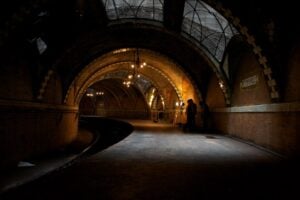
Old City Hall Station, one of New York City’s most famous abandoned subway stations. Photo: Julian Dunn, CC BY 2.0, via Wikimedia Commons.
Beneath the asphalt, roaring traffic, and towering glass skyscrapers of New York City lies one of the world’s largest and most storied rapid-transit systems. The subway has 472 stations and 665 miles of mainline track, carrying millions of riders through a network that still contains forgotten platforms, sealed passageways, unused lower levels, and abandoned loops.
Behind rusted gates, dark signal rooms, and tiled walls sit pieces of an earlier New York. Some are grand remnants of the original IRT, while others are unfinished provisions for lines that never materialized. One is not a subway station at all, but a railroad siding beneath one of Manhattan’s most famous hotels.
What follows is the documented history behind nine abandoned or unused subterranean spaces and one of the New York subway system’s most persistent legends.
1. Old City Hall Station (IRT Lexington Avenue Line)
Location: Beneath City Hall Park, Lower Manhattan
Years of Operation: October 27, 1904–December 31, 1945
Line / Track: City Hall loop, now used by the 6 train to turn around
When New York City’s first subway opened on October 27, 1904, City Hall was the jewel of the system. Designed by Heins & LaFarge, the station featured vaulted Guastavino tile ceilings, brass chandeliers, leaded-glass skylights, and graceful curves that made it unlike almost any station that followed. As trains grew longer and subway cars changed, the sharply curved platform became increasingly impractical, and the nearby Brooklyn Bridge station could better handle expanded service. City Hall closed to passengers at the end of 1945. The track remains active as the downtown 6 train’s turnaround loop, giving riders who remain on the train a fleeting look at one of the most beautiful relics of the original New York City subway.
2. Track 61 Beneath the Waldorf Astoria
Location: Beneath the Waldorf Astoria area near Lexington Avenue and East 49th Street
Status: Railroad siding associated with Grand Central Terminal, not a subway station
System: New York Central / Grand Central rail infrastructure
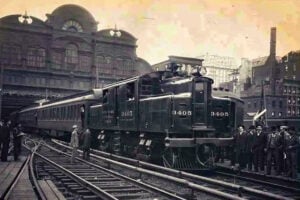
Track 61 is one of the most famous hidden spaces connected to Grand Central Terminal, but its history is less cinematic than the legend that grew around it. The siding originated as part of the terminal’s railroad and powerhouse infrastructure and later provided discreet access beneath the Waldorf Astoria. General John J. Pershing used it in 1938, and Franklin D. Roosevelt is documented using the siding in 1944 after an appearance at the hotel. For years, an old baggage car stored nearby was described as Roosevelt’s secret armored railcar, supposedly used to carry his limousine, but that story was later discredited when the car was identified as New York Central baggage car 002. The hidden track, platform area, and freight access are real; the famous tale of FDR’s private train car should be treated as New York lore rather than settled history.
3. Worth Street Station (IRT Lexington Avenue Line)
Location: Foley Square, along Lafayette Street near Worth Street
Years of Operation: October 27, 1904–September 1, 1962
Line / Track: Between Brooklyn Bridge–City Hall and Canal Street
Worth Street was one of the original IRT stations that opened with the subway in 1904. Its white tile walls, decorative borders, and distinctive mosaic station tablets once served the busy civic district around Foley Square. The station became redundant when the platforms at Brooklyn Bridge–City Hall were lengthened, bringing the larger station much closer to Worth Street. It closed on September 1, 1962. Today, trains still pass the darkened platforms, where portions of the old station remain visible from passing cars.
4. 18th Street Station (IRT Lexington Avenue Line)
Location: Park Avenue South at East 18th Street
Years of Operation: October 27, 1904–November 8, 1948
Line / Track: Between 14th Street–Union Square and 23rd Street
The abandoned 18th Street station was another part of the original IRT. It sat between what became the major Union Square subway complex and the station at 23rd Street. When the platforms at 14th Street were lengthened, 18th Street became too close to the expanded neighboring stop to justify continued service. The station closed on November 8, 1948. Its old platforms, columns, tilework, and station-name details can still be glimpsed from passing Lexington Avenue local trains.
5. 91st Street Station (IRT Broadway–Seventh Avenue Line)
Location: Broadway at West 91st Street, Upper West Side
Years of Operation: October 27, 1904–February 2, 1959
Line / Track: Between 86th Street and 96th Street
Built as part of the original subway, 91st Street served the Upper West Side for more than half a century. By the late 1950s, platform extensions at neighboring stations made the stop increasingly unnecessary, while 96th Street remained the far more important transfer point. The station closed on February 2, 1959. Its darkened platforms and surviving decorative elements remain beside the active tracks, visible briefly from passing local trains.
6. The Ghost Platform at Nevins Street (IRT Eastern Parkway Line)
Location: Flatbush Avenue near Fulton Street, Downtown Brooklyn
Status: Lower-level trackway and platform never used for passenger service
Line / Track: Beneath the active Nevins Street station
Nevins Street opened in 1908, but the station was built with provisions for ambitious IRT expansion plans that never became reality. Beneath the active station is a disused lower level containing an unused platform and trackway created as part of plans for future connections, including routes toward Lafayette Avenue and other proposed Brooklyn lines. None of those lower-level connections entered passenger service. The result is a genuine ghost level beneath a station used every day by riders on the 2, 3, 4, and 5 trains.
7. The 76th Street Station Legend (IND Fulton Street Line)
Location: Alleged location near Pitkin Avenue and 76th Street in Queens
Status: Planned extension; existence of a completed station remains unverified
Line / Track: Proposed continuation east of Euclid Avenue
No abandoned New York subway story has inspired more debate than 76th Street. Plans to continue the IND Fulton Street Line farther east under Pitkin Avenue were real, and track provisions beyond Euclid Avenue helped fuel decades of speculation. The legend claims that a nearly completed station once existed behind concrete walls, sometimes described as having finished platforms and tiled “76th St” signs. No conclusive photographic or documentary evidence has established that such a completed station was ever built. The safest historical conclusion is that the extension was planned and construction provisions existed, while the hidden finished station remains one of New York transit history’s great urban legends.
8. South Ferry Loop Station
Location: Southern tip of Manhattan beneath Battery Park
Years of Passenger Operation: Outer loop: 1905–2009 and 2013–2017; inner loop: 1918–1977
Line / Track: Old IRT South Ferry balloon loops
South Ferry’s old station was built around sharply curved balloon loops at the southern tip of Manhattan. The outer platform opened in 1905, while the inner platform opened in 1918 for Lexington Avenue service. The severe curves created large gaps between cars and the platform, requiring specialized operating procedures and, on the outer loop, mechanical gap fillers. The inner platform left regular passenger service in 1977. The outer loop survived until a modern full-length South Ferry terminal replaced it in 2009. After Hurricane Sandy severely flooded the newer station in 2012, the old outer loop returned to service in 2013 and remained in use until the rebuilt terminal reopened in 2017. The loop then returned to its ghost-station status.
9. The Lower Level of 9th Avenue (BMT West End / Culver)
Location: 39th Street and 9th Avenue, Brooklyn
Years of Passenger Operation: November 11, 1919–May 11, 1975
Line / Track: Lower level beneath the active 9th Avenue station
The lower level at 9th Avenue opened in 1919 and once served BMT Culver and West End trains. In 1954, a new connection at Ditmas Avenue tied the Culver Line into the IND system, leaving the older section between Ditmas Avenue and 9th Avenue as a short shuttle. That remnant became the Culver Shuttle, using the lower level until the service was abandoned in 1975. The upper level remains active for D trains, while stairways still lead toward the closed lower level, a reminder of the earlier Brooklyn route beneath today’s station.
10. The Abandoned Lower Level of Bergen Street (IND Culver Line)
Location: Smith Street at Bergen Street, Brooklyn
Status: Lower express platforms removed from passenger service in the 1990s; upper local platforms remain active
Line / Track: F and G local service above; Culver express tracks below
Bergen Street is a true bi-level subway station, but the abandoned part is the lower level, not the upper. The active local platforms are upstairs, while the former express platforms sit below them. The lower level was originally part of the station’s express design and was removed from passenger service in the 1990s. A 1999 fire in a nearby signal relay room later prevented express operation for years, although the express tracks were eventually restored for train movements. The MTA has studied what it would take to reopen the lower platforms and concluded that extensive reconstruction, accessibility work, waterproofing, lighting, communications, and other repairs would be required. For riders standing on the active platforms above, one of Brooklyn’s most substantial abandoned subway spaces is literally beneath their feet.
Field Guide: NYC’s Abandoned Subterranean Network
| Station / Site | Borough / Location | System / Line | Shuttered / Status | Primary Reason / Historical Status |
|---|---|---|---|---|
| Old City Hall | Manhattan | IRT Lexington Avenue loop | 1945 | Sharp curve and short platform became impractical for longer trains |
| Track 61 | Manhattan | New York Central / Grand Central | Rail siding, not a subway station | Former railroad infrastructure later used for discreet Waldorf access |
| Worth Street | Manhattan | IRT Lexington Avenue Line | 1962 | Made redundant by Brooklyn Bridge platform expansion |
| 18th Street | Manhattan | IRT Lexington Avenue Line | 1948 | Made redundant by neighboring platform expansion |
| 91st Street | Manhattan | IRT Broadway–Seventh Avenue Line | 1959 | Nearby station extensions and low relative importance |
| Nevins Street Lower Level | Brooklyn | IRT Eastern Parkway Line | Never opened | Provision for unbuilt IRT expansion routes |
| 76th Street | Queens | IND Fulton Street Line | Planned / legendary | Proposed extension was real; a completed hidden station remains unverified |
| South Ferry Loop | Manhattan | IRT loops | Inner 1977; outer 2009 / 2017 | Curved, short platforms replaced by a modern terminal |
| 9th Avenue Lower Level | Brooklyn | BMT West End / Culver | 1975 | Culver Shuttle discontinued |
| Bergen Street Lower Level | Brooklyn | IND Culver Line | Removed from passenger service in the 1990s | Former express platforms remain closed while upper local platforms stay active |
For more on New York’s lost transit history, see our look at 15 Lost Subway, Elevated & Rail Lines of New York City, revisit the system’s beginnings with 10 Oldest Subway Stations in NYC Still Operating, and explore 10 Lost New York Transit Lines, Terminals & Ferries That Built the City.
Sources
- New York Transit Museum — Subway Day
- New York Transit Museum — Old City Hall Station
- MTA New York City Transit — Feasibility and Analysis of F Express Service in Brooklyn
- nycsubway.org — Abandoned and Disused Stations
- nycsubway.org — IRT East Side Line
- nycsubway.org — BMT West End Line
- HISTORY — Secrets and Myths of Grand Central Terminal
- The New York Times — 76th Street Station Legend