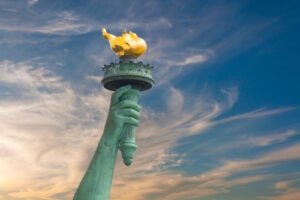
Close-up view of the Statue of Liberty’s raised arm, torch, and surrounding balcony. Photo by PannaPhoto / Shutterstock.com.
New York City’s famous landmarks are filled with spaces most people never see. Behind public halls, marble facades, observation decks, church walls, and monumental entrances are rooms and passageways created for building superintendents, powerful executives, celebrities, maintenance crews, and uses that disappeared generations ago. Some remain completely restricted, while others can be seen only through special tours or limited access.
What makes these places so fascinating is that they are hidden inside landmarks New Yorkers already know. Millions of people have walked past the New York Public Library, looked up at the Chrysler Building, visited Radio City Music Hall, or stood beneath the Statue of Liberty without realizing that very different spaces exist just beyond the areas normally open to the public.
Here are 10 secret spaces and hidden rooms inside 10 different New York City landmarks.
1. The Superintendent’s Family Apartment Inside the New York Public Library
- The Landmark: Stephen A. Schwarzman Building, 476 Fifth Avenue
- The Hidden Space: An eight-room apartment on the mezzanine floor
- Access: Restricted interior space
When the New York Public Library’s great Fifth Avenue building opened in 1911, keeping the enormous structure operating required a superintendent who could respond to problems at any hour. John H. Fedeler, the Library’s first superintendent and building engineer, lived with his family in an eight-room apartment on the mezzanine floor. Fedeler remained there for decades, raising two children inside one of New York City’s grandest public buildings. His son later succeeded him as superintendent. Long after the era of live-in building engineers disappeared, the apartment remained part of the Library’s extraordinary architectural history.
2. The Closed Celestial Observatory Inside the Chrysler Building
- The Landmark: Chrysler Building, 405 Lexington Avenue
- The Hidden Space: The former Celestial observatory on the 71st floor
- Access: Closed to the general public
The gleaming crown of the Chrysler Building once contained a public attraction that has been inaccessible for generations. Beginning in 1930, visitors could pay to enter Celestial, an observation deck on the 71st floor decorated with celestial motifs, stars, and golden rays. It offered spectacular views of New York from inside the building’s famous crown. The observatory closed in 1945, and the upper floors of the Chrysler Building have long since become spaces that ordinary visitors do not enter. The triangular windows remain visible from outside, but the former observation level behind them belongs to a vanished chapter of the skyscraper’s history.
3. The Secret Roxy Suite Inside Radio City Music Hall
- The Landmark: Radio City Music Hall, 1260 Sixth Avenue
- The Hidden Space: The private apartment created for Samuel “Roxy” Rothafel
- Access: Seen on the Radio City Music Hall Tour Experience and used for certain private events
Hidden inside Radio City Music Hall is an extraordinary private apartment created for the theater’s legendary impresario, Samuel “Roxy” Rothafel. Designed by Donald Deskey, the same designer responsible for Radio City’s celebrated Art Deco interiors, the suite gave Rothafel a secluded place to entertain guests away from the enormous auditorium and public spaces surrounding it. The apartment features a 20-foot gold-leaf ceiling, cherry-paneled walls, a reception parlor, and a formal dining room. Radio City itself still describes the Roxy Suite as its secret apartment, and visitors can see it during the theater’s official behind-the-scenes tour.
4. The Restricted 103rd Floor of the Empire State Building
- The Landmark: Empire State Building, 350 Fifth Avenue
- The Hidden Space: The exclusive 103rd-floor observation level
- Access: Closed to the general public and reserved for selected VIPs, celebrities, and dignitaries
Millions of people have visited the observation decks of the Empire State Building, but almost none will ever stand on its 103rd floor. Above the famous open-air observatory on the 86th floor and the enclosed 102nd-floor observatory is another level that is not part of the normal visitor experience. The Empire State Building confirms that the 103rd floor is reserved for VIPs, celebrities, and dignitaries. It is an extraordinary example of a space hidden not because it has been forgotten, but because access is intentionally limited inside one of the most visited landmarks in New York.
5. The Bank Vault and Swimming Pool Beneath the Woolworth Building
- The Landmark: Woolworth Building, 233 Broadway
- The Hidden Space: A historic bank vault and basement swimming pool
- Access: Restricted; the restored pool is part of the building’s residential amenities
The Woolworth Building was designed as far more than an office tower. Its lower levels included facilities for Irving National Bank as well as a swimming pool associated with the building’s original health and recreation facilities. The old safe-deposit vault survived after the bank moved out, while the basement pool was eventually drained and forgotten. During the conversion of the upper portion of the Woolworth Building into residences, the pool was restored as an amenity. Far below the Gothic tower that once held the title of the world’s tallest building, these unusual spaces remain part of an underground side of the landmark that most people never see.
6. The President’s Suite Hidden Inside 55 Wall Street
- The Landmark: 55 Wall Street, the former National City Bank Building
- The Hidden Space: The bank president’s private suite built into the southeast corner of the banking hall
- Access: Private interior space
The enormous former banking hall at 55 Wall Street was designed to impress customers, but one of its most important spaces was tucked away from the public floor. In the southeast corner was a private suite originally created for the bank president. The suite included an outer office, two conference rooms, and the president’s office, with parquet floors, paneled wainscoting, chandeliers, and a black marble fireplace. While customers conducted business beneath the monumental columns and coffered ceilings outside, the bank’s leadership could work and meet in a secluded suite built directly into the edge of the great hall.
7. The Hidden Interior of the Washington Square Arch
- The Landmark: Washington Square Arch, Washington Square Park
- The Hidden Space: An interior chamber and narrow service staircase leading toward the roof
- Access: Closed to regular public access
Thousands of people pass beneath the Washington Square Arch every day, but the monument is not solid marble from side to side. Inside its western pier is a narrow service staircase that climbs through the structure toward interior spaces and the roof. New York City officials have explained that the staircase was created for maintenance rather than normal public circulation, and the interior was never designed to accommodate regular visitors. The arch underwent a major restoration in the early 2000s that included interior work. From the outside, there is little indication that this familiar Washington Square Park landmark contains a hidden vertical passage and maintenance space within its massive masonry.
8. The Secret Passageway Inside the Merchant’s House Museum
- The Landmark: Merchant’s House Museum, 29 East Fourth Street
- The Hidden Space: A narrow concealed passageway beneath a built-in chest of drawers
- Access: The passageway is preserved, and visitors can now view the site as part of the museum experience
One of the newest additions to New York City’s hidden-history map was revealed inside one of its oldest surviving houses. In February 2026, the Merchant’s House Museum announced that research into a previously unknown concealed passageway had led the museum to identify it as an early Underground Railroad site. Hidden beneath a built-in chest of drawers on the second floor, the narrow passage descends through the house and had remained unnoticed for generations. The museum traces the feature to the house’s original 1832 construction by abolitionist Joseph Brewster. Whether viewed as an architectural mystery or as evidence of the dangerous secrecy surrounding early abolitionist activity, the discovery is an extraordinary example of a hidden space surviving inside a New York landmark for nearly two centuries.
9. The Restricted Torch Inside the Statue of Liberty
- The Landmark: Statue of Liberty, Liberty Island
- The Hidden Space: The interior access route to the torch
- Access: Restricted to authorized National Park Service personnel
Visitors can climb through the Statue of Liberty to its crown with advance reservations, but the torch is another story entirely. The National Park Service states that the torch has been closed to the public since the Black Tom explosion of July 30, 1916. Reaching it requires authorized workers to climb a narrow ladder inside the statue’s raised arm. The current torch was installed during the great restoration of the 1980s, while the original torch is now displayed in the Statue of Liberty Museum. For more than a century, the highest and most symbolic part of the monument has remained one of its most inaccessible interior spaces.
10. The Catacombs Beneath the Basilica of St. Patrick’s Old Cathedral
- The Landmark: Basilica of St. Patrick’s Old Cathedral, 263 Mulberry Street
- The Hidden Space: Historic underground catacombs beneath the cathedral
- Access: Limited access through authorized tours and cathedral programs
Beneath the Basilica of St. Patrick’s Old Cathedral in Lower Manhattan is a network of historic catacombs containing the remains of clergy and prominent New York Catholic families. The cathedral’s cornerstone was laid in 1809, and the grounds served as one of the most important centers of Catholic life in early New York. The catacombs beneath the church date to the early 19th century and remain part of Manhattan’s only operating Catholic cemetery and catacomb complex. Most people walking through Nolita see the old cathedral and its surrounding walls without realizing that another layer of New York history lies directly beneath the nave. For more on the landmark, see our history of St. Patrick’s Cathedral and the Basilica of St. Patrick’s.
Secret Spaces and Hidden Rooms at a Glance
| Hidden Space | Landmark | Era | Original Purpose |
|---|---|---|---|
| Superintendent’s Apartment | New York Public Library | 1911 | Eight-room home for the building superintendent and his family |
| Celestial Observatory | Chrysler Building | 1930 | Public observation deck, closed since 1945 |
| Roxy Suite | Radio City Music Hall | 1932 | Private apartment and entertaining suite for Samuel “Roxy” Rothafel |
| Restricted 103rd Floor | Empire State Building | 1931 | Exclusive upper observation level |
| Bank Vault and Pool | Woolworth Building | 1913 | Banking and recreation facilities |
| President’s Suite | 55 Wall Street | Early 20th century | Private executive offices and conference rooms |
| Arch Interior and Staircase | Washington Square Arch | 1892 | Interior maintenance access to the monument |
| Secret Passageway | Merchant’s House Museum | 1832 | Concealed passage identified by the museum as an Underground Railroad site |
| Restricted Torch | Statue of Liberty | 1886 | Interior maintenance access to the torch |
| Catacombs | Basilica of St. Patrick’s Old Cathedral | Early 19th century | Burial chambers beneath the cathedral |
For more unusual corners of the city, continue with 20 New York City Secrets Hiding in Plain Sight and 20 Hidden Gems In Manhattan Most Tourists Miss. Those guides focus on visible curiosities and places to discover around the city, while the spaces above are hidden inside individual New York landmarks.
Sources
- The New York Public Library — Stephen A. Schwarzman Building Facts
- Chrysler Building — Building History
- Radio City Music Hall — Roxy Suite
- Empire State Building — Facts and Figures
- The New York Public Library — The Woolworth Building: The Cathedral of Commerce
- New York City Landmarks Preservation Commission — Former National City Bank Building Interior
- New York City Council — Testimony on Interior Access to the Washington Square Arch
- Merchant’s House Museum — Merchant’s House and the Underground Railroad
- National Park Service — Statue of Liberty Frequently Asked Questions
- Basilica of St. Patrick’s Old Cathedral — Manhattan’s Catholic Catacombs and Cemetery
Published September 7, 2026.