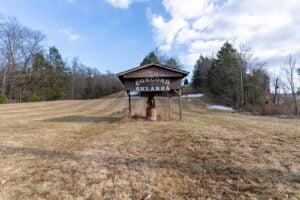
Feature Photo: TW Farlow Media / Shutterstock.com
For generations of Upstate New Yorkers, a day of skiing did not always mean a long drive to a major mountain. Plenty of families learned on a local hill with one rope tow, a small warming hut and a few trails cut through the woods. Other communities had genuine resorts with chairlifts, ski schools, restaurants and racing programs. Some of those places disappeared so completely that a person driving past the old entrance today might never know there had been a ski center there.
Upstate New York’s skiing history stretches far beyond the mountains still operating today. It includes the former slopes of Lake Placid, the Catskills, the Southern Tier, the St. Lawrence Valley and Western New York. Many opened during the skiing boom of the 1940s, 1950s and 1960s, when local entrepreneurs, colleges and ski clubs saw an opportunity to turn an ordinary hillside into a winter gathering place. The economics were not always easy. A warm winter could be costly, maintaining lifts demanded money, and sometimes the arrival of a larger ski center changed an entire region’s market.
But the story is not simply that 25 mountains went bankrupt and returned to forest. Some closed and reopened under different names. Some became parks or residential developments. A few former slopes are still used for other kinds of recreation. One, Toggenburg, was sold in 2026 to owners who plan to bring skiing back. Those distinctions are part of the history, and they matter to the people who remember these places.
Here are 25 former downhill ski areas across Upstate New York, where they operated, and what happened to them. They are listed as former ski operations; a mountain can qualify even when the property has since found another use.
1. Paleface Mountain — Jay, Essex County
Paleface Mountain, also listed in old ski guides as Bassett Mountain, once offered a substantial alternative to the larger ski areas around Lake Placid. The former operation stood near Route 86 in Jay. Period descriptions record about 700 feet of vertical drop, ten trails, a chairlift and a T-bar. It also offered night skiing on selected evenings and snowmaking—amenities that distinguish it from the many Adirondack hills with little more than a rope tow.
Paleface eventually ceased operating as a commercial ski area. Its name now appears mostly in vintage trail and lift records rather than current resort directories. Although the old facilities made it a recognizable winter destination, the surviving published material does not establish one definitive cause of closure, so it would be misleading to blame the end of Paleface on a particular company or financial event without further evidence.
2. Scotch Valley — Jefferson, Delaware County
Many skiers remember Scotch Valley as a Stamford-area resort, but its property on Route 10 was in the town of Jefferson. Opened in 1962 by Avery Robinson, Scotch Valley became much more than a modest neighborhood slope. Local historical research records chairlifts, a T-bar, a rope tow, a ski school and a 150-foot ski jump constructed in 1965. There was even a ten-lane bowling alley, giving visitors something to do when they came off the mountain.
The ski center later used the Deer Run name and closed in 1998. The grounds subsequently had uses other than public downhill skiing. Scotch Valley is a good example of how the old Catskill resorts tried to draw entire families for a day or weekend, with activities extending well beyond the trails themselves.
3. Big Tupper — Tupper Lake, Franklin County
Big Tupper on Mount Morris was one of the bigger community ski areas to disappear from New York’s winter resort map. It offered a genuine mountain experience, with a vertical drop exceeding 1,100 feet and trails for different ability levels. For Tupper Lake, it was also an important part of winter life, giving local families a place to ski without leaving the community.
The resort closed in the late 1990s, but that was not the end of the effort to save it. Volunteers helped restore operations between 2009 and 2015. After another lengthy closure, the property sold at auction in 2024. Local tourism officials report plans under the new ownership to reopen for public use, although those plans should not be mistaken for an operating ski resort as of November 2026. Big Tupper remains one of the state’s most closely watched potential comebacks.
4. Highmount Ski Center — Highmount, Ulster County
Highmount opened for the 1946–47 winter season under members of the Davenport family and partner C. Lincoln Christensen, on terrain adjoining what would become the Belleayre Mountain ski center. Its north-facing trails made good use of the Catskills’ winter conditions. Over time the original rope tows gave way to more ambitious lift infrastructure, including T-bars and a chairlift, as Highmount developed into a serious competitor in the region.
The ski center ceased regular operations in the 1990s. Historical accounts differ about the exact final season, so a precise closure year should not be presented as settled. Development proposals later considered incorporating portions of Highmount’s former trails into the neighboring Belleayre complex. State planning documents distinguish the privately controlled Highmount parcel from Belleayre’s public Forest Preserve land; proposals involving that property do not mean the historic independent resort has reopened.
5. Bobcat Ski Center — Andes, Delaware County
Near Andes, the Catskill Ski Center later became known as Bobcat. Local historian Karen Cuccinello traces its opening to 1963, when Waldemar Durke and Paul and Emma Grommeck developed the operation on Mount Pisgah. Early advertisements described downhill skiing for holiday and weekend visitors, and later facilities included T-bars, rentals, a ski school, a shop and a cafeteria. That gave Bobcat a much larger recreational role than its secluded location might suggest.
Bobcat operated for decades before closing around the middle of the 2000s; Cuccinello’s local history gives 2005. Its old name is now familiar mainly to people who skied in Delaware County and to collectors of historical ski guides. The surviving accounts document its long existence more clearly than they establish a single decisive reason for its closure.
6. Cortina Valley — Haines Falls, Greene County
Cortina Valley opened in 1974 in the Haines Falls and Tannersville area under Mario deBelardino. At different points it appeared under the names Ski Cortina and Villagio. The mountain had two chairlifts and additional surface lifts, offering a smaller Catskill option for skiers in a region where Hunter Mountain had already become a prominent destination. Cortina also hosted summer activities, including an Italian festival, an indication that its operators sought business beyond the winter season.
Its decline happened in stages rather than during one final closing day. According to a Delaware County historical account, the chairlifts stopped running in 1999 while surface-lift skiing continued for approximately another decade. That distinction is important: a photograph of an idle chairlift would not, by itself, prove the entire area had already stopped operating.
7. Toggenburg Mountain — Fabius, Onondaga County
Toggenburg was a fixture of the Fabius and Syracuse-area skiing community for nearly seven decades. Its evening programs, ski teams and base lodge made it especially convenient for people who wanted to ski after school or work. In 2021, Intermountain Management, which already controlled nearby Labrador and Song mountains, purchased Toggenburg and closed it. Many former customers objected to losing an independent choice so close to home.
The closing eventually led to a state antitrust case. New York’s attorney general sued in 2022, and a court ruled against Intermountain in 2025. On October 16, 2026, the attorney general announced that the resort had been sold to local businessman Douglas Wheeler as part of a settlement. The new owners plan to rebuild it for the 2027–28 winter season. That reopening is still in the future, but Toggenburg’s story is no longer simply one of permanent disappearance.
8. Marble Mountain — Wilmington, Essex County
Before the Whiteface Mountain Ski Center familiar to today’s skiers opened, New York State invested in an ambitious ski development at nearby Marble Mountain. Opened in 1949, Marble had lift-served runs and access to terrain intended to help make the Adirondacks a major alpine destination. The site suffered from a serious problem: its exposed slopes could be bitterly cold and windswept, with wind sometimes removing the snow that skiers needed.
State officials moved ahead with a different development on Whiteface, which opened in 1958. Marble remained part of the transition before closing in 1960. The surviving evidence makes the weather problem especially clear, rather than supporting a vague explanation about corporate competition. The original Marble Mountain operation is gone, but its history remains inseparable from the creation of Whiteface as a premier New York ski area.
9. Fawn Ridge — Lake Placid, Essex County
Long before modern skiing became concentrated at Whiteface, visitors and residents of Lake Placid had several separate downhill hills to choose from. Fawn Ridge was one of them. Historical ski guides and Jeremy Davis’s research on the northern Adirondacks identify it as a genuine lift-served ski area, not merely a nickname for a local sledding hill. It served skiers for decades as part of the area’s once-extensive network of small slopes.
Fawn Ridge also has an unusually clear link to the later development of Lake Placid. Federal court records involving a residential subdivision of the same name describe land on the edge of the village that had previously contained ski trails. The old alpine operation ended, and residential use eventually occupied portions of the former ski landscape. The Fawn Ridge name survived, even as its meaning changed.
10. Scott’s Cobble — North Elba, Essex County
Scott’s Cobble was another Lake Placid-area hill where generations of children learned to ski. The Town of North Elba and local skiing organizations helped develop the area, and it eventually had more than a simple rope tow. Recollections of the old hill describe after-school lessons, junior races and a practical place to learn turns before heading for bigger Adirondack mountains.
The downhill operation closed in the early 1970s. However, it would be wrong to describe the property as abandoned today. In 2022 the Scotts Cobble Nordic Center opened, with groomed trails for cross-country skiing and other winter recreation. The old alpine lift system is gone, but the location remains connected to community skiing—an unusual second chapter for a place on a list of lost ski areas.
11. Glenwood Acres — Glenwood, Erie County
Glenwood Acres helps explain how Western New York developed its own ski culture. The Crone family began a local ski hill in the Glenwood area, and the property grew from an early club operation into a lift-served center. Local recollections describe rope tows and T-bars, reflecting a period when clubs and families built winter recreation facilities on otherwise ordinary hillsides.
The independent Glenwood Acres identity eventually disappeared as the nearby Kissing Bridge resort expanded. Kissing Bridge itself acknowledges Glenwood Acres in its history and identifies it as a forerunner of the larger skiing operation. This is not a story of a mountain necessarily being abandoned to forest. Rather, the name of one early ski center was overtaken by the development of a resort that still operates.
12. Bluemont — Yorkshire, Cattaraugus County
The ski area near Yorkshire began in 1959 as Blue Mountain, built by a local family on terrain east of Springville. It offered a lodge, ski instruction, several trails and different lift types. One unusual early feature was a side-loading detachable chairlift. According to a history compiled with help from the founder’s son, problems with that lift led to Blue Mountain closing in 1962.
The center reopened in 1968 as Bluemont, using a more conventional chairlift, and operated through 1979. Later owners proposed a much larger private, year-round resort involving additional land and recreational facilities, but those plans failed to produce a lasting ski operation. Bluemont’s history shows how repeated investment and reinvention could not always keep an independent ski mountain running.
13. Grosstal, Wing Hollow and Ski Wing — Allegany, Cattaraugus County
These three names refer to successive versions of a ski operation on West Five Mile Road near Allegany, rather than three separate ski areas. Regional ski-history records date Grosstal’s opening to 1963. The hill experienced financial trouble and changes of ownership, and later operators used the Wing Hollow and Ski Wing names in attempts to establish a workable business.
The former resort’s story is unusual for the number of times its identity changed. Archived accounts describe bankruptcy proceedings and further management changes during the 1970s. Because much of the detailed narrative comes from recollections rather than readily accessible business records, it is more responsible to identify those documented changes than to assign a sweeping, unproven cause for the final closure.
14. Juniper Hills — Harrisville, Lewis County
Juniper Hills operated west of Harrisville along Route 3, a long way from the destination ski mountains of the central Adirondacks. It was nevertheless a developed local hill. Period ski-area guides list T-bar and J-bar lifts, multiple trails and slopes, and approximately 200 feet of vertical drop. Those details are supported by contemporary guide listings rather than only by later memories.
Historical inventories give its operating span as approximately 1964 to 1980. A ski area of that size might not appear on a statewide tourism poster, but it made a real difference to Lewis County families who wanted affordable winter recreation close to home. Today Juniper Hills is one of the northern New York operations preserved mainly in historical skiing records.
15. Ski Valley — Naples, Ontario County
Ski Valley, sometimes called Bristol Ski Valley in historical accounts, opened near Naples in 1965. With a double chairlift, T-bar, rope tow and roughly 600 feet of vertical terrain, it was a genuine Finger Lakes skiing destination. The center began as a public resort before later operating as a private club, showing how an area’s business model could change even while its lifts were still running.
Foreclosure followed in 2001. Later reports described efforts by new owners to renovate equipment and revive skiing under another name, but those proposals should not be confused with evidence of a sustained, publicly operating resort. Ski Valley’s story includes both its original commercial years and the continuing efforts to find a future for its slopes.
16. Eagle Ridge — Westfield, Chautauqua County
Eagle Ridge near Westfield is a reminder that some lost ski areas had extremely short lives. Historical records place the former center off Route 394 and describe about 250 feet of vertical terrain served by a double chairlift, a T-bar and a rope tow. That combination was ambitious for a neighborhood-sized mountain.
The ski-history record lists 1963 as its only operating year before the property changed hands. Unlike resorts that became landmarks for decades, Eagle Ridge appears to have had barely enough time to become established. Its surviving lift and location details are a useful reminder that even facilities requiring considerable upfront investment did not always last.
17. Harvey Mountain, Later Garnet Mountain — North River, Warren County
Harvey Mountain opened in 1962 on Barton Mines Road near North River. Bill and Ann Butler ran the operation, which had a T-bar, about 400 feet of vertical drop and trails suitable for family skiing. The warming hut began in a converted structure associated with the nearby garnet mining property. Over time the operation adopted the Garnet Mountain name, connecting its identity even more closely to the surrounding area.
The Butlers closed the ski center after the 1976–77 winter. This is one of the best documented family-run ski stories in the collection: Jeremy Davis of the New England Lost Ski Areas Project interviewed Ann Butler and preserved detailed accounts of the resort’s creation and eventual closure. The site was later sold to the state, and its old trails have largely returned to forest.
18. St. Lawrence University Snow Bowl — South Colton, St. Lawrence County
Near South Colton, St. Lawrence University operated a ski area known as the Snow Bowl. It offered a T-bar and roughly 300 feet of vertical drop, providing a place for students and local skiers to practice, race and enjoy winter recreation. The facility reflected a time when a college could maintain its own downhill terrain rather than send everyone to a distant commercial mountain.
Historical inventories place Snow Bowl’s operations from 1946 to 1982. Its disappearance belongs to a broader pattern of college-affiliated and community ski slopes closing as operating and maintenance requirements changed. For alumni and residents who learned there, however, the Snow Bowl was part of the university’s winter identity, not simply another defunct lift.
19. Petersburg Pass, Later Taconic Trails and Mount Raimer — Rensselaer County
Petersburg Pass opened in 1962 near Route 2 on the New York–Massachusetts border. Founded by Francis Wilson and Gilbert Devy, it began with a chairlift and several trails before adding more terrain and a beginner lift. Its location in the Taconic Mountains attracted skiers who wanted a mountain experience without traveling far north into the Adirondacks.
The ski center was sold in 1967, closed in 1969, and suffered a lodge fire the following year. A subsequent owner reopened it in the 1970s, and the area was known at different times as Taconic Trails and Mount Raimer. Operations ended in 1980 amid financial difficulties. The slopes no longer serve lift-ticket customers, but the surrounding mountains remain accessible through the Taconic Crest Trail system.
20. Alpine Meadows — Porter Corners, Saratoga County
Alpine Meadows was an important local skiing destination near Porter Corners. Its origins reached back to the years around World War II, when Ed Taylor Jr. helped develop the area. At various times the hill had numerous rope tows and an extensive network of trails for a center so close to Saratoga Springs. The Town of Greenfield Historical Society has preserved additional details about the local clubs and people involved in its early development.
After decades of operation and several changes of ownership, Alpine Meadows closed in the early 1990s. Saratoga Living has reported that a property dispute was a significant factor in its final years. The former ski center is remembered not just as a recreational business but as a place where Saratoga County children learned to ski for modest admission prices and where local winter weekends took shape.
21. Seven Springs — Parishville, St. Lawrence County
Seven Springs began as a ski and recreation facility near Parishville before becoming a property owned by Clarkson College, now Clarkson University. The university’s own institutional history describes a 70-acre site roughly ten miles southeast of Potsdam, with a lodge, ski slope, lift, pond and other recreation facilities. It served faculty, students and members of nearby communities.
Clarkson eventually closed the facility in 1993 as a cost-saving measure and subsequently sold it. Unlike many ski areas whose last season survives only in local recollection, Seven Springs has a clear documentary record of its later ownership and closing. It demonstrates how an institution’s recreational priorities could determine whether a small ski area remained open.
22. Innsbruck USA — Town of Binghamton, Broome County
People who skied around Binghamton during the 1960s and 1970s may remember Innsbruck USA, a local resort off Maxian Road. It had named trails, lifts and facilities substantial enough to appear on printed trail maps. The Triple Cities Ski Club has preserved a historical map and recollections of ski events held there, offering a glimpse into the Southern Tier skiing scene before many skiers began traveling to larger resorts.
The downhill operation ended in the late 1970s, but its former terrain was not lost to the public. The land is now part of Broome County’s Aqua-Terra Wilderness Area, where visitors can hike and explore land that once contained ski runs. The county’s own park description identifies the site as the former Innsbruck USA Ski Area, making its history especially easy to connect with the landscape that remains.
23. Roxbury Ski Center, Later Big Bear and No-Name — Vega, Delaware County
Roxbury Ski Center opened for the 1956–57 winter season in the Denver-Vega valley, on the opposite side of Bearpen Mountain from the Princeton Ski Bowl. A local historical society account describes a 2,000-foot T-bar that served runs including Avalanche and the longer Boulevard. The early lodge was basic, but the ski center drew people into a rural Catskill valley during the area’s growing winter tourism period.
New owners renamed the resort Big Bear during the 1960s, and it later operated as No-Name Ski Center. By the early 1970s the operation had ended. Its different names sometimes make the historical record confusing, but they belong to one mountain. The Historical Society of the Town of Middletown has documented the owners, locations and changing identity in a detailed study of lost local ski centers.
24. Snow Crest — Near Cortland, Cortland County
Snow Crest traces its origins to a rope tow first used at another local slope near Cortland. In 1947, organizers moved that equipment to the Lang farm on Page Green Road, where a new ski area took shape. Night lighting was later installed, making it possible for skiers to use the hill after dark. The Cortland Ski Patrol supplied an important safety and organizational presence.
The people associated with Snow Crest helped develop a more ambitious mountain at Greek Peak, which opened in January 1958. Snow Crest continued for another two years as a supplement to the new resort before closing in 1960. The Greek Peak Ski Patrol’s own history records that sequence, offering one of the clearest examples of a lost local ski hill helping create a successful successor.
25. Princeton Ski Bowl — Bearpen Mountain, Greene County
Princeton Ski Bowl opened in the mid-1950s on Bearpen Mountain near Prattsville. Its founder, Ben Lane, named the project for his university. What made this Catskill operation especially unusual was how skiers reached the upper slopes: trucks carried guests toward the summit, while rope tows also helped move people uphill. Its terrain offered long descents and the possibility of finding generous natural snow on the mountain’s higher elevations.
Princeton Ski Bowl closed in 1969, but the mountain still attracts hikers and backcountry skiers. Old machinery associated with the rope-tow system has been documented along the route. The history is preserved by the Historical Society of the Town of Middletown and in later reporting on Bearpen Mountain’s surviving ski-area ruins. It is a vivid reminder of how inventive and sometimes unconventional early ski operations could be.
What Happened to Upstate New York’s Smaller Ski Areas?
The disappearance of these ski areas did not have a single explanation. Weather made some mountains hard to operate reliably. Others struggled to finance improvements to lifts and snowmaking. Some were sold, absorbed into larger operations or converted to other uses. The experiences of Marble Mountain, Scotch Valley, Seven Springs and Toggenburg show just how different the endings could be.
What these places shared was their role in everyday Upstate New York life. They taught children to ski, hosted races, employed local people and gave communities somewhere to gather during the coldest months of the year. For some towns, the ski hill was as recognizable as the movie theater, bowling alley or main street diner.
Several of their names survive in more than memory. Glenwood Acres is part of the history of Kissing Bridge. Snow Crest helped lead to Greek Peak. Innsbruck USA’s old hillsides are now public parkland. Scott’s Cobble has a new life in Nordic skiing. And at Toggenburg, the possibility of lift-served skiing returning means its story is still being written. That’s what makes the history of New York’s lost ski areas worth preserving: the slopes may close, but the communities and stories behind them do not simply disappear.
Related Articles on ClassicNewYorkHistory.com
25 Classic Sporting Goods and Outdoor Stores That Shaped Upstate New York
25 Olympic Gold Medalists From Upstate New York
25 Abandoned Places in Upstate New York and What Happened to Them
10 Vanished Grand Resorts and Hotels of the Catskills and Adirondacks
15 Famous People You Didn’t Know Were From Lake Placid, New York
15 Historic Great Camps of the Adirondacks and Their Remarkable Architecture