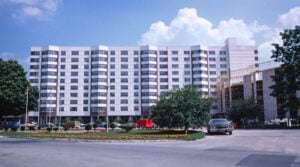
The Concord Hotel in Kiamesha Lake, New York. Photo by John Margolies, Public domain, via Wikimedia Commons.
I graduated high school in 1979 and went Upstate to school at a very small community college called Sullivan County Community College. It was probably the best time of my life. It wasn’t a school with the highest academic standards or anything like that; it was pretty much a place for kids who hadn’t done well in high school and still wanted a chance to go away to school. So, of course, there was a pretty rowdy bunch of people attending that place.
The majority of us had to work. I worked at an Agway gas station. Most of my friends, however, worked in the hotels that were still open. The big one was the Concord. Sullivan County Community College had a very good restaurant and hotel technology curriculum, so many kids were employed in the hotels. Sadly, almost all of those big hotels have closed. By the time I arrived in Sullivan County, they were already at the tail end of a remarkable era in Upstate New York history.
From the great 19th-century mountain houses to the post-World War II boom of the Catskills, New York’s mountain resorts created a vacation culture all their own. In the Catskills and Adirondacks, enormous hotels offered sweeping verandas, ballrooms, dining halls, golf courses, theaters, skating rinks, lakefront recreation, and entertainment that drew generations of visitors from New York City and far beyond. Railroads helped build the first great resort era; automobiles and commercial air travel later changed vacation habits, while fires, rising operating costs, and changing tastes helped bring many of these enormous properties to an end. These ten vanished resorts tell the story of an age that once defined vacationing in Upstate New York.
1. Grossinger’s Catskill Resort Hotel
Location: Liberty/Ferndale, Sullivan County (Catskills)
Origins: 1914 | Expanded at its later resort site: 1919 | Closed: 1986 | Main complex demolished: 2018
The Grossinger family’s Catskills story began in 1914, when they started taking in guests at a farmhouse in the Ferndale area. In 1919, the family acquired a larger property that became Grossinger’s Terrace Hill House and eventually grew into Grossinger’s Catskill Resort Hotel. Under Jennie Grossinger, the property became a defining resort of the Borscht Belt. At its height, Grossinger’s spanned roughly 1,200 acres and included 35 buildings, indoor and outdoor pools, golf, winter sports, major entertainment, and its own airstrip.
Grossinger’s also became part of skiing history when it pioneered artificial snow at a resort in 1952. Its entertainment and vacation culture became closely associated with the world later portrayed in the 1987 film Dirty Dancing; screenwriter Eleanor Bergstein drew on her own Catskills experiences, including summers at Grossinger’s. The resort closed in 1986. After decades of abandonment and unsuccessful redevelopment efforts, most of the remaining hotel complex was demolished in 2018.
2. The Concord Resort Hotel
Location: Kiamesha Lake, Sullivan County (Catskills)
Opened: 1937 | Closed: 1998 | Demolished: 2008
The Concord was the giant of the Catskills and the hotel I remember most from my own years in Sullivan County. Arthur Winarick acquired the property in the 1930s and transformed it into the Concord Plaza, which grew over the following decades into the largest of the great Borscht Belt resorts. At its peak, the Concord had roughly 1,200 guest rooms and a massive entertainment complex that included the 3,000-seat Imperial Room, where some of the biggest names in American entertainment performed.
The property also featured the famous Monster Golf Course and an enormous range of recreational facilities. Judy Garland, Tony Bennett, Barbra Streisand, Joan Rivers, Aretha Franklin, and many other major performers appeared there. The Concord closed in 1998 after years of financial trouble. Demolition of the old hotel structures was underway in 2008 as developers prepared the site for a new generation of resort development.
3. Brown’s Hotel
Location: Loch Sheldrake, Sullivan County (Catskills)
Opened: 1944 | Closed: 1988 | Former complex destroyed by fire: 2012
Brown’s Hotel was another of the great names of the Borscht Belt. Charles and Lillian Brown opened the hotel in Loch Sheldrake in 1944 and built it into a large resort known for its entertainment, nightlife, dining, swimming, and recreation. The Brown family had a long relationship with Jerry Lewis that began before Brown’s Hotel itself opened. Lewis had worked and performed at hotels associated with the Brown family while he was still young, and the Browns later named their major nightclub the Jerry Lewis Theater Club.
The resort’s stages featured performers including Harry Belafonte, Dean Martin, Woody Allen, Liberace, and many others. Brown’s eventually closed in 1988, and the property was later converted into condominiums. In April 2012, a major fire swept through the former resort complex, destroying seven of its nine buildings and erasing much of what physically remained of one of the Catskills’ most famous hotels.
4. Catskill Mountain House
Location: Pine Orchard, Town of Hunter, Greene County (Catskills)
Opened: 1824 | Last season: 1941 | Remains burned: 1963
Perched high above the Hudson Valley near what is now the North-South Lake Campground, the Catskill Mountain House became one of the most famous early resort hotels in the United States. Its long columned veranda looked out from the Catskill escarpment over a vast panorama that helped make the hotel a symbol of 19th-century American tourism. Presidents Ulysses S. Grant and Chester A. Arthur were among its notable guests.
The surrounding landscape was also tied to the artists of the Hudson River School, who helped make the Catskills nationally famous. The Mountain House’s popularity faded as vacation patterns changed, and 1941 was its final season. New York State later acquired the property, and in January 1963 the remaining structure was deliberately burned. Today, hikers can still visit the former hotel site and stand at the same dramatic overlook that once drew generations of guests.
5. Hotel Kaaterskill
Location: South Mountain, near Haines Falls, Greene County (Catskills)
Opened: 1881 | Destroyed by fire: 1924
Hotel Kaaterskill opened in 1881 as one of the largest and most extravagant mountain hotels of its era. Its origin has long been associated with the legendary “Chicken War,” the story that Philadelphia lawyer George Harding decided to build a rival hotel after a dispute at the nearby Catskill Mountain House over a request for fried chicken. Whether told as family history or Catskills legend, the story became inseparable from the hotel’s identity.
The scale of Hotel Kaaterskill was extraordinary. Historical accounts describe approximately 1,000 guest rooms along with bowling alleys, billiard rooms, recreation spaces, extensive outbuildings, and enormous mountain grounds. On September 8, 1924, fire destroyed the sprawling wooden hotel. What remains today is largely hidden beneath the forest, with foundations and traces of the complex still marking the site.
6. Prospect House
Location: Blue Mountain Lake, Hamilton County (Adirondacks)
Opened: 1882 | Closed: 1903 | Dismantled: 1915
Built by Frederick C. Durant at Blue Mountain Lake, the Prospect House brought remarkable luxury and technology into the Adirondack wilderness. The roughly 300-room hotel included steam heat, an elevator, a resident orchestra, a bowling alley, billiard room, telegraph office, library, restaurant, physician’s office, and pharmacy.
Its greatest claim to fame was electricity. The Prospect House became one of the earliest hotels in the world, and by many accounts the first, to provide incandescent electric lighting throughout its guest rooms. Thomas Edison personally supervised or oversaw important parts of the electrical installation, including the dynamo system. High operating costs, a short season, financial difficulties, and health concerns helped bring the hotel to an end. It closed in 1903 and was dismantled in 1915.
7. The Original Fort William Henry Hotel
Location: Lake George, Warren County (Adirondacks)
Opened: 1855 | Destroyed by fire: 1909
The original Fort William Henry Hotel opened at the southern end of Lake George in 1855, near the historic military site from the French and Indian War. The hotel was enlarged significantly during the 19th century and developed into one of the great gateways for travelers heading into the Adirondacks. Its long verandas and commanding view of Lake George made it a centerpiece of the resort era.
On June 24, 1909, the hotel was destroyed by fire at the beginning of the summer season. Unlike many hotels on this list, however, the Fort William Henry name did not disappear. A smaller successor hotel opened in 1911, and the property continued to evolve over the following century. The modern Fort William Henry Hotel still operates today, making the vanished 19th-century structure an important chapter in the much longer history of Lake George.
8. Paul Smith’s Hotel
Location: Lower St. Regis Lake, Franklin County (Adirondacks)
Opened: 1859 | Destroyed by fire: 1930
Apollos “Paul” Smith and his wife Lydia opened Paul Smith’s Hotel in 1859, creating one of the Adirondacks’ earliest great wilderness resorts. What began on a comparatively modest scale expanded into a hotel with 255 guest rooms, accommodations for wilderness guides, a boathouse, casino, bowling alley, and the supporting infrastructure needed to serve wealthy travelers in a remote setting.
The hotel’s guest list included presidents Grover Cleveland, Theodore Roosevelt, and Calvin Coolidge. Paul Smith’s grew into more than a hotel name; it became attached to a railroad, a telephone company, an electric company, and eventually the surrounding community. The hotel burned in 1930. Paul Smith’s son Phelps later left money and land for the creation of a college in his father’s name, and Paul Smith’s College opened in 1946 on the site associated with the old resort.
9. The Overlook Mountain House
Location: Overlook Mountain, Woodstock, Ulster County (Catskills)
First hotel opened: 1871 | First hotel burned: 1875 | Second hotel destroyed by fire: 1923
High above Woodstock, the Overlook Mountain House was built to compete with the other great Catskills mountain hotels. The first hotel opened in 1871 and could accommodate roughly 300 guests before fire destroyed it in 1875. It was rebuilt in 1878, but the remote mountaintop location and lack of direct rail access made business difficult.
After Morris Newgold acquired the property in 1917, another devastating fire destroyed the wooden hotel in the early 1920s. Newgold responded by beginning a new fire-resistant resort built largely of concrete. That project was never completed. Financial difficulties, changing travel patterns, and the Great Depression helped end the dream, leaving behind the massive concrete walls and empty window openings that hikers still encounter on Overlook Mountain today.
10. The Grand Hotel
Location: Highmount, Ulster County (Catskills)
Opened: 1881 | Closed: 1966
The Grand Hotel at Highmount was built by the Ulster and Delaware Railroad in 1881, tying the success of the resort directly to the railroad era of Catskills tourism. Designed by architect J. A. Wood, the hotel contained 418 rooms and stood on the side of Monka Hill with commanding views across the Big Indian Valley toward Slide Mountain.
The Grand remained in operation longer than many of the great 19th-century Catskills hotels, but the world around it changed. Passenger rail service declined, automobiles reshaped vacation travel, and commercial air travel opened destinations that earlier generations could barely imagine reaching for a holiday. The hotel eventually closed in 1966, bringing one of the longest chapters of the old Catskills grand-hotel era to an end.
A Surviving Echo of the Era: The Antlers
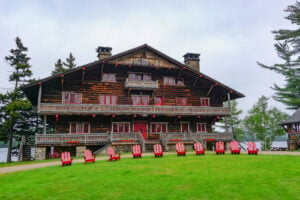
Not every great Adirondack resort disappeared completely. The Antlers at Raquette Lake provides a fascinating surviving link to the same period. Charles Bennett built the property in 1887 as a decentralized hotel, with separate buildings gathered around common dining and social spaces rather than one enormous central structure.
The Antlers changed uses over the decades instead of vanishing. SUNY Cortland has operated the property since 1965, and seven original buildings remain part of its outdoor and environmental education facilities. Today, the historic property can accommodate about 45 people and operates seasonally. Its survival makes it an especially interesting companion to the historic Great Camps of the Adirondacks and to the vanished hotels that once shared the same mountain landscape.
The great resort era of the Catskills and Adirondacks did not disappear all at once. Some hotels burned. Others were demolished, abandoned, converted, or simply became too expensive to operate. What disappeared with them was an entire style of vacationing in New York: long summer stays, enormous dining rooms, live orchestras, nightclubs, porches filled with guests, and mountain hotels that functioned almost like small cities. For those of us who were in Sullivan County while some of the last great resorts were still operating, that history does not feel quite as distant as the ruins might suggest.
For more stories about places that disappeared from the New York landscape, see our look at 10 Submerged and Vanished Communities of Upstate New York. You can also explore 15 Historic Great Camps of the Adirondacks and Their Remarkable Architecture