Feature Photo: Xackery Irving/Shutterstock.com
In the final decades of the 19th century, two neighboring Astor mansions occupied the west side of Fifth Avenue between 33rd and 34th Streets. At the northern end, near 34th Street, lived William Backhouse Astor Jr. and his formidable wife, Caroline Webster Schermerhorn Astor—known throughout Gilded Age society simply as Mrs. Astor. Next door, closer to 33rd Street, stood the home of William’s older brother, John Jacob Astor III, whose only son was William Waldorf Astor.
To the outside world, the Astor dynasty represented the summit of old New York wealth, its fortune rooted in the fur trade and the extraordinary Manhattan real estate holdings accumulated by John Jacob Astor. Inside the family, however, the two branches were divided by money, status, personality, and a celebrated argument over who had the right to be recognized as “Mrs. Astor.”
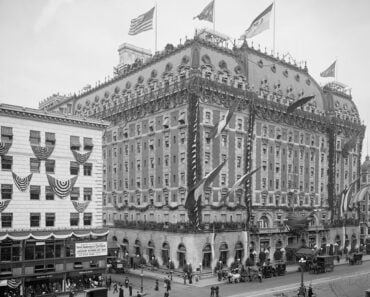
The feud has accumulated plenty of legend over the years, but one fact is beyond dispute: William Waldorf Astor demolished his family’s Fifth Avenue mansion and replaced it with the Waldorf Hotel. His cousin John Jacob Astor IV later replaced Caroline Astor’s neighboring mansion with the Astoria Hotel. Joined together in 1897, the rival buildings became the original Waldorf-Astoria, one of the most famous hotels in New York history.
The Battle Over “Mrs. Astor”
In Gilded Age New York, social rank was governed by a complicated system of introductions, visiting cards, dinners, balls, and family pedigree. At the summit of that world stood Caroline Astor. Working closely with social arbiter Ward McAllister, she helped define the circle that became known as New York’s “Four Hundred.” McAllister’s famous number was a description of fashionable society, not simply the literal capacity of Caroline’s ballroom.
After John Jacob Astor III died in 1890, his son William Waldorf Astor became the senior male representative of his branch of the family. William’s wife, Mary Dahlgren Paul Astor, now had a stronger claim within the family hierarchy, and contemporary accounts turned the resulting dispute into what newspapers and later writers called a battle over the title “Mrs. Astor.”
Caroline had long been New York society’s dominant Mrs. Astor. William Waldorf believed that his wife deserved the distinction as the wife of the senior male heir. Visiting cards, invitations, newspaper references, and even the delivery of mail became part of the story. Whatever weight one gives the most colorful versions of the “Battle of the Cards,” there is no question that the two branches of the Astor family were bitter rivals.
William Waldorf Astor Leaves New York
William Waldorf Astor had pursued politics before turning increasingly toward real estate and life abroad. He served in the New York State Legislature, lost a race for Congress, and later served as United States minister to Italy from 1882 to 1885. In 1890, the year his father died, Astor moved to England.
His departure did not mean he was finished with New York real estate. The family property at Fifth Avenue and 33rd Street was extraordinarily valuable, and William decided to replace his father’s mansion with a commercial hotel. Stories that he first considered building a stable to antagonize his aunt became part of Astor family lore, but the hotel itself was far more consequential than any stable could have been.
William retained architect Henry Janeway Hardenbergh to design an enormous German Renaissance-style hotel on the site. The completed Waldorf rose 13 stories and approximately 225 feet above Fifth Avenue, with 450 guest rooms and lavish public spaces. William named it the Waldorf after Walldorf, Germany, the ancestral home of the Astor family.
The transformation could hardly have been more dramatic. Caroline Astor had been living beside another private Astor residence. She suddenly found herself next to one of the most imposing new hotels in the city. The construction and the arrival of a large commercial building in what had been an elite residential stretch of Fifth Avenue only deepened the tension between the two branches of the family.
The Waldorf Opens on Fifth Avenue
The Waldorf opened for business on March 13, 1893. The following evening, the hotel hosted a major benefit concert for St. Mary’s Free Hospital for Children featuring the New York Symphony Orchestra under Walter Damrosch. The event attracted members of prominent families from New York and other major American cities and immediately helped establish the new hotel as a legitimate gathering place for high society.
William Waldorf Astor placed the hotel under the management of George C. Boldt, who had already established a reputation for luxury hospitality in Philadelphia. Boldt understood that a grand hotel could be much more than temporary lodging. The Waldorf offered elaborate dining rooms, drawing rooms, modern plumbing, electric lighting, telephone service, attentive staff, and spaces designed specifically for dinners, receptions, concerts, and society events.
One of the people who became inseparable from the hotel’s identity was Swiss-born maître d’hôtel Oscar Tschirky, forever remembered as “Oscar of the Waldorf.” Tschirky had worked at several prominent New York establishments before joining the Waldorf and became one of the best-known hospitality figures of the Gilded Age.
At first, some New Yorkers doubted that an extravagant hotel so far uptown could succeed. Instead, the Waldorf became a center of public society. Wealthy New Yorkers who had once entertained primarily inside private mansions increasingly used the hotel’s dining rooms and ballrooms, helping move elite social life into more public spaces.
Caroline Astor Moves Uptown
The success of the Waldorf coincided with another major change along Fifth Avenue. Wealthy families were steadily moving farther north, particularly toward Central Park. Caroline Astor joined that migration.
Architect Richard Morris Hunt designed a monumental double residence for Caroline and her son John Jacob Astor IV at Fifth Avenue and 65th Street. Constructed between 1891 and 1895, the French Renaissance-inspired mansion gave the family an even grander setting for society events while removing Caroline from the commercial activity that had overtaken her old corner at 34th Street.
The move left the former Astor property at Fifth Avenue and 34th Street available for a second enormous hotel. John Jacob Astor IV decided that his family would answer the Waldorf with a hotel of its own.
John Jacob Astor IV Builds the Astoria
In 1895, John Jacob Astor IV began construction of the Astoria Hotel on the site of his mother’s former mansion. He hired the same architect his cousin had used, Henry Janeway Hardenbergh. The Astoria rose higher than the Waldorf and was completed as a 17-story addition to the already extraordinary hotel complex.
The choice was a remarkable example of both rivalry and business sense. Rather than surrender the corner to his cousin’s successful Waldorf, John Jacob Astor IV placed another luxury hotel immediately beside it. The Astoria opened in November 1897.
Despite the strained relationship between the two family branches, the buildings were designed to function together under George Boldt’s management. The arrangement even acknowledged the possibility that relations might deteriorate again: the two structures remained physically distinct enough that they could be sealed off from one another if necessary.
Peacock Alley Joins the Two Hotels
The architectural symbol of the union was Peacock Alley, the approximately 300-foot corridor connecting the Waldorf and the Astoria. The passage became one of the most famous interior spaces in New York. Guests and visitors promenaded through the corridor to see and be seen, and the display of fashionable clothing and jewelry gave the passage its enduring nickname.
After the Astoria opened, the two hotels became known together as the Waldorf-Astoria. The combined complex contained about 1,300 guest rooms and 40 public rooms, making it the largest hotel in New York City and, by contemporary accounts, the largest hotel in the world.
The importance of the Waldorf-Astoria went well beyond size. It helped redefine the luxury hotel as a social institution. Dinners, charity events, receptions, balls, political gatherings, celebrity appearances, and elaborate public entertaining all became part of the life of the building. The Astor family had made its social reputation in private mansions; the Waldorf-Astoria helped move that world into a public hotel.
The Astor Rivalry Becomes a New York Institution
The irony was impossible to miss. A rivalry between two branches of one of America’s richest families had produced two competing hotels that proved more valuable together than apart. William Waldorf Astor remained in England, where he became a British citizen in 1899 and was elevated to the peerage as Baron Astor in 1916 and Viscount Astor in 1917. His wife Mary had died in 1894, only a year after the Waldorf opened.
Caroline Astor continued to preside over society from her mansion at Fifth Avenue and 65th Street until her death in 1908. John Jacob Astor IV remained one of the country’s best-known millionaires and later built the St. Regis Hotel. He died in the sinking of the RMS Titanic in April 1912.
George Boldt continued running the Waldorf-Astoria until his death in 1916. Two years later, the hotel passed out of direct Astor family control, but its name and reputation had already become part of New York mythology.
The End of the Original Waldorf-Astoria
By the 1920s, the center of fashionable New York had moved farther uptown, while newer hotels offered more modern accommodations. The old Waldorf-Astoria still carried enormous symbolic value, but the Fifth Avenue land beneath it had become even more valuable.
In late 1928, the property was sold for redevelopment in a transaction widely reported at around $20 million. The hotel closed in 1929. Demolition of the old complex began on October 1, 1929, clearing one of the most valuable building sites in Manhattan. Some of the granite, bronze, and other demolition material was ultimately dumped into the Atlantic near Sandy Hook, New Jersey.
The building that rose on the former Waldorf-Astoria site was the Empire State Building. Within only a few years, one New York landmark had been replaced by another.
The Waldorf-Astoria Lives On
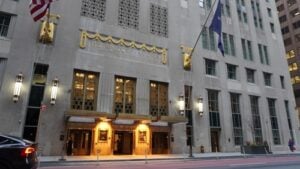
The end of the Fifth Avenue hotel did not end the Waldorf-Astoria name. A new Waldorf-Astoria opened on Park Avenue in 1931, carrying the identity of the original hotel into the Art Deco era.
The first Waldorf-Astoria remains one of the great stories of Gilded Age New York because its origins were so personal. Family rivalry, social ambition, changing real estate values, and the genius of George Boldt all collided on a single block of Fifth Avenue. What began with two neighboring Astor mansions ended with a hotel that changed the way New York’s elite entertained, dined, and displayed itself to the city.
For more on the New York that surrounded the original Waldorf-Astoria, read our History of New York’s Spite Houses and Tiny Homes, explore 10 Lost Grand Hotels in New York City and What Stands There Today, and see the History of the Empire State Building.
Sources
- New York Public Library — Waldorf-Astoria Hotel Records, 1893–1929
- New York City Landmarks Preservation Commission — Waldorf-Astoria Hotel Designation Report
- New York City Landmarks Preservation Commission — Hotel Architecture and the Original Waldorf-Astoria
- Museum of the City of New York — The Original Waldorf-Astoria Hotel
- Museum of the City of New York — Mrs. Astor’s Fifth Avenue Mansion
- Smithsonian Magazine — Oscar Tschirky and the Waldorf
- Library of Congress — Peacock Alley at the Original Waldorf-Astoria
- Library of Congress — Demolition of the Original Waldorf-Astoria, 1929
Published September 12, 2026.