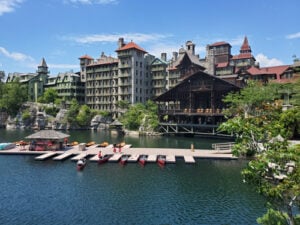
Mohonk Mountain House in New Paltz, New York, has been welcoming guests since 1869. Photo: Dariusz Gryczka / Shutterstock.com
One of the great pleasures of traveling through Upstate New York is discovering how much of its history can still be experienced firsthand. You can spend the night in a tavern that dates back to the American Revolution, sit on the porch of a grand Adirondack resort, or sleep in a castle overlooking one of the Finger Lakes. In some of these places, the hotel itself is as much of an attraction as anything you might visit during your vacation.
Before the interstate highways and national motel chains changed the way Americans traveled, hotels grew up around railroad stations, mineral springs, lakes and village crossroads. Wealthy families built summer retreats in the Adirondacks, while communities such as Syracuse, Utica and Glens Falls invested in elaborate downtown hotels that became important gathering places for local residents.
Many of those establishments disappeared, as we explored in our article on the vanished resorts and hotels of the Catskills and Adirondacks. Fortunately, others survived through restoration, rebuilding or conversion to new uses. The following 25 historic hotels and inns still offer overnight accommodations. Some operate seasonally, so check with the property before planning a trip. The list is not ranked by age or quality.
1. Beekman Arms and Delamater Inn – Rhinebeck
The Beekman Arms traces its history to a tavern established by William Traphagen in 1704. The present inn dates to 1766, making it one of the oldest surviving inns in the United States. During the Revolution, it was known as Bogardus Tavern. The Fourth Regiment of the Continental Army drilled on its grounds in 1775, and the inn’s history records visits by George Washington and other figures of the Revolutionary era.
Long after independence, the hotel continued to play a part in New York politics. Franklin D. Roosevelt, whose family home was in nearby Hyde Park, used its porch for campaign appearances. The accommodations now extend beyond the original tavern to the Delamater Inn and other buildings, but visitors can still dine and stay at the historic crossroads of Rhinebeck. Hotel website and history.
2. The Otesaga Resort Hotel – Cooperstown
Brothers Edward Severin Clark and Stephen Carlton Clark developed The Otesaga as a grand summer hotel on Otsego Lake. It opened on July 12, 1909, with a monumental entrance supported by tall columns and a broad porch overlooking the water. The Clark family’s fortune was tied to the Singer sewing machine business, and their investments helped shape Cooperstown long before the village became synonymous with baseball.
During the 20th century, the Knox School for girls used the hotel during the colder months. Today, the seasonal resort remains a wonderful example of the grand lakeside hotels that once attracted vacationers to Upstate New York. The hotel’s history also includes the development of the Leatherstocking Golf Course, named in honor of the literary works of James Fenimore Cooper.
3. The Sagamore Resort – Bolton Landing
In 1883, The Sagamore opened on Green Island in Lake George, where visitors could enjoy the Adirondacks without giving up the comforts of a fashionable hotel. The original resort suffered serious fires in 1893 and 1914. Subsequent rebuilding created the hotel that stands on the island today, with its white exterior and expansive lake views.
The resort hosted the National Governors’ Conference in 1954, but declining business eventually led to its closure in 1981. Developer Norman Wolgin acquired the property in 1983 and launched a restoration that brought the resort back to life. The hotel’s survival is particularly remarkable given how many of its contemporaries around Lake George disappeared. Hotel history.
4. Mohonk Mountain House – New Paltz
In 1869, Quaker educator Albert K. Smiley purchased a small inn and land surrounding Lake Mohonk in the Shawangunk Mountains. The original ten-room establishment gradually grew into the enormous resort known as Mohonk Mountain House. Its distinctive mixture of stone buildings, wooden balconies and towers reflects decades of expansion rather than a single construction project.
Mohonk became known for more than vacationing. Beginning in 1895, Albert Smiley organized conferences on international arbitration that brought together people interested in peaceful solutions to international disputes. The Smiley family still operates the resort, where guests can explore trails, gardens and the mountain landscape that inspired its creation. Hotel website and history.
5. Hotel Saranac – Saranac Lake
When Hotel Saranac opened in 1927, it offered a different type of Adirondack lodging from the lakeside camps and summer resorts. Built in the center of the village, the hotel served business travelers and vacationers in an urban-style setting. Its architect, William H. Scopes, incorporated a particularly elaborate upstairs gathering space inspired by a Renaissance palace in Florence.
Paul Smith’s College acquired the hotel in 1962 and used it to train students in hospitality management. After changing ownership and falling into decline, the property underwent a lengthy renovation and reopened in 2018 as part of Hilton’s Curio Collection. Its prominent Main Street presence and restored Great Hall make it an important part of Saranac Lake’s architectural heritage. Hotel website; historical timeline.
6. DoubleTree by Hilton Utica – Utica
The former Hotel Utica opened in 1912, when Utica was a prosperous manufacturing and commercial center. Designed by the architectural firm Esenwein & Johnson, the Renaissance Revival hotel featured an imposing lobby with an upper-level balcony. Its guests included Franklin D. Roosevelt, Amelia Earhart and Judy Garland, who, according to Utica University, once sang to people gathered in the lobby from that balcony.
The hotel closed in 1972 and remained out of operation for almost three decades before a restoration allowed it to reopen in 2001. Additional renovation eventually brought the building into the DoubleTree by Hilton chain. Travelers can still experience one of the landmarks of downtown Utica rather than staying in an entirely modern hotel outside the city. Hotel website; Utica University history.
7. Marriott Syracuse Downtown – Syracuse
Hotel Syracuse opened in August 1924 as a project backed by local investors. Designed by George B. Post & Sons, it was an enormous undertaking for the city, with hundreds of rooms, elegant public spaces and a pair of celebrated event rooms, the Grand Ballroom and Persian Terrace. Generations of Syracuse residents attended weddings and celebrations there.
After the hotel closed in 2004, its future remained uncertain until developer Ed Riley acquired the property and undertook a $75 million restoration. In 2016, the building reopened as Marriott Syracuse Downtown. Among the treasures visitors can see is a restored mural by artist Carl Roters depicting episodes from Syracuse history. Hotel website; historical timeline.
8. The Gideon Putnam – Saratoga Springs
Named after the entrepreneur who helped establish Saratoga Springs as a resort destination in the early 19th century, The Gideon Putnam opened in 1935. The hotel was part of a major public investment in the mineral springs and bathhouses that had made Saratoga famous. Its Georgian-inspired brick design complemented the other buildings constructed in what is now Saratoga Spa State Park.
The hotel originally accommodated visitors undergoing extended spa treatments. Today, overnight guests can enjoy the park’s walking paths, visit the nearby Roosevelt Baths & Spa or attend performances at the Saratoga Performing Arts Center. The hotel operates on a seasonal schedule, and its history is inseparable from New York’s efforts to preserve Saratoga’s mineral springs. Hotel website and history.
9. The Inn at Saratoga – Saratoga Springs
Built in 1843 as a boarding house, The Inn at Saratoga is identified by its operators as the city’s oldest continuously operating lodging establishment. Its earliest guests included people who traveled to Saratoga seeking relief from illnesses. During the 1860s, the building was enlarged and its street-facing exterior received a Gothic Victorian makeover.
The inn operated under several names over the years, including the Everett House, Hotel Brenner and Coachman Motor Inn. In the 1920s, Rabbi Brenner ran it as a Jewish hotel. The intimate scale of the property distinguishes it from the enormous Saratoga hotels that once lined Broadway, most of which are long gone. It remains a convenient place to stay when visiting the historic Saratoga Race Course. Hotel website and history.
10. Hotel at the Lafayette – Buffalo
One of Buffalo’s most important historic hotels opened in June 1904. The Hotel Lafayette was designed principally by Louise Blanchard Bethune, a pioneering American woman architect and the first woman admitted to the American Institute of Architects. Its French Renaissance-style exterior, constructed of red brick and light-colored terra cotta, remains a striking feature of Lafayette Square.
The hotel underwent changes in the 20th century, including the introduction of Art Deco decorative elements during renovations in the late 1940s. A major rehabilitation completed in 2012 returned the building to prominence. Now operating as Hotel at the Lafayette, the property preserves an important part of Buffalo’s architectural legacy. Hotel website and history.
11. The Queensbury Hotel – Glens Falls
The Queensbury Hotel grew out of a campaign by local business leaders who wanted Glens Falls to have a modern hotel and a place for community gatherings. Construction began in 1924, and the hotel opened on May 7, 1926. Its downtown location made it a useful stop for visitors traveling between the Capital Region and the Adirondacks.
Big band leaders Benny Goodman and Guy Lombardo performed in the hotel’s ballroom, and Robert F. Kennedy visited following his election to the United States Senate in 1964. Local businessman Ed Moore purchased the hotel in 2016, beginning another period of renovation and investment. The Queensbury remains a center of civic and social life a century after its opening. Hotel website and history.
12. Rogues Harbor Inn – Lansing
Dating to 1830, the Rogues Harbor Inn began as the Central Exchange Hotel, a stagecoach stop serving travelers moving through the region north of Ithaca. General Daniel Minier commissioned the substantial brick building, which contained numerous fireplaces and a grand ballroom. Long before automobiles became common, the inn offered food, lodging and a place to rest horses.
Later known as the Elm Grove Hotel, the property acquired its memorable nickname through its colorful reputation. Author Grace Miller White used the name for her novel Judy of Rogue’s Harbor, published in 1918. Today, the building welcomes overnight guests as a bed-and-breakfast near Cayuga Lake, offering a glimpse of the days when stagecoach routes shaped the region’s travel patterns. Inn website and history.
13. The Morgan State House – Albany
Not all historic hotels were originally built to accommodate travelers. The Morgan State House occupies a mansion constructed in 1884 near Washington Park in Albany. Its residential architecture reflects a period when prominent families built elegant homes in the expanding neighborhoods of New York’s capital city.
The mansion was subsequently restored and adapted into a small urban inn. Its parlor, decorative architectural details and garden offer a very different experience from the large convention hotels of downtown Albany. For visitors exploring the Capitol or the city’s historic residential districts, the property is an example of how a former private home can find a new purpose without losing its historic character. Inn website and history.
14. Best Western Syracuse Downtown Hotel and Suites – Syracuse
The name Best Western might not immediately suggest a historic hotel, but this downtown Syracuse property dates to 1927. Known for many years as the Jefferson Clinton Hotel, the building was designed by local architect Gustavus Young. It was one of numerous hotels serving the railroads and businesses of the surrounding Armory Square district.
The eleven-story building outlasted many of its neighboring hotels as the railroad-centered economy changed. Its unusual shape and prominent position at South Clinton and West Jefferson streets are reminders of that earlier era. The property continues to provide accommodations under the Best Western name, including suites with kitchen facilities. Hotel website; Armory Square history.
15. The Adelphi Hotel – Saratoga Springs
In 1877, William McCaffery opened an expanded Adelphi Hotel on Broadway. Saratoga Springs was then one of the country’s fashionable summer destinations, known for its mineral waters, gambling establishments and horse racing. The Adelphi became a gathering place for visitors drawn to the city’s lively social and political scene.
While much larger hotels such as the Grand Union and United States Hotel were demolished in the mid-20th century, the Adelphi survived. It stood empty for several years before new owners acquired it in 1978. Another extensive restoration in the 21st century transformed the property into a modern luxury hotel while retaining its historic identity. Hotel website and history.
16. Bear Mountain Inn – Bear Mountain
Opened in 1915, the Bear Mountain Inn was built as part of the development of Bear Mountain State Park. Park workers used locally obtained stone and chestnut timber to create its distinctive rustic architecture. Early visitors could arrive by Hudson River excursion boat, with an escalator helping transport people from the landing toward the inn.
The building closed in 2005 for extensive restoration and subsequently reopened with overnight accommodations. Its massive fireplaces and exposed woodwork are reminders of an era when public parks were designed to provide city residents with opportunities to experience the outdoors. The inn stands near Hessian Lake, with access to the surrounding park’s trails and attractions. Inn website and history.
17. The Roycroft Inn – East Aurora
The Roycroft Inn opened in 1905 to accommodate visitors to the Roycroft community established by Elbert Hubbard. The campus attracted artists, writers, printers and craftspeople who helped make East Aurora an important center of the American Arts and Crafts movement. Furniture, books, metalwork and decorative objects produced there emphasized the value of skilled craftsmanship.
The inn was later included in the Roycroft Campus National Historic Landmark designation. An $8 million restoration culminated in its reopening in 1995. Guests can still admire restored murals by artist Alexis Jean Fournier and furnishings associated with the Roycroft tradition. Few hotels in New York offer such a close connection to a significant American artistic movement. Inn website; Roycroft Campus history.
18. The Thayer Hotel – West Point
The United States Military Academy had accommodated visitors in an older hotel for much of the 19th century. By the early 20th century, that building could no longer meet the needs of the academy. The Thayer Hotel opened in June 1926, providing a new place for visiting military officials, cadet families and other travelers to stay.
Named for Sylvanus Thayer, the academy’s influential former superintendent, the hotel occupies a prominent site overlooking the Hudson River. Its imposing architecture fits naturally into the historic military landscape. A stay here offers an opportunity to explore the region, although visitors should check current academy access and identification requirements before arriving. Hotel website and history; West Point archives.
19. The Point – Upper Saranac Lake
The Point was built in the early 1930s as Camp Wonundra, a private Adirondack retreat for William Avery Rockefeller II. Designed by architect William G. Distin, the property represents the later years of the Great Camp tradition, when wealthy families created elaborate woodland compounds using timber, stone and other materials that harmonized with their natural surroundings.
Unlike a conventional hotel, The Point was conceived as a family estate rather than a public lodging establishment. It now operates as an intimate luxury resort with eleven guest rooms spread across several original camp buildings. The opportunity to stay in a former Rockefeller retreat makes this one of the more unusual historic properties in the Adirondacks. Resort website; Adirondack Architectural Heritage.
20. Mirror Lake Inn – Lake Placid
The history of the Mirror Lake Inn dates to 1924. The property became closely associated with the development of winter sports in Lake Placid, introducing a powered ski rope tow and providing training facilities for skaters. Its guests included future skating champions, and singer Kate Smith had a cottage built for her at the resort in the 1950s.
In January 1988, a devastating fire destroyed the main inn. The owners rebuilt it that same year, continuing the lodging tradition that had been established decades earlier. Although the main building is a reconstruction, the resort’s history and its connection to Lake Placid’s winter sports heritage remain very much alive. Inn website and history.
21. Belhurst Castle – Geneva
Standing near the western shore of Seneca Lake, Belhurst Castle was constructed as a private residence in the late 19th century. Its towers and stone exterior create the appearance of a European castle in the Finger Lakes. The building later became an entertainment and dining establishment, acquiring a reputation for gambling and illicit liquor during the Prohibition era.
After Robert and Nancy Golden purchased the property in 1975, portions of the castle were eventually converted into guest rooms. Further development added lodging facilities and a winery. Visitors seeking the most direct connection with the building’s history can choose accommodations within the original castle rather than one of the newer lodging wings. Castle website and history.
22. Geneva On The Lake – Geneva
Completed in 1914 as the private residence of Byron Nester, this villa overlooking Seneca Lake was designed by Lewis Colt Albro and Harrie T. Lindeberg. Its inspiration was Villa Lancellotti in Frascati, Italy. Classical columns, formal gardens and finely detailed interiors distinguish the property from the more rustic resorts found in other parts of Upstate New York.
Capuchin Franciscan friars acquired the estate in 1949 and used it as a monastery until 1974. After several years of vacancy, a restoration by the Schickel brothers transformed the property into a resort that opened on Thanksgiving Day in 1981. Its gardens and lakefront setting remain among the most distinctive features of the historic hotel. Hotel website and history.
23. The American Hotel – Sharon Springs
Built around 1840, the American Hotel recalls the years when visitors traveled to Sharon Springs for its mineral waters. The hotel later became a religious retreat used by Jewish congregations, reflecting another chapter in the village’s remarkable history. Eventually the building was abandoned for almost three decades.
Doug Plummer and Garth Roberts bought the deteriorating property in 1996 and spent five years restoring it. The hotel reopened in May 2001. New owners took over in 2025, and the American Hotel once again offers overnight accommodations and restaurant service on Main Street. The building is an especially compelling example of the revival of a historic Upstate New York inn. Hotel history; current lodging information.
24. The Red Coach Inn – Niagara Falls
When the Red Coach Inn opened on August 30, 1923, Niagara Falls was already famous as a destination for honeymooners. Owners William Schoellkopf and Charles Peabody drew inspiration from the Bell Inn in Finedon, England, creating a Tudor-style building overlooking the Upper Rapids of the Niagara River.
The inn’s name recalls the red carriage associated with the Marquis de Lafayette, depicted in a painting by Buffalo artist A. Rafael Beck in the dining area. Unlike the towering modern hotels that dominate portions of Niagara Falls, the Red Coach Inn preserves the more intimate scale of early 20th-century tourist lodging. Inn website and history.
25. Glen Iris Inn – Letchworth State Park
One of the most extraordinary settings for a historic inn in New York is the former estate of William Pryor Letchworth. A successful Buffalo businessman, Letchworth acquired land overlooking the Genesee River gorge and developed a country retreat known as Glen Iris. His gift of the estate and surrounding property to New York State in 1906 helped establish Letchworth State Park.
In 1914, the former residence began a new life as a country inn. Its location above Middle Falls offers visitors the chance to stay within the landscape that Letchworth worked to preserve. The historic inn generally closes during the colder months and accepts reservations for its operating season. Inn history; current lodging information.
If you enjoyed our look at the historic hotels of Upstate New York, be sure to check out our articles on 10 Lost Catskills & Adirondacks Hotels and Resorts, 15 Historic Great Camps of the Adirondacks and Their Remarkable Architecture, 25 Historic Hudson Valley Estates and Mansions With Remarkable Stories, 12 Most Charming Main Streets in Upstate New York That Feel Like a Movie Set, 25 Upstate New York Roadside Attractions Worth Pulling Over For, and The Beauty and History of Lake George.