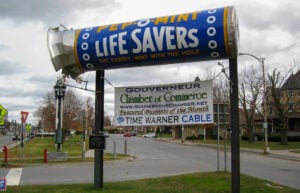
The giant Pep-O-Mint Life Savers candy roll monument in Gouverneur, St. Lawrence County, New York. Photo by Doug Kerr / Wikimedia Commons, CC BY-SA 2.0.
A road trip through Upstate New York has a way of producing unexpected discoveries. You might be driving along a quiet stretch of Route 20 when a towering roadside tepee appears above the highway. In another town, an enormous candy roll stands in a village park. Outside a mill in the Finger Lakes, a metal griddle large enough to cook a pancake for thousands of people hangs on the wall. These places are part of New York’s history, but they rarely receive the attention given to the state’s famous waterfalls, mountains, and museums.
Some attractions began as clever advertisements for businesses. Others were created by artists, built as memorials, or grew from the determination of one local resident to do something out of the ordinary. A few survive from the heyday of family automobile travel, when a colorful sign or peculiar building could persuade a carload of vacationers to pull over. Others are much newer, but they belong to the same tradition of making a place memorable.
The attractions on this list stretch from Western New York and the Southern Tier to the Hudson Valley, the Adirondacks, the Mohawk Valley, and the North Country. Not all 25 are simply sculptures beside a road. Some are small museums or unusual indoor experiences worth building a detour around. I’ve identified the locations and explained when a stop involves admission, seasonal hours, a short walk, or a business’s property. A photograph taken from a public road is quite different from permission to walk through someone’s yard.
Most important, these are places readers can realistically look for today. Older accounts of Upstate roadside oddities sometimes include attractions that have been removed or closed. The Volkswagen that once sat on a smokestack in Amsterdam, for example, was reported gone in August 2026, and the Boiling Pot area in Canajoharie was closed to public access in 2026. Neither should be presented as a currently open roadside stop. Here are 25 other places that make an Upstate New York drive more interesting.
1. The World’s Largest Pancake Griddle — Penn Yan, Yates County
At the Birkett Mills building in downtown Penn Yan, an enormous round metal griddle is mounted where passing motorists can see it. It measures 28 feet, 1 inch across and was made for the village’s Buckwheat Harvest Festival on September 27, 1987. That day, the mill and the community used the equipment to cook a record-setting buckwheat pancake. The event required machinery on a scale usually associated with construction rather than breakfast, including a cement mixer for the batter and a crane to help handle the gigantic pancake.
The pancake-size record was eventually surpassed, but the griddle survived as a reminder of the festival and of Penn Yan’s long connection to buckwheat milling. Birkett Mills still identifies it as a popular local photo opportunity. Where to see it: On the exterior of Birkett Mills, 1 East Main Street, at the Main and Seneca streets intersection. It is an outdoor photo stop; the operating mill does not offer regular public tours.
2. Nipper the RCA Dog — Albany
High above Broadway in Albany, a giant white dog with black ears sits on the roof of an old warehouse. It is Nipper, the animal associated with the famous His Master’s Voice trademark used by RCA. The enormous statue was installed in 1958, when the building at 991 Broadway housed an RCA appliance distributor. Made in sections and assembled atop the structure, the dog stands roughly 28 feet high and weighs about four tons. What began as a promotion has become one of Albany’s most recognizable landmarks.
There is also a preservation story here. By 2026 the long-vacant warehouse beneath Nipper had deteriorated, and local preservation advocates were seeking stronger protection for the statue. Nipper remained on his rooftop perch as those discussions continued. Where to see it: Look upward from the public streets around 991 Broadway in Albany’s Warehouse District. This is an exterior view only; do not enter the vacant building or adjoining restricted areas.
3. Gnome Chomsky — Kerhonkson, Ulster County
Drive along Route 209 near Kerhonkson and you may spot a cheerful garden gnome that is much too large for any ordinary backyard. Gnome Chomsky, the giant figure at Kelder’s Farm, was created through an art project associated with Maria Reidelbach and her collaborators. The statue was installed in 2006 and once held a record for its size. Other gnomes have since surpassed it, but the change in rankings has done little to reduce its charm as an Upstate roadside landmark.
The gnome is also a reminder that roadside art can support a working agricultural business. Kelder’s Farm offers seasonal activities and farm experiences, and the giant figure has become a recognizable symbol of the property. Where to see it: Kelder’s Farm, 5755 U.S. Route 209, Kerhonkson. It is visible from the roadside, while visiting farm attractions and grounds may involve seasonal admission. Check the farm’s current schedule before making a dedicated trip.
4. Shark Girl — Buffalo
Buffalo’s waterfront has an unusual resident: a seated figure with the body of a young girl and the head of a shark. Artist Casey Riordan created Shark Girl in 2013, giving the character a look that is both funny and a little melancholy. The sculpture became part of the Buffalo AKG Art Museum’s public-art initiative and a popular photographic subject at Canalside. Visitors often pose beside Shark Girl, whose ordinary posture makes the extraordinary head seem even stranger.
The artwork has been removed temporarily for conservation and shifted within the waterfront as nearby construction changed the landscape, so older photographs may show slightly different surroundings. The museum and Buffalo waterfront organizations continue to list Shark Girl at Canalside. Where to see it: The public waterfront around Canalside in downtown Buffalo; consult Buffalo Waterfront’s current visitor information for its precise placement.
5. The Cardiff Giant — The Farmers’ Museum, Cooperstown
The Cardiff Giant is a ten-foot-long gypsum figure that fooled thousands of spectators after it was unearthed on a farm in Cardiff, near Syracuse, in 1869. The apparent petrified man was not a prehistoric discovery. George Hull, who arranged the elaborate deception, had the figure carved and secretly buried before workers supposedly discovered it while digging a well. Newspapers, curious visitors, and people debating religion and science turned the hoax into a national sensation.
The original figure eventually reached Cooperstown, where The Farmers’ Museum has exhibited it since 1947. It is a wonderfully strange artifact of nineteenth-century showmanship and the willingness of audiences to believe an astonishing story. Where to see it: The Farmers’ Museum, Cooperstown. Unlike most outdoor attractions on this list, the giant is a museum exhibit requiring admission and a visit during museum operating hours.
6. The World’s Largest Kaleidoscope — Mount Tremper, Ulster County
Most kaleidoscopes are small enough to hold in one hand. At the Emerson Resort in the Catskills, visitors enter an enormous kaleidoscopic experience housed inside a former farm silo. The attraction opened in the 1990s and received Guinness recognition in 1997. Artist Charles Karadimos designed its huge mirror system, while the original multimedia presentations involved artists Isaac and Raphael Abrams and composer Gary Burke. Looking upward, visitors watch changing patterns of light and color accompanied by sound.
It is one of the few places on this list that turns a roadside curiosity into a complete indoor performance. The presentations have evolved, with different themes and imagery presented over the years. Where to see it: The Shops at Emerson, 5340 Route 28, Mount Tremper. Admission is charged, and shows operate on a posted schedule; check the resort before visiting.
7. The Fork in the Road — Milan, Dutchess County
A large steel fork stands where two roads meet in northern Dutchess County, giving the familiar expression a literal meaning. Artist Stephen Schreiber installed the sculpture in 2000 near the intersection of routes 199 and 308. Standing around 31 feet tall, it is difficult to mistake for a conventional directional sign. The joke is simple enough to understand from a passing car, which may explain why the installation has become a local favorite.
The fork also has the quality of classic roadside art: it does not need a museum label, elaborate interpretation, or a long visit. Its size and setting provide the entire experience. Where to see it: At the Route 199 and Route 308 junction near Milan, between the Rhinebeck and Red Hook areas. Use legal parking and remain clear of moving traffic; the sculpture sits at a roadway intersection, not inside a dedicated visitor attraction.
8. Cross Island Chapel — Oneida Area, Madison County
In a small pond near Oneida stands a white chapel so tiny that it can accommodate only a handful of people. Cross Island Chapel, built in 1989 by Chandler Mason, measures about 28 square feet. Its setting makes it even more unusual: the chapel sits on a little island, and reaching its doorway requires a boat. It became known for very small wedding ceremonies, with a minister and couple making the journey across the water.
This is not a regular church with a large parking lot and posted daily services. It belongs to a private property, and the appeal for many travelers is simply seeing the miniature building from the road. Where to see it: The Mason family pond area near Randall Road in the Oneida-Verona area. View the chapel from a lawful public vantage point; do not assume that the pond, boat, or island is open for unarranged visits.
9. The Tepee — Cherry Valley, Otsego County
Along historic U.S. Route 20, the Tepee is one of the best surviving examples of the kind of striking roadside building designed to catch the attention of passing vacationers. The large tepee-shaped structure has stood for generations near Cherry Valley, where visitors have stopped for gifts, souvenirs, and views across the surrounding countryside. The design belongs to the mid-twentieth-century age when unusual buildings became advertisements in their own right.
Part of its appeal is the sense of traveling an older highway rather than speeding along an interstate. The building is easy to recognize, and the elevated site offers a broad view toward the Mohawk Valley and the distant Adirondack landscape. Where to see it: 7632 U.S. Route 20, Cherry Valley. It operates as a roadside shop, but visitors should verify business hours and seasonal opening before traveling specifically to shop.
10. Mini Route 66 — Speculator, Hamilton County
The Adirondack village of Speculator is a long way from the real Route 66, which makes this miniature tribute all the more unexpected. Retired carpenter John Jacob Van Buiten constructed a group of small buildings inspired by the famous western highway and memories of a honeymoon road trip. Several were later relocated to Speculator, with seven miniature structures arriving in 2016. The collection includes tiny versions of familiar roadside buildings, such as a church, service station, and post office.
The buildings are closer to oversized model structures than a town visitors can enter, but their carefully finished exteriors reward a short walk. They also sit near other community recreation areas, making this an appealing stop for families traveling through the central Adirondacks. Where to see it: The park and ball-field area along Route 30 in Speculator, near the Sacandaga River Community Park and the restored Makomis fire tower. Visitors can view the miniature buildings from the public grounds.
11. Alley Oop Soldier — Rome, Oneida County
One of the strangest military-related statues in Upstate New York stands at the Griffiss International Sculpture Garden in Rome. Known as Alley Oop, the concrete figure resembles a cartoon caveman dressed as an American serviceman. It was made by military personnel during the 1940s at the installation that became Griffiss Air Force Base. Originally larger than the figure seen today, it was moved, neglected, rediscovered, and eventually restored to public view.
The statue’s history is more unusual than the familiar claim that it was a miniature-golf decoration. It was connected with the wartime military base, and an inscription at the garden recounts its recovery. Where to see it: Griffiss International Sculpture Garden, along Hill Road in Rome. Follow the sculpture-garden access and parking directions; a short walk is required to reach the statue.
12. The Giant Life Savers Roll — Gouverneur, St. Lawrence County
A giant package of Pep-O-Mint Life Savers seems an unlikely monument for a North Country village, but Gouverneur has a direct claim to the story. Edward John Noble, who bought and developed the Life Savers candy business after its invention by Clarence Crane, was born in Gouverneur. When the Life Savers manufacturing plant in Port Chester closed, one of the oversized decorative candy rolls from the building eventually made its way north to Noble’s hometown.
The monument was erected in 1987 and remains an eye-catching reminder of how a small town can be connected to a nationally familiar product. The Gouverneur Museum has preserved the detailed story of Noble and the giant candy roll. Where to see it: The village park area in downtown Gouverneur, near the village’s main commercial streets. It is an outdoor roadside photo opportunity.
13. Scary Lucy and Lovely Lucy — Celoron, Chautauqua County
Celoron, the village near Jamestown where Lucille Ball grew up, has not one but two statues honoring the television legend. The first, a bronze sculpture created by Dave Poulin and unveiled in 2009, became an internet sensation because many people thought its face looked nothing like Ball. The nickname Scary Lucy stuck. The work was intended to show Ball during her famous Vitameatavegamin routine from I Love Lucy, but public reaction eventually prompted a new commission.
Artist Carolyn Palmer created a second statue, commonly called Lovely Lucy, which was unveiled in 2016. The village kept the original too, making the two sculptures an attraction together. There is an interesting bit of local history in that decision: the statue that initially embarrassed some residents also brought visitors to the park. Where to see them: Lucille Ball Memorial Park on the shore of Chautauqua Lake in Celoron. Both statues remain in the public park, a short distance apart.
14. Secret Caverns — Howes Cave Area, Schoharie County
Drivers on the roads around Howes Cave have long encountered the eccentric painted advertisements for Secret Caverns. They are a classic example of independent roadside marketing, full of bold colors and strange humor. The signs point travelers toward a cave attraction whose best-known feature is an underground waterfall approximately 100 feet high. Secret Caverns offers a different experience from the more polished museum-style attractions nearby, with a strong sense of old-fashioned roadside tourism.
Visiting is more involved than walking up to a statue. The guided route includes 103 steps down into the cave, a walk through passages and formations, and the same staircase on the return. The operator requires sturdy footwear and warns that the cave is not accessible to wheelchairs or strollers. Where to see it: Secret Caverns near Howes Cave in Schoharie County. Admission is charged; check the official website for tour times before driving there.
15. The Star Trek Original Series Set Tour — Ticonderoga, Essex County
Just a short distance from the historic forts and mountain scenery of Ticonderoga, visitors can step into a meticulous recreation of the starship Enterprise from the original Star Trek television series. Local enthusiast James Cawley spent years rebuilding the sets from original production plans, photographs, and detailed study of the shows. The result includes the bridge and other rooms that recall the look of the Desilu Studios production during the late 1960s.
These are recreations, not the surviving original television sets, which were largely dismantled. The attraction is officially licensed and draws fans who might not otherwise plan a trip to this corner of the Adirondacks. Where to see it: 112 Montcalm Street, downtown Ticonderoga. It is an indoor ticketed tour; confirm dates, times, and special-event schedules before visiting.
16. Painted Pig Rock — Near Speculator, Hamilton County
Along Route 30 in the Adirondacks, a roadside boulder looks remarkably like the head of a pig. Local residents enhanced the resemblance with painted features, creating a small but memorable attraction known as Painted Pig Rock. According to regional tourism accounts, the rock’s shape was revealed during road work in the 1950s, and later painting brought out its pig-like face. Its survival also became a local cause when another road project threatened the site decades later.
Unlike a giant statue or building, this attraction depends on noticing something ordinary and seeing it differently. It captures the quirky personality of the old Adirondack roads, where landmarks did not need a ticket booth to become famous. Where to see it: On Route 30, also called Indian Lake Road, north of Speculator. It is a roadside sight, not a formal parking area. Do not stop on a dangerous shoulder or walk into moving traffic to photograph it.
17. The Vine Elephant — West Winfield Area, Central New York
A large elephant made from woven vines sounds unlikely until you see the photographs of artist Elizabeth Schoomaker’s work near West Winfield. The original sculpture required enormous amounts of wild grapevine and months of construction. It stood in a field on her property and became a favorite subject for motorists and photographers. The fragile materials also made it vulnerable: storms destroyed the original in July 2024, but Schoomaker rebuilt the elephant later that year, and other sculptures have since joined it.
The story is partly about the persistence of an independent artist who was willing to remake an ambitious work after severe damage. It is also a place where visitors must respect the setting. Where to see it: On South Road in the West Winfield area, on private property. The artwork is visible from the road. Do not climb on it, enter the property without permission, or treat the surrounding field as a public sculpture park.
18. The Mushroom House — Perinton, Monroe County
Hidden among trees near Powder Mills Park is a home that looks like a cluster of giant mushrooms. Architect James H. Johnson designed the building for Robert and Marguerite Antell around 1970, using raised concrete pods and stems in a hillside setting. The original inspiration was actually Queen Anne’s lace, not mushrooms, but the popular nickname quickly became part of its identity. Its organic design was so unusual that the Town of Perinton later designated it a local landmark.
Part of the structure’s appeal is the contrast with the ordinary suburban roads around it. Nothing about a routine drive near Pittsford prepares a visitor for concrete pods rising out of a wooded ravine. Where to see it: 142 Park Road in the Town of Perinton, with a Pittsford mailing address. This is a private residence, not a museum. View it only from lawful public areas and respect the occupants’ privacy.
19. The Jell-O Gallery — Le Roy, Genesee County
The village of Le Roy has a deliciously unexpected claim to American food history. Jell-O was developed here in 1897, and the local historical society maintains a gallery devoted to the dessert’s story. Visitors encounter familiar advertising images, packaging, molds, and memorabilia that trace the way an inexpensive gelatin product became a household brand. The collection gives a surprisingly detailed picture of American domestic life and marketing during the twentieth century.
This is more of a museum stop than a roadside statue, but its narrow focus makes it one of the state’s most distinctive small attractions. Where to see it: The Jell-O Gallery at 23 East Main Street in Le Roy. It operates on a seasonal schedule, generally from May into December, with admission charged. Consult the Le Roy Historical Society for current hours.
20. The Original American Kazoo Company — Eden, Erie County
The kazoo may be one of the simplest musical instruments ever sold, but making metal kazoos has its own industrial history. In Eden, the Original American Kazoo Company operates in a factory associated with the early twentieth century and continues using old machinery to manufacture the instruments. The company dates its formal establishment to 1916. A visit offers a glimpse of an industry in which stamping presses and belt-driven machines remain as interesting as the finished product.
The small museum and gift shop display unusual kazoos and explain how they are made. Visitors may also be able to watch production or make a kazoo of their own, depending on the tour offered. Where to see it: 8703 South Main Street, Eden. Because this is a working factory, contact the company before visiting if seeing the manufacturing operation is essential to your trip.
21. Pratt Rock — Prattsville, Greene County
Above the village of Prattsville, the cliff face holds a monument unlike the usual statue in a courthouse square. In the nineteenth century, local businessman and political figure Zadock Pratt commissioned carvings that celebrated family members, personal achievements, and events in his life. Horses, inscriptions, and other images appear across the rock, giving visitors the unusual experience of reading a life story carved into a mountainside.
The site has sometimes been called the Mount Rushmore of the East, although the comparison is more about its ambitious use of stone than its scale. It also includes memorial elements connected to the Civil War. Where to see it: Pratt Rock Park, Prattsville. The town reports that the park is free and open to the public, but reaching the carvings requires a steep climb. Wear suitable shoes and allow more time than you would for an ordinary roadside photograph.
22. The Toilet Gardens — Potsdam, St. Lawrence County
Not every roadside attraction begins as a beautification project. In Potsdam, property owner Hank Robar filled several lots with discarded toilets and urinals arranged as planters, some decorated with artificial flowers. The displays emerged from a dispute with local government over property use and became a years-long argument about zoning, protest, and what qualifies as public art. Their very oddness made them famous well beyond the North Country.
North Country Public Radio has chronicled both the legal controversy and the documentary Potty Town, which explores the story. The installations have appeared at different properties over time, so a reader should not assume every older photograph or address still matches the current displays. Where to look: The public streets around Market Street in Potsdam, where the toilet gardens became especially well known. They are on private lots; view from the sidewalk or other lawful public space without entering the property.
23. The Rod Serling Statue — Binghamton, Broome County
A visitor to Recreation Park in Binghamton can now find a bronze tribute to Rod Serling standing beside a doorway. The sculpture was dedicated in September 2024, honoring the writer and creator of The Twilight Zone close to the neighborhood where he grew up. Serling was born in Syracuse but considered Binghamton his hometown, and the park itself inspired the famous episode “Walking Distance,” in which a man returns to the places of his youth.
The statue is particularly satisfying because its setting matters as much as the sculpture. The park also contains an old carousel and bandstand, recalling the small-town memories that became central to Serling’s storytelling. Where to see it: The southeast section of Recreation Park, near Laurel and Seminary avenues on Binghamton’s West Side. The statue is outdoors in a public park; carousel operation is seasonal and separate from viewing the memorial.
24. The Giant Steampunk Robot — East Durham, Greene County
At Blackthorne Resort in East Durham stands a towering mechanical figure that looks as though it escaped from a science-fiction story. The roughly 17-foot-tall robot was built by steampunk artist Thomas Willeford for the 2014 Steampunk World’s Fair. Its pipes, metal parts, and industrial appearance make it especially striking in a Catskills resort setting. Rather than a conventional statue of a famous person, it celebrates a style of imaginative machinery and do-it-yourself fabrication.
The robot has been described as a permanent presence at the resort, housed in an open-sided structure. That does not make the property a public roadside park, however, and access may depend on resort operations or events. Where to see it: Blackthorne Resort, 348 Sunside Road, East Durham. Contact the resort before making a special trip and follow its directions about whether non-guests may approach the sculpture.
25. The Mystery Spot — Lake George Village, Warren County
There is no enormous sculpture or unusual building at the Mystery Spot in Lake George. Instead, a marked circular platform near the village visitor center has an unusual acoustic effect. Stand on the crossing metal rails at its center, face toward the lake, and speak. Many visitors hear their own words return as a surprisingly strong echo, while a person standing a short distance away may not experience the same effect.
Local tourism organizations describe the phenomenon as part of Lake George’s folklore, although visitors need not believe in anything supernatural to enjoy experimenting with the sound. It is an ideal short stop because the fun comes from trying the experience yourself. Where to see it: Blais Park, beside or behind the Lake George Visitor Center at Beach Road and Canada Street. Look for the compass-style circle and the point where the metal rails cross.
What Makes a Great Upstate New York Roadside Attraction?
Some of the best stops on a long drive are not the ones that appeared in the original itinerary. A giant candy roll can lead to the story of a hometown entrepreneur. A strange sculpture can reveal a local artist’s persistence. A museum devoted to a food product can explain how something invented in a small New York community found its way into kitchens across the country. These attractions are reminders that history does not always announce itself with a formal monument.
Not every destination on this list is free, and not every stop is accessible at every hour. Museums and farm experiences may charge admission, some locations operate seasonally, and a few artworks are on private property. Before planning a long detour, check the relevant operator or local tourism organization, and never park where roadside conditions make stopping unsafe. That small amount of preparation helps preserve the pleasure of discovering the unexpected.
For other ways to explore the state, see our 12 Most Charming Main Streets in Upstate New York and The Beauty and History of Lake George. The roads connecting New York’s small towns have stories of their own, and many begin with a sign or sculpture that makes a driver curious enough to stop.