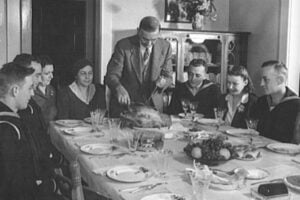
The Fincham family gathers around the table for a traditional Thanksgiving dinner. Photo: Howard R. Hollem / U.S. Office of War Information / Library of Congress / Public Domain.
If we could pull up a chair at a New York Thanksgiving table on Thursday, November 25, 1926, we would immediately recognize the centerpiece of the meal. A roast turkey surrounded by vegetables, gravy and cranberry sauce would not look particularly out of place today. But the dishes served before the turkey arrived and the courses that followed it might surprise us. Oysters, stuffed onions, mince pie, plum pudding and small servings of cheese all belonged to the holiday cooking traditions of the era.
New York was in the middle of the Roaring Twenties. The original Waldorf-Astoria still occupied the Fifth Avenue property where the Empire State Building would eventually rise. Horn & Hardart Automats offered a relatively inexpensive alternative to traditional restaurants, while poultry dealers and neighborhood butchers prepared for one of their busiest seasons.
Of course, there was no single Thanksgiving menu shared by every New Yorker. A family in a Manhattan apartment, a household on a North Country farm and guests at an expensive Midtown hotel could have very different meals. Newspaper advertisements, surviving menus and cookbooks published during the period nevertheless give us a fascinating glimpse into the food that New Yorkers could have enjoyed on Thanksgiving in 1926.
Buying the Thanksgiving Turkey in 1926
Preparing for Thanksgiving began with a trip to the market or neighborhood butcher. Although refrigeration was already important in the commercial food industry, the household freezer and the convenience of buying a frozen Thanksgiving turkey weeks in advance were not yet familiar features of everyday life.
Washington Market in Lower Manhattan was among the great centers of New York’s food trade. Poultry, meat and produce arrived from agricultural communities across the state and from suppliers much farther away. Local butchers brought those goods into neighborhoods where residents could select their holiday provisions close to home.
A surviving advertisement from the November 23, 1926, edition of the Tarrytown Daily News, reproduced by the Town of Greenburgh’s historical research program, offers a particularly revealing glimpse of Thanksgiving shopping in Westchester County. It promoted freshly slaughtered Maryland turkeys, along with roasting chickens advertised at 38 cents and broilers at 44 cents a pound. The advertisement emphasized the quality of the birds, just two days before Thanksgiving.
Turkey was the traditional centerpiece, but it was hardly the only possibility. Chicken, goose and duck also belonged to the cooking traditions of the time. A New York-published Good Housekeeping cookbook from 1927 offered alternative holiday menus centered on roast duck and chicken fricassee. The size of the household, its budget and its own culinary traditions helped determine what went into the oven.
The Relish Dish and the Oyster Course
One of the most noticeable differences between a formal Thanksgiving dinner of the 1920s and many modern holiday meals was the attention paid to small foods served before the main course. Celery, olives, pickles and nuts could be arranged around the table, providing something to nibble on while the rest of the meal was being prepared or served.
Oysters also had a long association with New York dining. They had been harvested from the waters around the city for generations, and oyster dishes appeared regularly in the cookbooks and restaurant menus of the nineteenth and early twentieth centuries. A holiday dinner might open with chilled oysters or a warm oyster soup, depending on the occasion and the household.
By 1926, however, the city’s historic relationship with its oyster beds was approaching a tragic turning point. Pollution had made many of the old harvesting grounds unsuitable for supplying food. The last of the city’s local oyster beds closed in 1927. Oysters remained available through other suppliers, but the days when New York Harbor could furnish enormous quantities of them were coming to an end.
For New Yorkers who enjoyed oysters at Thanksgiving, the dish represented a culinary tradition considerably older than the skyscrapers that were transforming Manhattan’s skyline.
Chestnut Stuffing, Oyster Dressing and Cranberry Sauce
The cookbooks of the era reveal just how much variety was possible when stuffing a Thanksgiving turkey. Chestnuts were one popular choice, lending a subtle sweetness to a savory bread-based dressing. Oyster dressing offered an entirely different flavor, bringing seafood into the very center of the holiday meal.
In The Art of Cooking and Serving, published in 1926, author Sarah Field Splint recommended chestnut stuffing with roast turkey. An earlier cookbook published in New York in 1917, A Thousand Ways to Please a Husband, featured oyster dressing as part of its Thanksgiving dinner. Both preparations were well established by the time New Yorkers sat down to eat in 1926.
Giblet gravy and cranberry sauce were other familiar accompaniments. Cooks could boil cranberries with sugar and prepare a sauce or strain and chill the fruit to produce a firm jelly. Commercial cranberry sauce was already available: Massachusetts cranberry grower Marcus Urann had begun canning it in 1912. The choice between homemade cranberry sauce and a prepared product was therefore beginning to emerge well before the middle of the twentieth century.
The Forgotten Vegetable Dishes
Mashed potatoes would have been a familiar sight in 1926, but the vegetables sharing space with them could make the table look rather different from a modern Thanksgiving spread. Onions prepared in cream sauces, stuffed baked onions, winter squash and turnips all appeared in cookbooks of the period. A 1927 cookbook published by the Good Housekeeping Institute in New York also suggested Brussels sprouts and cauliflower served with hollandaise sauce.
One dish that definitely would not have appeared in its familiar modern form was Campbell’s green bean casserole. That recipe was developed by Dorcas Reilly in 1955, nearly three decades later. Sweet potatoes topped with marshmallows, on the other hand, were already possible. A promotional cookbook issued in 1917 had introduced readers to a baked sweet potato preparation with a marshmallow topping.
A salad might also accompany the heavier dishes. One particularly appropriate choice was Waldorf salad, which originated at New York’s Waldorf Hotel in the 1890s. Oscar Tschirky’s 1896 cookbook included a version made from apples, celery and mayonnaise. Walnuts became associated with later versions of the dish. It was one of the many creations of New York’s hotel dining culture that found a place in American home cooking.
Pumpkin Pie, Mince Pie and Plum Pudding
Pumpkin pie was already a Thanksgiving favorite in 1926, but there were other desserts that families might have prepared for the occasion. Mince pie, once a far more conspicuous part of American holiday baking, could contain a combination of dried fruits, apples, spices and suet, with some traditional recipes also incorporating meat.
Plum pudding was another dessert with a lengthy holiday history. Despite its name, it was often made principally with dried fruit rather than fresh plums. A rich pudding accompanied by hard sauce, a sweet butter-based preparation, offered an alternative to pie. An American cookbook published in New York in 1917 included such a dessert in its suggested Thanksgiving dinner.
The meal might end with something other than a large slice of pie. Cheese, fruit, nuts, raisins and coffee appeared in period holiday menus. Splint’s 1926 menu, for example, paired the familiar pumpkin pie with cheese and coffee. That combination provides an interesting reminder of how the final courses of a holiday meal could differ from what many families serve today.
Dining Out on Thanksgiving in New York
Not everyone had a kitchen large enough to prepare a full holiday feast, and not everyone had a family gathering to attend. New York’s restaurant culture provided alternatives for people who wanted to enjoy a meal outside the home.
Horn & Hardart opened its first New York Automat in 1912. By the 1920s, the company’s restaurants were part of the city’s dining landscape. Their cafeteria-style arrangements allowed customers to select individual dishes rather than commit to an elaborate restaurant dinner. The Automat represented a distinctly modern approach to eating in a city where many residents lived in relatively small apartments.
At the other end of the dining spectrum were New York’s grand hotels. The Thanksgiving menus preserved in the New York Public Library and Cornell University collections demonstrate a tradition of meals extending well beyond turkey and its accompaniments. Earlier hotel menus included seafood, soups, several choices of meat and an assortment of desserts. An original Thanksgiving menu from the Hotel Astor dated November 25, 1920, is preserved in Cornell’s menu collection, a reminder that dining out on Thanksgiving was established well before 1926.
A Thanksgiving Dinner During Prohibition
There was another significant difference between Thanksgiving in 1926 and the celebrations of both earlier and later generations. The country was in the midst of national Prohibition, which had taken effect in January 1920. Restaurants could not legally sell ordinary alcoholic beverages to their holiday customers.
Sweet apple cider, ginger ale, coffee and other nonalcoholic refreshments were available alternatives. Cider had an especially natural association with the fall harvest in New York, a state with an extensive apple-growing tradition.
New York was nevertheless famous for its resistance to Prohibition. Governor Al Smith had signed the repeal of the state’s own enforcement law in 1923, although federal restrictions remained in effect. Illegal liquor continued to circulate through the city’s speakeasies and private social gatherings. Whether a particular Thanksgiving table offered a legal glass of sweet cider or something stronger depended on the circumstances of the gathering.
How Much Has Thanksgiving Dinner Really Changed?
Looking back at Thanksgiving dinner in 1926, perhaps the most surprising discovery is how much of it has survived. Roast turkey, cranberry sauce, stuffing, mashed potatoes and pumpkin pie were already familiar parts of the feast. The principal differences lie in the additional courses, the preparation of the vegetables, the variety of desserts and the effort required to purchase and prepare the food.
New York’s food culture has changed enormously since the Roaring Twenties, but the holiday still brings people together around a meal that earlier generations would recognize. A century later, there is something rather comforting in the knowledge that the turkey and pumpkin pie on our tables connect us with New Yorkers who celebrated Thanksgiving on November 25, 1926.
For more stories about New York’s holiday celebrations and dining history, explore our History of Macy’s Thanksgiving Day Parade, our History of Horn & Hardart Automats and How the Astor Family Feud Created the Original Waldorf-Astoria.