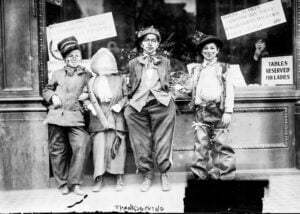
Thanksgiving maskers dressed in costumes outside a restaurant advertising a roast turkey dinner, circa 1910–1915. Photo: Bain News Service / Library of Congress / Wikimedia Commons / Public Domain.
Imagine opening your front door on Thanksgiving morning in New York City a little more than a century ago and finding a group of children wearing masks, battered hats and clothes several sizes too large. They weren’t collecting money for a charity or rehearsing for a school play. They were taking part in one of the city’s favorite holiday customs. Instead of saying “Trick or treat,” they asked, “Anything for Thanksgiving?”
For decades, Thanksgiving brought costumed children out onto the streets of New York. They knocked on doors, approached pedestrians and collected whatever small gifts adults were willing to give them. A few pennies, a piece of fruit or some candy could make the morning a success. The celebration became known as Ragamuffin Day, and the children were often called Thanksgiving maskers.
It is an especially fascinating piece of New York history because the custom sounds so much like the Halloween we know today. Yet the old Thanksgiving celebration flourished before modern Halloween trick-or-treating became widespread in America. Its disappearance tells us a great deal about how New York changed during the first half of the twentieth century.
The Origins of New York’s Ragamuffin Day
No one has conclusively established when the first Thanksgiving ragamuffins appeared on the streets of New York. One possible influence was the city’s tradition of colorful public celebrations surrounding Evacuation Day. Observed on November 25, Evacuation Day commemorated the departure of British troops from New York in 1783. Its proximity to Thanksgiving occasionally brought the two observances together.
During the nineteenth century, groups of costumed marchers known as the Fantasticals participated in holiday festivities. Their humorous disguises and irreverent performances offered a contrast to the more formal civic processions of the era. There were also older European customs involving disguises and requests for gifts, including English Guy Fawkes Day celebrations and various forms of seasonal mumming.
Any of these traditions might have contributed to Thanksgiving masking, particularly in a city where immigrant families brought their own holiday customs into close contact with one another. What we can establish with greater confidence is that Ragamuffin Day was already familiar to New Yorkers by the late nineteenth century. It was not necessary for children to join an official parade or belong to an organization. A costume and a willingness to approach strangers were enough.
Anything for Thanksgiving?
The name ragamuffin came from the appearance of many of the participants. Children dressed in worn-out adult clothing, sometimes blackening their faces with soot or wearing inexpensive masks. A father’s discarded jacket or an old hat could be transformed into a costume without spending any money. Some boys wore their sisters’ dresses, and girls dressed in boys’ clothes.
Not all the costumes were intended to imitate poverty. A report published in The New York Times on December 1, 1899, described a remarkable assortment of holiday disguises, ranging from sailors and harlequins to literary and political figures. Thanksgiving was also an important season for businesses selling masks and novelty goods. Long before Halloween became a major retail occasion, there was a market for holiday disguises in November.
The children approached people on the street and visited homes with their customary Thanksgiving greeting. The rewards were generally modest, but the opportunity to collect spending money on a day off from school was part of the attraction. For adults, keeping a few pennies handy was a convenient way to participate in the neighborhood celebration.
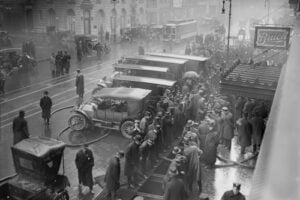
Photographs preserved by the Library of Congress provide an extraordinary record of the tradition. Images distributed by the Bain News Service in the early 1910s show children in oversized clothing and masks, gathering at doorways and searching the pavement for coins. The photographs are particularly valuable because they capture the ordinary street life of New York children rather than an official ceremony staged for dignitaries.
When Thanksgiving Mischief Became a Public Nuisance
Of course, not everyone enjoyed being approached by costumed children. Some youngsters retaliated when adults refused to give them anything. A newspaper account published in 1908 described the use of flour-filled stockings and other forms of mischief. A holiday that was entertaining to one New Yorker could be quite irritating to another.
The practice also raised objections among adults who believed children should not solicit money from strangers. To them, dressing in rags and pretending to be beggars was inappropriate behavior for a holiday devoted to gratitude. Those disagreements existed well before the economic crisis of the 1930s.
New York’s streets were changing, too. As automobile traffic increased and the city became more crowded, groups of unsupervised children roaming commercial thoroughfares presented different concerns than they had in an earlier era. There was a growing desire among civic organizations to provide supervised holiday entertainment.
Why Ragamuffin Day Disappeared
In 1924, Macy’s introduced the parade that would become New York City’s most famous Thanksgiving tradition. Originally promoted as a Christmas parade despite taking place on Thanksgiving, it offered elaborate costumes, floats and entertainment on a scale that neighborhood gatherings could never match. As the parade gained popularity, it became an increasingly important part of the city’s holiday identity.
The campaign against Ragamuffin Day became more organized in 1930. William J. O’Shea, New York City’s superintendent of schools, directed school administrators to discourage Thanksgiving masking and the solicitation of money and presents. It was a striking example of city officials attempting to change a holiday custom that children had been passing down for generations.
The Great Depression provided an especially difficult backdrop for the old practice. With many New York families facing unemployment, hunger and financial hardship, dressing up to imitate impoverished people could take on a very different meaning. Economic distress was not the only reason the tradition declined, but it helps explain the atmosphere in which opposition to it intensified.
Beginning in 1937, the Madison Square Boys’ Club organized Thanksgiving costume parades as an alternative to unsupervised street activities. By 1940, one such parade attracted more than 400 children. The club promoted the motto “American boys do not beg.” Children could still enjoy the costumes and excitement of the holiday without asking strangers for money.
The decline was gradual rather than immediate. Families in some neighborhoods continued the old custom well into the twentieth century. Research by New York Public Library historian Carmen Nigro identifies 1956 as the year of the last newspaper references she found to Thanksgiving Ragamuffin parades. By then, a different holiday had become the occasion most closely associated with children knocking on doors in costume.
Did Ragamuffin Day Become Halloween Trick-or-Treating?
In the early twentieth century, Halloween in America was associated with parties, masquerades and practical jokes, but the familiar ritual of children collecting candy from house to house was not yet widespread. Modern trick-or-treating gained popularity during the 1930s, 1940s and subsequent years.
Folklorists have identified Thanksgiving masking as one possible link between older European gift-seeking customs and American Halloween celebrations. The similarities are certainly compelling. Both involve disguises, visits to neighbors and an expectation of a small reward. However, Halloween developed through several regional and cultural traditions, and there is no definitive evidence that New York’s ragamuffins alone created modern trick-or-treating.
There is a particularly interesting example closer to home. The Three Village Historical Society has examined references to Ragamuffin parades in Suffolk County newspapers. Its research shows that by the 1950s the term was being used for community Halloween parades rather than Thanksgiving festivities. On Long Island, at least, the old name survived even as the celebration changed dates.
How Brooklyn Kept the Ragamuffin Name Alive
In the fall of 1966, Father McKenna of Our Lady of Angels Church and Bay Ridge resident Cliff Scanlon organized a children’s costume parade in Brooklyn. Youngsters from several neighborhood parishes participated. The celebration developed into the annual Bay Ridge Ragamuffin Parade, a community event that preserved the name of the old New York custom without reviving its Thanksgiving begging tradition.
The parade grew into a familiar autumn gathering along Third Avenue, with children, families and local organizations joining the festivities. In 2016, the city formally recognized its importance by co-naming the intersection of Third Avenue and 74th Street Ragamuffin Way. In 2026, the parade marked its 60th anniversary.
For a New Yorker walking along Third Avenue today, the street name offers a small reminder of a much larger piece of the city’s past. A tradition once familiar to children throughout New York has left its mark on a Brooklyn neighborhood, even though most Americans now associate costumes and knocking on doors with an entirely different holiday.
For more stories about the ways New Yorkers once celebrated and lived, explore our articles on 10 Lost New York City Traditions That Once Defined Life, the History of Macy’s Thanksgiving Day Parade and 25 Famous People You Didn’t Know Were From Bay Ridge, Brooklyn.