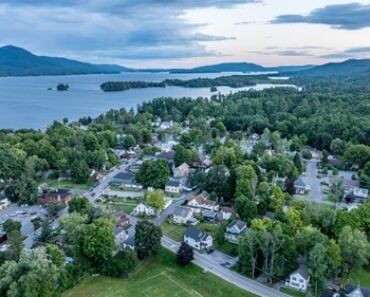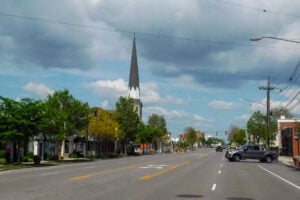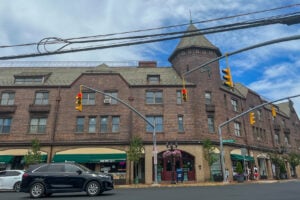
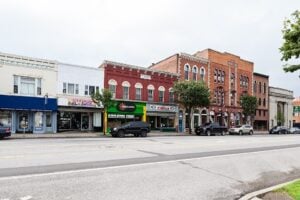
Historic East Main Street in downtown Fredonia, New York, photographed in 2015. Photo: Generic1139 / Wikimedia Commons / CC BY 3.0.
When the name Fredonia comes up in a conversation about Western New York, many people immediately think of the State University of New York at Fredonia. Yet the history of this small Chautauqua County village reaches well beyond its college campus. An Olympic pole vault champion grew up here, two brothers who became celebrated Civil War officers spent their childhoods here, and the founder of a company that would change the way Americans did their laundry was born here.
Located in the Town of Pomfret, just south of Dunkirk and Lake Erie, Fredonia occupies a particularly interesting place in the history of American industry. In 1821, William Hart developed a natural gas well along Canadaway Creek that helped establish the commercial use of natural gas in the United States. The village also witnessed the organization of the first local Woman’s Christian Temperance Union in 1873, a year before the national organization was founded in Cleveland.
Education has been a central part of Fredonia’s identity since the establishment of Fredonia Academy in 1826. The academy and the Fredonia Normal School were predecessors of today’s SUNY Fredonia. The village’s surrounding vineyards and farms, its nineteenth-century architecture and its educational institutions have given generations of residents a distinctive Western New York upbringing.
For this installment of our Famous People series, we have focused on individuals born in Fredonia or with substantial childhood or teenage connections to the community. Attending the university alone does not qualify someone for this particular list. The results reveal just how much history can emerge from one small New York village.
1. Jenn Suhr
Born Jennifer Stuczynski in 1982, Jenn Suhr grew up in Fredonia and graduated from Fredonia High School in 2000. She participated in several sports as a teenager and won a New York State high school pentathlon title. At Roberts Wesleyan College near Rochester, she was an accomplished basketball player before turning her attention to pole vaulting.
Suhr’s rise in her new sport was remarkably rapid. She earned a silver medal at the 2008 Beijing Olympics and won gold at the 2012 London Olympics, defeating a field that included two-time defending Olympic champion Yelena Isinbayeva. In 2016, Suhr also won the world indoor championship and established an indoor world record of 5.03 meters earlier that year.
Her athletic career made her one of the most accomplished American pole vaulters of her generation. For Fredonia residents who remembered her as a talented local high school athlete, the sight of Suhr representing the United States at three Olympic Games was a particularly special connection to the international sporting stage.
2. Jean Webster
Jean Webster was born Alice Jane Chandler Webster in Fredonia on July 24, 1876. Her family had unusually close ties to American literature. Mark Twain was her great-uncle, and her father, Charles L. Webster, was involved in publishing Twain’s books. She spent portions of her childhood in New York City and Fredonia, graduating from Fredonia Normal School in 1894 before continuing her education and eventually earning a degree from Vassar College in 1901.
Webster achieved her greatest literary success with Daddy-Long-Legs, published in 1912. The novel follows an orphan whose education is financed by an anonymous benefactor and is told largely through the young woman’s letters. Its humor and attention to women’s independence helped it reach an international audience. She followed it with Dear Enemy in 1915, a novel concerned with conditions in orphanages.
Daddy-Long-Legs was adapted for the stage and subsequently for several films, including a 1919 silent production starring Mary Pickford and a 1955 musical starring Fred Astaire and Leslie Caron. Webster died in 1916, but her best-known novel continued to introduce new generations of readers to the work of an author born in Fredonia.
3. Alonzo H. Cushing
Alonzo Hereford Cushing was born in Delafield, Wisconsin, in 1841. After his father’s death, his mother brought the family to Fredonia, where he spent his formative years. Cushing entered the United States Military Academy at West Point and graduated in 1861, just as the Civil War was beginning.
Serving as a Union artillery officer, Cushing participated in several major campaigns of the Army of the Potomac. At the Battle of Gettysburg in July 1863, he remained with his men despite suffering severe wounds and was killed at the age of 22. His conduct became one of the enduring stories of the battle.
More than a century and a half later, President Barack Obama presented Cushing’s posthumous Medal of Honor at the White House on November 6, 2014. The ceremony brought renewed national attention to the young officer and the Western New York village where his family had raised him.
4. William B. Cushing
Alonzo Cushing was not the only member of his family to become a nationally recognized Civil War officer. His younger brother William Barker Cushing, born in Wisconsin in 1842, also spent much of his childhood in Fredonia. He attended Fredonia Academy before entering the United States Naval Academy.
Although his time at the Naval Academy ended without graduation, Cushing returned to naval service during the Civil War. His reputation was established through a series of daring operations, the best known of which resulted in the destruction of the Confederate ironclad Albemarle in North Carolina in 1864. Congress formally recognized his service.
Cushing remained in the Navy after the war and attained the rank of commander. He died in 1874 at the age of 32. The stories of William and Alonzo illustrate the extraordinary sacrifices made by one Fredonia family during the Civil War.
5. Louis Cassius Upton
The next time you see the Whirlpool name on a washing machine, remember that the company’s founding story has a connection to Fredonia. Louis Cassius Upton was born in the village on October 10, 1886. He later entered the business world in the Midwest at a time when electricity was beginning to transform American households.
In 1911, Louis and his uncle Emory established the Upton Machine Company in Benton Harbor, Michigan, with financial backing from Lowell Bassford. Louis’s younger brother Fred also became an important participant in the business. The company concentrated on electrically powered washing machines, which offered households an alternative to the considerable manual labor involved in washing clothes.
The business merged with the Nineteen Hundred Washer Company in 1929 and eventually adopted the Whirlpool Corporation name in 1950. Upton died in 1952, having witnessed the growth of the enterprise from a small manufacturing operation into an established American appliance company. The business he helped create remains one of Fredonia’s surprising connections to the history of everyday American life.
6. Ruthie Collins
Country singer-songwriter Ruthie Collins grew up on a grape farm in Fredonia, surrounded by the agricultural landscape that distinguishes this section of Chautauqua County. Her early interest in music eventually led her to Nashville, where she developed a style drawing from traditional country, bluegrass and contemporary Americana.
Collins has released recordings including Get Drunk and Cry and Cold Comfort. Her songwriting reflects the influence of artists such as Emmylou Harris and Patty Griffin, while her song Joshua Tree draws inspiration from the relationship between Harris and Gram Parsons. Her work has also brought her to audiences outside the United States, including country music festivals in the United Kingdom.
In a state often associated with the music scenes of New York City, Collins offers a different perspective on New York’s contribution to American music. Her roots lie in the vineyards of the Lake Erie region, far from the clubs and recording studios of Manhattan.
7. Douglass Houghton
Although Douglass Houghton was born in Troy in 1809, his family settled in Fredonia during his early childhood. His father, Jacob Houghton, was a lawyer and judge, and the family home provided an intellectually stimulating environment. Douglass went on to study science in Troy and trained as a physician.
His career took him west to the Michigan Territory, where he worked in medicine and natural science. In 1837, Houghton became Michigan’s first state geologist. His surveys helped draw attention to the mineral resources of the Upper Peninsula, particularly the region’s rich copper deposits. He also served as mayor of Detroit.
Houghton drowned in Lake Superior in 1845 during the course of his fieldwork. His name survives in Michigan’s Houghton County and the city of Houghton. Both are reminders of the lasting influence of a scientist whose childhood education began in Western New York.
8. Nick Bailen
Born in Fredonia in 1989, Nick Bailen built a hockey career that eventually took him far beyond the ice rinks of New York State. He played collegiate hockey at Bowling Green State University before transferring to Rensselaer Polytechnic Institute in Troy, where he became an accomplished offensive defenseman.
Bailen’s ability to generate scoring opportunities from the blue line helped him establish a professional career in Europe. He played in the Kontinental Hockey League and became a particularly productive defenseman for Traktor Chelyabinsk, helping the club earn bronze medals in 2018 and 2022. He also played in Germany and represented Belarus internationally.
His career illustrates an often overlooked path available to American hockey players. While many fans measure professional achievement exclusively through the NHL, players such as Bailen have established substantial careers in major leagues elsewhere in the world.
9. Jeff Shaver
Jeff Shaver was born in Beaver, Pennsylvania, in 1963, but attended Fredonia High School, where he played several sports. He continued his education at SUNY Fredonia and became one of the outstanding pitchers in the history of the school’s baseball program.
Among his collegiate accomplishments was a no-hitter against Penn State Behrend. He also played on the Fredonia basketball team that won the ECAC Upstate tournament championship during the 1984–85 season. The Oakland Athletics selected him in the 22nd round of the 1985 Major League Baseball draft.
Shaver reached the major leagues on July 6, 1988, appearing in a game for Oakland. Although his major league career consisted of a single appearance, reaching that level represented a substantial achievement for the Fredonia baseball program. In 1994, he was inducted into the university’s Athletic Hall of Fame.
10. Russell Willson
Russell Willson was born in Fredonia on December 27, 1883. His family moved to Washington, D.C., while he was still very young, and he later entered the United States Naval Academy. His naval career extended through both world wars and encompassed an area of military service that was becoming increasingly important: secure communications.
During World War I, Willson developed a system known as the Navy Cipher Box, which helped protect sensitive naval messages. His contributions to communications earned him the Navy Cross and placed him among the important early figures in American naval cryptology.
Willson became superintendent of the Naval Academy in 1941 and subsequently held senior wartime staff positions. In 1945, he advised the American delegation at the San Francisco conference that established the United Nations. His career connects a Fredonia birthplace to the development of military communications and postwar international diplomacy.
11. Louis E. Woods
Louis Earnest Woods was born in Fredonia on October 7, 1895. He attended Syracuse University before receiving his commission in the United States Marine Corps in April 1917. Woods subsequently entered naval aviation, an emerging field that would become central to military operations during World War II.
During the Guadalcanal campaign in 1942, Woods commanded aviation units drawn from the Army, Navy and Marine Corps. Later in the Pacific war, he held senior aviation commands associated with the Okinawa campaign. His responsibilities reflected the growing importance of coordinating air operations among different branches of the armed forces.
Woods continued his military service after World War II and retired in 1951 with the rank of lieutenant general. His career is another example of the significant place people born in Fredonia occupy in the history of the United States military.
12. Olive Risley Seward
Olive Risley was born in Fredonia on July 15, 1844. Her father, Hanson A. Risley, held a federal government position, and her family’s political connections brought her into the company of William H. Seward, the former New York governor and United States secretary of state who had served under Abraham Lincoln and Andrew Johnson.
After the death of Seward’s wife, Olive became his companion and legally adopted daughter. She traveled with him on an extensive international journey in 1870 and 1871. For a nineteenth-century American woman, the opportunity to visit so many different parts of the world was highly unusual.
After Seward’s death in 1872, Olive completed the editorial work on William H. Seward’s Travels Around the World, published in 1873. The book remains a historical record of the journey and of her contribution to preserving Seward’s observations. Her story offers a connection between a small Western New York village and the diplomatic world of the nineteenth century.
13. Stephen Merrell Clement
Stephen Merrell Clement was born in Fredonia on November 4, 1859. His father, Stephen Mallory Clement, established a banking business in the village before becoming associated with Buffalo’s Marine Bank. The younger Clement spent part of his childhood in Fredonia and went on to attend Yale University.
He followed his father into banking and eventually became president of Marine Bank in Buffalo. His career coincided with an era of tremendous industrial and commercial growth across Western New York. Buffalo’s railroads, manufacturing businesses and access to the Great Lakes made financial institutions an increasingly important part of the regional economy.
Marine Bank later became part of the Marine Midland banking organization, whose branches were familiar to generations of New Yorkers. Clement’s story is a reminder that important business careers in Buffalo often began in smaller communities throughout the surrounding region.
14. George Borrello
George Borrello grew up in Silver Creek and Fredonia, graduating from Fredonia High School in 1985 before attending Purdue University. He returned to Western New York and established a career in business, including work in the hospitality industry.
Borrello entered public service through the Chautauqua County Legislature, where he served for eight years. He subsequently became county executive, and in 2019 he won a special election to the New York State Senate. His political career has included work on issues affecting agriculture, small businesses and rural communities.
For Fredonia, his connection is particularly direct: a local high school graduate who returned to the region and went on to represent Western New York in state government. He also returned to SUNY Fredonia to deliver a commencement address in 2022.
15. Kevin Sylvester
Sports broadcaster Kevin Sylvester was born in Fredonia but grew up in Waterloo in the Finger Lakes region. After graduating from Waterloo High School, he returned to his birthplace for college and earned his degree from SUNY Fredonia in 1995. His career in broadcasting included radio work in both Buffalo and Charlotte, North Carolina.
Beginning in 2005, Sylvester worked with the Buffalo Sabres, serving in television and radio roles that included studio hosting and road play-by-play broadcasting. His work made him a recognizable voice to Western New York hockey fans. He subsequently moved into golf broadcasting, covering professional tournaments for PGA Tour Radio.
Sylvester’s career demonstrates how a connection to Fredonia can extend beyond childhood. Although he was raised elsewhere, his birth in the village and later return for his college education give him two distinct ties to the community.
Fredonia is just one of the many Western New York communities with remarkable connections to American history. Explore more of the region in our articles 25 Famous People You Didn’t Know Were From Chautauqua County, New York, 25 Famous People You Didn’t Know Were From Jamestown, New York, 25 Famous People You Didn’t Know Were From Erie County, New York and 25 Famous People You Didn’t Know Were From Upstate New York.