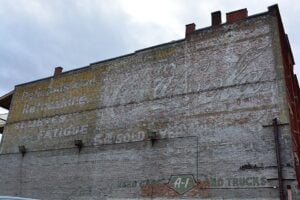
Ghost signs on the side of the historic Dunk Building at 144 Court Street in Binghamton, New York. Photo: Joe Mabel, CC BY-SA 4.0, via Wikimedia Commons.
Walk through the historic downtowns of Troy, Utica, Binghamton, Hudson, Kingston, Buffalo, or dozens of smaller Upstate New York cities and villages, and most of the activity is naturally at street level. Storefronts change, restaurants come and go, and old commercial buildings find new lives as apartments, offices, galleries, and shops. But look above the awnings and windows, especially along exposed brick side walls, and another layer of the city often survives.
These faded advertisements are known as ghost signs: hand-painted commercial messages that remained on brick or masonry long after the businesses, products, or advertising campaigns disappeared. Some are barely readable. Others still reveal brand names, prices, slogans, and local merchants from a century ago. Together they form an accidental archive of the commercial life that once filled Upstate New York’s Main Streets, canal towns, railroad districts, and industrial neighborhoods.
1. What Is a Ghost Sign?
A ghost sign is an old hand-painted advertisement that has survived on the exterior wall of a building after its original commercial purpose ended. The best-known examples date from the late nineteenth century through the first half of the twentieth century, when painted brick walls functioned as enormous outdoor advertisements for everything from crackers and tobacco to hotels, hardware stores, theaters, pharmacies, and local warehouses.
The signs survived for different reasons. Some were simply abandoned when a business closed. Others were painted over with newer advertisements and later reappeared as the upper layers weathered away. Still others were protected for decades when a neighboring building was constructed directly against the painted wall. When that adjoining structure was later demolished or altered, an advertisement that had been sealed away from sunlight and weather could suddenly return to view.
2. The Walldogs Who Painted the City
The skilled sign painters who created large wall advertisements were often called walldogs. Their work was physically demanding and frequently dangerous. They painted high above the street from ladders, scaffolds, and suspended platforms, turning blank brick walls into advertisements large enough to be read from passing streetcars, trains, automobiles, and sidewalks.
Contrary to the romantic image of every painter simply improvising enormous letters freehand, walldogs often worked from carefully prepared scaled designs. One common technique used perforated paper patterns and powdered chalk or charcoal to transfer dotted outlines onto the wall. Painters then connected those marks with brushes, creating crisp lettering and graphics at a scale that could cover several stories.
The paints themselves also help explain why so many signs survive. Historic wall advertisements commonly used oil-based paints, and surviving coatings may contain lead. Those materials could adhere tenaciously to porous brick and masonry. A century of sun, rain, snow, and freeze-thaw cycles gradually weakens the colors, but traces of pigment can remain visible long after the original advertisement has ceased to exist as a functioning sign.
3. When Brick Walls Became National Advertising
Ghost signs are especially useful because they capture the moment when national brands began competing for attention in ordinary American streets. One of the most important campaigns came from the National Biscuit Company, later known as Nabisco. Its Uneeda Biscuit campaign began in 1899 and spread painted advertisements across the country.
Upstate New York still contains remarkable evidence of that campaign. The Society for Commercial Archeology has documented surviving Uneeda Biscuit signs in Albany, Cohoes, Kingston, Newburgh, Schenectady, Troy, and elsewhere in the state. The familiar advertisements often used large white lettering, the Uneeda name, the National Biscuit Company identity, and the famous five-cent package price.
Coca-Cola is another recurring survivor. Early painted Coca-Cola advertisements appeared on pharmacies, groceries, hotels, and commercial buildings throughout the country. In Binghamton, a surviving sign at 144 Court Street still carries the old slogan “Delicious and Refreshing – Relieves Fatigue.” Similar Coca-Cola signs have been documented across the Capital Region and Western New York.
Tobacco companies were equally aggressive outdoor advertisers. Mail Pouch, Bull Durham, and other brands appeared on commercial buildings and barns, placing national products directly into the visual landscape of small cities and rural highways.
4. Local Businesses Left Their Own Names in Brick
The most interesting ghost signs are not always the national brands. Local hardware stores, moving companies, markets, hotels, clothing merchants, warehouses, and repair shops often painted their own names directly on the buildings they occupied.
These signs can tell historians what a structure once contained even after every storefront, awning, interior, and directory listing has changed. A moving-and-storage advertisement still visible at 186 State Street in Binghamton, for example, preserves the memory of a business that once occupied the building. In Utica, the large Jeffrey Hardware sign in the Bagg’s Square area remains connected to an earlier commercial use of the Whiffen–Robyat Building.
That is why ghost signs can be more revealing than decorative nostalgia. They are physical business records left directly on the architecture.
5. The Palimpsest: When One Advertisement Appears Through Another
Some walls contain more than one era of advertising. Historians and ghost-sign enthusiasts often borrow the word palimpsest for walls where multiple painted messages overlap. A newer advertisement may have been painted directly over an older one, only for decades of weathering to make parts of both visible at once.
One documented New York example comes from Poughkeepsie, where an older Liberty Tobacco advertisement was later overpainted by an Uneeda Biscuit campaign. The result allows two different periods of national advertising to occupy the same wall at the same time.
Palimpsests are especially valuable because they reveal that walls were not permanent billboards for one company. They were reused commercial space. As businesses changed and advertising contracts expired, painters simply created a new message over the old one.
6. Troy: Uneeda Biscuit Signs in the Collar City
Troy has one of the best-documented clusters of ghost signs in the Capital Region. Several surviving examples advertise Uneeda Biscuit, part of the National Biscuit Company’s enormous national campaign. A particularly legible example near Ferry Street and Williams Street Alley still reveals the Uneeda name, the early National Biscuit Company emblem, and the old five-cent package price.
Other Uneeda signs have been documented around Fourth Street and Harrison Street. Their survival is especially fitting in Troy, where dense rows of nineteenth-century commercial buildings created ideal blank side walls facing streets, alleys, and traffic corridors.
The signs also demonstrate how quickly these relics can disappear. Capital Region photographer Chuck Miller has documented ghost signs for years and has recorded examples lost when buildings were demolished or altered. A sign that survives today should never be assumed to be permanent.
7. Utica: Hardware, Tobacco, and Warehouse Advertising
Utica’s oldest commercial districts contain some of the richest ghost-sign territory in Central New York. Many examples cluster around downtown, Bagg’s Square, and streets associated with the former Erie Canal corridor.
One of the most visible is the Jeffrey Hardware sign on the Whiffen–Robyat Building near Bleecker Street in the Bagg’s Square East Historic District. The faded lettering remains high on the masonry even as the building below has entered a new period of use.
Other documented Utica examples include a Mail Pouch Tobacco sign near Columbia, Whitesboro, and Schuyler streets and the former Murray Warehouse lettering on the building later occupied by PJ Green. These are exactly the kinds of signs that reward walking rather than driving: they are often high on side walls, partially blocked by neighboring structures, or visible only from an alley or secondary street.
8. Binghamton: Coca-Cola and the Old Warehouse Districts
Binghamton still has multiple documented ghost signs in and around its historic commercial districts. At 144 Court Street, the side wall carries a fading Coca-Cola advertisement with the early “Relieves Fatigue” slogan. Modern photographs continue to document the sign as part of the Court Street Historic District.
A second surviving example at 186 State Street, in the State Street–Henry Street Historic District, advertises a former moving and storage business. Photographs taken in 2025 show the lettering still visible on the brick.
These two signs demonstrate the range of the medium. One sold a nationally recognized consumer product; the other advertised a local service business. Both have outlived the original reason they were painted.
9. Hudson: The Oneida Market Sign and the Effects of Redevelopment
Hudson offers one of the clearest examples of how renovation can both reveal and alter a ghost sign. At South Seventh Street near Warren Street, a painted advertisement for Oneida Market survives on a brick wall. Portions of the old message advertise “Finest Butter, Cheese & Eggs” and “Finest Meats, Poultry & Fish.”
The wall changed significantly during recent redevelopment. Photographic documentation shows that exterior cladding was removed between 2018 and 2019, revealing more of the painted wall. At the same time, a newer window opening interrupted part of the old advertisement. The result is a perfect illustration of the unstable life of a ghost sign: development can expose one section while destroying or obscuring another.
10. Kingston: A City With Its Own Sign-Painting Archive
Kingston is important not only because painted signs appeared on its commercial buildings, but because the city preserved an extraordinary record of the people who made them. The Friends of Historic Kingston collection held through New York Heritage documents the work of Modjeska Sign Studios, a Kingston sign company whose photographs record storefront lettering, painted wall advertising, neon signs, billboards, restaurants, and businesses from the 1920s through the 1970s.
Founder Augustus “Gus” Modjeska began by painting window displays and signs for local businesses and theaters. By the late 1920s he operated a sign studio, and the company eventually expanded into wall advertising, truck lettering, neon, and large billboards, including signs placed along the New York State Thruway.
The collection makes Kingston especially valuable for understanding ghost signs because it preserves not just the faded remains, but photographs of the sign-making business when this form of advertising was still alive.
11. Buffalo: One of New York’s Largest Surviving Collections
Buffalo’s enormous stock of nineteenth- and early-twentieth-century brick commercial buildings has left the city with a particularly large collection of surviving wall advertisements. Wikimedia Commons alone currently documents dozens of ghost signs around Buffalo.
Examples include fading advertisements on the former Simon Electric Company building at 367–369 Ellicott Street, a Buffalo Trust Company sign on Delaware Avenue, a Coca-Cola advertisement on the former Pleskow Brothers Pharmacy on Hickory Street, and old business signs still visible in the Theater District.
Buffalo demonstrates why ghost signs are not limited to picturesque Main Streets. They also survive in warehouse districts, neighborhood commercial blocks, industrial corridors, and the side walls of buildings that once faced railroad tracks or other vanished structures.
12. Why Ghost Signs Suddenly Reappear
One of the strangest parts of ghost-sign history is that a sign can disappear for generations and then return almost overnight. If another building is constructed directly against a painted wall, that wall can be sealed away from sunlight and weather. The advertisement effectively goes into storage without anyone intending to preserve it.
When the neighboring structure is demolished decades later, the old sign is exposed again. This has happened repeatedly in older American cities. In Schenectady, demolition work in 2016 revealed old beer and Uneeda Biscuit advertisements on lower State Street. Hudson’s Oneida Market wall offers another version of the phenomenon, where removal of exterior cladding revealed portions of an older painted advertisement.
These discoveries can be remarkably vivid because the paint was protected for decades. Unfortunately, once exposed again, deterioration resumes.
13. Preserve, Restore, or Let It Fade?
Ghost signs create a difficult preservation question because the fading itself is part of what makes them historic. Repainting every missing letter can produce a visually attractive mural, but it may also erase the original paint and weathering that made the sign an authentic artifact.
Conservation guidance generally favors caution. Historic painted wall signs should not simply be pressure-washed, sandblasted, coated, or repainted without professional evaluation. Old paint may contain lead, and both the pigment and the underlying brick can be fragile. Some conservation programs recommend leaving stable ghost signs intact rather than repainting them and consulting specialists before undertaking any restoration or consolidation work.
There is no universal answer. Some communities deliberately restore old advertisements as public art; others preserve the surviving material with minimal intervention; and some allow signs to continue fading naturally. The right approach depends on the condition of the masonry, the historic significance of the paint, ownership, local preservation regulations, and the purpose of the project.
14. How to Read a Ghost Sign
The next time you encounter one, do more than photograph the biggest word. Look closely at the whole wall.
- Look for prices: A five-cent package, ten-cent cigar, or dollar hotel room can help place an advertisement in a particular period.
- Look beneath the obvious lettering: Different colors or letter shapes may reveal an older advertisement beneath the visible one.
- Watch the mortar lines: Painters sometimes used the brick courses as practical guides for keeping enormous letters level.
- Notice blank sections and scars: A missing piece of an advertisement may indicate a former window, adjacent structure, billboard, or later renovation.
- Research the business name: City directories, historic newspapers, Sanborn maps, local archives, and old photographs can connect faded lettering with the business that once occupied the building.
Ghost signs survive because buildings remember things that cities forget. A restaurant can close, a factory can disappear, a railroad can move, and an entire product can vanish from store shelves, yet a few inches of old paint can remain on a brick wall for another generation. Upstate New York’s faded advertisements are not merely curiosities. They are pieces of commercial archaeology still exposed to the weather, waiting for someone on the sidewalk to look up.
For more on New York’s fading commercial history, see our companion feature Famous Ghost Signs in NYC and Where to Find Them. Readers interested in Upstate streets and historic communities can also explore 10 Historic Small Towns in Upstate New York Worth Visiting and The Real Main Street of New York: The History of U.S. Route 20.