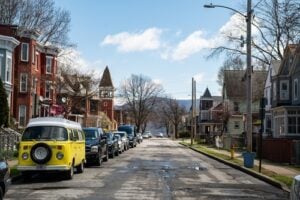
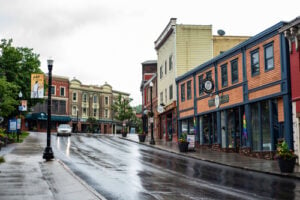
Broadway in downtown Saranac Lake, New York, during a summer rain on July 18, 2021. Photo by KMarsh / Shutterstock.com.
When I first went to college at Sullivan County Community College in Loch Sheldrake, New York, back in 1979, I will never forget my first evening there. I went out to hang around with some of my new friends, and we were all lying in a field as it started to get dark. I remember looking up at the sky and not being able to believe my eyes. I had never seen a sky so full of stars in my life.
I grew up in the Bronx and went to high school on Long Island. In both places, at night we would see a few stars through the smog and, especially, the light pollution. The only time I had ever seen anything remotely like what I saw that first night at college was when I went to the planetarium. It had a profound effect on me. I was only 17 years old, and seeing how small I was compared to the rest of the universe was both calming and a little scary: the galaxy that I had always heard was out there was now something I was actually seeing for the first time.
What that moment really did was begin my love affair with the beauty, mountains, fresh air, and smells of Upstate New York. So I dedicate this article to that one moment in time when life changed before my eyes in the blink of a star; or, I should say, millions of stars.
This list brings together ten communities in Upstate New York where beauty reigns in all forms and history remains visible in the streetscapes where visitors can still explore on foot. From the Finger Lakes and Central New York to the Hudson Valley, Adirondacks, and Catskills, each offers a different version of Upstate New York: lakefront parks, historic inns, museums, independent businesses, old estates, mountain views, and neighborhoods that retain a strong sense of place.
Skaneateles (Onondaga County)
At the northern end of Skaneateles Lake, the village of Skaneateles combines a compact historic downtown with immediate access to one of the Finger Lakes. Genesee Street runs through a commercial district filled with shops and restaurants, while nearby Clift Park, Thayer Park, and Shotwell Memorial Park open the village directly to the waterfront. Together, they make it easy to get from the center of town to lake views in minutes.
The village’s architecture reflects its nineteenth-century growth as a turnpike and mill community, with Federal, Greek Revival, and Victorian buildings still shaping the streetscape. One of its best-known landmarks is the Sherwood Inn, whose history dates to 1807, when Isaac Sherwood established a tavern connected to his stagecoach business. Today, the village remains a popular destination for walking, dining, shopping, seasonal events, and boat cruises on Skaneateles Lake.
Cooperstown (Otsego County)
Cooperstown is best known for the National Baseball Hall of Fame and Museum, but the village’s appeal extends far beyond baseball. Founded by the Cooper family in the late eighteenth century, it is closely tied to novelist James Fenimore Cooper, whose Leatherstocking Tales helped turn the surrounding landscape into part of American literary history. Main Street remains a walkable commercial corridor of brick storefronts, traditional streetlamps, restaurants, shops, and museums.
At the northern end of the village lies Otsego Lake, which Cooper famously called Glimmerglass in his fiction. Visitors can walk from downtown toward the lakefront and also explore two major cultural institutions just outside the center. Fenimore Farm & Country Village, formerly known as The Farmers’ Museum, interprets nineteenth-century rural life through a historic village and working farm, while the Fenimore Art Museum holds important collections of American folk art, fine art, photography, and Native American art.
Cazenovia (Madison County)
Set at the southern end of Cazenovia Lake, the village of Cazenovia developed around a remarkably intact historic center. Albany Street, part of U.S. Route 20, passes through a downtown framed by nineteenth-century commercial buildings, shops, restaurants, and tree-lined streets. The village’s early development was closely connected to John Lincklaen, an agent of the Holland Land Company who helped establish Cazenovia in the years following the American Revolution.
Lincklaen’s 1807 Federal-style estate survives as Lorenzo State Historic Site, one of the village’s most important landmarks. The mansion, formal garden, arboretum, visitor center, and extensive grounds provide a direct connection to Cazenovia’s early history and remain open to visitors on a seasonal schedule, while the grounds are accessible year-round. The combination of the historic village, lake, and preserved estate gives Cazenovia a particularly strong sense of continuity with its early nineteenth-century past.
Cold Spring (Putnam County)
Cold Spring sits along the Hudson River in the dramatic landscape of the Hudson Highlands. Incorporated in 1846, the village grew closely tied to the nearby West Point Foundry, which manufactured artillery, steam engines, and other iron products during the nineteenth century. Today, Main Street slopes toward the Hudson through a historic district filled with shops, restaurants, galleries, and older residential and commercial buildings.
The waterfront is one of Cold Spring’s great strengths, offering views across the river and into the surrounding Highlands. A short distance from the village center, the West Point Foundry Preserve protects the industrial complex’s archaeological remains and offers walking trails through a wooded landscape. Cold Spring is also served by Metro-North’s Hudson Line, making it one of the easiest historic Hudson Valley villages to reach from New York City without a car.
Rhinebeck (Dutchess County)
Rhinebeck has long served as a crossroads in the Hudson Valley, and its village center still reflects centuries of travel, commerce, agriculture, and civic life. The intersection of Route 9 and Market Street anchors a walkable downtown of restaurants, independent shops, historic buildings, and cultural destinations. The surrounding Dutchess County countryside adds farms, orchards, historic estates, and broad Hudson Valley landscapes to the village experience.
Rhinebeck’s best-known historic lodging is the Beekman Arms, whose present inn dates to 1766 and has operated continuously ever since. The building’s long history gives the center of Rhinebeck a tangible connection to the colonial and Revolutionary eras while remaining part of everyday village life. The combination of a preserved center and active businesses makes Rhinebeck feel historic without functioning as an outdoor museum.
Saranac Lake (Franklin and Essex Counties)
Saranac Lake developed a character unlike almost any other Adirondack community. During the late nineteenth and early twentieth centuries, it became internationally known as a center for tuberculosis treatment after Dr. Edward Livingston Trudeau established his work there. The village’s steep streets and neighborhoods still contain many of the distinctive cure cottages built with large porches where patients once spent long hours resting in the mountain air.
Historic Saranac Lake interprets that medical history today through the Saranac Laboratory Museum and continues preservation work throughout the community. Downtown Saranac Lake also maintains an active arts and small-business scene surrounded by the Saranac River, Lake Flower, and the Adirondack landscape. Nearby, the Adirondack Carousel remains a working year-round attraction featuring hand-carved animals inspired by Adirondack wildlife.
Canandaigua (Ontario County)
Canandaigua anchors the northern end of Canandaigua Lake with a broad Main Street lined by historic civic, residential, and commercial architecture. The city has long served as the county seat of Ontario County, and its courthouse became the setting for one of the most important trials in American women’s history. In June 1873, Susan B. Anthony was tried there for illegally voting in the 1872 presidential election after the case was moved from Monroe County.
South Main Street leads toward Canandaigua Lake and the historic City Pier, where distinctive wooden boathouses preserve an important part of the city’s waterfront history. The pier began as a steamboat dock in the nineteenth century and remains a popular place for lake views and walking. Nearby, Sonnenberg Gardens & Mansion State Historic Park preserves a Victorian mansion and formal gardens that add another layer to Canandaigua’s architectural and social history.
Aurora (Cayuga County)
Aurora occupies a narrow strip of land along the eastern shore of Cayuga Lake, where historic houses, former college buildings, inns, and tree-lined streets create one of the Finger Lakes’ most distinctive village landscapes. The community’s history is closely connected to Wells College, founded by Henry Wells in 1868. The college closed on June 30, 2024, ending more than 150 years as an operating institution, but the former campus and its historic buildings remain an important part of Aurora’s physical identity.
The Aurora Inn, built in 1833, remains one of the village’s central landmarks and continues to operate as part of the Inns of Aurora. Extensive preservation and restoration work has also returned a number of other historic village properties to active use. Because Aurora is so compact, visitors can experience much of its architecture and Cayuga Lake setting on foot, with the lake rarely far from view.
Penn Yan (Yates County)
Penn Yan sits at the northern end of the eastern branch of Keuka Lake and serves as the county seat of Yates County. Its name reflects the Pennsylvania and Yankee settlers who shaped the community, while its downtown retains the character of a working Finger Lakes commercial center. Main Street and the surrounding blocks contain historic storefronts, local businesses, restaurants, and public buildings serving both village residents and the agricultural countryside around them.
Yates County is also home to a substantial Mennonite population, including horse-and-buggy communities whose farms and businesses remain part of the region’s present-day agricultural life. Penn Yan is the western end of the Keuka Outlet Trail, a seven-mile public trail that follows the outlet between Keuka Lake and Dresden near Seneca Lake. Built along portions of an old railroad bed and the route of the historic Crooked Lake Canal, the trail passes waterfalls, mill ruins, wooded sections, and remnants of the area’s industrial past.
Woodstock (Ulster County)
Woodstock was an arts community decades before its name became permanently associated with the 1969 music festival, which was actually held in Bethel in Sullivan County. In 1902, construction began on the Byrdcliffe Arts Colony on the mountainside outside Woodstock, creating an Arts and Crafts community that attracted painters, writers, designers, craftspeople, and musicians. Byrdcliffe continues today as an active arts organization and artist colony.
The center of Woodstock gathers around the Village Green and Tinker Street, where independent shops, galleries, cafes, bookstores, and music-related businesses reflect the town’s long creative identity. The Woodstock Playhouse continues the community’s performing-arts tradition, while nearby trails into the Catskills provide access to Overlook Mountain and the landscape that first attracted generations of artists to the area. Woodstock’s appeal comes from that combination of small-town street life, artistic history, and mountain surroundings.
For more stories about the landscapes, communities, and history beyond New York City, explore The Beauty and History of Lake George, read Washington Irving, Sleepy Hollow, and the American Short Story, and discover the transportation story behind many Upstate communities in our History of the Erie Canal.
Sources
Village of Skaneateles — Community and Historic Downtown
Fenimore Farm & Country Village — 2024 Annual Report and Name Change
Fenimore Art Museum — Collections
New York State Parks — Lorenzo State Historic Site
Village of Cold Spring — Visitor Information
Scenic Hudson — West Point Foundry Preserve
Beekman Arms & Delamater Inn — History
Historic Saranac Lake — Saranac Laboratory Museum and Local History
Adirondack Carousel — Visitor Information
Ontario County — Canandaigua Main Street Guided History Walk
City of Canandaigua — History of the City Pier Boathouses
Sonnenberg Gardens & Mansion State Historic Park
New York State Education Department — Recently Closed Degree-Granting Institutions
Inns of Aurora — History of the Aurora Inn
Yates County — About Yates County and Its Mennonite Community
Yates County Fact Book — History of the Penn Yan Name
Friends of the Outlet — Keuka Outlet Trail History
Woodstock Byrdcliffe Guild — History of Byrdcliffe
Woodstock Playhouse — Official Site
Updated September 16, 2026.