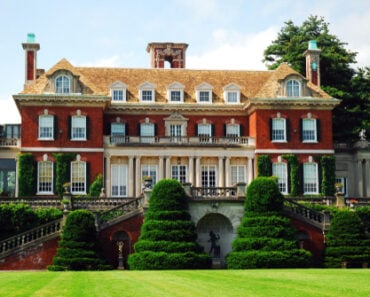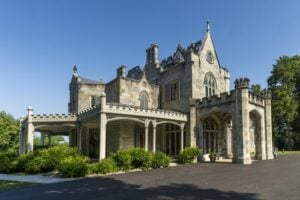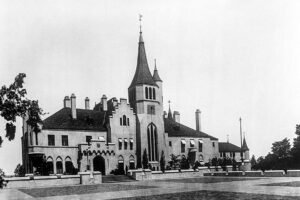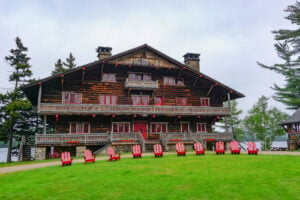
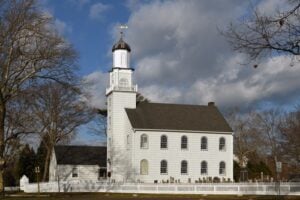
Setauket Presbyterian Church, also known as the First Presbyterian Church of Brookhaven, and its historic burial ground in Setauket, Long Island. The present church dates to 1812. Photo by Popova Valeriya / Shutterstock.com.
When people think of Long Island, New York, they often think of an endless whirlwind of shopping centers filled with pizzerias, bagel stores, and Chinese restaurants. They think of the Long Island Expressway, which for most people is more of a parking lot than an expressway. The island is filled with shopping malls, shopping centers, traffic, and perhaps above all, fast-food restaurants.
Nonetheless, scattered across Long Island are some very special places that time has not devoured and modernity has not erased. These are communities where the past still lives and breathes much as it did during the early years of the American experience. That is what this article is looking for: those special Long Island towns, villages, and hamlets where you can still feel as though you have stepped back into the 1800s, or even the 1700s.
Hidden within modern Long Island are communities where pieces of the seventeenth and eighteenth centuries are still visible in village greens, colonial houses, old churches, historic mills, whaling ports, burial grounds, and roads that existed long before suburbia arrived. These are not museum pieces frozen in time. They are living towns, villages, and hamlets where early American history still survives alongside present day Long Island.
Setauket
Settled in 1655 along the protected waters of Setauket Harbor, Setauket is one of Long Island’s most historically significant early communities. The Setauket Village Green remains a focal point, surrounded by historic buildings and churches. Caroline Episcopal Church was organized in 1723, and its present wooden church building was erected in 1729. During renovations, an eighteenth century bullet was discovered in the steeple and is believed to date from the Revolutionary War skirmish fought nearby in 1777. The bullet is now displayed inside the church.
Setauket is also inseparable from the history of the Culper Spy Ring, the secret intelligence network organized under Major Benjamin Tallmadge for General George Washington. Agents and couriers moved information through Setauket on its way across Long Island Sound and ultimately to Washington. Historic sites associated with the area’s colonial and Revolutionary era remain throughout the Three Village area, including the Brewster House, which dates to about 1665. Walking through Setauket today still reveals village greens, burial grounds, old roads, and homes connected to some of Long Island’s earliest history.
Stony Brook
Just west of Setauket, Stony Brook combines a historic harbor setting with one of Long Island’s best-known surviving mills. The Stony Brook Grist Mill dates to about 1751 and is listed on both the New York State and National Registers of Historic Places. The Ward Melville Heritage Organization describes it as Long Island’s only complete working grist mill. For generations, mills at this site used water power from the local mill pond to grind grain for area farmers.
Stony Brook’s village center was extensively reshaped during the twentieth century through the efforts of philanthropist Ward Melville, who wanted the community to retain the appearance of a traditional village. Nearby, the Long Island Museum preserves an outstanding collection of regional art, history, and horse-drawn vehicles. Visitors planning to see the grist mill should check current access before traveling; the mill has been temporarily closed because of the collapse of Harbor Road.
Cold Spring Harbor
Cold Spring Harbor developed along a narrow harbor valley on Long Island’s North Shore, where freshwater springs and access to the Sound helped shape the community’s early growth. By the nineteenth century, the harbor had become an important center of Long Island’s whaling trade. The community’s maritime history survives in the records, buildings, and artifacts preserved by the Whaling Museum and Education Center.
Main Street follows Route 25A through a compact commercial center of older buildings, shops, restaurants, and institutions set between steep wooded slopes and the harbor. The Whaling Museum maintains thousands of objects connected to Long Island’s maritime past, including a fully equipped historic whaleboat. Cold Spring Harbor also retains historic churches and older homes, while the waterfront and surrounding landscape continue to give the hamlet a strong sense of its nineteenth century identity.
Orient
At the eastern end of Long Island’s North Fork, Orient remains one of the island’s most distinctive historic hamlets. The community was originally known as Oysterponds and developed as a farming and maritime settlement surrounded by Long Island Sound, Gardiners Bay, and productive agricultural land. Village Lane remains one of the most recognizable parts of the community, lined with older homes, gardens, and historic buildings.
The Orient Historic District was placed on the National Register of Historic Places in 1976 after a major local preservation effort led by the Oysterponds Historical Society. The society continues to maintain a collection of historic buildings and exhibitions on Village Lane, including the Old Point Schoolhouse, which dates to 1873. Orient’s location at the far end of the North Fork has helped it retain a quiet residential and agricultural character that feels very different from the more heavily developed parts of Long Island farther west.
Cutchogue
Cutchogue sits in the heart of the North Fork’s agricultural country and preserves one of Long Island’s most important collections of historic buildings. The Cutchogue Village Green brings together several structures that illustrate different periods of local life, including early houses and a nineteenth century schoolhouse. The surrounding landscape of farms and vineyards helps preserve the agricultural setting in which the hamlet developed.
The best-known building on the green is the Old House, a National Historic Landmark traditionally said to date to 1649. That date has long been part of local history, but the Cutchogue New Suffolk Historical Council now notes that scientific evidence and surviving documentation do not fully settle the question. The earliest surviving document connected to the house is a 1699 deed. Rather than diminishing its importance, the uncertainty adds another layer to the story of one of New York State’s oldest surviving houses and the continuing work of historical research.
East Hampton
East Hampton is known worldwide as a luxury summer destination, yet its historic center still preserves a remarkable collection of early Long Island architecture. The settlement dates to 1648, and the village center includes old homes, ponds, greens, windmills, and farm buildings that connect the modern community to its seventeenth- and eighteenth-century roots.
Hook Mill, built in 1806, remains one of East Hampton’s most recognizable historic structures. Nearby, Mulford Farm dates to 1680 and is considered one of the country’s most significant surviving English Colonial farmsteads. Home Sweet Home, a saltbox house dating to about 1720, is closely associated with playwright and lyricist John Howard Payne. Payne was born in New York City, but he visited East Hampton as a child and had deep family connections there. The house later became a museum and memorial to Payne and his famous song, “Home, Sweet Home.”
Sag Harbor
Sag Harbor grew into one of Long Island’s great maritime communities during the eighteenth and nineteenth centuries. Congress established Sag Harbor as a port of entry on July 31, 1789, and the village later became one of the nation’s busiest whaling ports. Main Street still leads toward Long Wharf through a compact downtown of historic commercial buildings, restaurants, shops, and older residences built during the community’s seafaring years.
The Sag Harbor Whaling and Historical Museum occupies the 1845 home built for whaling ship owner Benjamin Huntting II. Nearby, the First Presbyterian Church, better known as the Old Whalers’ Church, was built in 1844 and combines Egyptian Revival and Greek Revival design. Its original 185 foot steeple was destroyed in the 1938 hurricane and was never rebuilt. Together with Long Wharf and the surrounding historic district, these landmarks keep Sag Harbor’s maritime history visible throughout the village.
Roslyn
Roslyn developed around the head of Hempstead Harbor as a milling and commercial settlement. Its winding streets, steep terrain, historic homes, and old commercial center give the village a character very different from the surrounding suburban landscape. One of its most important landmarks is the Roslyn Grist Mill, a rare surviving Dutch framed colonial watermill whose origins reach back to the early eighteenth century.
President George Washington visited Roslyn on April 24, 1790, during his tour of Long Island. He breakfasted at the adjoining home of mill owner Hendrick Onderdonk and referred to the mill in his diary. The grist mill is currently undergoing a major restoration led by the Roslyn Landmark Society and Nassau County. Work continued through 2026, so the building should be viewed as an active preservation project rather than an open museum. Elsewhere in the village, historic homes, the Roslyn Duck Pond, stone bridges, and the Ellen E. Ward Memorial Clock Tower help preserve the older streetscape.
Oyster Bay
Oyster Bay was settled in the seventeenth century and became one of the North Shore’s most important early communities. Its harbor, churches, roads, and surviving historic homes reflect layers of Long Island history stretching from the colonial period through the Revolutionary War and into the nineteenth and twentieth centuries.
One of Oyster Bay’s most important historic sites is Raynham Hall, the Townsend family home. Robert Townsend, who used the code name Culper Junior, became one of the central intelligence gatherers in George Washington’s Culper Spy Ring. During the British occupation, the house was also used by officers of the Queen’s Rangers. Today, Raynham Hall operates as a museum, preserving the complicated story of a household that found itself at the center of Revolutionary War espionage.
Amagansett
Amagansett was founded in the seventeenth century between East Hampton and Montauk, where agriculture, fishing, and Atlantic coastal life shaped the community for generations. Main Street and the surrounding historic district retain older shingled houses, small commercial buildings, churches, and remnants of the hamlet’s early rural character.
Amagansett’s maritime history is especially visible at the restored Amagansett U.S. Life Saving and Coast Guard Station on Atlantic Avenue. The present station was built in 1902 and served first with the United States Life Saving Service and later with the Coast Guard. In 1942, a Coast Guardsman patrolling from the station encountered four Nazi agents who had landed from a U boat as part of a sabotage mission. The building was eventually moved, preserved, returned to its original site, and restored as a museum. It now tells the story of lifesaving, coastal rescue, and one of the most extraordinary wartime incidents in Long Island history.
What makes these communities so important is not simply that they are attractive places to visit. They reveal a version of Long Island that can be easy to overlook beneath the parkways, shopping centers, suburban developments, and modern traffic that define so much of the island today. In these towns, villages, and hamlets, the older Long Island is still there: in the roads, churches, mills, harbors, village greens, and houses that survived while the world around them changed.
For more Long Island history, read The Battle of Sag Harbor in the War for Independence, explore 10 Historic Lighthouses of Long Island and the Stories Behind Them, and visit our look at St. James Train Station, 19th Century Building Still Stands.
Sources
Caroline Episcopal Church of Setauket: History
Ward Melville Heritage Organization: Stony Brook Historic Properties
Ward Melville Heritage Organization: Stony Brook Grist Mill Visitor Information
The Long Island Museum: About the Museum
The Whaling Museum and Education Center: Cold Spring Harbor Whaling History
Oysterponds Historical Society: Historic Buildings in Orient
Cutchogue New Suffolk Historical Council: The Old House and the 1649 Origin Story
Historic East Hampton: Mulford Farmstead
Home Sweet Home Museum: John Howard Payne
Village of Sag Harbor: History
Sag Harbor Whaling and Historical Museum
Roslyn Landmark Society: Roslyn Grist Mill
Roslyn Landmark Society: Roslyn Grist Mill Restoration Update
Raynham Hall Museum: Robert Townsend and the Culper Spy Ring
Amagansett Life Saving Station: History
Updated September 16, 2026.