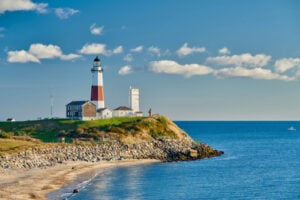
Feature Photo: Montauk Point Lighthouse in Montauk, New York. haveseen / Shutterstock.com
Long Island has always been shaped by the water around it. Stretching nearly 120 miles into the Atlantic, the island sits between ocean shipping routes, Long Island Sound, Gardiners Bay, Peconic Bay, and some of the most heavily traveled approaches to New York Harbor.
Before radar, satellite navigation, and GPS, mariners depended on charts, soundings, landmarks, fog signals, and lighthouse beams to help them find safe passages through dangerous shoals, reefs, bars, and tidal currents. Long Island’s lighthouses became essential parts of that system, guiding merchant ships, whalers, steamships, fishing vessels, and countless smaller craft.
The 10 lighthouses below span more than a century of Long Island maritime history. Some remain active aids to navigation. Others have become museums, municipal buildings, private landmarks, or restoration projects. Together they tell the story of how Long Island’s coastline was made safer for the people who traveled its waters.
1. Montauk Point Lighthouse
Location: Montauk Point, Suffolk County
Completed: 1796
Current Status: Active aid to navigation; National Historic Landmark and museum
Standing at the easternmost tip of Long Island, Montauk Point Lighthouse is the oldest lighthouse in New York State. Congress authorized the lighthouse in 1792 during the presidency of George Washington, and construction began in June 1796. The tower was completed on November 5 of that year.
The lighthouse became a critical navigational landmark for vessels approaching New York Harbor, Long Island Sound, and other ports along the eastern seaboard. Generations of whaling ships, steamers, submarines, fishing boats, and sailing vessels have passed Montauk Point with the tower serving as a reassuring landmark on Turtle Hill.
Erosion eventually became one of the lighthouse’s greatest threats. When it was constructed, the tower stood roughly 300 feet from the edge of the bluff. Decades of shoreline protection followed, including the celebrated terracing work associated with Giorgina Reid and, more recently, a major U.S. Army Corps of Engineers stone-revetment project completed in 2023. The Coast Guard transferred ownership of the lighthouse to the Montauk Historical Society in 1996, while the light continues to serve mariners.
2. Eatons Neck Lighthouse
Location: Eatons Neck, Northport, Suffolk County
Completed: 1798; first lit January 1, 1799
Current Status: Active U.S. Coast Guard aid to navigation
Eatons Neck Lighthouse is one of Long Island’s oldest surviving navigational landmarks. Congress appropriated money for the station in 1798, ten acres were purchased from John Gardiner, and President John Adams authorized construction on July 2. The lighthouse was completed that December and first lit on January 1, 1799.
The octagonal tower marks the eastern side of the entrance to Huntington Bay. Early lighting equipment proved inadequate, leading to repeated improvements during the 19th century. A third-order Fresnel lens was installed in 1858, and substantial renovations followed a decade later.
The 73-foot lighthouse was eventually electrified and automated, but unlike many historic stations that went dark, Eatons Neck remains an active aid to navigation. Its long service gives it an unusually direct connection between the earliest years of the United States lighthouse system and modern Long Island maritime traffic.
3. Sands Point Lighthouse
Location: Sands Point, Nassau County
Established: 1809
Current Status: Inactive historic lighthouse; privately owned
Sands Point Lighthouse was established in 1809 on the Cow Neck Peninsula to help vessels navigate the western end of Long Island Sound and the waters around Manhasset Bay. For more than a century, its tower served traffic passing the Gold Coast shoreline of northern Nassau County.
The station’s light was discontinued in 1922, when a new automated light was placed offshore. The lighthouse property was sold the following year to Alva Belmont, whose nearby Beacon Towers estate became one of the famous Gold Coast properties later associated with the world that helped inspire F. Scott Fitzgerald’s The Great Gatsby. Belmont sold the estate and lighthouse to newspaper publisher William Randolph Hearst in 1927.
The historic tower survived the subdivision and redevelopment of the larger property. Although it no longer functions as a lighthouse and is not generally open to the public, it remains an important survivor from the early federal lighthouse era on Long Island.
4. Execution Rocks Lighthouse
Location: Western Long Island Sound, offshore from Sands Point
First Lit: 1850
Current Status: Active aid to navigation
Execution Rocks Lighthouse stands on a low granite reef near the western entrance to Long Island Sound. The reef is exposed at low tide and can disappear beneath the water at high tide, making it a serious hazard to navigation. Congress appropriated money for a lighthouse there in 1847, construction was completed in 1849, and the light went into service in 1850.
The tapering granite tower was designed late in the career of architect and engineer Alexander Parris. A keeper’s dwelling was later added, and the light was upgraded with a fourth-order Fresnel lens in 1856. The station was automated in the 20th century and remains an active navigational aid.
Its ominous name produced stories that British forces had chained American prisoners to the rocks during the Revolutionary War and left them to drown with the rising tide. The United States Lighthouse Society notes that these stories have never been substantiated. The documented danger of the reef itself is dramatic enough: the lighthouse was built because ships needed a reliable warning against rocks that could vanish beneath Long Island Sound.
5. Horton Point Lighthouse
Location: Southold, North Fork, Suffolk County
First Lit: October 15, 1857
Current Status: Active navigational light; Nautical Museum open seasonally
Horton Point Lighthouse stands high above Long Island Sound on a bluff in Southold. Although the idea of a lighthouse at Horton Point reached back to the early federal period, the project did not move forward until the 1850s, when petitions emphasized the hazards facing the growing number of vessels traveling the Sound.
Congress made appropriations in 1854 and 1856, construction began in May 1857, and the light was first illuminated on October 15. The 58-foot tower originally held a third-order Fresnel lens, and its light shone from roughly 110 feet above sea level. Before the station was established, the waters off Horton Point had become notorious for shipwrecks caused by sandbars and glacial rocks.
The original tower was taken out of service in 1933 when an automatic skeletal light was installed nearby. During World War II, the light was extinguished and the lighthouse was used by the military as a lookout and observation site. A major restoration returned the historic tower to service in 1990, and the keeper’s house now contains Southold Historical Museum’s Nautical Museum.
6. Fire Island Lighthouse
Location: Western Fire Island, Suffolk County
Current Tower First Lit: November 1, 1858
Current Status: Active private aid to navigation within Fire Island National Seashore
For generations of ships crossing the Atlantic, Fire Island Lighthouse was one of the great signs that New York was near. The first lighthouse at the western end of Fire Island began service in 1826, but at only 74 feet tall it proved inadequate for the growing demands of navigation along the barrier island.
The present 168-foot tower was completed in 1858 and equipped with a first-order Fresnel lens. Its focal plane stood high enough above the sea for the light to be visible more than 20 nautical miles offshore. The tower did not receive its familiar black-and-white daymark until the 1890s.
The Coast Guard deactivated the lighthouse in 1974, and the neglected tower faced the possibility of demolition. The Fire Island Lighthouse Preservation Society formed in 1982 and helped raise the money needed for restoration. The beacon returned to service in 1986. Today the lighthouse is maintained as a private aid to navigation and remains one of Long Island’s most recognizable maritime landmarks.
7. Cedar Island Lighthouse
Location: Cedar Point County Park near Sag Harbor, Suffolk County
Current Structure: 1868–1869
Current Status: Decommissioned; restoration project
Cedar Island Lighthouse was established in 1839 to guide vessels traveling into Sag Harbor during the community’s great whaling era. The original station was a wooden keeper’s dwelling with a small tower rising from the roof. By the 1860s, that structure had deteriorated and was struggling to support its heavy lantern equipment.
Congress authorized a replacement in 1867, and the present granite lighthouse was constructed in 1868 and completed shortly afterward. The L-shaped keeper’s dwelling and square tower guided whalers, merchant vessels, fishing boats, and other traffic moving between Gardiners Bay and Sag Harbor.
The lighthouse was decommissioned in 1934. Four years later, the great Long Island hurricane of 1938 deposited enough sand between Cedar Island and the mainland to create a permanent connection, transforming the island into what is now Cedar Point. Suffolk County acquired the property in 1967. A 1974 fire destroyed the lighthouse’s interior and roof, but preservation groups and the county have continued working toward restoration.
8. Old Field Point Lighthouse
Location: Village of Old Field near Stony Brook, Suffolk County
Current Lighthouse Completed: 1869
Current Status: Active aid to navigation; first floor serves as Old Field Village Hall
Old Field Point has been marked by a lighthouse since the 1820s. Congress funded the first station in 1822 and 1823, and the original lighthouse was completed in 1824. Increasing traffic on Long Island Sound eventually led to construction of the larger lighthouse that stands today.
Work on the present Victorian Gothic Revival building began late in 1868 and was completed in September 1869. The massive granite structure combined the keeper’s residence and tower into one building and became a familiar landmark for mariners traveling the Sound.
Old Field also has a remarkable history of women lighthouse keepers. After the death of keeper Walter Smith in 1830, his wife Elizabeth served for 26 years. Their daughter, Mary Smith Foster, followed her and remained keeper until 1869. Today, the first floor of the lighthouse serves as Old Field Village Hall, while the tower continues to function as an aid to navigation.
9. Orient Point Lighthouse, the “Coffee Pot”
Location: Oyster Pond Reef in Plum Gut, off Orient Point, Suffolk County
First Lit: November 10, 1899
Current Status: Active aid to navigation; not open to the public
Orient Point Lighthouse stands in Plum Gut, the narrow and turbulent passage between Long Island’s North Fork and Plum Island. Powerful tidal currents made the channel dangerous enough that an offshore lighthouse was built directly on Oyster Pond Reef.
Construction began in 1898 and continued through difficult weather before the light was first shown on November 10, 1899. The cast-iron and brick-lined caisson lighthouse belongs to the family of offshore towers often called “sparkplug” lighthouses. Locally, Orient Point Light became known as the “Coffee Pot” because of its distinctive shape.
The station had to withstand heavy currents, winter ice, and repeated storms. Thousands of tons of riprap were eventually placed around its foundation for protection. The lighthouse survived proposals for removal in the 20th century and continues to mark the dangerous waters of Plum Gut.
10. Huntington Harbor Lighthouse
Location: Entrance to Huntington and Lloyd Harbors, Suffolk County
Completed: 1912
Current Status: Active aid to navigation; preserved by the Huntington Lighthouse Preservation Society
Huntington Harbor Lighthouse is one of the most architecturally unusual lights around Long Island. Congress appropriated money for a new station in 1907, and the lighthouse was completed in 1912 on a reef serving the entrances to Huntington and Lloyd Harbors.
The reinforced-concrete structure was designed in a Venetian Renaissance-influenced Beaux-Arts style that gives it the appearance of a small castle standing in the water. Its foundation crib was constructed on land, floated to the site, sunk onto the prepared reef, and filled with concrete to create a stable base.
The Coast Guard automated the light in 1949. By the 1980s, deterioration had become so severe that demolition was considered. Local residents and boaters organized to save the structure, eventually creating the preservation organization that owns it today. The 48-foot lighthouse remains active, with its navigational light maintained in cooperation with the U.S. Coast Guard.
10 Historic Long Island Lighthouses at a Glance
| Lighthouse | Date | Location | Current Status |
|---|---|---|---|
| Montauk Point Lighthouse | 1796 | Montauk | Active; museum and National Historic Landmark |
| Eatons Neck Lighthouse | 1798–1799 | Northport | Active Coast Guard aid |
| Sands Point Lighthouse | 1809 | Sands Point | Inactive; privately owned |
| Execution Rocks Lighthouse | 1850 | Western Long Island Sound | Active aid to navigation |
| Horton Point Lighthouse | 1857 | Southold | Active light; nautical museum |
| Fire Island Lighthouse | 1858 | Fire Island | Active private aid; public landmark |
| Cedar Island Lighthouse | 1868–1869 | Cedar Point / Sag Harbor | Inactive; restoration project |
| Old Field Point Lighthouse | 1869 | Old Field | Active; Village Hall |
| Orient Point Lighthouse | 1899 | Plum Gut | Active aid to navigation |
| Huntington Harbor Lighthouse | 1912 | Huntington Bay | Active; preservation society |
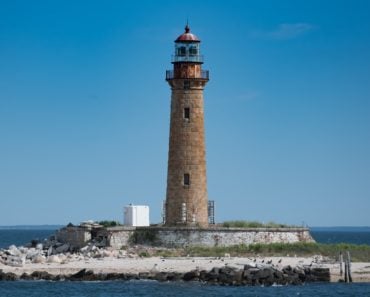
Long Island’s lighthouse history extends beyond these 10 landmarks. Readers can explore our full history of Little Gull Island Lighthouse and learn more about the East End’s maritime past in our account of the Battle of Sag Harbor during the American Revolution.
Sources
Montauk Historical Society — Montauk Point Lighthouse History
U.S. Army Corps of Engineers — Montauk Point Coastal Preservation
U.S. Coast Guard — Eatons Neck Light
Lighthousefriends.com — Sands Point Lighthouse
United States Lighthouse Society — Execution Rocks Lighthouse
Southold Historical Museum — Horton Point Lighthouse History
National Park Service — Fire Island Lighthouse History
Cedar Island Lighthouse — History
Village of Old Field — Old Field Lighthouse History
Lighthousefriends.com — Orient Point Lighthouse
Huntington Lighthouse Preservation Society — Lighthouse History
Published September 2, 2026.