
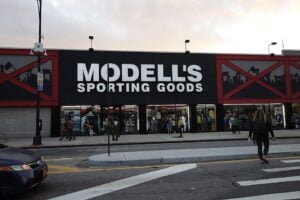
Feature Photo: Modell’s Sporting Goods at Atlantic Terminal in Brooklyn, New York. Tdorante10, CC BY-SA 4.0, via Wikimedia Commons.
New York City once had a sporting-goods-store culture as distinctive as its department stores, record shops, and neighborhood hardware stores. Before online shopping changed the way people bought athletic equipment, New Yorkers went to stores where they could try on a baseball glove, have a tennis racquet restrung, get fitted for running shoes, buy a hockey stick, pick out camping gear, or order uniforms for an entire team.
Some of these businesses became enormous regional chains. Others were neighborhood institutions known mainly to nearby athletes. Manhattan had grand sporting-goods emporiums and specialty outfitters, while Brooklyn, Queens, and the Bronx had stores that supplied generations of Little League players, runners, skaters, fishermen, school teams, and weekend athletes.
This is not a ranking, and not every company on the list has disappeared completely. In several cases, the company or brand survives elsewhere, but the New York City store, retail banner, or classic sporting-goods era described here is gone. These are 25 sporting goods stores and athletic retail landmarks New York City has lost.
1. Modell’s Sporting Goods
New York City Roots: Founded on Cortlandt Street in Lower Manhattan
Classic Retail Era: 1889–2020
For generations of New Yorkers, sporting goods meant Modell’s. Morris A. Modell opened the original store on Cortlandt Street in 1889, and the family business eventually grew into a regional chain with locations throughout the five boroughs and the Northeast.
Modell’s sold everything from baseball gloves and basketballs to sneakers, exercise equipment, team jerseys, and winter gear. Its “Gotta Go to Mo’s!” advertising became part of New York culture, and the stores were especially busy whenever a local team made a championship run. By 2020, however, Modell’s was struggling with debt, changing shopping habits, and a difficult retail environment. The company filed for Chapter 11 bankruptcy and began liquidating its remaining stores, bringing its 131-year physical retail run to an end.
2. Herman’s World of Sporting Goods
New York City Roots: Lower Manhattan
Classic Retail Era: 1916–1996
Herman’s began in 1916 when Herman and Eddie Steinlauf opened a store on Nassau Street in Lower Manhattan. The business started as a music store before moving heavily into sporting goods and eventually becoming one of the largest sporting-goods chains in the country.
New Yorkers remember Herman’s for its enormous selection of equipment for skiing, tennis, camping, baseball, basketball, running, and countless other sports. The chain expanded far beyond New York, but financial problems and heavy debt eventually led to bankruptcy proceedings. Herman’s liquidated in 1996, and Modell’s acquired a number of former Herman’s locations.
3. Gerry Cosby & Co.’s New York Stores
New York City Connection: Madison Square Garden and the Penn Plaza area
NYC Retail Era: Mid-20th century–2010s
Gerry Cosby was already an accomplished hockey goaltender before his name became one of the most respected names in New York sporting goods. Cosby helped the United States win the 1933 World Ice Hockey Championship and later became closely associated with the New York Rangers and the sporting world surrounding Madison Square Garden.
Gerry Cosby & Co. became famous for hockey equipment, jerseys, protective gear, customization, and team supplies. For decades, stopping at Cosby’s was part of the Madison Square Garden experience for hockey fans. The business later operated near Penn Plaza after leaving the Garden itself. The company still exists, but its current physical store is in Sheffield, Massachusetts; the famous New York City retail era is gone.
4. Davega Stores
New York City Roots: Founded in New York City
Retail Era: 1879–1963
Davega was selling sporting goods in New York long before anyone had heard the phrase “big-box retailer.” Founded in the city in 1879, Davega developed into a chain selling sporting goods alongside radios, televisions, appliances, clothing, and other consumer merchandise.
For early- and mid-20th-century New Yorkers, Davega offered baseball equipment, skates, outdoor goods, and other sporting merchandise in stores around the city. The company ultimately went bankrupt in 1963. Some Davega locations were acquired by the parent company of Modell’s, creating an interesting link between two very different generations of New York sporting-goods retailing.
5. Abercrombie & Fitch’s Original Sporting-Goods Era
New York City Connection: Madison Avenue at East 45th Street
Original Outfitter Era: 1892–1977
Long before Abercrombie & Fitch became known as a fashion retailer, the original New York company was one of the most celebrated sporting and outdoor outfitters in the world. David T. Abercrombie began the business in 1892, and Ezra Fitch later helped transform it into a legendary destination for affluent sportsmen, explorers, travelers, and adventurers.
The enormous Madison Avenue store carried fishing tackle, camping equipment, golf and tennis gear, outdoor clothing, expedition supplies, and other sporting goods. Famous customers included prominent athletes, writers, explorers, and political figures. The original company fell into bankruptcy during the 1970s, and its Madison Avenue liquidation in 1977 ended a remarkable chapter of New York retail history. The modern Abercrombie & Fitch brand is a very different business from the old sporting-goods outfitter remembered here.
6. Triangle Sports
Location: 182 Flatbush Avenue, Brooklyn
Retail Era: 1916–2012
Triangle Sports stood in its distinctive wedge-shaped building near the intersection of Flatbush Avenue, Fifth Avenue, and Dean Street for nearly a century. The family business began in 1916 as an Army surplus store and evolved into a full sporting-goods and outdoor retailer.
Brooklyn customers came to Triangle for athletic equipment, footwear, camping supplies, winter clothing, uniforms, and countless other items. The neighborhood around the store changed dramatically when Barclays Center was constructed directly across the street. The owners decided to sell the valuable property, and Triangle Sports closed in 2012 after approximately 96 years in business.
7. Tent & Trails
Location: 21 Park Place, Lower Manhattan
Park Place Era: 1972–2018
Tent & Trails was the kind of New York store where serious outdoor people could spend hours. The family business had roots in United Chambers Trading, which opened on Chambers Street in 1956, before Tent & Trails became a fixture at 21 Park Place in the early 1970s.
The multi-floor shop carried hiking boots, backpacks, tents, climbing equipment, expedition clothing, sleeping bags, and technical outdoor gear. Its cramped, merchandise-packed layout was part of the experience. The store closed in June 2018 after nearby construction created structural problems for the building. What was initially described as a temporary closure became permanent, ending one of Lower Manhattan’s great outdoor-retail institutions.
8. Blades Board & Skate
New York City Connection: Multiple Manhattan stores, including Broadway and West 72nd Street
Peak Era: 1990s–2010s
Anyone who remembers the great New York inline-skating boom of the 1990s probably remembers Blades. At its peak around 1998, Blades had at least eight New York City stores and became one of the city’s most visible retailers for inline skates, skateboards, snowboards, and related street-sports equipment.
The West 72nd Street shop was particularly closely associated with the Central Park skating scene. As inline skating faded from its 1990s peak and retail conditions changed, the chain gradually shrank. Its longtime West 72nd Street store closed in 2016, and the final Blades location closed in 2020.
9. Eastern Mountain Sports’ New York City Stores
New York City Connection: SoHo and the Upper West Side
NYC Store Era: Ended in 2016
Eastern Mountain Sports brought the northeastern outdoor-store tradition directly into Manhattan. Its New York shops catered to climbers, hikers, kayakers, campers, skiers, and New Yorkers who might spend the workweek in the city but head for the mountains on weekends.
The two-floor Upper West Side location at Broadway and West 76th Street closed in February 2016. The SoHo store on Broadway closed shortly afterward as the chain’s parent company went through bankruptcy proceedings. Eastern Mountain Sports has continued as a brand outside New York City, but its large Manhattan retail presence belongs to an earlier era.
10. Alex Taylor & Co.
Location: 22 East 42nd Street, Manhattan
Classic Era: Late 1890s–20th century
Alex Taylor & Co. was a sporting-goods institution on East 42nd Street long before modern athletic superstores appeared. In 1947, The New Yorker described Alex Taylor as entering his 50th year on 42nd Street, a remarkable run in one of Manhattan’s busiest commercial districts.
The store served golfers, skiers, tennis players, squash players, school athletes, and other sports enthusiasts. Period accounts described everything from ski equipment and racquets to specialized training and sporting accessories. Alex Taylor represented an era when a knowledgeable Midtown sporting-goods merchant could build a reputation over decades of personal service.
11. A.G. Spalding & Bros. New York Stores
New York City Connection: Fifth Avenue and other Manhattan locations
Historic Retail Era: Late 19th–mid-20th century
A.G. Spalding & Bros. helped shape the sporting-goods business itself. Founded by baseball pioneer Albert Goodwill Spalding, the company manufactured equipment for baseball and a rapidly expanding range of other sports while operating major retail locations in New York City.
By the early 20th century, the Spalding store on Fifth Avenue was one of Manhattan’s premier places to shop for racquets, baseball equipment, golf gear, skis, athletic clothing, and other sporting goods. The Spalding name still exists as an equipment brand, but the grand company-operated Manhattan sporting-goods stores are long gone.
12. Sports Authority
New York City Connection: Manhattan, the Bronx, Brooklyn, and Queens
Chain Era: 1987–2016
Sports Authority represented the big-box phase of sporting-goods retailing. Its New York City stores offered huge selections of fitness equipment, athletic clothing, sneakers, team-sports equipment, golf merchandise, camping supplies, and seasonal goods under one roof.
By 2016, Sports Authority was overwhelmed by debt and intense competition. The company filed for bankruptcy and moved toward liquidation. New York City locations included the large Third Avenue store in Manhattan as well as stores in the Bronx, Brooklyn, and Queens. By the end of 2016, the national chain was gone.
13. City Sports
New York City Connection: Manhattan locations
Chain Era: 1983–2015
City Sports was founded in Boston, but its urban retail model was a natural fit for Manhattan. The stores catered heavily to runners, gym members, tennis players, and city residents who wanted athletic footwear and technical clothing without traveling to a suburban sporting-goods warehouse.
The company expanded throughout the Northeast before filing for bankruptcy in 2015. A planned reorganization failed to produce a buyer willing to keep the chain operating, and liquidation sales began at all remaining City Sports locations in November 2015. Its Manhattan stores disappeared along with the original chain.
14. JackRabbit
New York City Connection: Union Square, Upper West Side, Brooklyn, and other locations
JackRabbit Brand Era: 2000s–2022
JackRabbit became one of the defining specialty running stores of modern New York. Its stores were built around serious shoe fitting, running analysis, training advice, and a strong connection to New York’s enormous running community.
Fleet Feet acquired JackRabbit in 2021 and announced that the JackRabbit name would be transitioned to Fleet Feet by the end of 2022. Many of the physical retail locations continued under the Fleet Feet banner, but the familiar JackRabbit identity that New York runners knew disappeared.
15. Footaction USA
New York City Connection: Major Manhattan and outer-borough shopping districts
Banner Era: Ended in 2021–2022
Footaction became a major part of New York’s sneaker-shopping landscape, especially as basketball footwear, signature sneakers, athletic warm-ups, and sportswear became inseparable from street fashion. Its stores appeared in high-traffic shopping districts around the city.
Parent company Foot Locker decided in 2021 to wind down the Footaction banner, converting some stores to other concepts and closing the rest. During the fourth quarter of 2021 alone, Foot Locker reported closing 120 Footaction stores while converting 45 others to different banners. The Footaction name subsequently disappeared from New York retail.
16. Peck & Snyder
Location: Nassau Street, Lower Manhattan
Original Retail Era: 1866–1894
Peck & Snyder reaches back to the earliest days of organized American sport. Andrew Peck and W. Irving Snyder created their New York sporting-goods business in the 1860s, operating on Nassau Street and selling equipment for the fast-growing game of baseball along with other sporting goods.
The company also occupies an important place in baseball-card history. Its advertising cards featuring the 1869 Cincinnati Red Stockings are regarded among the earliest commercial baseball cards. A.G. Spalding acquired Peck & Snyder in 1894 and gradually absorbed the old sporting-goods business. The Peck & Snyder name has since been revived as a modern apparel brand, but the original Nassau Street sporting-goods store belongs to 19th-century New York.
17. Von Lengerke & Detmold
New York City Connection: Lower Manhattan, Fifth Avenue, and Madison Avenue
Retail Era: 1882–1929
Von Lengerke & Detmold was one of New York’s premier sporting outfitters in the late 19th and early 20th centuries. Founded in 1882, the firm built its reputation selling high-quality fishing, camping, hunting, and outdoor equipment to demanding customers.
The company occupied a succession of important Manhattan addresses as the city’s retail center moved uptown. In 1928, Abercrombie & Fitch acquired Von Lengerke & Detmold, and the New York operation was folded into Abercrombie shortly afterward. The acquisition brought together two of the city’s great old sporting-goods houses.
18. Baker, Murray & Imbrie
New York City Connection: Warren Street and 97 Chambers Street
Classic Era: Early 20th century
Baker, Murray & Imbrie was another major name in Lower Manhattan sporting goods. The company sold a broad range of equipment for fishing, camping, golf, tennis, and other outdoor pursuits, serving customers at a time when the blocks around Chambers Street contained an extraordinary variety of specialty merchants.
In April 1920, Baker, Murray & Imbrie moved its large retail operation from Warren Street to 97 Chambers Street. The company also had connections to the complicated early history of the Abercrombie sporting-goods businesses. Its old retail operation vanished long ago, but the Chambers Street building remains a reminder of the area’s commercial history.
19. Schoverling, Daly & Gales
New York City Connection: Broadway, Lower Manhattan
Classic Era: Late 19th–early 20th century
Schoverling, Daly & Gales belonged to an earlier generation of New York sporting-goods merchants, when fishing tackle, outdoor gear, athletic equipment, and other sportsman’s supplies were concentrated among specialized downtown dealers.
The Smithsonian’s National Museum of American History preserves a 1905 Schoverling, Daly & Gales fishing-tackle catalog from New York. Historical records place the firm at 302 Broadway during the early 20th century. The business eventually evolved through later corporate names, but its old Broadway sporting-goods-store identity disappeared with the changing downtown retail district.
20. Urban Athletics
New York City Connection: World Financial Center and Madison Avenue
Opened: 1995
Urban Athletics became a favorite among serious New York runners. Jerry Macari opened the first store at the World Financial Center in 1995 and later added a Madison Avenue location. The business combined running shoes and gear with the kind of personal advice that helped specialty running stores build fiercely loyal followings.
Urban Athletics also became part of the city’s running community through clubs, training, and events. The physical stores eventually closed, leaving longtime customers to remember a period when independent running shops played an especially visible role in New York’s road-racing culture.
21. NikeTown New York
Location: 6 East 57th Street, Manhattan
Retail Era: 1996–2018
NikeTown was not simply another Nike store. When it opened on East 57th Street in November 1996, the five-story flagship was designed as an athletic spectacle, combining product displays with the atmosphere of an old New York gymnasium and the emerging culture of sneakers as fashion.
For more than two decades, NikeTown became a Midtown destination for tourists, athletes, runners, basketball fans, and sneaker collectors. Nike closed the 57th Street flagship in spring 2018 as it prepared a new Manhattan flagship. Nike remains a major New York retailer, but the original NikeTown experience at 6 East 57th Street is gone.
22. Atlantic Center & Sports
Location: 32-90 Steinway Street, Astoria, Queens
Retail Era: Early 1980s–2018
Atlantic Center & Sports was the opposite of the giant national chains. Nick Kapatos opened the independent Steinway Street shop in the early 1980s, and the store became a neighborhood destination for sporting and outdoor equipment, particularly fishing and outdoor gear.
The storefront changed very little over the decades, which only added to its old-school character. After nearly 40 years, Kapatos decided to retire when faced with a rent increase. Atlantic Center & Sports closed at the end of March 2018, ending one of Astoria’s longest-running independent sporting-goods businesses.
23. The Dugout Sporting Goods
Location: Castle Hill Avenue, the Bronx
Retail Era: Approximately 1976–2023
The Dugout was a true neighborhood sporting-goods store. For 47 years, Bronx families came there for baseball gloves, team equipment, uniforms, and other athletic supplies. The store developed relationships that lasted across generations, with parents eventually bringing in children of their own.
The Dugout also sponsored Little League teams and adult softball leagues, making it part of the neighborhood’s sports culture rather than simply a place to buy equipment. Owner Linda Lionetti announced her retirement, and the store closed on January 23, 2023. Its departure was another reminder of how difficult it has become for traditional neighborhood sporting-goods stores to survive.
24. Sports Fever’s Retail Sporting-Goods Era
Location: Avenue U, Brooklyn
Retail Era: Nearly five decades
Sports Fever served Brooklyn customers for decades as a traditional sporting-goods store, selling equipment and apparel for school teams, youth sports, and individual athletes. The Avenue U business became especially valuable for customers who wanted personal fitting and team-oriented service rather than the anonymous experience of a giant chain.
After 48 years of serving the public, the company announced that it would no longer operate as a traditional retail sporting-goods store. Sports Fever continued in a different form, supplying and designing apparel for schools, organizations, teams, and companies, but its old walk-in sporting-goods retail era came to an end.
25. Sprint Sports
Location: 2511 Broadway, Upper West Side
Retail Era: 1986–2022
Sprint Sports opened on Broadway between West 93rd and West 94th Streets in 1986. Owner Dany Ghatan and his staff built a loyal neighborhood following by specializing in athletic shoes and apparel and by giving customers the kind of careful fitting and personal service that online shopping cannot reproduce.
After more than 35 years, Ghatan decided it was time to retire. Rising costs, pandemic-era supply problems, and other pressures had made running a small retail business increasingly difficult. Sprint Sports closed in 2022, ending another long-running Upper West Side shopping tradition.
Readers who enjoy New York sports history can continue with our complete history of the New York Yankees, complete history of the New York Mets, complete history of the New York Knicks, and complete history of the New York Rangers. For another look at the city’s changing shopping landscape, see our article on the most famous department stores in New York City history.
Sources
Reuters via Investing.com — Modell’s Files for Bankruptcy Protection
Gerry Cosby & Co. — Company History
Smithsonian National Museum of American History — Davega Stores
The Washington Post — Abercrombie & Fitch’s 1977 Liquidation
Brooklyn Paper — Triangle Sports Closing After 96 Years
Tribeca Citizen — The Days of Tent & Trails
NYCSK8 — Blades Board & Skate History
DNAinfo — Eastern Mountain Sports Upper West Side Closing
The New Yorker — Alex Taylor & Co.
The New Yorker — Spalding and New York Sporting-Goods Shopping
The Real Deal — Sports Authority’s New York City Stores
Gordon Brothers / PR Newswire — City Sports Liquidation
National Sporting Goods Association — Fleet Feet Acquires JackRabbit
Foot Locker, Inc. — Footaction Store Closures and Conversions
Major League Baseball — Peck & Snyder and Early Baseball Retail History
Cornell Publications — Von Lengerke & Detmold History
Tribeca Citizen — Baker, Murray & Imbrie at 97 Chambers Street
Smithsonian National Museum of American History — Schoverling, Daly & Gales Catalog
QNS — Atlantic Center & Sports Closing
News 12 The Bronx — The Dugout Sporting Goods Closing
Sports Fever — End of Traditional Retail Sporting-Goods Operations
West Side Rag — Sprint Sports Closing
FashionUnited — NikeTown New York Closing and Flagship Transition
Published September 3, 2026.







_23_-_Modell%27s.jpg)