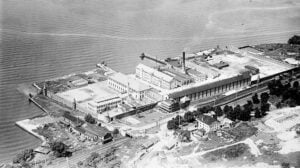
Feature Photo: Aerial view of Sing Sing Prison in Ossining, New York, 1920. Bain News Service, Library of Congress, Public Domain, via Wikimedia Commons.
New York has housed some of the most famous jails and prisons in American history, from the old Tombs in Lower Manhattan and Sing Sing on the Hudson River to Rikers Island and the maximum-security walls of Clinton Correctional Facility in Dannemora.
Over nearly two centuries, some prisoners managed to get beyond those walls in escapes that became newspaper sensations, triggered enormous manhunts, exposed security failures, or passed into New York criminal folklore. Some stayed free for only hours. Others remained fugitives for months or years.
The 10 escapes below are presented chronologically rather than ranked. They include city jails, county correctional facilities, and New York State prisons, with the focus on escapes that were especially unusual, historically significant, or widely reported.
1. John Mahony, the Four-Time Escape Artist of the Tombs
Era: 1860–1880
Facility: The Tombs, Lower Manhattan
Known For: Escaping from the Tombs four separate times
Long before the famous escape artists of the 20th century, John Mahony built a reputation as one of New York’s most persistent jail-breakers. According to a 1941 history of the Tombs published by The New Yorker, Mahony escaped from the notorious Lower Manhattan jail four times. His first break came in 1860, when he was only 16 years old, and his last came in 1880.
Mahony’s career in escape did not stop at the Tombs. He also managed to get out of Sing Sing, Rikers Island Penitentiary, an Army guardhouse, a Washington jail, and police custody in Philadelphia, and he once escaped from guards while being transported by train in New York State. His fourth escape from the Tombs reportedly caused other prisoners to cheer.
2. Ned and Sophie Lyons Escape from Sing Sing
Date: December 1872
Facility: Sing Sing Prison, Ossining
Inmates: Ned Lyons and Sophie Lyons
Ned and Sophie Lyons were among the most notorious thieves and confidence criminals of 19th-century New York. Both ended up imprisoned at Sing Sing at the same time, with Ned confined in the men’s prison and Sophie in the women’s prison across the road.
Ned escaped first in December 1872. Sophie followed later that month after taking advantage of the relative freedom she had gained while working for the head matron. Contemporary and later accounts describe an escape plan involving outside help and access to a prison-door key. The couple fled to Canada and remained fugitives for years before eventually returning to the United States.
The dual escape became one of the more remarkable episodes of the criminal career Sophie later described in her autobiography, Why Crime Does Not Pay.
3. William J. Sharkey Walks Out of the Tombs in Disguise
Date: November 23, 1873
Facility: The Tombs, Lower Manhattan
Inmate: William J. Sharkey
William J. Sharkey was a New York political figure and convicted murderer awaiting execution when he pulled off one of the most famous escapes in the history of the Tombs.
During a visiting day on November 23, 1873, Sharkey changed into women’s clothing and covered his face with a heavy veil. Guards later remembered a strangely dressed woman leaving the jail, but by the time they discovered Sharkey’s clothing and the remains of his shaved mustache in his cell, he was gone.
The escape embarrassed the Tombs and led to the dismissal of several keepers. Sharkey was never returned to New York custody. Later reports placed him abroad, and The New Yorker reported that he eventually turned up in Ireland, where he lived the rest of his life.
4. Willie Sutton Scales the Wall at Sing Sing
Date: December 11, 1932
Facility: Sing Sing Prison, Ossining
Inmate: Willie Sutton
Willie Sutton became famous as one of America’s most accomplished bank robbers, but he was also an experienced escape artist. After being sentenced to 30 years for assault and robbery, Sutton escaped from Sing Sing on December 11, 1932.
The FBI records that Sutton used two nine-foot sections of ladder that had been joined together to scale the prison wall. He remained free until February 1934, when he was arrested again after returning to bank robbery.
Sutton would later escape from prisons in Pennsylvania as well, but the Sing Sing breakout remains the New York escape most closely associated with the man who became known as “The Actor.”
5. Robert Garrow Escapes from Fishkill
Date: September 8, 1978
Facility: Fishkill Correctional Facility, Dutchess County
Inmate: Robert Garrow
Robert Garrow was a convicted murderer whose crimes had already triggered a massive Adirondack manhunt in 1973. While incarcerated, he presented himself as severely disabled and was eventually transferred to the less restrictive setting at Fishkill Correctional Facility.
On September 8, 1978, Garrow escaped from Fishkill by scaling a 15-foot fence. Investigators discovered that he was armed with a pistol that had been smuggled into the prison by his son. His ability to move under his own power also revealed that his physical limitations had been greatly exaggerated.
A new manhunt began around the prison. Garrow remained at large for several days before correction officers located him. He was shot and killed after opening fire during the confrontation. The escape intensified scrutiny of the decisions and security failures that had allowed such a dangerous prisoner to reach a less secure setting.
6. The 1986 Sing Sing Smoke-Bomb Escape
Date: December 9, 1986
Facility: Sing Sing Correctional Facility, Ossining
Inmates: Julio Giano, Thomas Linz, and Darius Gittens
More than half a century after Willie Sutton escaped Sing Sing, three inmates broke out of the famous Hudson River prison in December 1986. The men escaped from a second-floor bathroom area and used homemade smoke devices to obscure the view as they fled toward the railroad tracks outside the prison.
The breakout immediately disrupted rail service along the Hudson and brought more than 100 law-enforcement officers into the search. Darius Gittens was captured at a nearby train station only hours after the escape. Thomas Linz and Julio Giano remained free longer, but both were back in custody by December 11.
The incident showed that even one of New York’s most famous maximum-security prisons could still be vulnerable to a carefully planned breakout.
7. Michael DiCarluccio Hides in the Trash at Rikers Island
Date: February 24, 1989
Facility: Rikers Island
Inmate: Michael DiCarluccio
One of the strangest escapes from Rikers Island involved a garbage run. Michael DiCarluccio, who was being held on attempted-murder charges, disappeared while assigned to a garbage detail in February 1989.
Correction officials said DiCarluccio concealed himself in a dumpster that was placed on a truck leaving the island. The escape was not discovered until the vehicle approached a disposal site in College Point, Queens, where the driver saw someone jump from the truck.
DiCarluccio remained free for two days. Correction officers found him hiding in the basement of a Queens apartment building where he had previously worked as a janitor, and he surrendered without incident.
8. Four Inmates Break Out of Shawangunk
Date: November 7, 1994
Facility: Shawangunk Correctional Facility, Ulster County
Inmates: John Beuther, Patrick Proctor, Sean Ryan, and Keith Hart
Shawangunk Correctional Facility had been open for only eight years when four inmates broke out of the maximum-security prison in November 1994. It was the first successful escape from the institution.
The escape triggered a large ground-and-air search. John Beuther was caught on prison property, while the other three made it beyond the immediate perimeter. Patrick Proctor and Sean Ryan were located near a water tower, both suffering injuries associated with getting through the prison’s razor wire. Keith Hart was found later that day in nearby woods.
All four men were back in custody by the following day. One of them, Sean Ryan, was a member of the Westies gang from Hell’s Kitchen and had previously escaped from Rikers Island.
9. Ralph “Bucky” Phillips Escapes from Erie County Custody
Date: April 2, 2006
Facility: Erie County Correctional Facility, Alden
Inmate: Ralph “Bucky” Phillips
Ralph “Bucky” Phillips turned a county-jail escape into one of the largest and most dangerous manhunts in modern New York history. Phillips escaped from the Erie County Correctional Facility in the early morning of April 2, 2006, after breaching the roof of a kitchen work area.
A New York State Commission of Correction investigation later found serious security, staffing, and management failures at the facility. Phillips remained at large for more than five months, moving through western New York and neighboring Pennsylvania while authorities linked him to burglaries, stolen vehicles, and the shootings of New York State troopers.
State Trooper Joseph Longobardo died after being shot during the manhunt. Phillips finally surrendered near the Pennsylvania border on September 8, 2006. He later pleaded guilty to charges connected to the shootings and received a life sentence.
10. Richard Matt and David Sweat Escape from Dannemora
Date: June 6, 2015
Facility: Clinton Correctional Facility, Dannemora
Inmates: Richard Matt and David Sweat
The 2015 escape of convicted murderers Richard Matt and David Sweat from Clinton Correctional Facility became one of the most famous prison breaks in modern American history.
Matt and Sweat spent months exploiting access to service areas behind their cells and eventually made their way through the prison’s internal infrastructure and out through a manhole beyond the walls. Prison employee Joyce Mitchell and correction officer Gene Palmer were later convicted for conduct that helped the escape.
The discovery that the two men were missing on June 6 launched a massive 23-day manhunt across northern New York. Hundreds of law-enforcement officers searched forests, roads, camps, and communities near the Canadian border. Matt was shot and killed by authorities on June 26. Two days later, State Police Sgt. Jay Cook shot and captured Sweat near Constable, New York.
A subsequent investigation by the New York State Inspector General found chronic complacency, failures in cell searches and night counts, inadequate employee screening, and other major security breakdowns that allowed the escape plan to develop without detection.
10 Notorious New York Prison Escapes at a Glance
| Escape | Facility | Year | Outcome |
|---|---|---|---|
| John Mahony | The Tombs | 1860–1880 | Escaped from the Tombs four times; repeatedly recaptured |
| Ned and Sophie Lyons | Sing Sing | 1872 | Both escaped and fled to Canada |
| William J. Sharkey | The Tombs | 1873 | Escaped in disguise and was never returned to New York custody |
| Willie Sutton | Sing Sing | 1932 | Remained free until 1934 |
| Robert Garrow | Fishkill | 1978 | Killed after being located near the prison |
| Giano, Linz, and Gittens | Sing Sing | 1986 | All three recaptured within two days |
| Michael DiCarluccio | Rikers Island | 1989 | Recaptured in Queens two days later |
| Four Shawangunk inmates | Shawangunk | 1994 | All recaptured by the following day |
| Ralph “Bucky” Phillips | Erie County Correctional Facility | 2006 | Captured after more than five months |
| Richard Matt and David Sweat | Clinton Correctional Facility | 2015 | Matt killed; Sweat captured after a 23-day manhunt |
Readers interested in more of New York’s darker history can explore the history of Rikers Island and our look at 10 unsolved New York City mysteries.
Sources
Encyclopedia.com — Sophie Lyons
Federal Bureau of Investigation — Willie Sutton
Times Union — Robert Garrow Timeline and Fishkill Escape
UPI — Michael DiCarluccio’s Rikers Island Escape
UPI — Shawangunk Correctional Facility Escape
New York State Commission of Correction Report — Ralph Phillips Escape
New York State Inspector General — Clinton Correctional Facility Escape Investigation
Published September 3, 2026.