
Feature Photo: Claudine Van Massenhove / Shutterstock.com
New York City has two very different places where extraordinary concentrations of portable wealth can be found within a few miles of each other. In Midtown Manhattan, the Diamond District fills a single block of West 47th Street with jewelers, diamond dealers, cutters, wholesalers, appraisers, and exchanges. Downtown, the Federal Reserve Bank of New York stores the world’s largest known depository of monetary gold deep beneath its headquarters.
The two places are sometimes lumped together in stories about New York’s wealth, but they serve completely different purposes. The Diamond District is a working commercial marketplace where diamonds, jewelry, watches, and some precious metals are bought and sold. The Federal Reserve gold vault is a custodial facility for governments, central banks, and official international organizations. It is not a place where members of the public can buy gold.
Where Is the NYC Diamond District?
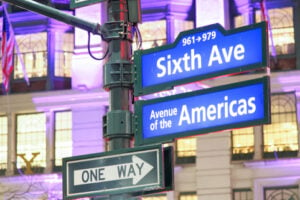
The New York City Diamond District is located on West 47th Street between Fifth Avenue and Sixth Avenue, also known as Avenue of the Americas, in Midtown Manhattan. It is immediately south of Rockefeller Center and only a short walk from Times Square.
The district occupies just one block, but the amount of jewelry business concentrated there is extraordinary. When New York City formally opened the 47th Street Diamond District Business Improvement District in 1997, the city reported more than 2,600 independent businesses operating on the block. At that time, city officials said at least three-quarters of all diamonds entering the United States passed through the district.
Another often-repeated statistic claims that roughly 90 percent of diamonds entering the United States pass through the Diamond District itself. That wording is too broad. New York City officials have historically said that about 90 percent of diamonds entering the United States pass through dealers in New York City, while the 1997 figure specifically tied to the one-block 47th Street district was at least three-quarters.
What Is the NYC Diamond District Like?
Unlike a conventional shopping street lined only with large storefronts, much of the Diamond District operates inside multi-dealer jewelry exchanges and office buildings. A single address can contain numerous independent diamond and jewelry businesses, while other merchants operate traditional street-level stores.
That concentration is one reason the block feels so different from the polished Fifth Avenue retail corridor only steps away. Wholesale dealers, retailers, brokers, cutters, appraisers, watch sellers, and jewelry manufacturers can all be conducting business within the same building.
The district has also preserved a style of commerce that predates modern online shopping. Smithsonian Magazine described 47th Street as a marketplace where personal reputation and long-standing relationships remain unusually important, and where major transactions can still be sealed with a handshake.
Before 47th Street, New York’s Jewelry Trade Was on Maiden Lane
The Diamond District did not begin in Midtown. From the middle of the 19th century into the early 20th century, Maiden Lane in Lower Manhattan was one of New York’s principal jewelry and diamond centers. Its location close to Wall Street placed jewelers, precious-metal businesses, banks, and merchants within the same commercial neighborhood.
During the 1920s, the diamond trade began moving uptown. As banks and financial companies expanded downtown and rents increased, jewelry and diamond businesses searched for less expensive space farther north. West 47th Street gradually emerged as the new center.
This means the history of New York’s Diamond District is really the story of two Manhattan neighborhoods: Maiden Lane in the Financial District and West 47th Street in Midtown.
How World War II Changed the Diamond District
The most important transformation came during the years surrounding World War II. Antwerp and Amsterdam had long been among the great centers of the European diamond trade. As Nazi persecution and war devastated Jewish communities and disrupted the European diamond industry, refugee diamond merchants came to New York and strengthened the growing trade on 47th Street.
Smithsonian’s history of the district notes that 47th Street became substantially more important as refugee diamond merchants arrived during World War II. Their international connections, technical knowledge, family businesses, and trading relationships helped turn New York into one of the major centers of the postwar diamond world.
The district’s identity remained strongly connected to Jewish diamond merchants for generations, but it continued changing with later waves of immigration. Indian merchants became increasingly important beginning in the late 20th century as India, particularly Mumbai and Gujarat, grew into a major global center for diamond cutting and polishing.
The Diamond Dealers Club Was Founded Before the Midtown District Took Over
One of the original draft’s biggest historical problems was the suggestion that the Diamond Dealers Club was established on 47th Street in 1931. The Diamond Dealers Club was indeed founded in 1931, but its own history says the organization began in an office in Lower Manhattan, where New York’s diamond business was still centered.
The club was created to give diamond merchants a secure place to trade and to establish standards for business conduct. Its membership grew dramatically as European diamond dealers came to the United States during and after World War II. The Diamond Dealers Club eventually became one of the defining institutions of the 47th Street trade and today describes itself as the largest and oldest organization active in the United States diamond industry.
How Much Diamond Business Takes Place on 47th Street?
Some published descriptions of the district claim that approximately $400 million in transactions take place there on an average day. That number has been repeated by the Diamond District Partnership and in later reporting, but it should be treated as an industry estimate rather than a precise daily count.
What is better documented is the extraordinary concentration of the trade. New York City’s 1997 opening of the Diamond District BID described more than 2,600 businesses on the one-block district and said the vast majority of diamonds entering the United States came through New York City dealers working there.
That is remarkable density even by Manhattan standards. A single block became an international marketplace connecting miners, cutters, wholesalers, jewelers, manufacturers, collectors, and consumers.
Can You Buy Gold Bars in the NYC Diamond District?
Yes, some businesses in and around the Diamond District sell bullion, gold coins, precious-metal products, and estate jewelry, but 47th Street is primarily known for diamonds and fine jewelry rather than as a single standardized bullion exchange. Inventory and services vary widely from dealer to dealer.
If you are buying physical gold, the most important comparison is not simply the advertised price of gold. The Commodity Futures Trading Commission recommends knowing the current spot price, comparing the dealer’s retail price with the metal’s underlying value, asking for all fees and commissions in writing, and finding out what the dealer would pay if you sold the metal back.
A buyer should also ask about purity, weight, return policies, payment terms, and documentation before handing over money. The Federal Trade Commission recommends researching the seller, checking complaints and reviews, and getting refund and return policies in writing.
Gold, silver, and collectible coins can carry premiums far above their metal value, so a higher price does not automatically mean a better investment. The CFTC has repeatedly warned consumers about high-pressure precious-metal sales operations and excessive markups.
The Federal Reserve Gold Vault Is Not Part of the Diamond District
The Federal Reserve Bank of New York is located downtown at 33 Liberty Street, on a block bounded by Liberty Street, Nassau Street, William Street, and Maiden Lane. It is several miles south of the Diamond District and belongs to a completely different part of New York’s financial system.
The connection between the two areas is historical rather than operational. Maiden Lane was once a center of New York’s jewelry trade, and today the same Lower Manhattan neighborhood is home to the New York Fed and the institutions of Wall Street.
How Much Gold Is Under the Federal Reserve Bank of New York?
The New York Fed says its gold vault remains the world’s largest known depository of monetary gold. As of 2024, the vault held approximately 507,000 gold bars weighing about 6,331 metric tons.
The vault sits on Manhattan bedrock approximately 80 feet below street level and 50 feet below sea level. The location is not just about security. Bedrock is necessary to support the enormous concentrated weight of the gold.
Holdings were once even larger. The New York Fed says the vault peaked in 1973 with more than 12,000 tons of monetary gold.
Who Owns the Gold in the New York Fed Vault?
The Federal Reserve Bank of New York does not own the gold stored in its vault. The Federal Reserve System does not own it either.
The New York Fed acts as custodian for account holders that include the United States government, foreign governments, other central banks, and official international organizations. Individuals and private companies are not permitted to store gold there.
This distinction matters because the vault is sometimes described as if it were America’s personal stockpile of gold. It is not. It is an international custodial facility holding separately identified reserves for official institutions.
Why I Would Not Put a Dollar Value on the Federal Reserve Gold
The original draft valued the gold in the vault at more than $400 billion. The problem is that a market value becomes obsolete whenever the gold price changes.
The New York Fed itself does not present the vault’s holdings using a constantly changing market valuation. It notes that the market value of a gold bar depends on weight, purity, and the prevailing gold price, while the United States official book value used for gold holdings is $42.2222 per troy ounce.
For an evergreen history article, the physical amount of gold, approximately 507,000 bars and 6,331 metric tons as of 2024, is far more useful than attaching a market value that could be wrong a week after publication.
How Secure Is the Federal Reserve Gold Vault?
The vault’s security sounds like something written for a movie. According to the New York Fed, the only entrance is protected by a 90-ton steel cylinder set inside a 140-ton steel-and-concrete frame. When closed, the cylinder creates an airtight and watertight seal.
Inside the vault, gold is stored in 122 compartments. Each compartment normally contains gold belonging to a single account holder, and access requires a control group consisting of two members of the gold-vault staff and one member of the New York Fed’s internal audit staff.
The bank even notes that all three representatives must be present whenever a compartment is opened, including something as routine as changing a light bulb.
What Connects 47th Street and the Federal Reserve Gold Vault?
Diamonds on 47th Street and central-bank gold beneath Liberty Street are not part of the same marketplace, but together they tell an extraordinary story about New York.
For generations, the city has concentrated trade, finance, immigration, specialized labor, banking, and international commerce into remarkably small geographic areas. Maiden Lane became a jewelry center near Wall Street. The jewelry trade moved north and became the Diamond District. Meanwhile, Lower Manhattan developed into the financial center that eventually included the Federal Reserve Bank of New York and its massive underground gold vault.
One block in Midtown became famous for diamonds that can fit inside a pocket. One vault downtown became famous for gold bars weighing about 27 pounds each. Both exist because New York spent centuries building networks of merchants, banks, traders, immigrants, and institutions that reach far beyond the city itself.
More New York City Shopping and Financial History
The Diamond District sits beside one of Midtown’s most famous landmarks, so readers can continue with our History of Rockefeller Center. For more on Lower Manhattan’s financial history, read our History of the New York Stock Exchange. Readers interested in nearby Midtown history can also explore our History of Times Square.
Sources
Diamond Dealers Club, About the DDC and Its History
Smithsonian Magazine, How Manhattan’s Diamond District Continues to Operate Like an Old World Bazaar
Federal Reserve Bank of New York, Gold Vault
Federal Trade Commission, Buying Platinum, Gold, and Silver Jewelry
NYC Diamond District History at a Glance
| Period | What Happened |
|---|---|
| Mid-19th century to 1920s | Maiden Lane in Lower Manhattan serves as a major center of New York’s jewelry and diamond trade. |
| 1920s | Diamond and jewelry businesses increasingly move uptown as downtown rents rise. |
| 1931 | The Diamond Dealers Club is founded in Lower Manhattan. |
| World War II era | European refugee diamond merchants help transform West 47th Street into an international diamond center. |
| 1997 | New York City formally opens the 47th Street Diamond District Business Improvement District. |
| Today | West 47th Street between Fifth and Sixth Avenues remains New York City’s Diamond District. |
Federal Reserve Gold Vault at a Glance
| Fact | Detail |
|---|---|
| Location | Federal Reserve Bank of New York, 33 Liberty Street, Lower Manhattan |
| Depth | Approximately 80 feet below street level and 50 feet below sea level |
| Gold bars | Approximately 507,000 as of 2024 |
| Total weight | Approximately 6,331 metric tons as of 2024 |
| Peak holdings | More than 12,000 tons in 1973 |
| Ownership | The gold belongs to official account holders, not the New York Fed or Federal Reserve System |
| Private storage | Individuals and private companies are not permitted to store gold in the vault |
Published August 13, 2026.
Where Is the NYC Diamond District? History of 47th Street and the Federal Reserve Gold Vault article published on ClassicNewYorkHistory.com © 2026