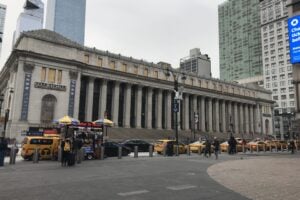

MetLife Building -Photo: Brian Kachejian ©2017
There are many buildings in New York City that stand next to each other, separated by only a few floors or slight differences in designs. However, a handful of buildings will always stand apart from the rest of New York City’s tall buildings. The Flatiron Building comes to mind instantly. Of course, there is the Empire State Building, The Chrysler Building, and the new World Trade Center. One building that has changed its name but not its looks and stands as one of those distinguished buildings is none other than the MetLife Building. This article takes a look at the History Of The Metlife Building from the days when it was called the Pan Am Building to its current status as one of New York’s distinguished buildings.
The MetLife Building is an iconic feature in the New York City skyline designed by Walter Gropius, Pietro Belluschi, and Emery Roth & Sons. It was originally built in 1963, known as the Pan Am building. This is one of the priciest pieces of real estate in New York, and for good reason. It stands as one of the tallest buildings in the country. The MetLife Building is located in Midtown Manhattan and was the last building to be constructed before the city changed the rules on placing corporate logos on top of skyscrapers. Recent plans have also been to update the building’s letters only a few years ago.
The New York MetLife Building stands over 800 feet tall and has been around for more than 50 years. The original building project for the MetLife tower, back then known as the Pan Am building, is said to have originally been titled Grand Central City, but it was later changed and renamed in 1960 thanks to the primary tenant, Pan American Airways.
They officially made the move to open the building on March 7th, back in 1963, even though the project was still incomplete at that time. At first, Pan Am occupied at least 15 floors in the building, and this location remained their main headquarters for years until their presence was later drastically cut. Eventually, they would occupy only a few floors in the building. Eventually, Pan Am moved its main headquarters to Miami, Florida, before the company Pan American Airways finally ceased operations entirely altogether.
Pan American Airways allegedly sold the now MetLife building property back in 1981 for $400 million to MetLife, who turned around and sold it years later. In 1992, it was announced that the Pan Am sign would be taken down and replaced with the MetLife sign not long after. It’s estimated that the MetLife building cost roughly 100 million dollars to construct back in the day, and since then, it has been estimated to be worth much more than that, worth more than $3 billion today.
Though property ownership has sometimes been seen as highly private, it’s known today that billionaire Donald Bren has a 97.3 percent ownership stake through the Irvine Company. However, Tishman Speyer is still the managing partner, with less than 3 percent ownership stake. In 2005 Tishman Speyer purchased the property when MetLife sold the building for $1.79 billion. For many years, the ownership of the iconic landmark had been largely unknown.
Back in the mid-’60s, there used to be an operational helipad on top of the Pan Am building, known today as the MetLife building, and people would often be shuttled in from the airport and brought to the top of the Pan Am building between 1965-1968. It later re-opened in early 1977 but was shut down several months later after a deadly accident occurred when a helicopter’s landing gear had failed, causing it to turn sideways and ultimately crash. This event resulted in several people losing their lives.
Interestingly and very sadly, just a few days before this article was published, New Yorkers experienced another helicopter tragedy. In mid-afternoon on a very rainy day in New York City on June 11th, 2019, a helicopter crashed on the roof of a Seventh Avenue Building. While comparisons to the 1977 helicopter crash into the Pan Am building might be concluded, most New Yorkers at the scene immediately feared an act of terrorism. In a city in which the memories of 9/11 are never forgotten, any explosion in a building triggers the worst fears. However, the city determined rather quickly that it was no act of terrorism but rather a freak accident that is still under investigation.
History of New York’s MetLife Building: Pop Culture
This building has been prominently featured in a variety of popular television shows and movies etc, including featured films like Armageddon , The Avengers
 , Knowing
 , Godzilla
 , Kingsman: The Golden Circle
 , and Catch Me If You Can
 . It was also featured on the Pan Am television series, where it was seen hosting the old original Pan Am logo. It can also be seen in the video game Grand Theft Auto IV.
Located close to Grand Central Terminal, with views of Park Avenue, it’s one of the best locations in the New York region. The 59-story building is one of the largest in the United States, but it’s also been known as one of the world’s most prominent commercial office space locations. The building is the headquarters for the largest life insurance company in the country, MetLife, but also for the wealth and investment division of Barclays, and hosts office space for Merrill Lynch, Gibson, DXC Technology, and others.
The Metlife Building is a highly visible structure and is easily one of the most recognizable skyscrapers in the New York region, offering a mix use of both office and commercial space, hosting many famous residents. It’s an impressive Manhattan landmark that has a rich history, providing the venue for many world-class entrepreneurs to thrive. Considering how much it has gone up in value in only 50+ years, originally constructed for $100 million and recently estimated at more than $3 billion, it’s also been an incredibly wise investment for some.
Updated November 24, 2023