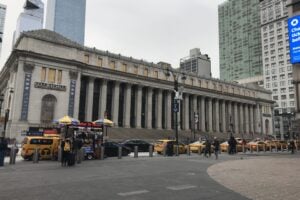

Feature Photo: Beyond My Ken, CC BY-SA 4.0 <https://creativecommons.org/licenses/by-sa/4.0>, via Wikimedia Commons
Loehmann’s became one of New York’s best-known off-price department store chains, famous for giving generations of shoppers access to designer clothing at deeply discounted prices. Frieda Loehmann built the idea in Brooklyn during the early 1920s, and the business her family developed eventually spread across the United States. The brick-and-mortar chain disappeared after its third bankruptcy in 2014, and a later online version ended in 2018. Yet that was not the final chapter. Century 21 acquired the Loehmann’s brand in 2020, brought it back through a Long Island pop-up in 2025, and the current Loehmann’s website is again promising that the retailer is “coming back soon.”
The Origins of Loehmann’s
The retailer traced its roots to Frieda Mueller Loehmann. Born in the 1870s and raised in Cincinnati, she married musician Charles Loehmann, a flutist whose performing career ended after he developed paralysis of the lip. Frieda eventually became the primary breadwinner for the family and moved to New York, where she worked as a buyer and developed the contacts that would help shape her future business.
Sources differ slightly on the precise starting year. The New York Community Trust places Frieda’s first Loehmann’s operation in 1920, while later corporate histories and contemporary retail accounts use 1921 as the company’s conventional founding year. Either way, the business began in Brooklyn and soon became known for a simple but powerful idea: buy designers’ samples, overstocks, cancellations, and leftover merchandise for cash, then sell those clothes to customers at prices far below traditional department-store levels.
Frieda Loehmann
Frieda’s early business grew into the legendary Brooklyn store at Bedford Avenue and Sterling Place. The building at 1476 Bedford Avenue had originally been used in Brooklyn’s automobile trade before becoming the home of Loehmann’s. Frieda eventually bought the property and lived above the store.
Her buying strategy changed the way many women shopped for fashion. She made regular trips into Manhattan’s garment district, where designers and manufacturers could quietly sell samples, cancellations, and excess merchandise without putting those goods into their regular retail channels. Loehmann’s could then pass the savings along to customers who wanted designer clothing without paying full department-store prices.
Frieda also gave the original store a personality of its own. Customers remembered its ornamentation, crowded racks, bargain-hunting atmosphere, and the feeling that finding the right item required patience and a sharp eye. That treasure-hunt experience would remain central to the Loehmann’s identity long after Frieda was gone.
Frieda had little interest in building a national chain herself. Her son Charles took a different approach. He opened a Loehmann’s store on Fordham Road in the Bronx in 1930 and gradually expanded the business. Frieda continued running the original Brooklyn operation until her death in 1962 at the age of eighty-eight.
After Frieda’s death, the original Brooklyn store eventually closed. The building was sold and later became home to New Life Tabernacle Church. The exterior still survives at 1476 Bedford Avenue, preserving a physical connection to the place where one of America’s most influential off-price retail concepts took shape.
The Back Room
One of the most famous features of Loehmann’s was the Back Room. This was where shoppers hunted through deeply discounted designer merchandise, often with labels removed or altered to protect the designers’ relationships with full-price department stores. For devoted Loehmann’s customers, figuring out who had designed a garment became part of the fun.
The fitting-room experience became almost as famous as the clothing. Loehmann’s was known for communal dressing rooms where customers tried on clothes in front of one another and strangers sometimes offered opinions whether they had been asked or not. For many shoppers, especially in New York, that unusual combination of fashion, bargains, competition, and conversation became part of the Loehmann’s tradition.
How Did Loehmann’s Fare Over Time?
The business that Charles Loehmann developed grew dramatically after Frieda’s death. The company went public in 1964 and expanded well beyond New York. By 1980, Loehmann’s operated forty-eight stores in twenty-one states and had become a nationally recognized off-price retailer.
Ownership then began changing rapidly. AEA Investors acquired Loehmann’s in 1981 and sold it to Associated Dry Goods in 1983 for $96 million. When May Department Stores acquired Associated Dry Goods in 1986, Loehmann’s became part of May as well.
In 1988, May sold the seventy-seven-store Loehmann’s chain to an investor group led by Sefinco Ltd. and the Sprout Group. At the time, Loehmann’s had reported $334 million in annual sales. The chain later returned to the public markets in 1996.
By the late 1990s, Loehmann’s was operating roughly one hundred stores around the United States. On the surface, that looked like the high point of the company’s growth. Financially, however, the chain was already becoming increasingly vulnerable.
Three Bankruptcies
Loehmann’s filed for Chapter 11 bankruptcy protection in May 1999. The company reorganized and emerged from bankruptcy in September 2000, allowing it to continue operating.
In 2004, Arcapita acquired Loehmann’s in a transaction valued at approximately $177 million. Two years later, Dubai-based Istithmar bought the retailer from Arcapita for approximately $300 million. At the time, Loehmann’s operated sixty stores in seventeen states.
The financial problems returned. On November 15, 2010, Loehmann’s filed for Chapter 11 for a second time. The company remained open during the restructuring and emerged from bankruptcy on March 1, 2011, after securing $45 million in exit financing and eliminating $110 million in long-term bond debt.
The rescue did not last. Loehmann’s filed for Chapter 11 a third time in December 2013. By then the company was facing intense competition from other off-price retailers, outlet stores, and online shopping. It was also late to develop a serious e-commerce business compared with some of its competitors.
The End of the Stores
In January 2014, a bankruptcy court approved going-out-of-business sales at all thirty-nine remaining Loehmann’s stores in eleven states and Washington, D.C. More than $65 million in merchandise was placed into liquidation. The last physical stores closed in February 2014, ending nearly ninety-three years of continuous brick-and-mortar Loehmann’s retailing.
Esopus Creek Value Series Fund acquired the Loehmann’s name, intellectual property, and customer lists during the bankruptcy process. The brand was relaunched as an online-only retailer later in 2014, an attempt to preserve the name without rebuilding the expensive store network.
That online version did not restore Loehmann’s to its former prominence and ceased operating in 2018. For several years, it seemed that Loehmann’s had finally become one of those famous New York retail names that existed only in photographs and memories.
Loehmann’s Returns
The story changed again in 2020 when fellow New York discount retailer Century 21 acquired the Loehmann’s brand. For several years, little happened publicly. Then, in August 2025, Loehmann’s returned to Long Island with a limited warehouse-sale pop-up at Tanger Outlets in Deer Park.
The event ran from August 22 through September 1, 2025, and deliberately revived elements of the old Loehmann’s experience, including the famous Back Room. Century 21 described the strategy as a reinvention of the brand built around pop-ups and off-price designer merchandise.
The comeback was real enough that shoppers once again walked into a physical Loehmann’s-branded retail space more than a decade after the chain’s liquidation. Additional pop-ups were discussed for New York City and Florida.
As of August 31, 2026, Loehmann’s has not returned as the nationwide store chain it once was. However, the official Loehmann’s website is active and prominently states that the company is “coming back soon,” inviting customers to sign up to be among the first to shop when the brand returns. More than a century after Frieda Loehmann began selling discounted fashion in Brooklyn, the Loehmann’s name still has enough recognition and nostalgia that another chapter remains possible.
Readers interested in more of New York’s retail history can also explore the history of Bloomingdale’s, the history of Lord & Taylor, the history of Bonwit Teller, and the history of TSS Times Square Stores.
Sources
The New York Community Trust — Frieda Mueller Loehmann
The Washington Post — Off the Rack: The Legacy of Loehmann’s
U.S. Securities and Exchange Commission — Loehmann’s Corporate History and 2004 Transaction
Los Angeles Times — May Co. Agrees to Sell Loehmann’s, 1988
Loehmann’s — 2011 Chapter 11 Reorganization
Loehmann’s Liquidation — 2014 Going-Out-of-Business Sales
Long Island Business News — Loehmann’s Returns With Deer Park Pop-Up
Loehmann’s Official Website — Current Brand Status
Updated August 31, 2026.
History Of Loehmann’s Department Stores article published on ClassicNewYorkHistory.com © 2026