Feature Photo:John Penney / Shutterstock.com
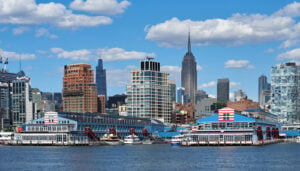
I recently visited the Arte Museum, a digital art experience located at Chelsea Piers in Manhattan. The museum itself was extraordinary, filled with immersive exhibits that blended technology and creativity in ways I had never experienced before. Yet as impressive as the museum was, I found myself becoming equally fascinated with the location that housed it. Standing inside Chelsea Piers and looking out toward the Hudson River, I realized I knew surprisingly little about the place’s history. Like many New Yorkers, I had heard the name countless times. I knew it as a destination for sports, entertainment, and recreation. But I had never stopped to ask how this massive waterfront complex came to exist. The deeper I dug into its history, the more I realized that Chelsea Piers tells a remarkable story about New York City itself, a story that stretches from the golden age of transatlantic ocean liners to one of the most popular recreational destinations in Manhattan today.
Long before Chelsea Piers became a center for recreation and entertainment, Manhattan’s west side waterfront was one of the busiest maritime corridors in the world. During the late 19th century, New York City was experiencing tremendous growth as immigration, international commerce, and ocean travel transformed the city into a global powerhouse. Existing waterfront facilities were struggling to keep up with the increasing size of passenger ships and the growing volume of traffic entering New York Harbor. City officials recognized the need for a modern terminal complex capable of accommodating the next generation of ocean liners and helping maintain New York’s position as America’s most important port.
Construction of Chelsea Piers began in the early years of the 20th century as part of an ambitious waterfront redevelopment project. The complex was designed by the architectural firm Warren and Wetmore, the same firm that would later gain worldwide recognition for designing Grand Central Terminal. Built between 1902 and 1910, the piers represented some of the most advanced maritime infrastructure of their era. Unlike many older wooden piers that lined Manhattan’s waterfront, Chelsea Piers featured steel-framed structures capable of handling the enormous passenger vessels that were becoming symbols of international travel. The completed complex stretched along the Hudson River from approximately West 17th Street to West 23rd Street and immediately became one of the most important passenger terminals in the world.
The timing of Chelsea Piers could not have been better. The early decades of the 20th century represented the golden age of ocean liner travel. Some of the most famous shipping companies in history operated from these piers, including the White Star Line and Cunard Line. Travelers arriving at Chelsea Piers included wealthy industrialists, celebrities, diplomats, immigrants seeking new lives, and ordinary passengers crossing the Atlantic for business or pleasure. The piers served as New York’s front door to the world. For countless people, their first glimpse of America began at Chelsea Piers.
Perhaps the most famous chapter in Chelsea Piers history involves the RMS Titanic. Pier 59 had been designated as the ship’s destination when it arrived in New York in April 1912. Instead, following the tragic sinking of the Titanic after striking an iceberg, Chelsea Piers became the focal point of one of the most heartbreaking moments in maritime history. When the rescue ship RMS Carpathia arrived carrying Titanic survivors, thousands of anxious family members, reporters, and curious New Yorkers gathered along the waterfront waiting for news. The scenes that unfolded at Chelsea Piers during those days became part of one of the most enduring stories of the 20th century.
Chelsea Piers continued to play a vital role in ocean travel throughout the following decades. Cunard’s legendary vessels, including the RMS Lusitania, were associated with the piers, and the waterfront remained a bustling center of international activity. During both World War I and World War II, the piers took on additional importance as military transport facilities. Troops, supplies, and equipment moved through the complex as New York supported the nation’s wartime efforts. The waterfront that had welcomed travelers from around the world now served as a critical component of America’s military logistics network.
By the middle of the 20th century, however, a major shift was underway. Commercial aviation was rapidly transforming long-distance travel. What once required days aboard an ocean liner could now be accomplished in hours aboard an airplane. Passenger ship traffic declined dramatically as airlines became the preferred method of crossing the Atlantic. The great ocean liners that had defined Chelsea Piers for generations began disappearing from the waterfront. As shipping patterns changed and maritime activity shifted elsewhere, the piers gradually declined. By the 1970s and 1980s, large portions of the complex sat underutilized, and the future of the historic waterfront appeared uncertain.
Fortunately, Chelsea Piers received a second chance. During the 1990s, developers and city planners began exploring ways to reinvent the aging structures while preserving their historic character. Rather than demolishing the piers, a decision was made to transform them into a large-scale sports and entertainment complex. The redevelopment breathed new life into the waterfront. Former maritime facilities were converted into athletic fields, ice rinks, golf facilities, event spaces, and recreational venues. The transformation represented one of the most successful adaptive reuse projects in New York City history.
Today, Chelsea Piers has become one of Manhattan’s most active recreational destinations. The complex includes golf facilities, ice skating rinks, basketball courts, soccer fields, fitness centers, bowling, event venues, and numerous attractions that draw visitors from throughout the region. The site has also become a location for film and television production. In recent years, new attractions such as the Arte Museum have expanded the waterfront’s appeal even further, bringing immersive digital art experiences into a setting that once welcomed some of the world’s most famous ships. What was once a gateway for transatlantic travelers has become a destination for New Yorkers seeking recreation, culture, and entertainment.
What fascinates me most about Chelsea Piers is how perfectly it reflects the story of New York City itself. Unlike many historic sites that survive as museums frozen in time, Chelsea Piers adapted to changing circumstances and found a new purpose. The same structures that once welcomed ocean liners carrying passengers from Europe now welcome families, athletes, tourists, artists, and everyday New Yorkers. The waterfront remains alive, just in a different way than its original designers could have imagined.
As I left the Arte Museum and walked through Chelsea Piers, I found myself looking at the buildings differently. What had seemed like a modern recreational complex suddenly revealed itself as a living piece of New York history. Beneath the sports facilities, event spaces, and entertainment venues lies a remarkable story of immigration, international travel, wartime service, architectural innovation, and urban reinvention. Chelsea Piers may no longer be New York’s gateway to the world, but more than a century after its construction, it remains one of the most fascinating places on Manhattan’s waterfront and one of the city’s greatest examples of how history and progress can coexist.
The Remarkable History of Chelsea Piers in NYC article published on ClassicNewYorkHistory.com ©2026
ClassicNewYorkHistory.com claims ownership of all its original content and Intellectual property under United States Copyright laws and those of all other foreign countries. No one person, business, or organization is allowed to republish any of our original content anywhere on the web or in print without our permission. All photos used in the articles are either original photographs taken by ClassicNewYorkHistory.com journalists, public domain Creative Commons photos, or photos licensed officially from Shutterstock under license with ClassicNewYorkHistory.com and ClassicRockHistory.com. All photo credits have been placed at the end of the article.
We are not responsible for any locations visited based on our recommendations or information in the articles, as the website is for entertainment only.