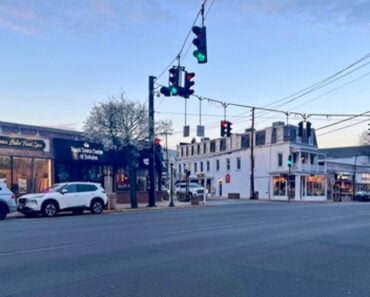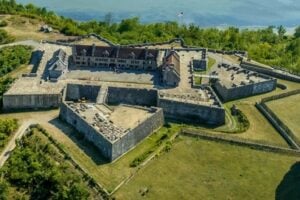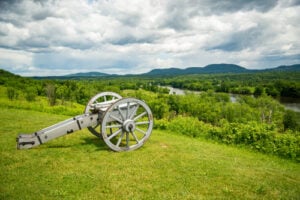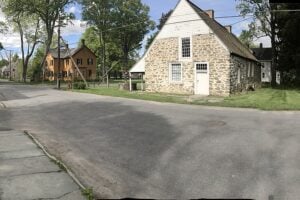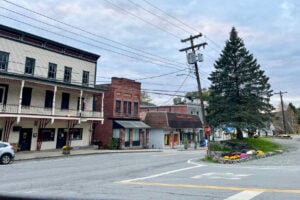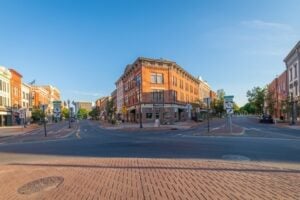
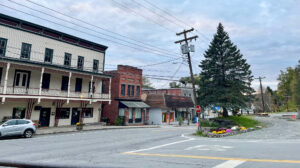
Upper Main Street in Callicoon, a historic community in Sullivan County, New York. Photo: Jaclyn Vernace / Shutterstock.com.
This one was interesting for me to write because when I was 17, I went to Sullivan Community College. It was basically the only college that would accept me. I wasn’t that great as a student in high school, but that’s because I wanted to be a musician, and I spent all my time practicing piano. It wasn’t because I was lazy; I just found what I wanted to do with my life, and I did that for a good 30 years.
Sullivan County occupies a distinctive place in New York history. The western Catskills, the Delaware River, the resorts of the old Borscht Belt, and the fields around Bethel have attracted visitors for generations. Its name is inseparable from the Woodstock festival of 1969, but those three days are only a small part of the county’s story. Long before the festival, families were building businesses and communities in Liberty, Monticello, Fallsburg, Roscoe, Callicoon, and the smaller hamlets along the region’s valleys and hills.
A history of famous people from Sullivan County presents a challenge that makes it especially interesting. Some notable residents grew up here and made their careers elsewhere. Others came to Sullivan County as adults, invested decades in its communities, and became inseparable from local history. A writer, an investment executive, a Hollywood actor, and the owner of the farm that hosted Woodstock do not all have the same sort of hometown connection. Those differences matter, and this article identifies them rather than giving everyone an invented Sullivan County childhood.
The range of accomplishment is remarkable. A Liberty businessman created one of America’s major cable-television companies and used his wealth to develop Bethel Woods. Monticello produced people who went on to lead major universities, study the Moon, shape New York’s courts, and build careers in sports and music. In Woodridge and South Fallsburg, future recording artists learned their craft far from the recording industry’s centers. Artists and writers from Livingston Manor and Liberty took the Catskills’ name into museums and literary circles around the country.
I’ve also kept this countywide list deliberately distinct from our separate article about famous people from the Catskill Mountains. Just two names appear in both. The emphasis here is Sullivan County’s own geography, institutions, and communities, from local schools and family businesses to dairy farms, theaters, and historic hotels. Here are 25 notable people whose lives have a meaningful connection to Sullivan County, New York.
1. Mark Ruffalo
Sullivan County connection: Longtime Sullivan County homeowner and Callicoon-area resident; born and raised elsewhere.
Mark Ruffalo was not born in Sullivan County, and there is no reason to describe him as a Catskills native. The actor developed his career in theater and film before making the region a substantial part of his family’s life. He owned a property near Callicoon from the 1990s and later lived there with his family. Contemporary reporting described him visiting village businesses, knowing local neighbors, and taking part in conversations about what was happening to nearby farms and roads. The relationship was more involved than a celebrity’s occasional vacation in a country house.
Ruffalo built an acclaimed acting career in films including You Can Count on Me, Spotlight, and the Marvel productions in which he portrayed Bruce Banner. His Sullivan County connection became especially public through his opposition to high-volume hydraulic fracturing and his support for environmental campaigns in New York. His appearances at meetings and public demonstrations were tied to concerns about the landscape and water supplies near his Catskills home. He belongs here as a longtime resident and advocate, not as someone raised in Callicoon.
2. Debra Winger
Sullivan County connection: Longtime Sullivan County resident who raised her family in the county; born outside New York.
Debra Winger became famous through films that established her as one of the most recognizable American actresses of the 1980s, including An Officer and a Gentleman and Terms of Endearment. She was not born in Sullivan County. After marrying actor Arliss Howard, she made a home in the Catskills and raised her children there, stepping away from the relentless pace of Hollywood work for significant periods. Reporting over many years places her home and family life in Sullivan County rather than merely recording a brief seasonal visit.
Her film work continued, including Shadowlands, Rachel Getting Married, and later independent productions. Winger also participated in local environmental activism and supported arts organizations in the county, including the NACL Theatre in Highland Lake. Her story reflects an important aspect of Sullivan County’s cultural life: prominent artists sometimes became genuine longtime neighbors, not simply performers passing through the historic resort hotels. Her ties are those of an adopted resident, not a person born or raised in the county.
3. Alan Gerry
Sullivan County connection: Born and raised in Liberty; founded his cable business there and helped create Bethel Woods.
Alan Gerry grew up in Liberty at a time when television was becoming a new form of American entertainment. He left school to serve in the Marine Corps during World War II and later learned electronics and television repair. When he returned home, poor reception in the mountainous countryside suggested a business opportunity. A single rooftop antenna was no solution for a region where valleys and hills interfered with broadcasts. Gerry began developing shared antenna systems that could deliver television signals to multiple households.
The venture eventually became Cablevision Industries, a major privately held cable-television operator acquired by Time Warner in 1996. Gerry’s later philanthropy remained firmly connected to Sullivan County. Through the Gerry Foundation he acquired the former Woodstock festival site, and the Bethel Woods Center for the Arts opened there in 2006. That makes Gerry an unusually important county figure: a local entrepreneur whose successful national business helped finance an institution preserving one of Sullivan County’s best-known chapters of history.
4. Zoe Leonard
Sullivan County connection: Born in Liberty in 1961; established her artistic career largely elsewhere.
Zoe Leonard was born in Liberty in 1961, a detail confirmed by major museums and galleries that have exhibited her work. Her career developed in New York City’s contemporary-art world, especially through photography, sculpture, and installations that investigate how people see, remember, and record their surroundings. The county connection is her birthplace; it would be misleading to insist that all of the themes in her art can be traced directly to a rural childhood without evidence from Leonard herself.
Leonard’s work appeared in international exhibitions and major museums, including the Whitney Museum of American Art and the Museum of Modern Art. Projects such as Analogue have explored urban change and the disappearance of familiar forms of commercial life, while other works have considered photography itself as an object and a process. Her achievements show how a person born in one of Sullivan County’s villages can become a substantial voice in contemporary art without being defined by that birthplace alone.
5. Judith S. Kaye
Sullivan County connection: Born in Monticello, attended local schools, and graduated from Monticello High School.
Judith Ann Smith, later known as Judith Kaye, grew up in Monticello and attended a one-room schoolhouse before continuing her education in the village. She graduated from Monticello High School at an unusually young age, then studied at Barnard College and New York University School of Law. Her accomplishments took place in a profession in which women faced significant barriers to advancement. She began her legal career in private practice before being appointed to New York’s highest court.
In 1983, Kaye became the first woman to serve on the New York Court of Appeals. Ten years later she became its first woman chief judge, serving through 2008. She was associated with reforms involving court administration, families, and access to justice. Because she also appears in our broader Catskills article, her inclusion here is intentional: she is one of two repeated figures whose documented Sullivan County childhood and statewide historical importance make the connection essential.
6. Danz CM (Danielle Johnson)
Sullivan County connection: Born and raised around Woodridge and Rock Hill; attended local schools.
The electronic musician and producer known as Danz CM grew up in the Woodridge and Rock Hill area. Her own biography and interviews describe childhood in communities still affected by the decline of the Borscht Belt resort economy. She recalled abandoned ski facilities, roads through wooded hills, and the work her family did to support themselves. As a teenager she was already collecting records, experimenting with music and design, and finding creative communities on the internet while living far from the clubs of Manhattan.
She first attracted attention recording under the name Computer Magic and later released music as Danz CM. She became a self-directed producer, songwriter, and creator of Synth History, a publication devoted to synthesizers and electronic music. The county link is more than an incidental birthplace: she speaks directly about growing up in Woodridge and Rock Hill and about how independent exploration shaped her artistic development. Her career brings a contemporary musical voice into a county history often dominated by its older resort performers.
7. Susan Deer Cloud
Sullivan County connection: Born in Livingston Manor and raised in the Catskills.
Poet and writer Susan Deer Cloud was born in Livingston Manor in 1950 and has written about the landscapes and family histories of the western Catskills. Her essays and poems draw on memory, language, relationships with the natural world, and questions of cultural identity. Rather than treating the mountains merely as scenery, her writing has often made the Catskills a lived place filled with personal and historical meaning. She studied at Binghamton University and Goddard College, continuing to develop her work beyond Sullivan County.
Her books include Before Language and The Way to Rainbow Mountain, and she received a creative-writing fellowship from the National Endowment for the Arts. Institutional literary biographies establish her connection to Livingston Manor and the Catskill region. Her work makes an important addition to the county’s literary history, one not dependent on film or television celebrity but on sustained accomplishment as a poet and essayist.
8. Gavin DeGraw
Sullivan County connection: Grew up in South Fallsburg and graduated from Fallsburg Central High School.
Gavin DeGraw’s musical beginnings are closely connected to South Fallsburg and the wider Fallsburg community. Born in Middletown in neighboring Orange County, he grew up in Sullivan County in a family that played and listened to music. He and his older brother Joey performed together while still young, playing local engagements and learning material drawn from rock, soul, and rhythm and blues. His early experiences included singing and playing piano at Catskills venues before he pursued professional work outside the region.
DeGraw became a major recording artist after the success of songs such as I Don’t Want to Be, which became closely identified with the television series One Tree Hill. His music also includes Chariot and Not Over You. He appears in the broader Catskills famous-people list, but his documented upbringing and high-school years make him a natural second deliberate repeat here. For readers interested in how Sullivan County’s hotel and club music culture affected young performers, DeGraw is a particularly accessible example.
9. Leon T. Silver
Sullivan County connection: Born in Monticello in 1925; moved to Connecticut during early childhood.
Leon Theodore Silver was born in Monticello in 1925, although his family moved to Connecticut soon afterward. He trained as a geologist, served in the Navy, and eventually earned a doctorate at the California Institute of Technology. His research into rocks and their geological ages established him as a respected scientist long before his name became associated with space exploration. For accuracy, the Monticello link is his documented birthplace, not a claim that he spent his school years exploring Sullivan County’s rock formations.
Silver played a major role in preparing astronauts for the Apollo missions. He worked with crews on field geology, teaching them to recognize significant rocks, observe landscape relationships, and collect samples that scientists could interpret after the astronauts returned to Earth. Caltech’s own memorial identifies his work in the Apollo program as an important part of his legacy. It is a remarkable connection: a geologist born in Monticello helped make humanity’s exploration of the Moon more scientifically valuable.
10. Gene D. Block
Sullivan County connection: Grew up in Monticello and later became a neuroscientist and university administrator.
Gene Block grew up in Monticello, where his father worked in the milk-delivery business and his own curiosity extended to radios, automobiles, and how mechanical things operated. UCLA’s biographical accounts recall a teenager who repaired equipment and drove a delivery truck, experiences that helped shape an interest in experimentation. He later studied psychology at Stanford University and the University of Oregon and developed a distinguished research career studying the biological timing systems that regulate daily rhythms.
Block spent decades at the University of Virginia before becoming chancellor of the University of California, Los Angeles, in 2007. He led UCLA through a long period of development and stepped down from the chancellorship in 2024. It is important not to describe him as still holding that office in 2026. His connection to Monticello is well documented by the university itself, and his career combines two kinds of achievement: original scientific research and leadership of a major public university.
11. Catello “Cat” Manzi
Sullivan County connection: Born in Monticello and grew up in the region’s harness-racing culture.
Catello Manzi was born in Monticello in 1950 into a family closely associated with harness racing. The local raceway was part of the county’s sporting and economic identity, attracting drivers, trainers, owners, and spectators. Manzi began racing as a young man and developed the judgment and physical discipline required to handle a sulky behind a trotting or pacing horse. His career became far larger than a local track’s reputation, but Monticello remained central to his beginnings.
Known as ‘Cat,’ Manzi went on to become one of the most successful drivers in American harness racing. He won major races and driving titles over a long professional career and was inducted into the Harness Racing Hall of Fame. Unlike a sports figure connected to Sullivan County by a single appearance at a resort, Manzi was born in its county seat and emerged from a longstanding local racing tradition. His accomplishments reflect a form of sporting history that played an especially important role in Monticello.
12. Allen Young
Sullivan County connection: Born in Liberty and raised in Glen Wild in the Town of Fallsburg.
Writer and activist Allen Young was born in Liberty in 1941. His parents operated a poultry farm and provided accommodations for summer visitors in Glen Wild, a small community in the Town of Fallsburg. That background placed his early life within both the working landscape of Sullivan County and the seasonal economy that shaped the Catskills. He later pursued higher education and journalism, becoming involved in national political and social movements during the 1960s and afterward.
Young became an influential writer and editor associated with the gay liberation movement and produced books and reporting on civil rights, politics, and public life. His career included work that documented the experiences and arguments of a movement seeking equal treatment and greater public visibility. Whatever readers think they know about the history of the Borscht Belt, Young’s childhood in Glen Wild adds a different and revealing account of the people raised in the communities that hosted those summer visitors.
13. Joey DeGraw
Sullivan County connection: Raised in South Fallsburg alongside his brother Gavin DeGraw.
Joey DeGraw grew up in South Fallsburg in a household where music was a regular part of family life. He started playing instruments at a young age and developed songwriting skills before leaving Sullivan County. His earliest musical experiences included the local venues and rehearsals shared with his younger brother Gavin, but their later careers were not identical. Joey pursued his own approach to songwriting and performance rather than relying solely on the more widely known DeGraw name.
His work has included independent recordings, live performances, and music-related businesses, including the National Underground in New York City. He also developed an extensive network of performance and recording collaborations. Joey is sometimes overlooked when discussions of South Fallsburg’s musical graduates focus exclusively on Gavin. Including both brothers recognizes that the county’s contribution to popular music came from a family and local community where multiple people made professional careers in the arts.
14. Gary Schutt
Sullivan County connection: Born and raised in Monticello; began recording his own music while still a teenager.
Rock musician Gary Schutt grew up in Monticello as the son of a professional jazz drummer. According to his own biographical account, he began playing instruments very young and recorded original music at home while still a teenager. His interest spread from drums to guitar, bass, keyboards, singing, and production, forming the foundation of a career built around musical versatility. He later attended Berklee College of Music and became involved in professional recording and touring.
Schutt has worked as a performer and multi-instrumentalist with musicians including Jeff Scott Soto and has issued independent solo recordings. His professional career has ranged across hard rock and other styles rather than following one narrowly defined role. His roots in Monticello are unusually clear because he has described his early musical education and family home in detail. The county can claim a working musician whose skill behind and in front of the microphone helped sustain a long career.
15. Peter Tufano
Sullivan County connection: Born in Monticello and later recognized by his hometown for his academic career.
Peter Tufano was born in Monticello and went on to study at Harvard University, earning degrees in economics, business administration, and business economics. His academic career focused in part on household finances: the real decisions families make about saving, borrowing, and managing uncertainty. Such subjects may sound distant from a county history article, but they connect directly to questions affecting ordinary households in communities of every size.
Tufano spent many years on the faculty of Harvard Business School before becoming dean of the University of Oxford’s Saïd Business School in 2011. He held the deanship through 2021 and later returned to Harvard, rather than remaining Oxford’s dean indefinitely. His work contributed to discussions about savings programs and financial innovation. His academic record also documents recognition from Monticello, making his hometown connection more than an unsourced claim about birthplace.
16. Max Yasgur
Sullivan County connection: Longtime Bethel-area dairy farmer whose land hosted the Woodstock festival.
Max Yasgur was born in New York City, but his farming life and public reputation became inseparable from Sullivan County. He grew up in a family involved in dairy farming and later developed a major operation in the Bethel area. By the 1960s, his herd and dairy facilities were among the county’s largest. He also participated in local business and civic matters. His story is rooted in the practical work of agriculture, a county occupation that existed long before the Woodstock festival and continued after it.
In 1969, festival promoters desperately needed a new site after their original plans collapsed. Yasgur agreed to lease land near Bethel, making possible the music gathering that became Woodstock. The event brought enormous crowds and controversy to the community, and Yasgur faced local criticism as well as admiration. His identity as the farmer who hosted Woodstock is deserved, but it should not erase the long record of work that made him a substantial Sullivan County resident before the cameras arrived.
17. Duke Devlin
Sullivan County connection: Arrived for Woodstock in 1969 and remained a Sullivan County resident for decades.
Duke Devlin came to Bethel for the 1969 Woodstock festival and made an unusual decision afterward: he stayed. Born elsewhere and traveling from Texas, he took jobs that tied him to Sullivan County rather than following most of the audience back home. His working life included agricultural work and a long period with Sullivan County BOCES. He and his wife also operated a small farm stand, and he became familiar to neighbors around Jeffersonville and Bethel.
As the festival site became a destination for visitors from around the world, Devlin took on the role of a storyteller and site interpreter, sharing accounts of the original gathering. Bethel Woods and local organizations have documented his unusual life as a person who came for a concert and became part of the county. He is not a Sullivan County native, nor should the 1969 audience be confused with its lifelong residents. But decades of ordinary work and cultural interpretation make him a genuine adopted local figure.
18. Elliot Tiber
Sullivan County connection: Worked at his family’s El Monaco motel in White Lake and became involved in Woodstock preparations.
Elliot Tiber was born and raised outside Sullivan County, but his parents operated the El Monaco motel in White Lake, and he spent considerable time involved in the family business and local civic affairs. In 1969, when the proposed Woodstock festival lost its first venue in Wallkill, Tiber made contact with the organizers and offered the use of property and a local permit associated with earlier gatherings. His connection to the event has become part of the familiar history of Woodstock in Bethel.
Tiber told his version of the story in the memoir Taking Woodstock, which inspired Ang Lee’s 2009 film. There is, however, a necessary qualification: his claim that he personally introduced the organizers to Max Yasgur has been disputed by Woodstock organizer Michael Lang and other participants. His involvement should be described without treating every scene from the memoir as established fact. His family business made him part of Sullivan County’s resort economy, even though his birth and later career were elsewhere.
19. Sam Morrison
Sullivan County connection: Longtime Livingston Manor resident; established his jazz career outside the county.
Saxophonist and flutist Sam Morrison developed his professional career in the wider New York jazz world rather than in a Sullivan County school band. His training and collaborations brought him into the orbit of major improvising musicians, and he became particularly associated with the soprano saxophone and flute. His performance credits include work with Miles Davis and other jazz figures. He belongs in this article through a documented later home in Livingston Manor, not through a claim to have been born in the hamlet.
The music itself reflects a range of styles and collaborations, from jazz ensembles to more experimental recordings. The Livingston Manor connection gives Sullivan County another example of the Catskills as a place where professional artists chose to live and work after developing careers elsewhere. It would be inaccurate to suggest that the forests of Sullivan County directly produced his sound without evidence, but his long connection to the community adds him to the county’s artistic history.
20. Larry Chance
Sullivan County connection: Longtime Liberty resident and lead singer of Larry Chance and the Earls; born in the Bronx.
Larry Chance was born in the Bronx and grew up partly in Philadelphia, where he became interested in popular vocal music. He later established a career with Larry Chance and the Earls, recording songs that became familiar to listeners of doo-wop and early rock and roll. The group’s repertoire included Remember Then and Life Is But a Dream. Chance spent much of his professional life performing for audiences around the world, and his Sullivan County roots came through his decision to settle there as an adult.
He moved to the Liberty area after years of performing at Catskills resorts and built a home there. In 2019, the Sullivan County Legislature recognized him with a Distinguished Citizen Award, explicitly describing him as a longtime neighbor and community member. His connection is therefore documented and substantial, even though he is not a Sullivan County native. Chance also links the county’s old resort entertainment business with the continuing lives of musicians who performed on those stages.
21. Jeff McBride
Sullivan County connection: Born in Monticello; became an internationally recognized magician and teacher.
Jeff McBride was born in Monticello in 1959, giving Sullivan County a direct link to a very different performing art. His career in magic grew around the combination of sleight of hand, mask work, theater, movement, and the kind of visual storytelling that can cross language barriers. Unlike a conventional stage act built entirely around revealing tricks, McBride developed performances in which character and transformation were central.
He became known for the Mask, Myth and Magic productions, performed internationally, appeared on television specials, and founded a school devoted to the art and practice of magic. Professional biographies and interviews identify Monticello as his hometown. For a county associated so strongly with comedy and nightclub entertainment, McBride offers an unexpected performing-arts connection from the region’s own population.
22. Sari Feldman
Sullivan County connection: Born in South Fallsburg and graduated from Fallsburg Central School.
Sari Feldman grew up in South Fallsburg, where reading and access to books helped shape her professional interests. In an essay about her childhood she recalled living in a community without its own full-service public library and depending on bookmobile visits and trips to libraries elsewhere. She graduated from Fallsburg Central School in 1970, later earned a degree from Binghamton University, and pursued graduate training in library science at the University of Wisconsin.
Feldman became a major figure in American public librarianship, leading the Cuyahoga County Public Library system in Ohio and serving as president of the American Library Association from 2015 to 2016. Her leadership emphasized libraries as places of public learning, civic connection, and access to information. Her career gives Sullivan County a remarkable example of a person whose small-town experience of limited library access influenced a lifetime of work expanding what public libraries could offer.
23. Ivan C. Lafayette
Sullivan County connection: Born in Monticello in 1930; grew up primarily in Brooklyn.
Ivan C. Lafayette was born in Monticello in 1930, although his childhood and schooling took place chiefly in Brooklyn. After military service, he settled in Queens and became a long-serving member of the New York State Assembly. His political career began far from the Sullivan County town in which he was born, and the distinction is worth stating. His inclusion is a birth connection rather than a claim that Monticello schools prepared him for public office.
Lafayette represented parts of Jackson Heights, Corona, and Elmhurst for decades and rose to leadership positions including deputy speaker of the Assembly. He supported legislation concerning consumer protection and education, including provisions affecting college admissions testing. A New York State legislative resolution documenting his life confirms his Monticello birthplace and later Brooklyn upbringing, making this an independently verifiable connection to Sullivan County.
24. Elisabeth Worth Muller
Sullivan County connection: Longtime Monticello suffrage organizer and local public figure; birthplace not verified as Sullivan County.
Elisabeth Worth Muller became an energetic organizer for women’s voting rights in Monticello. A trained lawyer, she was associated with the Monticello Suffrage Club and took part in the public demonstrations and political campaigning that surrounded the struggle for the vote. Contemporary accounts describe women from the club appearing at regional events and advocating for suffrage among visitors as well as year-round residents. Her significance rests on her activity in Sullivan County, not on any verified claim that she was born there.
Muller also sought elected office after the suffrage movement achieved its central goal. Her record is not without troubling elements: she supported eugenic marriage proposals, and later accounts document sympathetic comments about European authoritarian leaders during the 1930s. A history of an activist should not erase those positions because they complicate an otherwise appealing story. Muller remains an important part of Monticello’s women’s-history record, including both her suffrage work and the attitudes that now deserve critical examination.
25. Jackie Horner
Sullivan County connection: Longtime Liberty resident and Grossinger’s dance instructor; born and raised elsewhere.
Jackie Horner arrived at Grossinger’s Catskill Resort Hotel in 1954 as a professional dancer and was invited to remain as a year-round instructor. Her work placed her at the heart of the Borscht Belt’s elaborate resort entertainment culture, where organized dance lessons, competitions, and evening performances were central to the vacation experience. She continued her association with Grossinger’s for decades and made Sullivan County her home, long after the hotels’ most celebrated era had ended.
Horner became especially well known through her association with Dirty Dancing. Screenwriter Eleanor Bergstein had spent summers at Grossinger’s and learned from Horner; the film drew on memories of the resort world and its dance culture. Horner provided historical insight as the screenplay developed. Sullivan County organizations honored her for preserving and explaining that history. Her place on this list is rooted in decades of residence and professional work in Liberty, not in a local birth certificate.
Why Sullivan County Has Such a Remarkable History
Sullivan County did not shape all 25 lives in the same way. Some people were born in Monticello or Liberty and left before reaching adulthood. Others grew up in the local schools, built careers in music or public service, and carried those hometown experiences with them. Still others arrived as established performers, businesspeople, or artists and became neighbors whose work changed the county itself. Separating those kinds of ties makes the county’s history more interesting, not less.
What stands out is how much Sullivan County’s history extends beyond Woodstock and the vanished Borscht Belt hotels. There are local connections to lunar exploration, a major cable-television enterprise, the highest court in New York State, Olympic-scale entertainment, art museums, and the continuing importance of public libraries. The county’s farms, villages, and schools produced some of those achievements; its character as a place to live attracted others.
For more New York biographies, read our articles on 25 Famous People You Didn’t Know Were From the Catskills, 25 Famous People You Didn’t Know Were From Upstate New York, and 15 Legendary Comedians and Performers Who Got Their Start in the Catskills Borscht Belt Resorts.