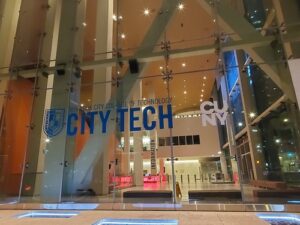
The New York City College of Technology (City Tech), part of the City University of New York, in Downtown Brooklyn. Photo: Dariusz Gryczka / Shutterstock.com.
Few institutions reflect the changing history of New York City quite like the City University of New York. Its colleges have educated generations of students who grew up in crowded neighborhoods, worked while attending classes, or came from families for whom a college degree once seemed beyond reach. Across the five boroughs, CUNY became an important part of the city’s educational, professional, and cultural life.
But the City University of New York did not begin as a university with campuses scattered across the boroughs. Its history reaches back to 1847, when merchant and civic leader Townsend Harris helped establish the Free Academy in Manhattan. The idea was unusually ambitious for its time: the city would use public money to make advanced education available to academically qualified students without charging them tuition.
Over the next century, that first institution was joined by colleges for women, new municipal campuses in Brooklyn and Queens, and eventually community colleges intended to serve students throughout New York City. In 1961, Governor Nelson A. Rockefeller signed legislation bringing the colleges into a formally organized university. A decade later, open admissions transformed who could enter the system, while the fiscal crisis of 1976 put an end to its longstanding tradition of free tuition at the senior colleges.
Today, CUNY is a large public university with colleges and professional schools serving all five boroughs. Its history is not simply a record of buildings and name changes. It is a story of the changing relationship between New York City, its public schools, the students seeking a better future, and the public commitment required to educate them.
The Origins of Free Public Education in New York City
In the middle of the nineteenth century, New York was already a growing commercial and immigrant city. Private colleges offered higher education, but tuition and other expenses placed it out of reach for many families. Public education itself was expanding, and some civic leaders began asking a larger question: why should the opportunity for advanced study depend so heavily on family wealth?
Townsend Harris, a successful merchant and president of the city’s Board of Education, championed the Free Academy. Harris wanted an institution in which qualified students from different economic backgrounds could study together, with academic work and conduct rather than social standing determining their place. The proposal encountered opposition from people who questioned whether taxpayers should support college-level education.
On May 7, 1847, the New York State Legislature chartered the Free Academy. The institution did not actually open until January 29, 1849, when 143 boys entered a building at Lexington Avenue and 23rd Street in Manhattan. Their ages and course of study reflected an educational system very different from a modern four-year college. The Free Academy provided advanced instruction at a time when the boundary between secondary and collegiate education was less clearly defined.
The original academy admitted boys, not girls, and its academic entrance requirements meant that the promise of access was not experienced equally by every New Yorker. Nevertheless, the public financing of advanced education represented an important departure from the idea that higher learning belonged chiefly to families able to purchase it. In 1866, the Free Academy was renamed the College of the City of New York, the institution that became City College of New York.
City College and the Promise of an Education Based on Merit
City College became a symbol of New York’s willingness to educate talented students from families with limited financial resources. In an expanding industrial city, the opportunity to study mathematics, languages, science, and other subjects could lead to careers that had once seemed inaccessible. Generations of students attended classes while facing the pressures of work, crowded housing, and the responsibilities of family life.
For much of its early history, City College remained an institution for men. It also maintained demanding admissions standards. Its reputation for academic rigor was a source of pride, but selectivity could exclude students whose elementary and secondary schools had not prepared them equally well for entrance examinations. Those competing ideas—academic standards and broad public access—would return repeatedly throughout CUNY’s history.
City College eventually moved to its striking Gothic-style campus in Hamilton Heights, replacing the more limited facilities associated with the original Free Academy. The new buildings helped give the municipal college a recognizable place in Manhattan’s landscape. The college was no longer simply an experiment in free education; it had become a permanent part of the city’s identity.
The Founding of Hunter College and Public Higher Education for Women
Another major step came in 1869, when the New York City Board of Education established the Female Normal and High School. Its purpose was to prepare young women for teaching and to offer advanced public education that had previously been largely unavailable to them. The institution opened with approximately 1,000 students, many of them considerably younger than students entering college today.
In 1870, the school was renamed the Normal College of the City of New York. Under its first president, Thomas Hunter, it developed a broad program of study and became an important route into education and professional life for women from different backgrounds. Its mission expanded over time beyond training teachers, and in 1914 it took the name Hunter College.
Hunter’s history is important because it corrects an easy misunderstanding about the origins of CUNY. The Free Academy established the principle of publicly supported advanced education in 1847, but it did not offer that opportunity equally to women. The school that became Hunter helped address that exclusion and laid the foundation for another major branch of the municipal college system.
Hunter also developed a campus in the Bronx, which would eventually become Lehman College. By the middle of the twentieth century, the municipal colleges were beginning to reach well beyond the Manhattan locations where the city’s publicly supported higher education had started.
The Board of Higher Education and Expansion Across the Boroughs
As New York City grew into a five-borough metropolis, relying primarily on City College and Hunter was increasingly inadequate. Families in Brooklyn, Queens, the Bronx, and Staten Island faced travel difficulties, while the demand for public higher education continued to rise. The colleges needed better coordination and, just as importantly, new places to serve students.
In 1926, the New York State Legislature established the Board of Higher Education of the City of New York. It assumed responsibility for coordinating the existing municipal colleges and developing additional opportunities outside Manhattan. The Board was an important predecessor of CUNY’s modern governing structure, although the university itself did not yet exist.
Brooklyn College was founded in 1930 by combining existing Brooklyn branches of City College and Hunter College. It became the city’s first public coeducational liberal arts college, opening initially in temporary facilities before developing its well-known campus in Midwood. The creation of Brooklyn College brought a major public institution into a borough whose large population had long needed greater access to higher education.
Queens College followed in 1937, drawing together branches of the older municipal colleges and opening in Flushing. Together, the new borough colleges marked an important change in public education. The city was no longer trying to accommodate all its college students at a small number of Manhattan institutions. It was beginning to build a network closer to the communities those colleges served.
The Postwar Expansion and the Rise of Community Colleges
World War II and the years that followed brought another surge in the need for higher education. Returning service members sought training and degrees under the GI Bill, while the city’s economy demanded workers with more specialized skills. Four-year colleges could not meet every need, especially for students who wanted technical training or a more affordable route toward a degree.
In 1946, the New York State Institute of Applied Arts and Sciences opened in downtown Brooklyn. It evolved into New York City Community College and eventually became New York City College of Technology. The institution illustrated how practical and technical education became an increasingly important part of the public college mission.
Staten Island Community College opened in 1956, Bronx Community College followed in 1957, and Queensborough Community College began classes in 1960. These campuses gave residents of different boroughs opportunities to begin college closer to home. Community colleges also offered associate degrees and programs connected to employment, while allowing some graduates to transfer to senior colleges.
The colleges did not all have identical tuition arrangements, and it would be inaccurate to describe every student at every municipal institution as attending entirely free of charge. But the larger purpose was consistent: public higher education should be available to more New Yorkers than the limited number who could enter established four-year colleges.
Governor Nelson Rockefeller and the Creation of CUNY in 1961
By 1960, New York City’s collection of municipal colleges had grown considerably, yet it still lacked the integrated status and academic authority of a full university. The State University of New York had been established in 1948 and was expanding across the state. New York City’s public colleges also needed a structure capable of coordinating growth, offering graduate education, and establishing a clearer common identity.
In April 1961, Governor Nelson A. Rockefeller signed legislation establishing the City University of New York. Seven municipal colleges were brought together in the new university framework, which also received authority to offer doctoral programs. Educator John R. Everett became CUNY’s first chancellor. The Board of Higher Education continued to have an important governance role, but the colleges now belonged to a formally unified university.
The legislation did not create City College, Hunter, Brooklyn College, or Queens College from scratch. Each had its own history and traditions. Nor did the new system instantly erase the differences among senior and community colleges. Its importance was that it provided a common institutional structure through which the city could plan enrollment, budgets, graduate programs, and future campuses.
The CUNY Graduate Center began offering doctoral programs in 1962, marking an important expansion beyond undergraduate teaching. Mathematician Mina Rees became the first dean of graduate studies. Research and graduate education would become increasingly important, even as the university continued to define itself through its commitment to working-class and immigrant New Yorkers.
New Colleges and Changing Opportunities During the 1960s
The 1960s saw the creation and reorganization of institutions that helped shape modern CUNY. Borough of Manhattan Community College and Kingsborough Community College began instruction during the decade. The college that became John Jay College of Criminal Justice developed from programs concerned with police science and the study of criminal justice.
Two older parts of the system gained independent status in 1968. Baruch College emerged from City College’s business school, whose origins went back to 1919, while Hunter’s Bronx campus became Lehman College. These changes reflected the university’s growing range of academic missions and the differing needs of the boroughs.
CUNY also began developing programs intended to support students who had been underserved by traditional college admissions. The SEEK program, whose name stands for Search for Education, Elevation, and Knowledge, and the College Discovery program offered academic and financial assistance to eligible students. Such programs acknowledged that opening college doors meant little without providing help to students facing unequal educational preparation and limited financial resources.
For all the expansion, however, a serious issue remained unresolved. New York City was increasingly diverse, yet the students enrolled at some senior colleges did not reflect the racial and economic makeup of the public-school system. The tension between competitive admissions and the university’s public mission was moving toward a confrontation.
The 1969 Student Protests and the Fight for Open Admissions
In 1969, Black and Puerto Rican student activists at City College and other CUNY campuses challenged admissions policies that they believed excluded large numbers of students from their communities. Organizers advanced demands involving access, representation in the curriculum, the hiring of faculty and administrators, and the governance of the colleges. Their movement became part of a larger national debate about civil rights and public institutions.
At City College, student demonstrations and the occupation of campus buildings drew intense attention. Other campuses experienced protests of their own. The activists did not invent the idea of open admissions; university leaders had already been discussing a broader admissions policy. But the demonstrations increased pressure to act much sooner than originally planned.
On July 9, 1969, the Board of Higher Education adopted a resolution to accelerate open admissions, bringing forward a policy previously planned for the middle of the 1970s. The first entering class under the new policy would arrive in the fall of 1970.
The episode is central to the history of CUNY because it exposed a difficult question within the university’s founding ideal. A free college could still be inaccessible to many New Yorkers if the process of admission favored students who had benefited from better educational preparation. The campaign for open admissions forced the university to confront that difference.
What Open Admissions Changed in 1970
The open-admissions policy took effect in the fall of 1970. It established a route into the university for New York City high school graduates, including students who had not met the traditional academic standards for senior-college admission. The policy did not guarantee that every applicant could enter any particular four-year college. The senior colleges and community colleges retained different roles in accommodating the much larger student population.
Open admissions brought thousands of additional students into CUNY and changed the composition of the university. Students who might previously have been turned away could begin college, while many campuses had to expand introductory teaching, tutoring, counseling, and remedial instruction. The policy increased access but also demanded more classrooms, instructors, and resources.
Supporters regarded the change as a major advance in educational opportunity, particularly for Black, Puerto Rican, immigrant, and working-class communities. Critics worried about academic preparation, instructional standards, and the university’s ability to accommodate so many new students. Those arguments continued for years, often reflecting deeper disagreements about how public colleges should balance selectivity with their responsibilities to the city.
The same period brought new institutions serving communities that had long sought their own colleges. Medgar Evers College was established in Brooklyn in 1970, following local advocacy for a public college in central Brooklyn. Hostos Community College had opened in the South Bronx in 1968 after demands for accessible education from Puerto Rican and other neighborhood residents. The university’s growth was increasingly shaped by communities as well as by administrators and elected officials.
The 1976 Fiscal Crisis and the End of Free Tuition
The expansion of CUNY collided with New York City’s severe fiscal crisis in the middle of the 1970s. The city faced extraordinary financial pressures, and public institutions came under demands to reduce spending. CUNY had enrolled more students and expanded services at the very moment government resources were becoming harder to secure.
In 1976, CUNY began charging tuition, ending a tradition of tuition-free undergraduate education at its senior colleges that reached back to the Free Academy. There had been exceptions and fees for particular groups of students in earlier periods, but free tuition for eligible students had been central to the city’s public-college identity for generations.
The change was not merely an accounting decision. It altered what college attendance meant for students whose families could not readily afford even modest tuition bills. Financial aid continued to provide opportunities, but the assumption that public higher education in New York City should be offered without tuition had been fundamentally changed.
CUNY also faced budget cuts and enrollment pressures that affected programs, staffing, and services. The fiscal crisis did not end the university or erase the achievements of open admissions, but it made clear that expanding access and sustaining that access required long-term public financial support. The consequences of the 1970s continued to shape debates about CUNY for decades.
CUNY’s Later Development and Its Place in the Five Boroughs
After the fiscal crisis, CUNY continued to evolve. The College of Staten Island was formed through the merger of two institutions in 1976. The CUNY School of Law opened in 1983, adding professional legal education to the system. Other specialized schools and programs expanded CUNY’s offerings in health, public service, business, journalism, technology, and graduate research.
The university also adapted its admissions and academic policies over time. The original open-admissions system did not remain unchanged, and later reforms placed greater emphasis on academic preparation, placement standards, and student progress. Different colleges continued to serve different purposes, ranging from associate-degree education to doctoral research.
Throughout these changes, CUNY’s locations remained an essential part of its character. Students could attend a college in the Bronx, Brooklyn, Manhattan, Queens, or Staten Island without necessarily leaving the city where they grew up. That geographic reach helped the university serve New Yorkers whose lives did not fit the traditional image of a residential college student leaving home for four years.
The City University of New York Today
As of 2026, CUNY’s official institutional overview describes a university comprising 26 colleges and schools, including 11 senior colleges, seven community colleges, and eight graduate, honors, and professional schools. Its campuses are spread across all five boroughs. Some older historical descriptions still refer to 25 institutions, but the more recent university overview uses the figure of 26.
CUNY reports approximately 247,000 undergraduate and graduate students and awards tens of thousands of degrees each year. Many students are the first in their families to attend college. Others are working adults, immigrants, students pursuing professional credentials, or graduates of the city’s public high schools who want to continue their education while remaining close to home.
Research and graduate study are important parts of the modern university, but CUNY’s wider importance is rooted in its relationship to the city. Its colleges prepare teachers, nurses, scientists, engineers, artists, public servants, business professionals, and people working in countless other fields. The university’s students and alumni form part of the daily life of New York, far beyond the boundaries of its classrooms.
Why the History of CUNY Matters
The story of CUNY began with Townsend Harris’s belief that public funds could support advanced education for people who did not come from wealthy families. That principle produced the Free Academy in 1847, even though the original institution’s doors were not open equally to everyone. Over the following century, the establishment of what became Hunter College, Brooklyn College, Queens College, and the community colleges gradually extended that promise to more of the city.
The creation of the unified university in 1961, the struggle for open admissions in 1969 and 1970, and the introduction of tuition during the 1976 fiscal crisis are not separate stories. Together they show how the meaning of public education was repeatedly contested and redefined. CUNY expanded because New Yorkers demanded greater opportunity, and it faced serious pressures whenever the city could not or would not finance the education it had promised.
For generations of families, CUNY has represented the possibility of pursuing an education without leaving New York City. Its buildings, programs, and admissions standards have changed, but its historical significance rests on a question raised almost two centuries ago: who should have the opportunity to receive a college education? That question remains as relevant to the city’s future as it was when the Free Academy was founded.
For more stories about New York’s colleges and their graduates, see our articles on 25 Famous People You Didn’t Know Graduated from CUNY Schools, 25 Famous People Who Went to College in New York City, and 25 Famous People You Didn’t Know Graduated from SUNY Schools.