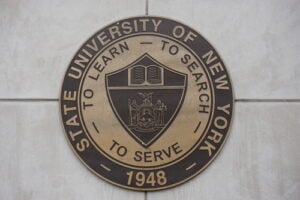
The State University of New York (SUNY) seal, displaying the university system’s founding year of 1948. Photo: EQRoy / Shutterstock.com.
For much of its history, New York State had some of the country’s most prominent institutions of higher learning without having a unified state university system. Columbia University, Cornell University, Syracuse University, and other private colleges helped establish New York as a major center of scholarship, while state-supported schools trained teachers, agricultural specialists, and people entering technical professions. But the colleges serving the public were scattered among separate institutions, rather than organized as one comprehensive public university.
That arrangement lasted until 1948, when Governor Thomas E. Dewey signed legislation establishing the State University of New York, better known as SUNY. New York was the last of the forty-eight states then in the Union to create a state university system. The new organization brought existing institutions together and gave the state a framework for expanding higher education to students who could not easily attend expensive private colleges or move far from home.
What began as an administrative consolidation became one of the most ambitious public education projects in New York history. The four major university centers at Albany, Binghamton, Buffalo, and Stony Brook eventually developed into research institutions, while community colleges brought degree programs and occupational training into counties across the state. Governor Nelson Rockefeller’s building program in the 1960s transformed the physical appearance of many SUNY campuses.
Today, SUNY describes itself as the nation’s largest comprehensive public university system, with 64 campuses serving New York City, Long Island, the Hudson Valley, and communities throughout Upstate New York. The history of SUNY is therefore more than the story of a single university. It is the story of how New York turned a collection of separate schools into a statewide network of education, research, and public service.
New York’s Colleges Before SUNY Existed
New York was not without public higher education before 1948. The institution that became SUNY Potsdam traces its beginnings to 1816, and New York established its first state normal school in Albany in 1844. Normal schools were created primarily to prepare teachers, an increasingly important task as public elementary and secondary education expanded. Other state-supported institutions developed programs in agriculture, technology, and specialized professions.
What New York lacked was the kind of unified public university system found in other states. A student interested in becoming a teacher might attend a state teachers college, while someone seeking a broader university education often looked to a private institution. Those arrangements reflected a longstanding dependence on private and locally developed colleges rather than a single state-operated university with a coordinated mission.
Cornell University’s position illustrates the complexity. Cornell was founded in 1865 as a private university with a land-grant mission, and certain colleges operating within it became state-supported statutory colleges. Those colleges now form part of SUNY’s statutory-college structure, even though Cornell University itself remains private. The distinction is important: New York supported higher education before SUNY, but it had not yet placed its different public and state-supported institutions under a comprehensive university administration.
Why Governor Thomas E. Dewey Established SUNY in 1948
The years immediately following World War II brought new urgency to the question of who could attend college. Returning military personnel sought education through the GI Bill, while growing numbers of young people wanted degrees that could lead to professional work. The existing college system did not have enough affordable places or a sufficiently broad geographic reach to accommodate that demand.
Governor Thomas E. Dewey and the legislature responded to recommendations from a commission examining New York’s higher-education needs. In March 1948, Dewey signed the legislation creating the State University of New York. SUNY’s official historical account identifies the original organization as a consolidation of twenty-nine previously unaffiliated institutions, including eleven teachers colleges. Some historical publications give a different initial total because they count individual units differently, but twenty-nine is the figure used in SUNY’s current institutional history.
The new system was governed by a board of trustees with statewide responsibilities. It remained subject to important oversight by the New York State Board of Regents, which already played a central role in educational policy. SUNY was also distinct from what became the City University of New York, whose colleges served a separate public university system in New York City.
The first years were devoted to organizing institutions that had different histories, academic specialties, and local traditions. SUNY was not created by building twenty-nine new campuses in a single year. Its achievement was to connect schools that had already served the public and to create a plan for adding educational opportunities where they were needed.
The Rockefeller Expansion of the 1960s
SUNY’s greatest period of physical growth came during the administration of Governor Nelson A. Rockefeller, who took office in 1959. Enrollment had risen sharply during the 1950s, and classrooms, laboratories, libraries, and residence halls were struggling to keep pace. The state needed more than a new administrative structure: it needed places where a much larger student population could actually study.
In 1962, New York established the State University Construction Fund to speed the planning and building of SUNY facilities. The fund allowed the system to undertake major campus projects with a more specialized construction organization. Modernist buildings and newly developed grounds appeared across the state. Some campuses were transformed almost beyond recognition as New York invested in libraries, lecture halls, scientific laboratories, and student housing.
The scale was remarkable. A history published by SUNY Purchase reports that full-time enrollment increased from approximately 38,000 in 1958 to 235,000 by 1973. Those figures help explain why the Rockefeller years are so central to the system’s history. It was not simply a matter of adding attractive buildings; the state was expanding the number of people who could pursue a public college education.
Not every campus was intended to perform the same role. SUNY strengthened liberal arts colleges, agricultural and technical institutions, health sciences programs, and professional education. At the same time, it developed four university centers that would provide a broader range of graduate study and research. Each of those centers arrived at that role through a different history.
The Four SUNY University Centers
University at Albany
The University at Albany began as the New York State Normal School in 1844, one of the earliest state-supported colleges created to prepare teachers. It became part of SUNY in 1948 and was designated a university center during the early 1960s. That change expanded its mission beyond teacher education into research, graduate programs, liberal arts, and professional disciplines.
Rockefeller’s building program produced the university’s distinctive Uptown Campus, designed by architect Edward Durell Stone. Construction began in 1962, and its monumental podium, towers, and geometric layout became one of SUNY’s most recognizable architectural statements. The development of the new campus was a visible expression of the state’s decision to make Albany a major university center rather than only a teachers college.
Binghamton University
Binghamton University’s story began in 1946 as Triple Cities College, a branch of Syracuse University established in Endicott to serve returning veterans and local students. It joined SUNY in 1950 and became Harpur College, later moving to its campus in Vestal in 1961. The institution’s rapid growth reflected the demand for an affordable liberal arts education in the Southern Tier.
In 1965, it was formally designated the State University of New York at Binghamton. Its evolution into a research university was very different from Albany’s transition out of teacher training: Binghamton grew from a small postwar branch college into one of the university centers. That history also illustrates how SUNY could absorb and transform an institution that had originally belonged to a private university.
University at Buffalo
The University at Buffalo had the longest independent university history of the four centers. It began in 1846 as a private medical college and developed into a comprehensive institution with professional schools, including medicine and law. In 1962, the private University of Buffalo joined SUNY, adding an established academic and research organization to the state system.
Its incorporation was significant because SUNY did not have to create those professional schools from the ground up. The university continued expanding, including the development of its North Campus in Amherst, while retaining its historic South Campus and medical connections in Buffalo. The result was a public research university built upon a substantial private institutional legacy.
Stony Brook University
Stony Brook University began in 1957 as a state college intended to prepare secondary-school teachers in mathematics and science. Its first home was at the Planting Fields estate in Oyster Bay on Long Island. Only a few years later, the college moved toward a much more ambitious mission, with a new campus planned on land donated by Ward Melville near the village of Stony Brook.
The Stony Brook campus opened in 1962. As the university expanded, it developed major research programs and advanced medical education, eventually becoming home to an academic medical center. From a small teacher-training institution in Oyster Bay, it grew into one of the state’s principal research universities. Its history captures the dramatic scale of SUNY’s mid-century ambitions on Long Island.
How SUNY Built Its Community College Network
Alongside the university centers, SUNY expanded a different kind of institution: the community college. Not every student wanted or needed to enter a four-year university immediately. Many sought affordable preparation for employment, an associate degree, or a way to complete the first two years of college while living at home. A network of locally accessible institutions could meet those needs in ways that the research universities could not.
One of the earliest examples was the institution now called Mohawk Valley Community College. Founded in Utica in 1946 as the New York State Institute of Applied Arts and Sciences, it offered technical education for returning veterans and other students before SUNY itself was established. It became a SUNY unit in 1950, helping illustrate how the new state system incorporated existing schools and encouraged them to develop.
New York’s community college model involved partnerships between the state and local sponsors, frequently county governments. Campuses such as Nassau Community College, Monroe Community College, Onondaga Community College, and many others gave students options close to home. These institutions also served adults changing careers, workers seeking technical qualifications, and students planning to transfer to four-year programs.
The system now includes thirty community colleges. Their importance is not only geographic. They offer a different point of entry into higher education, and they have repeatedly adapted their programs to changing regional employment needs. In an education system stretching from Long Island to the North Country and Western New York, that local role is fundamental to SUNY’s purpose.
More Than Four-Year Colleges: SUNY’s Other Institutions
SUNY’s identity cannot be reduced to its four university centers or community colleges. The system also includes comprehensive colleges with traditions in teacher education and the liberal arts; colleges of technology; specialized institutions; health-sciences universities; and statutory colleges associated with private universities. These institutions have different academic missions, but they belong to one statewide framework.
Campuses such as SUNY Cortland, SUNY Oswego, SUNY Geneseo, SUNY Fredonia, and SUNY Plattsburgh reflect the transformation of older teacher-training schools into institutions offering broader undergraduate and graduate programs. Others, including SUNY Maritime College and the SUNY College of Environmental Science and Forestry, have specialized missions connected to professional fields and research.
That variety is one of the defining differences between SUNY and the image people sometimes have of a state university as one enormous campus. The system includes institutions with very different sizes, settings, and educational priorities. A student attending a rural community college and a doctoral researcher working at a major laboratory are both part of SUNY, but their day-to-day experiences can be quite different.
What SUNY Looks Like Today
As of 2026, the State University of New York reports sixty-four campuses, including thirty community colleges and thirty-four state-operated and statutory institutions. The colleges and universities are spread across New York State, with settings ranging from major cities and suburban communities to small Upstate towns. SUNY also operates academic medical centers and supports scientific and other research activities.
The system’s official statistics report 387,446 students enrolled in fall 2025, including students at state-operated campuses and community colleges. SUNY also serves many people through non-credit instruction, continuing education, and workforce training. Those additional activities are significant, but they should not be confused with the number of students enrolled in degree and credit-bearing programs during a particular semester.
SUNY remains one of New York’s principal instruments for expanding educational opportunity, although affordability, public funding, enrollment patterns, and the needs of individual campuses continue to generate debate. Its institutions also have major roles in health care, economic development, scientific research, and cultural life. Those responsibilities have grown far beyond the original goal of bringing existing public colleges under one administration.
Why the History of SUNY Matters to New York
New York waited until 1948 to build a unified state university system, but it did not begin from nothing. The state already had colleges with long histories, private universities of national importance, and public schools dedicated to preparing teachers and technical workers. Governor Thomas E. Dewey’s legislation brought separate institutions together, while Nelson Rockefeller’s expansion gave SUNY the buildings, research centers, and larger enrollment that made it a central part of New York life.
What I find most significant about that history is the reach of the system. Its campuses were never limited to one large city or one kind of student. SUNY offered different paths to higher education in places where a private university might be too far away or too expensive. The university centers became major research institutions, but the community colleges and other campuses were just as important to the larger promise of access.
For related stories, explore our articles on 25 Famous People You Didn’t Know Graduated from SUNY Schools, The 10 Most Visually Stunning and Scenic College Campuses in Upstate New York, and 25 Famous People You Didn’t Know Went to College in Upstate New York.