
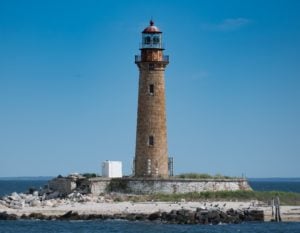
Photo: Rusty Watson
When people talk about Long Island’s lighthouses, the conversation usually starts with Montauk Point Lighthouse. That’s understandable. It sits at the eastern tip of Long Island, one of the most visited destinations in New York State, welcoming tourists from around the world. Then there’s the Jones Beach Water Tower, often mistaken for a lighthouse, and the Jones Beach area itself, which has become one of the most recognizable landmarks on Long Island. I’ve been to the Jones Beach Theater many times over the years. If you’ve ever sat in the orchestra section during a high tide and a full moon, you know exactly what I’m talking about. Let’s just say water has a way of finding its way into places you never expected.
Those are the lighthouses and landmarks that most Long Islanders know. They’re tied to beaches, concerts, tourism, and summer vacations. But Long Island’s maritime history is filled with lesser-known structures that played just as important a role in protecting sailors and guiding ships through dangerous waters.
One of the most fascinating examples is Little Gull Island Light.
I hesitate to call it a forgotten lighthouse because most people never knew it existed in the first place. Located on a tiny island in the middle of Long Island Sound, far from the crowds of Montauk and Jones Beach, Little Gull Island Light has quietly stood watch over one of the most treacherous stretches of water in the Northeast for more than 160 years. While millions of people have visited Long Island’s better-known landmarks, very few have ever set foot on Little Gull Island. Yet its story is every bit as interesting as any lighthouse in New York.
Little Gull Island sits at the eastern entrance to Long Island Sound between Long Island and Fishers Island. Despite its small size, the island occupies a critically important location. For centuries, ships entering and leaving Long Island Sound had to navigate strong currents, hidden rocks, and unpredictable weather. Mariners frequently referred to nearby waters as hazardous, particularly around a dangerous reef known as The Race, where currents can exceed several knots and create challenging navigation conditions.
Recognizing the need for a navigational aid, the federal government established a lighthouse on Little Gull Island in 1806. The original structure was among the earliest lighthouses built in the region. Unfortunately, that first lighthouse had a relatively short life. During the War of 1812, British forces destroyed the tower, leaving the area without its critical navigational beacon.
Following the war, a replacement lighthouse was built in 1818. However, the structure that stands today dates to 1868, when the current granite tower was completed. Constructed of durable stone, the new lighthouse was designed to withstand the harsh weather conditions that routinely batter the island. Rising approximately 81 feet above the water, the tower became one of the most recognizable navigational landmarks at the eastern entrance to Long Island Sound.
Life for lighthouse keepers on Little Gull Island was anything but easy. Unlike some lighthouses located near towns or villages, this station was isolated. Supplies had to be transported by boat, often through rough seas. Keepers and their families lived on a tiny island exposed to storms, wind, and harsh winters. Yet they performed their duties with remarkable dedication. Before automation, maintaining a lighthouse required constant attention. Lamps needed to be cleaned, fuel replenished, lenses maintained, and weather conditions monitored. The safety of countless sailors depended on the reliability of the light.
Little Gull Island Light also played an important role during a period when maritime commerce was vital to the Northeast’s economy. Cargo vessels, fishing boats, passenger steamers, and military ships all passed through nearby waters. Long before modern GPS systems and electronic navigation equipment existed, lighthouses like Little Gull Island were essential pieces of transportation infrastructure. Their beams served as guides through darkness, fog, and storms.
As technology advanced during the 20th century, lighthouse operations began to change. Automation reduced the need for full-time keepers, and eventually the station became fully automated. Although human presence disappeared, the lighthouse continued to perform its original mission. Today the light remains an active aid to navigation operated by the United States Coast Guard.
The island itself has become important for reasons beyond maritime history. Little Gull Island is now recognized as a significant wildlife sanctuary. The island provides nesting habitat for numerous seabird species, including common and roseate terns. Because of its ecological importance, public access is restricted, helping protect the fragile environment and the wildlife that depends on it.
One of the reasons I find Little Gull Island Light so fascinating is that it represents a different side of Long Island history. It doesn’t have gift shops, observation decks, or thousands of tourists taking selfies every day. There are no concert crowds gathering nearby and no long lines of visitors waiting to climb the tower. Instead, it quietly continues doing the job it was built to do more than a century and a half ago.
In many ways, Little Gull Island Light symbolizes the countless overlooked pieces of history scattered throughout New York. While famous landmarks capture most of the attention, places like this remind us that history is often found in unexpected locations. Standing alone in the waters of Long Island Sound, Little Gull Island Light has witnessed wars, storms, technological revolutions, and generations of maritime traffic. It may not be as famous as Montauk Point Lighthouse, but its story deserves to be remembered just the same.